Richard Branson on Brand
For Richard Branson, a brand earns its power by improving people’s lives in stale markets, making the experience better and more fun, and protecting reputation through quality and people.
- A brand should stand for quality, fun, and doing things differently.
- Brand grows when you improve bad customer experiences through countless small details.
- Bold bets can put a brand on the map, but only if you protect reputation.
- People build the brand: hire well, inspire them, and listen to staff and customers.
- A strong brand can travel across industries when the core philosophy stays consistent.
Brand is a promise of quality, fun, and difference
Branson treats brand less like a logo and more like a clear promise. In his account, Virgin should signal quality, a sense of fun, and a willingness to do things differently from tired incumbents. That combination is what makes the name meaningful across many categories rather than decorative on top of them.12
He also links business itself to improving people’s lives. That matters for brand because the promise is not just attitude or style; it has to show up as a better experience for the customer. Humor and enjoyment are not extras in this view but part of what people should feel when they deal with the company.342

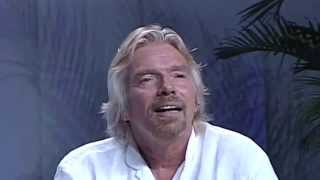
“I like to think it stands for quality…”TED conference conversation, 2022 · full transcript →
The brand gets built in the customer experience
Branson repeatedly comes back to execution. He argues that exceptional companies separate themselves through the little details customers actually notice, and he describes personally taking notes, listening to staff and customers, and acting on what he hears. In other words, the brand is built through hundreds of visible decisions, not a slogan.56
That thinking explains why Virgin entered industries he thought were badly run. He saw moments where the experience was so poor that a challenger could stand out quickly by making the service feel more alive, more thoughtful, and more enjoyable. In airlines, for example, he describes a market where the experience was bleak and could be transformed by bringing energy and entertainment into it.78
Bold moves make the brand memorable
Branson does not separate brand from risk-taking. He believes saying yes, moving fast, and being willing to look foolish are part of how new ideas break through, especially when you are challenging larger players. This makes the brand feel adventurous and alive rather than cautious and corporate.91011
At the same time, he points to specific bets that gave Virgin visibility. He says the move that put Virgin on the map was buying a secondhand 747, which shows how a decisive act can redefine what the public thinks a company is capable of. Brand, in this sense, grows when action proves the story.12
He also suggests that standing out often requires a rebellious edge, especially early on. The point is not shock for its own sake, but creating enough distinctiveness that people instantly understand you are not another version of the incumbents.
Reputation is the asset that keeps a brand valuable
For Branson, a brand can only stretch if people trust it. He is blunt that reputation is what you truly have, and he ties personal reputation and brand reputation together. That means a brand is fragile: attention and excitement help, but they are worthless if trust erodes.1314
This is why he treats the line between success and failure as thin. A bold brand is not an excuse for recklessness; it has to survive mistakes, legal fights, and competitive attacks. Protecting jobs, protecting the company, and protecting the name all sit together in his telling.151617
People and delegation are how a brand scales
Branson’s view of brand is inseparable from leadership. He says people skills matter most, and he keeps returning to the need to find the right people, inspire them, and draw out their best. In practice, that means the customer’s experience of the brand depends heavily on the enthusiasm and judgment of the team.181920
He also explains that his own limitations pushed him toward delegation early. Because he needed people better than himself around him, he built by trusting others, which helped Virgin move across sectors without pretending one person could master everything. That is a useful lesson for brand extension: consistency comes from values and people, not from one founder controlling every detail.212223
A brand can cross industries if the mission stays the same
One of Branson’s most distinctive ideas is that a brand should not be trapped in one category. He argues that staying in a single business would have left Virgin vulnerable, and he says plainly that if the company had remained in record shops it would have failed. Diversification, for him, was not a distraction from the brand but part of keeping it alive.2425
The reason this works in his framework is that the underlying mission stays recognizable. He keeps looking for markets where customers are underserved, then applies the same playbook: challenge the status quo, improve the experience, hire strong people, and make it enjoyable. If that core travels, the brand can travel too.7326
Branson on brand, in his own words
“I like to think it stands for quality…”
Where to watch
 Richard Branson on Brand Diversification: Keep Asking Why Not2022 · 36 min · full transcriptBest overview of how Virgin extended its brand across industries while protecting what the name stood for.
 Richard Branson on Virgin Growth Strategy: Diversify, Delegate, Win2023 · 76 min · full transcriptBest for Branson’s view that brand strength comes from customer details, listening, delegation, and adaptation.
 Richard Branson on Entrepreneurial Leadership: Culture, Risk, and Purpose2022 · 26 min · full transcriptBest short explanation of what Virgin stands for and why people and culture matter to brand.
 Richard Branson on Calculated Risk Taking: Say Yes and Go for It2016 · 26 min · full transcriptBest for understanding how risk-taking and headline moves helped put Virgin on the map.
 Richard Branson on Virgin Brand Strategy: Fun, Differentiation, and Bold Bets1998 · 11 min · full transcriptBest for the playful, differentiated consumer-facing side of the Virgin brand.
Questions people ask
- What did Richard Branson say about customer service and the little details?
- What did Richard Branson say about dyslexia and delegation?
- What does Richard Branson say about protecting reputation in business deals?
- What does Richard Branson say entrepreneurship is really about?
- Why did Richard Branson sell Virgin Records to support Virgin Atlantic?
- What did Richard Branson say made Virgin Atlantic different from other airlines?
Sources
Every quote above, word for word from the transcripts. Numbers match the text.
“I like to think it stands for quality…”
“If it's not fun, we don't do it.”
“What is a business? A business is simply somebody coming up with an idea to make other people's lives better.”
“The more humor you can have, the better.”
“If you get the little details right, it makes for an exceptional company over an average company.”
“So I think, you know, every every little detail, I think, we, the team have got right at at Virgin, and if you get the little details right, you know, then collectively, you... It makes for an exceptional company over an average company. And, you know, if I'm on a Virgin plane, or in any Virgin company, I'll have my notebook, I'll take notes, I'll listen to it, listen to the staff, listen to the customers, you know, and then act on it when I get to the far end, and and and then be in touch... Back in touch with the people who, you know, gave me the ideas to thank them and tell them what we've done. And and and I think a good a good leader has to be a good listener.”
“I mean, I think I learned early on that if you can, uh, if you can run one company, um, you can really run any company. I mean, company's all about finding the right people and inspiring those people, um, uh, you know, drawing out the best in people and, um, and I'm, uh, I just love learning and I'm incredibly inquisitive, and, um, I love taking on the, you know, the status quo and trying to turn it upside down. So, um, so I've seen life as one long, one long learning process, and if I see, you know, if I fly on somebody else's airline and find the experience is not a pleasant one.”
“But, anyway, we didn't listen to him on that. We did get the second 747, and I think, you know, the reason I think my partners were wrong was traveling on airlines in those days was abysmal. I mean, they would dump a bit of cold chicken on your lap. There was no entertainment. The cabin crew didn't smile because they were treated so badly. The planes were old and run down. So, you know, bring somebody in from the entertainment world and liven it up and make it a wonderful experience. And um...”
“…life’s a lot more fun when you say yes, not when you say no…”
“…you have to be a little bit brave and stupid and foolish to do that…”
“Well, I suppose I've stuck my neck out a lot of times. I've learned that life’s a lot more fun when you say yes, not when you say no. Sometimes you thought that and your face won’t do it that way. Look, sometimes you've got to make a decision, get on and give it a go. You have to be a little bit brave and stupid and foolish to do that, and fortunately we've got away with it more often.”
“I think the thing that put Virgin on the map was when we bought one secondhand 747…”
“…all you have in life is your reputation…”
“You know, in my new book, finding my virginity, I talk about our dealings with Delta and how, you know, the friend... They they felt that they'd legged us over on... In in in a clause in a contract and how they they they came to us to rectify it. And, you know, this... That... That's something I'll never forget. And and most likely, we'll we'll be, you know, partners with Delta for the rest of my life because of that, you know, that, you know, that that kind of that kind of approach. You know? So I think, you know, if you if you realize that your reputation is all you have and your personal reputation, the reputation of your brand, then you've got to, make sure that you're you're you're negotiating a deal that that you're not gonna be unhappy with and that, and you think of all the things that could potentially go wrong and how you can get out of it if something goes wrong. But equally important is, you know, is trying to trying to strike a a fair balance with the people you're negotiating with.”
“There's a very thin dividing line between success and failure…”
“…there's a very thin dividing line between success and failure…”
“Well, I think that, um, you know, there's a very thin dividing line between success and failure, and I think if you start a business without financial backing, um, you're likely to, you're likely to go the wrong side of that dividing line. Um, the, uh, we had, um, we were being attacked by British Airways. They were trying to put, um, our airline out of business, and, um, and they launched what’s become known as the dirty tricks campaign. And, um, and I realized that, you know, the whole empire was likely to come crashing down unless I chipped in a chip. And, uh, and in order to protect the jobs of the people who work for the airline and protect the jobs of the people who work for the record company, um, I had to sell…”
“I think I think the people skills is is is the most important, skill.”
“…company's all about finding the right people and inspiring those people…”
“…companies are all about finding the right people, inspiring those people…”
“I was 15, I was dyslexic, and I needed people better than me to be around.”
“I think that... Well, first of all, I I I would like to say I'm proud of being a dyslexic thinker, and I'm delighted that dyslexic thinking is now becoming almost part of the vocabulary. And I'm pleased to, you know, talk to many dyslexic kids over the years to try to make them realize that, you know, do not do not be worried about it. You know, look at look at the areas that you that you enjoy and concentrate on those. The areas that you're not great at, you you know, either that you'll catch up later on in life, or, you know, if you're gonna start a business, you can delegate and find other people who can deal with those.”
“…if you can run one company, um, you can really run any company…”
“If we'd stayed still and only focused on one business, we wouldn't have a business today.”
“If we were still in record shops, we would have been bust.”
“…if you can run one company, you can really run any company…”
How this guide was made: drafted with AI from the full transcripts of the recordings cited, then checked: every quotation must match a transcript word for word and be the speaker's own words, and an independent review gates accuracy. Methodology and corrections.