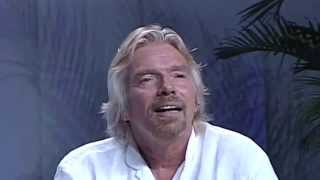
Richard Branson on Business Strategy
Richard Branson’s strategy is to enter badly served markets, create a meaningfully better customer experience, diversify boldly, and take risks only after protecting the downside.
- Enter markets where incumbents treat customers badly.
- Win through experience and small details customers actually feel.
- Diversify so one disrupted business does not sink the whole group.
- Take bold bets, but only after limiting the downside.
- Strategy depends on people: listen well, delegate hard, and protect reputation.
Start where customers are badly served
Branson’s first filter for strategy is simple: do not enter a sector just because it is large or fashionable. Enter when customers are having a poor experience and incumbents have become complacent. That is the opening he kept looking for across records, airlines, rail, and other ventures.12
He tends to see frustration as a signal, not just an annoyance. When he encounters a bad product or stale category, he looks for a chance to overturn the status quo with something people would actually enjoy using. That makes his strategy less about abstract market positioning and more about spotting where people are putting up with too much.234
Compete by making the experience noticeably better
Once he chooses a market, Branson’s way to win is not subtle imitation. He tries to build the best experience in the field, because he believes a new business that is genuinely best in class is more likely to survive. In practice, that means changing what customers feel in the product, not just what appears in a strategy deck.56
He puts unusual weight on details. He argues that the gap between an average company and an exceptional one is often built from many small improvements, especially the ones customers directly notice. He also ties this to leadership behavior: listen to staff, listen to customers, take notes, and act on what you hear.678
His airline examples show the pattern clearly. He saw flying as dreary and badly run, then looked for ways to make it lively, enjoyable, and service-oriented rather than merely functional. That is classic Branson strategy: find an emotionally flat category and make it human and memorable.96
Diversify to survive change
Branson does not believe a company should cling to one business forever. He says Virgin would not have survived if it had remained focused on only one line of business, and he makes the same point more specifically about record shops. Diversification, for him, is not distraction for its own sake; it is a way to stay alive when industries shift or decline.1011
This view comes from experience with disruption across sectors. If one business weakens, another can carry the group, giving the organization resilience that a single-business company may lack. His strategy therefore combines opportunism with a survival instinct: keep asking what next, and do not let yesterday’s success become today’s trap.10113
Take big risks only after capping the downside
Branson is associated with boldness, but his own explanation is more disciplined. He likes big chances, yet he insists that the first strategic question is how to protect the downside. That changes risk-taking from recklessness into a structured bet.1213
His airline launch is the clearest example. He pushed ahead despite internal skepticism, but he arranged the aircraft deal so failure would be survivable rather than fatal. In other words, he was willing to swing hard once he knew the miss would not destroy what he had already built.1415
This is one of the most practical parts of his strategy. You do not need certainty before acting, but you do need a loss scenario you can live with. That lets instinct and speed matter without turning one decision into existential damage.12154
Build strategy around people, delegation, and reputation
Branson sees people skills as central to strategy, not separate from it. He emphasizes listening, drawing out the best in others, and surrounding himself with strong people. Because he knows he cannot do everything himself, delegation becomes part of the operating model that makes expansion possible.8
That logic also explains how he can move across industries. His view is that running companies is largely about finding the right people and inspiring them, not mastering every technical detail personally. For a diversified group, that means leaders must trust talented operators and often promote from within so the culture can scale.219
He also treats reputation as strategic infrastructure. If reputation is all you have, then brand trust, fair dealing, and long-term relationships are not soft virtues; they are core assets that affect future partnerships and growth. In his framework, you protect the brand while taking risks, not after the fact.2021
Make room for fun, purpose, and responsibility
Branson does not separate strategy from enjoyment and meaning. He says if something is not fun, Virgin does not do it, and he treats playfulness as an advantage rather than a distraction. This matters strategically because lively brands and energized teams can outmove larger, more bureaucratic rivals.2223
He also argues that business should solve problems and, once successful, carry responsibility. Early on, survival and cash flow matter, but over time wealth should be linked to wider contribution. He describes socially useful business as compatible with commercial success rather than opposed to it.2425
So his end state is not growth at any cost. It is building companies that people enjoy, that improve weak industries, that stay financially alive, and that eventually give something back. That combination is a big part of what makes his strategic worldview distinctive.2225
Branson on business strategy, in his own words
“If we'd stayed still and only focused on one business, we wouldn't have a business today.”
Where to watch
 Richard Branson on Virgin Growth Strategy: Diversify, Delegate, Win2023 · 76 min · full transcriptBest single overview of Branson’s strategy: diversify, delegate, and win through customer experience and small details.
 Richard Branson on Entrepreneurship and Risk: How He Caps the Downside2017 · 88 min · full transcriptBest for understanding how he makes bold moves without betting the company.
 Richard Branson on Brand Diversification: Keep Asking Why Not2022 · 36 min · full transcriptBest explanation of how Virgin expanded across categories while protecting the brand.
 Richard Branson on Leadership and Virgin: Building, Risk, and Purpose2019 · 24 min · full transcriptBest for his rule about only entering sectors that are being badly run.
 Richard Branson on Creativity and Entrepreneurship: Take Bold Risks2016 · 40 min · full transcriptBest for the creative side of strategy: making dull industries enjoyable and different.
 Richard Branson on Entrepreneurship: Survive, then give back2013 · 50 min · full transcriptBest for how survival, cash flow, and later responsibility fit into his business thinking.
Questions people ask
- How does Richard Branson cap the downside when starting a new business?
- What did Richard Branson say about customer service and the little details?
- What did Richard Branson say about dyslexia and delegation?
- What does Richard Branson say about protecting reputation in business deals?
- What does Richard Branson say entrepreneurship is really about?
- How does Richard Branson choose and promote people in his company?
Sources
Every quote above, word for word from the transcripts. Numbers match the text.
“…the only reason we would go into a new sector is if we felt it was being badly run…”
“I mean, I think I learned early on that if you can, uh, if you can run one company, um, you can really run any company. I mean, company's all about finding the right people and inspiring those people, um, uh, you know, drawing out the best in people and, um, and I'm, uh, I just love learning and I'm incredibly inquisitive, and, um, I love taking on the, you know, the status quo and trying to turn it upside down. So, um, so I've seen life as one long, one long learning process, and if I see, you know, if I fly on somebody else's airline and find the experience is not a pleasant one.”
“I look at everything as an opportunity.”
“I think if the, if the right challenge comes up, I will, I will still jump in and say yes.”
“…my whole attitude to life is, you know, if you create a new business that's the best in its field, it's likely to survive.”
“If you get the little details right, it makes for an exceptional company over an average company.”
“So I think, you know, every every little detail, I think, we, the team have got right at at Virgin, and if you get the little details right, you know, then collectively, you... It makes for an exceptional company over an average company. And, you know, if I'm on a Virgin plane, or in any Virgin company, I'll have my notebook, I'll take notes, I'll listen to it, listen to the staff, listen to the customers, you know, and then act on it when I get to the far end, and and and then be in touch... Back in touch with the people who, you know, gave me the ideas to thank them and tell them what we've done. And and and I think a good a good leader has to be a good listener.”
“I think being a really good listener is one of them things…”
“But, anyway, we didn't listen to him on that. We did get the second 747, and I think, you know, the reason I think my partners were wrong was traveling on airlines in those days was abysmal. I mean, they would dump a bit of cold chicken on your lap. There was no entertainment. The cabin crew didn't smile because they were treated so badly. The planes were old and run down. So, you know, bring somebody in from the entertainment world and liven it up and make it a wonderful experience. And um...”
“If we'd stayed still and only focused on one business, we wouldn't have a business today.”
“If we were still in record shops, we would have been bust.”
“Take great chances and yet predict or protect the downside…”
“The most important thing when you start a business is thinking about protecting the downside.”
“I quite like to start an airline…”
“To protect the downside, so I knew that the worst that could happen would be, you know, maybe six months of the profits of Virgin Records we would lose if it didn't work out. And, Boeing agreed to it. And, you know, when the end of the first year came, instead of handing the plane back, people loved Virgin Atlantic, and, you know, we had a... You know, you know, people flocked to it, and we had a spirit about it, which is very different from British Airways. We ended up buying a couple more seven... Secondhand seven four sevens from Boeing. And and then, you know, over the years since, we bought, some hundreds of planes from, you know, for the three or four different airlines we set up over the years from Boeing.”
“Well, uh, I, um, I'm a great believer in promoting from within the company and not necessarily promoting from outside. We do, we do on occasions bring people from outside, but the advantage of promoting from within the company is, uh, you know, people from within the company know that they've got a chance of, you know, growing with the company, um, and, uh, and, and, you know, and it's, can be quite demoralizing if you keep bringing people in from outside above people, and, um, so by the time we've actually promoted somebody, we know their weaknesses, we…”
“…your reputation is all you have in life.”
“You know, in my new book, finding my virginity, I talk about our dealings with Delta and how, you know, the friend... They they felt that they'd legged us over on... In in in a clause in a contract and how they they they came to us to rectify it. And, you know, this... That... That's something I'll never forget. And and most likely, we'll we'll be, you know, partners with Delta for the rest of my life because of that, you know, that, you know, that that kind of that kind of approach. You know? So I think, you know, if you if you realize that your reputation is all you have and your personal reputation, the reputation of your brand, then you've got to, make sure that you're you're you're negotiating a deal that that you're not gonna be unhappy with and that, and you think of all the things that could potentially go wrong and how you can get out of it if something goes wrong. But equally important is, you know, is trying to trying to strike a a fair balance with the people you're negotiating with.”
“If it's not fun, we don't do it.”
“I think play is really important.”
“…wealth comes with it, and responsibility comes with that wealth…”
“…it could be a win-win-win situation…”
How this guide was made: drafted with AI from the full transcripts of the recordings cited, then checked: every quotation must match a transcript word for word and be the speaker's own words, and an independent review gates accuracy. Methodology and corrections.