Richard Branson on Brand Diversification: Keep Asking Why Not
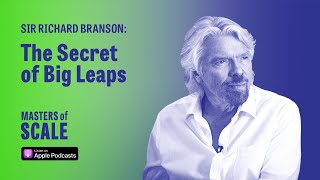

What Branson talks about
Richard Branson joined the Masters of Scale podcast in January 2022 to discuss founding Virgin, brand diversification, company culture, and the entrepreneurial habit of asking “what if?” and “why not?”
Also known as: The secret to big leaps; Sir Richard Branson: The secret to big leaps.
Richard Branson traces Virgin’s growth from a student magazine and record store to airlines, rail, cola, and space. Across the conversation, he returns to the habit of asking “what if?” and “why not?” and then acting on it.
He also explains the less flashy system behind the stunts: delegation, finding better people, protecting the brand, and building companies that people enjoy using. The interview shows how boldness and discipline work together in his style of entrepreneurship.
Reid Hoffman hosts and interviews Branson throughout, with occasional narration and commentary.
In his words
“Screw it, let's do it”
“What if, why not?”
“I was 15, I was dyslexic, and I needed people better than me to be around.”
“One day, somebody said to me, "Music is horrendously expensive. Why don't you consider starting a music company?”
“If we were still in record shops, we would have been bust.”
Key points
- Branson says his entrepreneurial pattern starts with asking “what if?” and “why not?”
- He credits dyslexia with making him a strong delegator and forcing him to hire people better than himself.
- Virgin Records began with cash-flow improvisation, including taking orders before having stock.
- Virgin Atlantic succeeded by improving the customer experience and hiring enthusiastic people, not just technical experts.
- He argues that brand value matters and that keeping one powerful brand across businesses created leverage for Virgin.
- Some ventures, like Virgin Cola, failed because the product was not differentiated enough to defend itself.
- Diversification helped Virgin survive industry shocks, including COVID, and space ventures later helped support the wider group.
Full transcript: Richard Branson, Masters of Scale interview (2022)
I arrived in Vegas, and I was taken to the Palms Hotel, which was a very high hotel, and I was told I was going to jump into the party below from the top of the roof. Normally, I'm game for anything, but as we went up the lift, you know, I was just thinking, it's very windy outside. It was blowing about 40 or 50 miles an hour. Is this sensible? That's Virgin founder and incorrigible thrill seeker Sir Richard Branson, and that question is, is this sensible?
One he's asked himself time and time again, often with the same answer: screw it, let's do it. And it's the answer he gave on that windswept rooftop 400 feet above Las Vegas. It was 2007, and Sir Richard was there to publicize the launch of his new airline Virgin America. Far below, a crowd filled with celebrities and press waited in anticipation. The chant began: jump, jump (applause), jump. So when I got up onto the roof, people said, "It's not that windy," and there were walls all the way around the roof, so we
couldn't feel the wind, and then I buckled into a sort of bungee jump and jumped off the roof. (music) And as I came down the side of the building, I hit the side of the building with my ass. Well, the wind blew me into it. Arse is classical English for one's posterior, rump, or backside. (music) And I ended up at the bottom, dangling with blood dripping into this party that was taking place below, and I felt like a rather foolish rag doll. It definitely hadn't gone according to plans, but anyway, I was still alive. Although his
dignity was bruised, it was a publicity triumph and another win for Branson's screw it, let's do it, screw it, let's do it ethos. And this ethos has got Sir Richard in other scrapes that range from dangerous to bizarre to just bewildering. Saying "screw it, let's do it" is how Richard has started many of Virgin's most legendary ventures. It's even the title of one of his many books, Let's Do It, and it fits perfectly in with my metaphor for entrepreneurship that it's like jumping off a cliff and then building the airplane as you fall. Of course, this is just a metaphor unless you're Sir Richard Branson, who literally does jump off all manner of tall structures and literally does build flying machines.
And the prelude to each of these bold jumps is the refrain: what if, why not? That's why I believe you should never stop asking what if and why not. Take those daring notions seriously and go all in on the bold leaps. They will keep you innovating. You gotta have incredible talent at every position. It's like this huge push. There are fires burning when you're going home. Can you believe it? You're such an idiot, and then you go back to, this is totally gonna be amazing. There are so many easy ways. (music) How you do it.
This is Masters of Scale. I'm Reid Hoffman, co-founder of LinkedIn, partner at Greylock, and your host. And I believe you should never stop asking what if and why not. Take those daring notions seriously and go all in on the bold leaps. They will keep you innovating. It may surprise you to learn that I've never shot myself out of a cannon, jumped a motorcycle through burning hoops, or walked a tightrope over a tank of underfed piranhas. We describe the people who pull off these kinds of stunts as daredevils, and we often think of these kinds of people as reckless, impulsive, and perhaps not long for this world. But the successful daredevils are quite
the opposite. They aren't doing these stunts on a whim or taking them lightly. If they did, well, they wouldn't achieve the status of daredevil; they'd be piranha food long before anyone ever heard of them. Instead, they spend countless hours preparing. They're methodical, and they often have a team of people helping them. They make what they do look easy, but it's not. This is why when you see this kind of stunt on TV, an announcer is likely to intone, "Don't try this at home." Sir Richard Branson is not only a daredevil but a hugely successful serial founder who has started a staggering number of scale businesses under his Virgin brand, and like a daredevil, he has found a way that lets him take death-defying entrepreneurial leaps again and again in
new markets and industries at a rate that makes him one of the most prolific and successful founders in the Masters of Scale pantheon. Although Richard is willing to jump into unknown territory with nary a glance and a wink, once he's in, he's fully committed and he won't back down. So how does he manage this? Sir Richard has refined an approach that has let him scale up his urge to throw caution in the wind and try new things. It has let him scale Virgin from a hip little record store in the early 70s London to a global brand that has included airlines, music publishing, adventure experiences, and even cola. Sir Richard's approach begins with him asking himself what if and why not and often ends with him
somewhere unexpected. That's what happened with his first venture, a student magazine. The Vietnam War was going on. Like a lot of young people, we thought it was a travesty of justice, a horrendous, horrendous, horrendous mistake. And so I decided actually to start a magazine to campaign against it. Like most schoolboys, Richard lacked an office, and because this was the late 60s, he didn't have his own phone, which he needed to sell advertising and conduct interviews. He found his solution in a classic British icon, a red telephone box. But the amount of time he was spending in his three-foot-by-three-foot office started causing problems. I started on the magazine from the school phone box, and
At 15, the headmaster said to me that I either had to stay at school and do my schoolwork or leave school and do the magazine. And so I said goodbye to him, and the magazine became quite successful. I mean, we sold about a hundred thousand copies an issue. This set the template for a long line of screw it, let's do it moments that would define Sir Richard and Virgin. But this wasn't the luck of youthful recklessness. Even at this point, Richard had learned a lesson that I would say is the unsung secret to just why he has been able to say screw it, let's do it so many times through his career. When I started, I was 15, I was dyslexic, and I needed people better than me to be around. One
of the advantages of being dyslexic is I became a great delegator. And when I talk to various people who are starting up in business, the most important thing I can tell them is delegate. Find somebody better than yourself to do the day-to-day running. Make sure that you can find time to think about the bigger picture. Make sure you can find time to firefight with the various companies that have problems. A lot of people are scared of delegating. They're scared that somebody else will take their job. They want to hang on to everything themselves. But by delegating, we've been able to build many, many different organizations over the years. Realizing this early allowed Richard to make time to constantly be asking what if, why not, and then taking the leap.
Because he knows he's got the best possible people helping him rebuild that airplane, balloon or spaceship on the way down. The magazine was the launch pad for Sir Richard's next more famous venture. The spark came, as it so often does with Richard, when someone made an offhand comment. One day, somebody said to me, "Music is horrendously expensive. Why don't you consider starting a music company?" And so we started Virgin Records. It should probably go without saying, but I'll say it anyway, that this was in the days before digital music. The Walkman was still a few years away. CDs were a futuristic gleam on the horizon. Vinyl was king. There was only one problem for Richard's fledgling record store.
But it was a pretty big one. We didn't have any records. But once the orders came in, we then went and bought them from record shops and tried to get a discount and handed leaflets outside concerts. And because we didn't buy the records up front, we got the cash flow to fund it in that way. And Virgin Records was born. That's right, Richard took the orders and the money before he had the stock or even knew if you'd be able to get it at the price he was offering his customers. There are a few things I love about this story. The audacity of starting a record store without any records is one of them. But I also love that their lack of cash flow led directly to their advantage. Richard and his team had no choice but to negotiate those steep discounts.
Because they had already made the sales. Richard's fast-growing reputation as someone who did things differently in a quick, cavalier manner was attractive to lots of people, not least of all musicians. A young artist came to me with a tape, and he was only 15 years old himself, and I found the tape hauntingly beautiful. We didn't have a record company, so we went to the eight record companies to try to get somebody to put it out. None of them would put it out. Here it comes, another moment when Richard decides to go all in on a daring notion. So we decided to start a record company, and Tubular Bells was the name of the album, and Mike Oldfield was the artist, and it sold millions of copies.
Even if the name doesn't ring any bells, tubular or otherwise, you would be very likely to recognize the music. The album's opening track was used as a theme for the movie The Exorcist. And on the back of that, we were able to build the largest independent record company in the world, and ultimately to sign people like The Rolling Stones, Janet Jackson, Genesis, Peter Gabriel, The Sex Pistols, and so on and so on. So it was a lot of fun. Note that Virgin Records wasn't offering a disruptive new business model. This was the golden era of the record company, and Virgin was just one of many. However, there was a freshness that came directly out of Richard's screw it, let's do it ethos. As the old song goes, "It ain't what you do, it's the way that
you do it." I think a lot of artists came to us because they knew that we were good at marketing, and we had a great team of people all under 20 years old who had a lot of fun in their marketing campaigns and didn't take themselves too seriously. And somehow, we managed to put these artists on the map. I put it to Sir Richard that this same spirit of fun was the key to his next big success. Some of my earliest memories of you and Virgin is that youthfulness, that vitality, that playfulness in being bold in the marketing. But then, of course, it reflects also boldness in the business. I go pick software because in many ways, it's easy and valuable, and I try to do the easiest thing that's valuable.
You have a boldness of jumping into hard businesses. The airline business is really difficult, and yet you kind of like, okay, we've done this amazing music business—the creation of a young, energetic, vibrant new brand by being bold and different. What made you then go, okay, now I'm gonna do an airline? Well, it originated out of frustration. Thirty-five years ago, when we started it, the big carriers were dreadful. You were lucky if you had a lump of chicken dumped in your lap, and there was no entertainment and very, very surly, silly crew generally. And on one of those flights coming to the Virgin Islands, I got bumped, which is a sort of typical thing that airlines did in those days. And so I hired a plane and filled it up.
With all the people who had been bumped and called it Virgin Airlines as a joke, however, the joke very quickly had Richard asking himself seriously the question: What if? Why not? And we arrived in the BVI and during that flight, I just thought airlines do bump people. Maybe I should ring up Boeing the next day, which I did, and asked if they had any secondhand 747s for sale. Turns out they did. There's not much of a bigger example of going all in on a do-daring notion than buying a 747, even if it is secondhand. But Richard knew there was far more to running an airline than owning a plane. He was about to take another daring leap off the side of a cliff, and he wanted the best people with him and the best advice.
Guiding him, so he turned to Freddie Laker, founder of UK's Laker Airlines, which had recently been crushed by established giant British Airways. He said, "You've got one plane and they've got 250 planes. And you know, if you're going to get the airline on the map, you've got to use yourself. Get yourself on the front page and not an anecdote on the back page." What I love about this story is that Freddie Laker didn't pour cold water in Richard's skirt "Let's do it" approach. Instead, he showed him how to double down and make it work by doing something that played very much into Richard's strengths. "I love a challenge. I love going into new industries that I know little about. I pretty well knew everything I didn't like about the airline industry. I was 28 years old. I
traveled a lot on other people's planes. British Airways was then run by a gentleman by the name of John Leonard King, Baron of Wharton, A.B. This was long before Sir Richard's own knighthood. Back then, he was seen as a reckless upstart, not fit to even spit polish the riding boots of the Right Honorable Baron. I remember Lord King, our rivals said when I announced I was going to go in the airline business. He said, "Far too old now to rock and roll, far too young to fly. And what's an entertainment person going into the airline business?" The Baron King of Wharton, A.B., sneeringly saw Sir Richard's outsider status as a weakness, but it was actually Richard's biggest strength along with his screw it, let's do it attitude and of course
what BA didn't realize was actually people like to be entertained. They like to have a wonderful experience. They like to be in a company where the owner takes their interests and all the details, you know, like a private restaurant. I got to thinking about this out loud after my interview with Sir Richard, and what they do is they chart out every step. It works much better in the physical world but like every step, and they go "Okay, you decide you're going to travel today, what do you do at home? How do you get to the airport? What happens when you get to the airport? What happens at the airport? What happens when you get on a plane? You sit down on the plane. What does the first greeting look like? What is the next?" Literally, that's part of the reason why, for example, among other things, that Virgin Atlantic was the first one to
innovate on the safety video, because they're literally looking at every single little micro step across the whole thing, because their theory basically is that, actually, in fact, 10 little micro steps that are improved lead to possibly magic across the whole thing. Yes, when you get a big step, that's really valuable, but even micro changes as it goes through. So, for example, they're looking at the safety video and they go, "What can we do about the safety video? Like, everyone hates watching the safety video. They're boring. They're like these PSAs that are like, 'We've got you locked in jail and you have to watch this.' Hello and welcome aboard our newest plane, the CV 19 Aerowood. As we prepare for
departure, your seatbelt buckle should be fastened whenever the fasten seat belt is illuminated. When the light is switched to the off position, and should you be seated and not en route to the lavatory, we implore you to keep your seat belt fastened at all times during this flight. To fasten your seatbelt, one must reach down with their right hand." (Applause) (Music) And they're like, "Okay, well, can we make it fun?" Right? And it was like, "Yeah, we could make it fun. We could have odd people read the script and we could say, 'I realize that most of you probably know how to play on your safety belt, and if you don't, seek help, but here's how you do it if you're being entertaining,' right?" You know, that kind of thing. And so, that's the thing that they do the whole
way through. Richard wasn't just focused on entertainment. He knew exactly which parts of the business had to be taken seriously and that he would need to build an expert team to build them out. Doing this would let him scale his daring move to start an airline. "If you're going into the airline business, make sure that the people running it are going to make sure it's a very safe airline and you get the best technical people on board. But then on the planes themselves, you don't need the cabin crew spent 20 or 30 years flying on other people's airlines. Go look for people who are really excited about the job and train them and make sure that they perform in a fun way, and because they're proud of the company, they'll excel at what they're doing." Virgin Atlantic shook up the staid airline industry and
the passengers loved it. With its massages, onboard bars, in-flight entertainment, and general attitude of fun, the upstart airline wowed its customers and showed up the complacency of British Airways. And Richard had no qualms about reminding them again and again with a series of cheeky publicity stunts. A particularly memorable one was in 1999 when the London Eye, the landmark 120 meter diameter observation wheel, was being erected in the British capital. The event was being sponsored by British Airways. I got a call at 5 am one morning to be told that they couldn't get the wheel up, so we scrambled an airship and it flew over the wheel and over the couple
Hundred press and photographers and TV cameras waiting for it to go up, and the airship simply said, "BA can't get it up." And we got the headlines, and they didn't. So I think it's just fun things where you pull the tail of the bigger competitor, and you do it hopefully to make people smile. It didn't necessarily make British Airways smile on some of these things, but anyway, it helped put Virgin on the map. Stunts like these helped endear Virgin to the public. Richard was Robin Hood thumbing his nose at the establishment, but this Virgin firmly in BA's firing line. They turned the guns onto us. I mean, there was a big fat book called Dirty Tricks. It's not just the turn of phrase; a book with that title exists.
In fact, to hear Sir Richard listing them, "dirty" is too soft of a phrase. For instance, one of their detectives was caught going through rubbish bins of journalists that had written about Virgin and British Airways. They went through my rubbish bins. They had a unit that illegally accessed our computer information, and then they would ring up Virgin passengers pretending to be from Virgin, telling the passengers their flight was delayed, and then switching them to British Airways. And thanks to the loyalty of our customers, we did survive it. These dirty tricks had a very real impact on Virgin's bottom line, and it forced Richard to make a difficult decision. It got so bad that I felt that
In order to save all the jobs at the airline and to save the jobs at the record company, that something would have to give. And so I decided to sell the record company, which protected all the jobs in both the record company and the airline, and it also sent a message to British Airways: "You know, he's just sold for a billion dollars." Layoff, and it was sad. I mean, we had literally just signed the Rolling Stones; we just signed Janet Jackson, but I sort of pulled myself together when I ran past a headline of a newspaper on a stand in the street which said "Branson sells for a billion." And I just realized I was crying at the time, and I thought if anybody—if anybody could see this headline of me crying, they would be rather baffled. So I pulled myself together and then used the money to create lots of new things, so it was great.
Lots of happy memories. Anyway, if you're smaller, you know when the big guys try to drive you out of business, the only thing that you've got going for you is the loyalty of your customers and your passengers. And so the dirty tricks campaign that BA launched against us, we had to fight tooth and nail to survive, and we took them to court. We won the biggest damages in British history. We're back before the break. Sir Richard's refusal to stop asking "What if?" and "Why not?" had led him to take on British Airways. It was a battle in which Sir Richard learned that you need to go all in on your daring notions; otherwise, you risk being crushed before you even get off the ground. But on a lighter note,
The fight between Virgin and BA also showcased another side of Sir Richard's character: his love for audacious and fun publicity stunts. It's another area in which Sir Richard goes all in on his daring notions and does so very publicly. I asked him to share a few with me. Trying to be the fastest across the Atlantic in a boat and ending up with the boat breaking up and sinking; trying to be the first across the Atlantic in a hot air balloon, ending up crashing into the North Sea; crossing the Pacific in a balloon from Japan, and everything that could go wrong went wrong; trying to sort of see: can a balloon fly
At 35, 40,000 feet? Could a balloon go at 200 miles an hour in the jet stream without breaking up? We built a UFO, as you do. We drifted across London, and all the radio stations were lit up about the UFO. The police had scrambled two police forces; they'd scrambled the army. (music) We had our airship company filming the Super Bowl for NBC, but they made it very clear that Super Bowl advertising is the most expensive in the world and that they couldn't put their cameras up onto the fly Virgin Atlantic logo on the side of the balloon. So we unfurled a banner outside the back of
The airship which said, "NBC cameramen are the best looking guys in America," and we got lots and lots and lots of cameras coming up to the airship, and it's made—I think my autobiography is a lot more fun to read than if it was just success after success that we've had. Lots of ups and downs, and so better stories to tell the grandkids. It's true, these are all great stories and not just for the grandkids. Like any enthralling fairy tale, they are full of magic and whimsy and spring from asking "What if?" and "Why not?" What if I sow these magic beans? Why not follow that white rabbit, climb that beanstalk? Unfortunately, there
Are times when your unstoppable urge to follow the next staring notion is going to run into an immovable force. It's 1994, and Sir Richard Branson is about to take another leap into unfamiliar territory. Somebody brought me a can of this cola and said, "I'm going to do a blind test on you." They did a blind test, and I chose this particular cola. And then I took it to my kids' school, and we did blind tests on all the kids, and the vast majority went for this cola. So, you know, the Virgin brand resonated in those days, particularly in Europe. So again, we thought, "Screw it, let's do it. Let's launch Virgin Cola. Let's take on Coke and Pepsi." And for about 18 months, we were outselling them.
People were very excited by it. It was a hit in the UK, but then Sir Richard tried to stage an invasion of the US market. I arrived in Times Square with the Sherman, British Sherman tank. We crushed all these Coke cans and Pepsi cans, and so cola was flying everywhere. And Coke were not amused, and nor were Pepsi. Coca-Cola didn't respond with dirty tricks like BA; they staged a full-on assault. They got a DC-10 on the Atlanta runway, they filled it up with squat teams and cash, and this private DC-10 arrived in the UK, and very quickly the Virgin Cola just disappeared from the shelves.
And yeah, they sort of kneecapped us. And the lesson to learn from that was we weren't different enough. When BA tried to do that to us with Virgin Atlantic, we had the quality edge on them. With a can a cola, it can't be radically better than Coke or Pepsi, but I don't think it damaged the Virgin brand. Trying things like this, and people identify with people who try things and don't necessarily succeed and then try again, and so on with other things. After this interview, one of my producers asked me my thoughts on why Virgin Cola got crushed by its competitors. Well, I think there were two reasons. The most central one is the product really wasn't that differentiated, right? So because the product wasn't differentiated,
he couldn't muster a defense line. So yes, British Airways tried to crush him, but they're trying to crush him in courts and deny access, and he could survive through demand. For example, if his product was really differentiated, you would have consumers going, "Why is it not here? Right, like I want it," versus, "Well, that was kind of fun, but okay, fine, you got Coke, I'll take Coke. Oh, got Pepsi, I'll take Pepsi." And he identified that; I think that was actually true because it's like, "Look, I've got tasty sugar water too." Now, the second condition though, is that if Coke and Pepsi hadn't responded vigorously, then maybe he could have built up a place where it was enough following over time where people just said, "Okay, my preference," just like some people have preference for Coke and some people have
a preference perhaps, and a third people have a preference for Virgin Cola. But they responded early, and the way they responded was to go around to all the places that would distribute Virgin Cola and say, "We'll pay you money not to carry Virgin." Right, and why would the retailer take the money? Because they're like, "Well, actually, in fact, I don't think Virgin Cola being here is increasing my net cola sales. Right, and you're just giving me some more money. It's not my problem. Great, I got extra profitability for it." And they were willing to do that because they didn't have people coming in going, "Where is my Virgin Cola?" Right, and so I think that was part of the problem on the cola side. This is the risk of going for things. Sometimes they flat out don't work, but the upside is that there are so many
more daring ideas to try. Well, I was in Japan sitting on one of those wonderful Japanese fast trains into Tokyo, and I came back to England and thought British Rail, which was run by government, was abysmally run, and maybe I could persuade the government to allow Virgin to operate on the British Rail's track. Well, initially I got the head of British Rail to my house, and you may have to edit the next bit a bit, but as he was leaving the house, the microphone was on at the door, and we heard him say it, broadcast all over the house, "I'm not going to let that Branson get his hands on my train set," and that made us all the more determined. Obviously, Virgin Trains was eventually awarded a contract from
the UK government to operate. We got fantastic new high-speed trains called Pendolinos, and it turned into one of the most successful businesses we'd had up until now. Sir Richard had proven that you can keep asking, "What if? Why not?" to hugely improve existing products and services and reach massive scale. But what about when it's a product that doesn't exist yet? Sir Richard was set on course to find out with an idea that came from an unlikely place: the last ever leader of the Soviet Union, Mikhail Gorbachev. I was offered by Gorbachev a ride to be actually the first citizen to go into space on one of his spaceships. I mean, he rang me up to offer me that, and then his people rang back and
told me the price, and I remember thinking, "You know, for 50 million dollars for a ticket to space and, you know, to be tied up in Russia for 18 months," Richard being Richard, his next thought was automatic: "One day maybe we could start our own space line." And once I thought we had the wherewithal to start our own space line, I remember going to the registry office and registering Virgin Galactic Airways. I also registered Virgin Intergalactic Airways just because I'm an optimist, and then travelled around the world meeting brilliant engineers and came across Burt Rutan, who's the best in that area, and he was already coming up with the idea of Spaceship One to win the X Prize, and basically we agreed to
set up a space company. I thought it would take six to eight years to achieve. It's nearly 18 years later, we've had our downs, we've had our ups, but we're on the verge, I think, of being able to bring a lot of people's dreams to reality. And I think if you can create a company that brings people's dreams to reality, it's likely to be successful. Commercial space flight remains uncharted territory today, but almost two decades ago, Sir Richard was already imagining how he could put the Virgin spin on the experience. Rocket science is difficult, and it's certainly taken us longer than we thought, but you know, we've got 800 wonderful engineers working on it, and we're very pleased with where it's going. What's incredible is how few people have ever been to space, I think.
You know, 550 people have been to space throughout the world to date. And when I talked to a group of people, I would say 75 would love to go to space. Uh, the other 25 think those people who want to go to space are absolutely mad. But there's a lot of people, if they could afford it, and if we could guarantee them a return ticket, would love to go to space. And so what we've been working on is creating a space line that is safe, that in time will become relatively affordable, and which will give people the experience for a lifetime. Intergalactic adventures may seem a far cry from that student magazine that started the Virgin story, but this range of interests is key to Virgin's success. I'm a great
believer in diversification, and diversification has saved us on many occasions in the 55 years since I've been in business. If we were still in record shops, we would have been bust. If we were still in record companies, we may well have been bust. And so by evolving all the time, that's kept the Virgin brand alive and well and healthy. The strength of this diversity has come to full focus during the COVID pandemic. COVID was wondered why we'd chosen the particular industries to diversify into suddenly six months ago, because whether it was fitness clubs, they were closed down; hotels, they were closed down; banks were suffering financial services; airlines; cruise companies, etc., etc. So we had particularly
bad luck as to what industries we were in. And this is where Richard's willingness to delegate has come into its own. And so six months ago, we just had to sit down. And because I'd been a good delegator, I had six months on Necker Island. Necker Island, a Virgin-branded island in the British Virgin Islands, owned by Sir Richard Branson, where I could really concentrate on making sure that all those businesses survived and working with our wonderful team on that as well. And they all have survived. I think some of them will come out stronger from it. We've lost some very good people in some of the businesses, which is a horrible thing to have to do. Hopefully we'll get them back again
someday. And Virgin has been saved by Richard's most ambitious of daring leaps. Interestingly, I've been able to cash in some chips on our space companies, which have helped the rest of the group. So one of the two companies that were going well, which was Virgin Galactic and Virgin Orbit, in a sense helped bail out the rest of the Virgin industry. But these sorts of challenges companies are going to have in a 55-year span. And I think it proves whether your team are tough and resilient and can deal with it. And I think they've done a really good job. This is one of the concrete benefits of Richard's "screw it, just do it" approach that has allowed him to launch so many successful and a few unsuccessful companies. His willingness
to constantly ask "what if, why not" is the very reason he can keep on asking it and bring his whimsical focus to bear on more and more projects, even space exploration. After this interview, one of my producers asked me my thoughts about the Virgin story, that's how he's done it all under the same brand. I think the thing he's brilliant at, and I've learned from, and I would have done differently in my own entrepreneurial career if I was a student of entrepreneurship, is — and Silicon Valley people don't do this at all — we just hold on to the brand. Imagine if I, for example, in setting up LinkedIn, had said, "Okay, the whole website, LinkedIn.com, is LinkedIn, but a LinkedIn brand to do airlines or to do hotels or do business conferences or all that, that's mine." Like
anything else, like any other use is mine. Probably my VCs probably said, "Fine, we'll take 50,000 off the net present value of the asset we're investing in, because it doesn't really matter," and we'll do that. And then you could build up a brand. I think that is a more common pattern in the UK, and I think it's smart. And one of the things that Silicon Valley doesn't do, and that there's real brand value there, because once one of these things hits escalation, that brand differentiation allows you potentially to launch or do something else with that. And that gives you the carryover to multiple things. And especially, of course, when the brand is as powerful about being young and fresh and new and so forth as part of the Virgin brand, then that's, of course, helpful in a lot of different contexts. And rather than diluting the brand, engaging in all of these different businesses
has strengthened it. I mean, the great thing about Virgin is because we've been involved in so many different kinds of businesses, one can pull together a whole eclectic group of people who are superb before they even start with a new company, but then also bring in one or two wizened souls to steer the ship. And one of the advantages of being able to build lots of different organizations and lots of different areas is the learning process. You just learn every new business we start, I'm learning a whole lot about a whole new sector of life that is fascinating. This diversity strengthens not just the Virgin brand but also its ability to keep asking, "What if, why not?" and keep taking those death-defying leaps
and this is the spirit every founder wants to maintain at every stage of scale. I'm Reid Hoffman. Thank you for listening. Masters of Scale is a WaitWhat original. The show is recorded remotely with sanitized audio gear. Our executive producers are June Cohen and Daryn Tripp. Our supervising producer is Jay Punjabi. Our producers are Jordan MacLeod, Adam Scuse, Catherine Clark, Gray Hallie Bondi, Marie McCoy Thompson, Christina Gonzalez, and Chris McLeod. Our editor-at-large is Bob Saffian. Our music director is Ryan Holiday. Original music and sound design by Daniel Nissenbaum. Audio editing by Keith J. Nelson, Steven Davies.
And Andrew Nalt. Mixing and mastering by Brian Pugh. Special thanks to Chris Yay, Elisa Schreiber, David Sanford, Syed Sepia, Adam Heiner, Emily McManus, Kelsey Capitano, Tim Cronin, Sarah Sandman, Kerry Goldstein, Anna Pizzano, Mina Korosala, Charlie Meneses, and Colin Howarth. (music)
From YouTube captions, lightly punctuated for readability. Timestamps link to the video above. Errors are possible.
Cite this recording
Richard Branson, “Masters of Scale interview (2022)”, January 2022. Transcript and video: Thinkers Archive, https://thinkersarchive.com/richard-branson/brand-diversification-masters-of-scale-2022/
Quoting a passage? Link to its exact moment: every timestamp above has its own anchor (for example https://thinkersarchive.com/richard-branson/brand-diversification-masters-of-scale-2022/#t-135).