Richard Branson on Virgin
Richard Branson sees Virgin as a brand built to challenge badly run industries by making customers’ lives better through quality, fun, boldness, and strong people.
- Virgin enters industries when customers are being badly served.
- Its job is to make people’s lives better, with quality, fun, and attention to detail.
- Branson built Virgin by saying yes to bold opportunities and not fearing failure.
- Virgin depends on great people, delegation, listening, and drawing out the best in teams.
- Diversification was not a distraction for him; it was how Virgin survived change.
Virgin starts with a simple test: is the industry letting customers down?
Branson’s basic reason for launching new Virgin businesses is straightforward: he looks for sectors that are badly run and then asks whether Virgin can improve them. He does not describe expansion as random empire-building. He describes it as a response to poor customer experience and stale incumbents.1
That idea helps explain the jump from music into airlines, trains, and other categories. In his telling, the common thread is not the industry itself but the opportunity to challenge the status quo and make the experience better for ordinary people.34
Virgin’s promise is quality and fun, not just lower prices
Branson wants Virgin to stand for a distinctive experience. He says the brand stands for quality, and he repeatedly ties Virgin’s success to improving what customers actually notice, especially the small details that turn an average company into an exceptional one.567
He also thinks dull industries can be made enjoyable. Humor, energy, and surprise are not side issues in his model; they are part of the product. That is why he talks about making life better, making people smile, and making unpleasant categories more enjoyable.38
For Branson, this is practical, not cosmetic. If a new business becomes the best in its field, he believes it has a strong chance of surviving, which links customer delight directly to business durability.9
Virgin grew because Branson was willing to say yes before certainty arrived
Branson’s operating instinct is to move toward opportunity rather than away from risk. He says life is more fun when you say yes, and he treats boldness as a necessary part of building something new.101112
He is also unusually open about the mindset this requires. Starting new ventures can look brave, foolish, or both, and he sees comfort with failure as central to entrepreneurship. That helps explain moves that put Virgin on the map, including the leap into aviation.131415
This does not mean recklessness for its own sake. The pattern is to spot an opening, act decisively, and accept that there is a thin line between success and failure when you are taking on established players.1718
The real engine of Virgin is people: hire well, delegate, and listen hard
Branson is clear about what he thinks his own contribution is. He puts people skills at the center: finding strong people, inspiring them, delegating to them, and trusting them. He even argues that once you understand how to build a company around the right people, the underlying logic carries across industries.202122
His own limitations shaped this approach early. He says he needed people better than himself around him, and that habit became a strength rather than a weakness. Delegation is not just efficiency in the Virgin model; it is a founding principle.
Listening is just as important as delegation. Branson says a leader should listen closely to staff and customers, act on what they hear, and thank people for useful ideas. That fits his wider belief that drawing out the best in people matters more than controlling everything personally.257
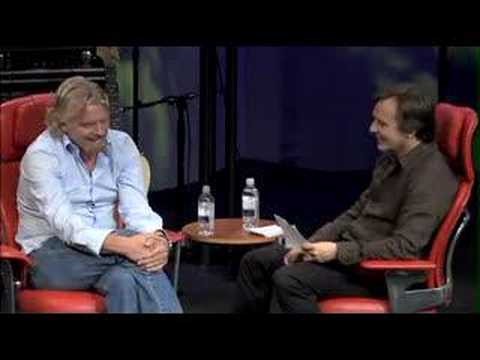
“…companies are all about finding the right people, inspiring those people…”TED talk, 2004 · full transcript →
Virgin became a group, not a single business, because standing still was dangerous
Branson rejects the idea that Virgin should have remained narrowly focused. He says plainly that if the company had stayed in one business, it would not still exist. Diversification, in his view, was not a distraction from Virgin’s identity but a way to preserve it through industry change and crisis.2728
What held the group together was not one product category. It was a repeatable method: spot a poorly served market, build a better experience, put strong people in charge, and protect the reputation of the brand.12920
That is why Virgin could move from records into airlines and beyond while still feeling coherent to him. The common denominator was always the same ambition: create something distinctive that improves people’s lives.315
Branson on virgin, in his own words
“…companies are all about finding the right people, inspiring those people…”
Where to watch
 Richard Branson on Leadership and Virgin: Building, Risk, and Purpose2019 · 24 min · full transcriptBest single overview of why Virgin enters new sectors and the operating idea behind the brand.
 Richard Branson on Virgin Growth Strategy: Diversify, Delegate, Win2023 · 76 min · full transcriptBest on diversification, delegation, and why details and people mattered to Virgin’s survival.
 Richard Branson on Brand Diversification: Keep Asking Why Not2022 · 36 min · full transcriptStrong explanation of how Virgin could expand across categories without losing its logic.
 Richard Branson on Calculated Risk Taking: Say Yes and Go for It2016 · 26 min · full transcriptBest for Branson’s risk philosophy and how bold moves helped put Virgin on the map.
 Richard Branson on Entrepreneurial Leadership: Culture, Risk, and Purpose2022 · 26 min · full transcriptUseful for understanding how Branson connects the Virgin brand to quality, people, and experimentation.
Questions people ask
- What did Richard Branson say about customer service and the little details?
- What did Richard Branson say about dyslexia and delegation?
- What did Richard Branson say about saying yes and taking risks?
- What does Richard Branson say entrepreneurship is really about?
- Why did Richard Branson keep taking on big challenges?
- How did Richard Branson start Virgin Atlantic?
Sources
Every quote above, word for word from the transcripts. Numbers match the text.
“…the only reason we would go into a new sector is if we felt it was being badly run…”
“What is a business? A business is simply somebody coming up with an idea to make other people's lives better.”
“I look at everything as an opportunity.”
“I like to think it stands for quality…”
“If you get the little details right, it makes for an exceptional company over an average company.”
“So I think, you know, every every little detail, I think, we, the team have got right at at Virgin, and if you get the little details right, you know, then collectively, you... It makes for an exceptional company over an average company. And, you know, if I'm on a Virgin plane, or in any Virgin company, I'll have my notebook, I'll take notes, I'll listen to it, listen to the staff, listen to the customers, you know, and then act on it when I get to the far end, and and and then be in touch... Back in touch with the people who, you know, gave me the ideas to thank them and tell them what we've done. And and and I think a good a good leader has to be a good listener.”
“The more humor you can have, the better.”
“…my whole attitude to life is, you know, if you create a new business that's the best in its field, it's likely to survive.”
“…life’s a lot more fun when you say yes, not when you say no…”
“I think, um, yeah, I do think life's, life's a lot more fun if you, if you, if you say yes.”
“I think if the, if the right challenge comes up, I will, I will still jump in and say yes.”
“…you have to be a little bit brave and stupid and foolish to do that…”
“…not having a fear of failure is at the heart of entrepreneurialism…”
“I think the thing that put Virgin on the map was when we bought one secondhand 747…”
“There's a very thin dividing line between success and failure…”
“…there's a very thin dividing line between success and failure…”
“…companies are all about finding the right people, inspiring those people…”
“…if you can run one company, you can really run any companies…”
“…if you can run one company, you can really run any company…”
“I think being a really good listener is one of them things…”
“If we'd stayed still and only focused on one business, we wouldn't have a business today.”
“If we were still in record shops, we would have been bust.”
“…your reputation is all you have in life.”
How this guide was made: drafted with AI from the full transcripts of the recordings cited, then checked: every quotation must match a transcript word for word and be the speaker's own words, and an independent review gates accuracy. Methodology and corrections.


