Richard Branson on Personal Story
Richard Branson treats personal story as a source of direction: school struggles, family lessons, youthful ventures, and old dreams become fuel for bold action.
- He turns biography into action, not nostalgia.
- His school struggles pushed him to build his own path.
- His mother and early independence helped make risk feel natural.
- Old fascinations can become real businesses decades later.
- He wants people to follow their own dreams rather than someone else’s script.
His personal story begins with not fitting the standard path
Branson’s story starts with struggle in formal education, but he does not frame that as the end of opportunity. He is proud of being a dyslexic thinker and encourages people to focus on what they enjoy, then get help in the areas where they are weak. That turns a supposed disadvantage into a practical way of building a life and career.
He says his teenage magazine became his real education. Running it forced him to learn printing, paper, advertising, and distribution, which gave him hands-on business training before he ever thought of himself as a businessman. In his telling, personal story matters because the experiences that look accidental often become the foundation of later success.
He believes identity is shaped by saying yes before you feel ready
A recurring thread in Branson’s story is that a fuller life comes from saying yes. He connects personal growth to willingness: making decisions, giving things a go, and accepting that bold moves can make you look foolish. For him, character is not revealed only in reflection; it is built through action.34
That is why his life story sounds less like a carefully planned career and more like a chain of committed experiments. He likes challenge, and he says he still jumps at the right one if he would regret watching someone else do it instead. Personal story, in this view, is written by the chances you accept.678
Early ventures taught him who he was
Branson’s account of his early years shows that personal story is formed through doing small things seriously. The youth magazine was not just a teenage project; it taught him how to operate in the real world, meet people, and solve practical problems. He presents that period as the bridge between a curious young person and an entrepreneur.
He also points to youth as a moment when risk is easier because there is less to lose. That helps explain why his story begins with boldness early: he did not wait for certainty, status, or a perfect plan. He moved first, and the moves themselves helped define the person he became.9

“Screw it. Let's do it.”BBC Radio 1 interview/promo for Screw It, Let's Do It!, 2006 · full transcript →
Long-held dreams can become businesses later in life
For Branson, personal story is not separate from business creation. A childhood and teenage fascination with space eventually turned into Virgin Galactic, and he even recalls a television moment that led him to register the name. What begins as private imagination can become public enterprise if you keep following it.
The same pattern appears in how he talks about challenge more broadly. He sees opportunities everywhere and is willing to pursue the ones that stay emotionally alive for him over time. His story suggests that paying attention to old obsessions is not indulgent; it can be strategically important.138
He uses personal story to encourage other people to choose their own path
Branson does not treat his life story as something unique and untouchable. He uses it to make a broader point: people should follow their own dreams rather than be pushed into someone else’s plan. That applies to children, careers, and ambition more generally.
He also tries to make his story useful to people who feel limited by labels or setbacks. His message to dyslexic kids is to stop treating the struggle as a verdict and instead build around strengths, curiosity, and delegation. In that sense, personal story is not just a record of what happened to you; it is a tool for deciding what to do next.15
Branson on personal story, in his own words
“Screw it. Let's do it.”
Where to watch
 Richard Branson on Entrepreneurship and Saying Yes: Screw It, Let's Do It2006 · 34 min · full transcriptBest for how school struggles and a teenage magazine became the start of his entrepreneurial identity.
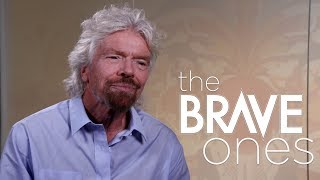 Richard Branson on Calculated Risk Taking: Say Yes and Go for It2016 · 26 min · full transcriptBest for his core life philosophy of saying yes and letting bold action shape your story.
 Richard Branson on Space Tourism: Virgin Galactic and the Future2015 · 13 min · full transcriptBest for seeing how a childhood fascination with space turned into a real company.
 Richard Branson on Entrepreneurship and Risk: How He Caps the Downside2017 · 88 min · full transcriptBest for how personal experience, reputation, and lived lessons shaped his judgment.
 Richard Branson on Business, Innovation and Giving Back: TED Talk2004 · 30 min · full transcriptBest for the bigger picture of how dyslexia, family, and adventure influenced how he leads.
Questions people ask
- What did Richard Branson say about dyslexia and delegation?
- What did Richard Branson say about how he started out as an entrepreneur?
- Why did Richard Branson keep taking on big challenges?
- How did Richard Branson start Virgin Atlantic?
- What did Richard Branson say about letting children follow their own dreams?
Sources
Every quote above, word for word from the transcripts. Numbers match the text.
“…life’s a lot more fun when you say yes, not when you say no…”
“…you have to be a little bit brave and stupid and foolish to do that…”
“I think, um, yeah, I do think life's, life's a lot more fun if you, if you, if you say yes.”
“I think if the, if the right challenge comes up, I will, I will still jump in and say yes.”
“I can't resist saying yes. Uh, if there's a, you know, if there's a challenge, uh, that, um, that I'm going to regret sitting and watching somebody else doing on television and having said no myself. So, you know, I think if the, if the right challenge comes up, I will, I will still jump in and say yes. Um, you know, the, the, the challenge that we are concentrating on right now, uh, is one that, uh, you know, has been perhaps the biggest challenge of my, uh, my life, and that, and that is, um, building a space line, and, um, it's taken 10 years to get to you, to get to where we are today.”
“…not having a fear of failure is at the heart of entrepreneurialism…”
“I look at everything as an opportunity.”
“If we can do this, just imagine what you can do!”
How this guide was made: drafted with AI from the full transcripts of the recordings cited, then checked: every quotation must match a transcript word for word and be the speaker's own words, and an independent review gates accuracy. Methodology and corrections.


