Start Before Ready
How a struggling student turned curiosity into a business education.

“Um, and so we launched this magazine which was, um, You magazine, designed to uh, be a magazine for young people to get the voice of young people out. Um, and it became my education. I did it from sort of 15 to 17, 18. Uh, interviewed tons of people. Um, uh, was the editor. Um, uh, was not interested in becoming a businessman at all. But uh, in order for the magazine to survive, I had to, you know, worry about uh, the printing and the paper and the advertising sales and the distribution. So um, so it was a good—it was a good education to help me um, become an entrepreneur as well.”BBC Radio 1 interview/promo for Screw It, Let's Do It!, 2006 · 2:12
The lesson
Branson’s entrepreneurial style began with a constraint: he struggled in school and learned differently. In these recordings, he treats dyslexia not mainly as a deficit but as a forcing function that pushed him toward the big picture, delegation, and practical learning by interest rather than rote instruction1. That matters for this chapter because his version of “start before ready” did not come from feeling fully prepared; it came from working with the way he actually learned.
His teenage magazine became the bridge from curiosity to business education. He started it to give young people a voice, but keeping it alive forced him to learn printing, paper, advertising sales, and distribution in the real world2. The larger lesson is that a project can teach you more than waiting for credentials, especially if the project puts you in contact with customers, partners, and operational problems.
This helps explain Branson’s bias toward action. Across the interviews, he returns to saying yes, asking “why not?”, and moving before everything is perfectly mapped out3. But the action is not reckless: he pairs boldness with protecting the downside, so that a first move becomes survivable and therefore possible45.
His move into music shows how one experiment can become a platform for the next. Branson traces Virgin from the student magazine into records and then into a broader company, with music as the launchpad and a place where improvisation and curiosity mattered6. Branson’s pattern was not to master one field academically and then enter it; it was to spot an opening, gather capable people, and learn by building.
Underneath all of this is a repeatable model: begin with interest, learn fast in public, and compensate for your weaknesses through people. Branson repeatedly emphasizes surrounding himself with people better than him and inspiring the right team78. So “start before ready” does not mean doing everything alone; it means starting early enough that the work itself becomes your education.
5 principles from Richard Branson
Turn learning differences into operating advantages
If standard schooling does not fit how you learn, design a way of working that does. Focus on strengths, keep hold of the big picture, and delegate the tasks that others can do better.
“I think that... Well, first of all, I I I would like to say I'm proud of being a dyslexic thinker, and I'm delighted that dyslexic thinking is now becoming almost part of the vocabulary. And I'm pleased to, you know, talk to many dyslexic kids over the years to try to make them realize that, you know, do not do not be worried about it. You know, look at look at the areas that you that you enjoy and concentrate on those. The areas that you're not great at, you you know, either that you'll catch up later on in life, or, you know, if you're gonna start a business, you can delegate and find other people who can deal with those.”
Use a real project as your education
A small venture can teach sales, operations, distribution, and decision-making faster than abstract study. Choose a project that forces contact with real people and real consequences.
“Um, and so we launched this magazine which was, um, You magazine, designed to uh, be a magazine for young people to get the voice of young people out. Um, and it became my education. I did it from sort of 15 to 17, 18. Uh, interviewed tons of people. Um, uh, was the editor. Um, uh, was not interested in becoming a businessman at all. But uh, in order for the magazine to survive, I had to, you know, worry about uh, the printing and the paper and the advertising sales and the distribution. So um, so it was a good—it was a good education to help me um, become an entrepreneur as well.”
Act before you feel fully prepared
Momentum often starts when you say yes to an opportunity or question why something has to stay the same. Waiting for total confidence can delay the very experience that would make you capable.
“I think, um, yeah, I do think life's, life's a lot more fun if you, if you, if you say yes.”
Protect the downside while taking bold shots
Branson’s version of boldness includes limiting what you can lose if the move fails. Before acting, define the worst reasonable outcome and make sure you can survive it.
“Take great chances and yet predict or protect the downside…”
Build with people better than you
Starting early does not require knowing everything yourself. It requires finding strong people, learning from them, and creating a team that covers your gaps.
“…companies are all about finding the right people, inspiring those people…”
In his own words
The quotes behind the lesson, word for word from the transcripts. Numbers match the lesson above.
“I think that... Well, first of all, I I I would like to say I'm proud of being a dyslexic thinker, and I'm delighted that dyslexic thinking is now becoming almost part of the vocabulary. And I'm pleased to, you know, talk to many dyslexic kids over the years to try to make them realize that, you know, do not do not be worried about it. You know, look at look at the areas that you that you enjoy and concentrate on those. The areas that you're not great at, you you know, either that you'll catch up later on in life, or, you know, if you're gonna start a business, you can delegate and find other people who can deal with those.”
“Um, and so we launched this magazine which was, um, You magazine, designed to uh, be a magazine for young people to get the voice of young people out. Um, and it became my education. I did it from sort of 15 to 17, 18. Uh, interviewed tons of people. Um, uh, was the editor. Um, uh, was not interested in becoming a businessman at all. But uh, in order for the magazine to survive, I had to, you know, worry about uh, the printing and the paper and the advertising sales and the distribution. So um, so it was a good—it was a good education to help me um, become an entrepreneur as well.”
“I think, um, yeah, I do think life's, life's a lot more fun if you, if you, if you say yes.”
“Take great chances and yet predict or protect the downside…”
“The most important thing when you start a business is thinking about protecting the downside.”
“One day, somebody said to me, "Music is horrendously expensive. Why don't you consider starting a music company?”
“I was 15, I was dyslexic, and I needed people better than me to be around.”
“…companies are all about finding the right people, inspiring those people…”
Reflect
- What weakness or frustration in your own learning or work style could become an advantage if you redesigned how you operate?
- What small project could become your version of a real-world education by forcing you to learn customers, sales, and execution?
- Where are you waiting to feel ready, and what would it look like to take a first step while still capping the downside?
Check your understanding
Go deeper
 Richard Branson on Entrepreneurship and Saying Yes: Screw It, Let's Do It2006 · 34 min · full transcript
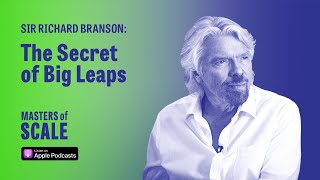 Richard Branson on Brand Diversification: Keep Asking Why Not2022 · 36 min · full transcript
 Richard Branson on Entrepreneurship and Risk: How He Caps the Downside2017 · 88 min · full transcript
 Richard Branson on Creativity and Entrepreneurship: Take Bold Risks2016 · 40 min · full transcript
 Richard Branson on Business, Innovation and Giving Back: TED Talk2004 · 30 min · full transcript