Fight the Giant
How Virgin acted like a challenger brand when British Airways tried to crush it.
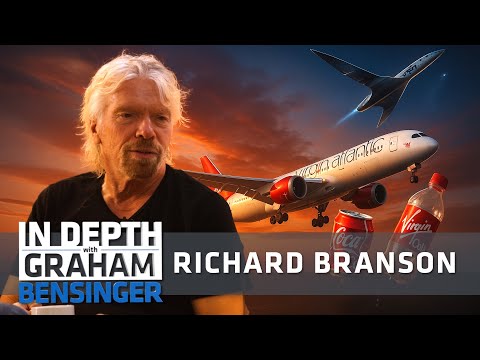
“…my whole attitude to life is, you know, if you create a new business that's the best in its field, it's likely to survive.”Graham Bensinger interview, 2025 · 45:39
The lesson
Branson built Virgin Atlantic as a challenger by starting with a simple test: if an industry treats customers badly, that is an opening. He believed a new business had a chance if it could become the best in its field, and he saw poor airline service as exactly that kind of opportunity. In his telling, flying had become dull, uncomfortable, and badly run, so Virgin’s job was not to copy the incumbents but to make the experience much better.123
That challenger stance was also a brand stance. Branson wanted Virgin to stand for quality, but not the stiff, corporate version of quality; he paired it with fun, novelty, and a willingness to shake up stale industries. This is why Virgin’s positioning worked as more than advertising: it connected a customer promise with a personality that made the big competitors look tired and out of touch.45
The fight with British Airways mattered because it tested whether Virgin could survive when a powerful incumbent fought back hard. Branson describes a moment when British Airways was trying to put Virgin Atlantic out of business through what became known as the dirty tricks campaign, and he saw how thin the line can be between success and failure. His response was not just rhetorical; he was willing to put the wider Virgin group at risk in order to protect the airline and the people whose jobs depended on it.678
What made this episode powerful for the Virgin brand is that it turned a business dispute into a clear David-versus-Goliath story. Branson already liked taking on the status quo, and this conflict gave customers a visible example of that instinct under pressure. A smaller company that improves the customer experience, defends its reputation, and keeps fighting can earn loyalty not just for what it sells, but for what it represents.2910
The deeper lesson is that challenger brands are not defined by size alone. They are defined by behavior: noticing where incumbents fail customers, building a better experience, and being prepared to defend the brand when attacked. Branson’s view of business as a long learning process fits this well, because challengers have to keep adapting while holding onto the core promise that made them matter in the first place.111213
5 principles from Richard Branson
Attack customer pain, not just competitors
Branson entered airlines because the experience was poor, not because he wanted to imitate existing carriers. Look for markets where customers are tolerated instead of delighted, then design around what would make the experience clearly better.
“…my whole attitude to life is, you know, if you create a new business that's the best in its field, it's likely to survive.”
Make your brand mean something concrete
For Branson, the Virgin name had to signal quality and a different kind of experience, not just visibility. A challenger brand becomes stronger when its personality is backed by a real product promise customers can feel.
“I like to think it stands for quality…”
Expect incumbents to fight back
If you threaten a dominant player, resistance is part of the game. Plan not only for launch, but for the moment when a larger rival uses its power to pressure, distract, or damage you.
“Well, I think that, um, you know, there's a very thin dividing line between success and failure, and I think if you start a business without financial backing, um, you're likely to, you're likely to go the wrong side of that dividing line. Um, the, uh, we had, um, we were being attacked by British Airways. They were trying to put, um, our airline out of business, and, um, and they launched what’s become known as the dirty tricks campaign. And, um, and I realized that, you know, the whole empire was likely to come crashing down unless I chipped in a chip. And, uh, and in order to protect the jobs of the people who work for the airline and protect the jobs of the people who work for the record company, um, I had to sell…”
Defend reputation as fiercely as revenue
Branson treats reputation as the asset that holds everything else together. When a conflict becomes public, protect trust with customers and staff, because brand damage can outlast any short-term financial hit.
“…all you have in life is your reputation…”
Use the challenger story to unite people
A smaller company can rally customers and employees when it clearly stands against a broken status quo. Branson’s approach shows that people support challengers when they see both courage and a genuine effort to serve them better.
“I mean, I think I learned early on that if you can, uh, if you can run one company, um, you can really run any company. I mean, company's all about finding the right people and inspiring those people, um, uh, you know, drawing out the best in people and, um, and I'm, uh, I just love learning and I'm incredibly inquisitive, and, um, I love taking on the, you know, the status quo and trying to turn it upside down. So, um, so I've seen life as one long, one long learning process, and if I see, you know, if I fly on somebody else's airline and find the experience is not a pleasant one.”
In his own words
The quotes behind the lesson, word for word from the transcripts. Numbers match the lesson above.
“…my whole attitude to life is, you know, if you create a new business that's the best in its field, it's likely to survive.”
“I mean, I think I learned early on that if you can, uh, if you can run one company, um, you can really run any company. I mean, company's all about finding the right people and inspiring those people, um, uh, you know, drawing out the best in people and, um, and I'm, uh, I just love learning and I'm incredibly inquisitive, and, um, I love taking on the, you know, the status quo and trying to turn it upside down. So, um, so I've seen life as one long, one long learning process, and if I see, you know, if I fly on somebody else's airline and find the experience is not a pleasant one.”
“But, anyway, we didn't listen to him on that. We did get the second 747, and I think, you know, the reason I think my partners were wrong was traveling on airlines in those days was abysmal. I mean, they would dump a bit of cold chicken on your lap. There was no entertainment. The cabin crew didn't smile because they were treated so badly. The planes were old and run down. So, you know, bring somebody in from the entertainment world and liven it up and make it a wonderful experience. And um...”
“I like to think it stands for quality…”
“If it's not fun, we don't do it.”
“Well, I think that, um, you know, there's a very thin dividing line between success and failure, and I think if you start a business without financial backing, um, you're likely to, you're likely to go the wrong side of that dividing line. Um, the, uh, we had, um, we were being attacked by British Airways. They were trying to put, um, our airline out of business, and, um, and they launched what’s become known as the dirty tricks campaign. And, um, and I realized that, you know, the whole empire was likely to come crashing down unless I chipped in a chip. And, uh, and in order to protect the jobs of the people who work for the airline and protect the jobs of the people who work for the record company, um, I had to sell…”
“There's a very thin dividing line between success and failure…”
“…there's a very thin dividing line between success and failure…”
“…all you have in life is your reputation…”
“…your reputation is all you have in life.”
“I’ve seen life as one long, one long learning process…”
“I look at everything as an opportunity.”
“…company's all about finding the right people and inspiring those people…”
Reflect
- Where in your work do established players accept a bad customer experience as normal, and what would a genuinely better version look like?
- If a much larger competitor tried to squeeze you out, what part of your reputation or customer promise would you need to defend first?
- Does your brand currently stand for a specific experience customers can describe, or mainly for marketing language?
Check your understanding
Go deeper
 Richard Branson on Adventure and Resilience: Balloons, Airlines, Space2025 · 74 min · full transcript
 Richard Branson on Entrepreneurial Leadership: Culture, Risk, and Purpose2022 · 26 min · full transcript
 Richard Branson on Entrepreneurship: Building, Risk, and Purpose26 min · full transcript
 Richard Branson on Business, Innovation and Giving Back: TED Talk2004 · 30 min · full transcript
 Richard Branson on Entrepreneurial Philosophy: Fun, Risk, and Purpose2013 · 44 min · full transcript
 Richard Branson on Virgin Brand Strategy: Fun, Differentiation, and Bold Bets1998 · 11 min · full transcript