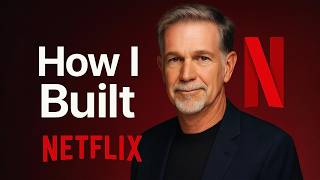
Reed Hastings on Entrepreneurship
Reed Hastings sees entrepreneurship as product-led, unusually optimistic, and only sustainable when bold bets are matched with great people, candid learning, and a relentless focus on customers.
- Start from a product conviction, not from entrepreneurship as an identity.
- Founding requires unrealistic optimism and comfort with big risk and painful mistakes.
- Hard work is not enough; weak teams create bureaucracy and kill innovation.
- Organize around exceptional people, context, and freedom rather than micromanagement.
- The point of the company is to serve customers with something simpler and better.

“Um, and so I was content to try many things, and I did a company, Pure Software, only because I got excited about a certain product, and I needed to do a company to get that product out. So I was always led by my passions, and it's worked out super well.”The Knowledge Project podcast interview, 2024 · 1:07:07
Entrepreneurship starts with product passion, not with chasing the title
Hastings does not frame entrepreneurship as a glamorous career move. He says he started Pure Software because he got excited about a specific product and needed a company to get that product into the world, and he describes himself as being led by his passions rather than by a master plan to become a founder.1
That helps explain his broader approach: he looks for core principles and then organizes around them. In practice, that means an entrepreneur should begin with a real conviction about what should exist, not with a vague desire to "do a startup."21
His own early experiments also show that strong enthusiasm is not enough by itself. He was deeply committed even to bad ideas, which is a warning that founders need both conviction and the ability to test whether the product actually works in real life.3
“Um, and so I was content to try many things, and I did a company, Pure Software, only because I got excited about a certain product, and I needed to do a company to get that product out. So I was always led by my passions, and it's worked out super well.”The Knowledge Project podcast interview, 2024 · full transcript →
A founder has to be optimistic enough to leap before certainty exists
Hastings treats starting a company as inherently extreme. His view is that founding requires a level of optimism that lets you act despite incomplete information, severe risk, and no guarantee that things will work out.5
That same mentality shows up in how he thinks about major strategic moves. He argues that companies sometimes need to be aggressive enough that the move feels uncomfortable, because timid action will not create something new or help you survive major transitions.6
But this is not blind confidence. Hastings openly admits he was as committed to one terrible idea as he was to Netflix, which is a useful entrepreneurial lesson: confidence is necessary, but confidence alone does not distinguish the great bet from the bad one.3

“…starting a company is like jumping out of an airplane without a parachute…”First Time Founders with Ed Elson, 2025 · full transcript →
The best ventures solve a simple customer problem and ride a long trend
For Hastings, entrepreneurship works best when it combines an immediate customer pain point with a long-term technological shift. Netflix began from the frustration of rental friction and then kept orienting toward a world where entertainment would become easier, more convenient, and eventually internet-based.7
He consistently ties the business back to the customer experience. He says the company’s primary responsibility is to entertain customers, and he elsewhere reduces the mission to two tests: customer satisfaction and operating income.9
That is why Netflix could start with DVDs by mail and still be built with streaming in mind. The early form could change, but the underlying principle stayed constant: organize around the better future you think is coming and keep reducing friction for the user.107
What broke at Pure Software taught him how entrepreneurship fails
One of Hastings’s clearest lessons is that startup success can be undermined by the way the organization evolves. Looking back at Pure Software, he says talent density declined, and once that happened the company needed more rules to prevent mistakes, which pushed out stronger people and made the whole system less productive.11
This is why he became so skeptical of heavy process in creative work. In his view, processes can choke innovation, and trying to run software like a factory does not produce exceptional output.1211
For entrepreneurs, this is a crucial warning. The same systems that feel responsible as a company grows can become substitutes for judgment, candor, and talent, gradually draining the very creativity that made the company worth building in the first place.1112
Build like a championship team: high talent, high candor, low control
Hastings’s answer to entrepreneurial scaling is not tighter control but better people. He says that once Netflix was stable enough to think beyond survival, the company realized it should organize around working with incredible people on hard problems, which led directly to freedom and responsibility.13
That philosophy changes the founder’s job. Instead of making every decision, Hastings prefers setting context and letting strong people run, and he even takes pride in making as few decisions as possible.1415
He believes overmanagement filters out performance and creativity, so the goal is to operate near the edge of chaos without tipping into dysfunction. That only works if the team is unusually strong, candid, and aligned on performance.161718
Bold entrepreneurship includes painful mistakes and the need to recover
Hastings does not present entrepreneurship as a clean upward arc. He connects aggressive decision-making with the possibility of painful errors, and his reflections show that big swings can both drive progress and create real damage if they get too far ahead of customers.6
What matters is not avoiding every failure but learning from it without losing honesty. He speaks candidly about the emotional cost of mistakes, even describing periods when he struggled to forgive himself, which suggests that resilience is part of the founder’s craft, not an optional personality trait.19
His broader view of success keeps entrepreneurship in perspective. Business matters because it can create positive impact for others, not because there is one perfect founder script to copy.21
Hastings on entrepreneurship, in his own words
“…starting a company is like jumping out of an airplane without a parachute…”
“Um, and so I was content to try many things, and I did a company, Pure Software, only because I got excited about a certain product, and I needed to do a company to get that product out. So I was always led by my passions, and it's worked out super well.”
Where to watch
 Reed Hastings on Life After Netflix: From Streaming to Skiing2025 · 41 min · full transcriptBest short entry point on founder psychology, product passion, aggressive decisions, pivots, and painful mistakes.
 Reed Hastings on Leadership & Culture: Big-Hearted Champions2023 · 59 min · full transcriptBest overview of Hastings’s entrepreneurial arc from early experiments to Netflix and what failure taught him.
 Reed Hastings on Freedom & Responsibility: Building Netflix2014 · 59 min · full transcriptBest on how a founder organizes a growing company around context, freedom, and long-term strategic bets.
 Reed Hastings on Talent Density: Building Great Teams at Netflix2023 · 62 min · full transcriptBest on why talent density matters so much in startups and how weak teams create rules and drag.
 Reed Hastings on Streaming And Education: How Netflix Scaled2013 · 21 min · full transcriptBest on Netflix’s origin, the customer problem it solved, and the long bet on streaming.
Questions people ask
- What did Reed Hastings say about freedom and responsibility at Netflix?
- What did Reed Hastings say about loyalty vs performance?
- What did Reed Hastings say about talent density at Netflix and Pure Software?
- What does Reed Hastings mean by managing on the edge of chaos?
- What did Reed Hastings say about following your passions in business?
- What does Reed Hastings think success means?
Sources
Every quote above, word for word from the transcripts. Numbers match the text.
“Um, and so I was content to try many things, and I did a company, Pure Software, only because I got excited about a certain product, and I needed to do a company to get that product out. So I was always led by my passions, and it's worked out super well.”
“I'm always interested in kind of core fundamental principles.”
“I was equally committed to that terrible idea as I was to Netflix.”
“…starting a company is like jumping out of an airplane without a parachute…”
“…we had to be so aggressive that it should make the hair on the back of our neck stand up…”
“…more and more consumers want control. They want freedom.”
“I have two religions, customer satisfaction and operating income.”
“…we should organize everything around supporting that…”
“So I founded Pure Software in 1990 and grew kind of typical great software company doubling. I wasn't careful about it, and I would say talent density declined. That company, we went public in '95, got acquired in '97. And when I analyze looking back what happened, one of the major things was declining talent density. And then with declining talent density, you need a bunch of rules to protect against the mistakes, and that only further drives out the high caliber people. And so it was through that experience that I realized, okay, I've tried to run software like a manufacturing plant and reducing error and putting in process. And then that doesn't get high productivity or high talent.”
“Processes can be the death of innovation.”
“Yeah, up until 2002, all we focused on was survival. And then once we got public and, and we're profitable we started thinking, wow, this thing might last. And the, the cruelest irony would be to not want to work there. You know to let it become a place we didn't want to be. And so we tried to think through what do we really care about? We realized what we really care about is working with incredible people on hard problems and that, that was the essence. So we should organize everything around supporting that of working with, you know, just incredibly talented people. And so that led us to freedom and responsibility, because incredible people don't wanna be micro managed.”
“…manage through setting context and letting people run…”
“I take pride in making as few decisions as possible as opposed to as many as possible…”
“If you over manage, for example, a tight process or specific hours that you have to be in the office or a wide variety of things, you filter out performance and creativity. And the looser that you can run, the more creative that the organization will be. So we talk about it as managing on the edge of chaos. You don't actually wanna fall into chaos. Okay? In chaos, the product barely gets released. It's full of bugs. People are upset. Payroll's not made. Lots of bad things happen. But it's getting us close to that edge of chaos where there's last minute saves and a lot of dynamism as you can possibly tolerate as opposed to, say, a semiconductor factory, which is trying to reduce variation and reduce error to get rid of variants.”
“We talk about it as managing on the edge of chaos.”
“Ultimately, it was about performance, and that helped us clarify our own values—that we were more valuing growth and achievement than we were, say, lifetime loyalty. Which is different than a family company or other relationships that we have where we value loyalty in our friendships, in our marriage, and other things. We value loyalty over performance.”
“I didn't know how to forgive myself…”
“…there's no one path to imitate…”
How this guide was made: drafted with AI from the full transcripts of the recordings cited, then checked: every quotation must match a transcript word for word and be the speaker's own words, and an independent review gates accuracy. Methodology and corrections.