Reed Hastings on Teams & Culture
Reed Hastings sees Netflix culture as a system for creative work: hire exceptional people, give them context and candor, and remove rules that slow judgment and innovation.
- Netflix culture is built for creative work, not factory-style control.
- Its foundation is talent density: a great team raises performance and reduces the need for rules.
- Freedom works only with responsibility, judgment, and broad context.
- Candor is essential because innovation depends on honest feedback and dissent.
- Culture should be written down, debated, and improved rather than preserved unchanged.

“At root, we do think it's the culture that really enables that kind of innovation.”TED conversation with Chris Anderson, 2017 · 5:54
Netflix culture is designed for creativity, not control
Hastings’s central claim is that creative companies need to be run differently from factories. In a factory, the goal is consistency and error reduction, so tight supervision and process make sense. In creative work, that same model becomes a drag on initiative, adaptation, and invention.123
That is why he describes Netflix culture less as a set of perks and more as an operating model for innovation. He believes many companies become too process-heavy, and that over time those processes make them rigid when markets shift. His warning is blunt: process can solve short-term problems while quietly weakening long-term adaptability.452
He ties this directly to Netflix’s business environment, where change comes fast and the company has to keep reinventing itself. In that setting, culture is not decoration around strategy; it is what allows bold moves and quick response. That is why he says culture is what enables innovation.67
“At root, we do think it's the culture that really enables that kind of innovation.”TED conversation with Chris Anderson, 2017 · full transcript →
The foundation is talent density
For Hastings, the first principle of Netflix culture is talent density: having more exceptional people per team. He learned this partly by contrast, after seeing what happens when talent density falls and managers compensate by adding more rules, more checks, and more bureaucracy. In his view, lower talent density and heavier process reinforce each other in the wrong direction.8
This is why Netflix rejects the idea that a company should act like a family in the ordinary sense. Hastings says it should operate more like a high-performing team, where the standard is contribution, not simple belonging. The emphasis is on surrounding people with other strong performers working on hard problems.91011
That approach can sound harsh, but Hastings frames it as clarity about what the organization is optimizing for. He says Netflix valued growth and achievement more than lifetime loyalty, and paired that with generous severance rather than pretending every role should last forever. The point is to keep standards explicit instead of mixing personal loyalty with performance expectations.1213

“We’re a team, not a family…”Stanford GSB Q&A, 2016 · full transcript →
Freedom only works when paired with responsibility and judgment
The most famous phrase associated with Netflix culture is freedom and responsibility, and Hastings means both parts. He wants employees to have unusual latitude, but not because rules do not matter; rather, because judgment matters more. Managers should give context, and decision owners should act.141516
This is why Hastings prefers context over control. Leaders are supposed to set direction, share information broadly, and help people understand the business and the tradeoffs. Then the person closest to the decision should make it, after gathering input well.1718
He is also clear that this is not a license for sloppiness. He describes the goal as operating near the edge of chaos, not in chaos itself: loose enough to preserve dynamism, tight enough to still deliver. The balance is deliberate because too much control filters out creativity, while too little discipline breaks execution.1920
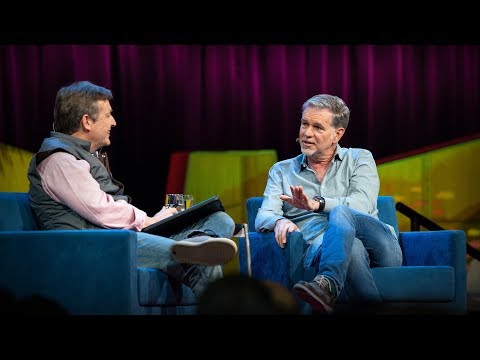
“Yeah, absolutely. We did have one advantage, which is we were born on DVD, and we knew that that was going to be temporary. No one thought we'd be mailing discs for 100 years. So then you have a lot of paranoia about what's coming next, and that's part of the founding ethos, is really worrying about what's coming next. So that's an advantage. And then in terms of the culture, it's very big on freedom and responsibility. I pride myself on making as few decisions as possible in a quarter.”TED talk, 2017 · full transcript →
Candor is a core management tool, not a personality trait
Hastings treats candor as necessary infrastructure for a high-talent company. If people are going to have freedom and make consequential decisions, they also need direct feedback, honest disagreement, and fast correction. Candor is not random bluntness; it is meant to help people improve and help the company make better choices.21
He especially emphasizes making dissent easier to express. Because hierarchy naturally suppresses disagreement, leaders have to actively reward people for speaking up and create practices that draw out opposing views. In his description, Netflix tries to farm for dissent rather than waiting for it to appear on its own.22
This connects back to innovation. If a company avoids difficult conversations, it becomes slower, more political, and less able to see threats clearly. Hastings generally prefers confronting uncomfortable truths early so the organization can adapt before problems become fatal.226
“But in particular in feedback, because of the power dynamics, you really have to create an openness for people to give you feedback by giving them psychological rewards. That was so great, by lauding them. And we do things to farm for dissent. So let's say there's a decision about, you know, what should we do about the pandemic, and, you know, what should we, you know — then we would open it up for discussion, and then we want each person to weigh in with: do they think it's a good idea or bad idea to say, close down or whatever the issue is. Another thing we do is run an exercise: what would be different if you were CEO instead of me? And it's a…”TED conversation with Chris Anderson, 2017 · full transcript →
Culture should be explicit, debatable, and constantly improved
Hastings does not think culture should remain unwritten or mystical. One reason the Netflix culture deck mattered is that writing values down makes them easier to question, refine, and use. Instead of a sermon from management, culture becomes something employees can examine and push against.
He also rejects the idea that culture should be preserved unchanged once it works. His view is that trying to freeze culture in place is a mistake; the job is to make it better as the company changes. Strong culture matters, but it should remain alive rather than ceremonial.2526
That also means other companies should not copy Netflix mechanically. Hastings argues that leaders should not imitate his persona or another founder’s style. The deeper lesson is to build a coherent culture that matches your work, your people, and the kind of performance you need.27

“…we're not trying to preserve the culture; we're trying to make it better…”Milken Institute Global Conference interview, 2012 · full transcript →
Hastings on teams & culture, in his own words
“It's very big on freedom and responsibility.”
“We’re a team, not a family…”
“At root, we do think it's the culture that really enables that kind of innovation.”
“…the macro thing is, use good judgment.”
“Processes can be the death of innovation.”
“…we're not trying to preserve the culture; we're trying to make it better…”
Where to watch
 Reed Hastings on Freedom & Responsibility: How Netflix Runs Creative Work2017 · 62 min · full transcriptBest single explanation of how freedom, responsibility, candor, hiring, and rules fit together in Netflix’s model.
 Reed Hastings on Culture and Talent Density: Context, Not Control2016 · 81 min · full transcriptBest for understanding the culture deck, why writing culture down matters, and why Hastings prefers context over control.
 Reed Hastings on Talent Density: Building Great Teams at Netflix2023 · 62 min · full transcriptBest on talent density, why too many rules signal weaker teams, and what it means to manage near the edge of chaos.
 Reed Hastings on Netflix Culture: Why Rules Need Reinvention2018 · 38 min · full transcriptBest on why creative organizations need fewer rules, more feedback, and a different model from error-minimizing systems.
 Reed Hastings on Netflix Culture: Build It, Don’t Preserve It2012 · 27 min · full transcriptBest on how Netflix culture emerged, why it was published, and why culture should be improved rather than preserved.
Questions people ask
- What did Reed Hastings say about Netflix culture and taking bold risks?
- What did Reed Hastings say about loyalty vs performance?
- What did Reed Hastings say about talent density at Netflix and Pure Software?
- What did Reed Hastings say about why Netflix wrote down its culture deck?
- What did Reed Hastings say about why creative work should not be run like a factory?
- What does Reed Hastings mean by managing on the edge of chaos?
Sources
Every quote above, word for word from the transcripts. Numbers match the text.
“…for creative work there's a different model.”
“In a factory, you control people, you supervise them, but in creative work, you want to inspire them, you want to excite them. And that's completely different. And yet many people still run creative firms almost as if they wanted to be a factory. I know because I did it in our first company in pure software. Every time something went wrong, I would put a process in place to try to make sure that thing didn't go wrong again. And that works in the short term, but it makes you very rigid. And then the market shifted. In that case, it was C++ to Java, but they all shift in some way. And we were unable to adapt,…”
“…if you wanna stimulate creativity, which is making a lot of mistakes and those kinds of things, then that's a different model…”
“…our culture is designed at inspiring and motivating creative people…”
“Processes can be the death of innovation.”
“That's the bitch about the internet -- it moves fast, you know?”
“At root, we do think it's the culture that really enables that kind of innovation.”
“So I founded Pure Software in 1990 and grew kind of typical great software company doubling. I wasn't careful about it, and I would say talent density declined. That company, we went public in '95, got acquired in '97. And when I analyze looking back what happened, one of the major things was declining talent density. And then with declining talent density, you need a bunch of rules to protect against the mistakes, and that only further drives out the high caliber people. And so it was through that experience that I realized, okay, I've tried to run software like a manufacturing plant and reducing error and putting in process. And then that doesn't get high productivity or high talent.”
“We’re a team, not a family…”
“…we try to model ourselves like a professional sports team…”
“We're not gonna guarantee you a lot, but we'll guarantee that it will always surround you with great people and have you work on hard problems.”
“Ultimately, it was about performance, and that helped us clarify our own values—that we were more valuing growth and achievement than we were, say, lifetime loyalty. Which is different than a family company or other relationships that we have where we value loyalty in our friendships, in our marriage, and other things. We value loyalty over performance.”
“And viewing our task in building organizations like a championship team. And for 10,000 years, the primary organizational unit of society has been family, okay, all the way through kings and companies and family companies. So, so many assumptions we have are built around this 10,000 years of human history where organizations and families are the same thing, okay? And it's only this patina of corporations, and that's a thin layer over that that's different. And so we were the first ones to just lay it out there, to say adequate performance gets a generous severance package.”
“It's very big on freedom and responsibility.”
“Yeah, absolutely. We did have one advantage, which is we were born on DVD, and we knew that that was going to be temporary. No one thought we'd be mailing discs for 100 years. So then you have a lot of paranoia about what's coming next, and that's part of the founding ethos, is really worrying about what's coming next. So that's an advantage. And then in terms of the culture, it's very big on freedom and responsibility. I pride myself on making as few decisions as possible in a quarter.”
“…the macro thing is, use good judgment.”
“We want our leaders to be great teachers…”
“…the captain of the ship makes the decisions, but it's good for them to collect a lot of information.”
“We talk about it as managing on the edge of chaos.”
“If you over manage, for example, a tight process or specific hours that you have to be in the office or a wide variety of things, you filter out performance and creativity. And the looser that you can run, the more creative that the organization will be. So we talk about it as managing on the edge of chaos. You don't actually wanna fall into chaos. Okay? In chaos, the product barely gets released. It's full of bugs. People are upset. Payroll's not made. Lots of bad things happen. But it's getting us close to that edge of chaos where there's last minute saves and a lot of dynamism as you can possibly tolerate as opposed to, say, a semiconductor factory, which is trying to reduce variation and reduce error to get rid of variants.”
“…we want to get people to realize if it's about helping each other, you have wide license, to be honest…”
“But in particular in feedback, because of the power dynamics, you really have to create an openness for people to give you feedback by giving them psychological rewards. That was so great, by lauding them. And we do things to farm for dissent. So let's say there's a decision about, you know, what should we do about the pandemic, and, you know, what should we, you know — then we would open it up for discussion, and then we want each person to weigh in with: do they think it's a good idea or bad idea to say, close down or whatever the issue is. Another thing we do is run an exercise: what would be different if you were CEO instead of me? And it's a…”
“…we're not trying to preserve the culture; we're trying to make it better…”
“…strong cultures work and weak cultures are diffused…”
“…you've got no hope if you try to pretend to be Reed Hastings or Mark Zuckerberg or Bill Gates…”
How this guide was made: drafted with AI from the full transcripts of the recordings cited, then checked: every quotation must match a transcript word for word and be the speaker's own words, and an independent review gates accuracy. Methodology and corrections.