Reed Hastings on Culture and Innovation: Reinvention at Netflix

What Hastings talks about
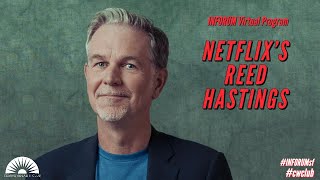
Reed Hastings spoke in this Commonwealth Club conversation in 2018 about Netflix’s culture of innovation, candor, talent density, and adapting management practices across countries including Japan and Brazil.
Also known as: Commonwealth Club World Affairs of California conversation; Reed Hastings on Culture and Innovation; Reinvention at Netflix.
Reed Hastings discusses how Netflix built a culture designed for innovation rather than efficiency. He argues that many companies over-optimize for process, while creative businesses need freedom, candor, and high talent density to keep reinventing themselves.
He also explains how Netflix adapted these ideas across countries, including lessons from Japan and Brazil about feedback, relationship-building, and cultural differences. A major theme is that good culture is not a slogan but the actual behaviors that get rewarded or tolerated.
Nicole dewees introduces the event, Ben Horowitz interviews Hastings, and Hastings speaks throughout the substantive discussion.
In his words
“Company culture is the behaviors that get you promoted or get you. let go”
“Process is it all feels good?”
“The people who prospered were the people who could develop and follow process well”
“No pain, no gain”
“It's not a novel thing that a new technology has unintended and bad consequences”
Key points
- Company culture is defined by the behaviors that get rewarded or get people let go.
- Netflix tries to build a culture of candor, talent density, and reduced rules and process.
- Process can improve short-term execution but slowly suffocate creativity and adaptability.
- Feedback must be honest, professional, and constructive—not random venting.
- Different national cultures require different ways of practicing candor and trust.
- Creative companies should optimize for long-term innovation, not manufacturing-style efficiency.
- Netflix’s culture is meant to evolve as the company grows and enters new markets.
Full transcript: Reed Hastings, Commonwealth Club conversation (2018)
Do Hi everyone i'm inforum programs manager nicole dewees Welcome to today's program with netflix ceo reed hastings We are here to celebrate hastings new book, no rules rules netflix and the culture of reinvention He will be in conversation with ben horowitz co-founder of andreas and horowitz If you'd like to ask either of them a question during this program You can do so in the comment section of the live stream that you're currently watching The commonwealth club has temporarily suspended in-person events, but to keep you informed during this pandemic We are running full speed ahead with a slate of online programs Most of these programs are currently free to the public. So we do ask that you consider donating to help us continue our work you can visit us at Commonwealthclub.org online to learn more and you can also text the word donate to 415-329-4231 Live during this program now, please join me in welcoming reid hastings and ben horowitz to inforum Thank you nicole. Hello, and welcome to today's virtual program within forum at the commonwealth club i'm ben horowitz co-founder and general partner at andreessen horowitz I'm pleased to be in conversation with my friend reed hastings many of you know reid as the co-founder ceo and chair of netflix
He is here to discuss his new book. No rules rules Netflix and the culture of reinvention Just a reminder. If you'd like to ask a question, please do so in the chat or comment section on youtube or facebook All right, great. So let's get into it um reid so first of all i'd like to thank you for writing this book because I get uh asked to recommend business books a lot and um, i'm usually dumbfounded and people think that i'm illiterate because I don't read but it's mostly I don't like Many of the business books that I do read, but I really like this one and one of the reasons I really liked it is you kind of start from that honest place, which is Where most of us learn management lessons which is kind of a place of failure. I screwed it up And now I need to figure it out And that that's almost how i've learned everything. I know in management And you did that at uh, your prior company pure software which You wanted needed reinvention Um, but cunt and so can you tell us about that and kind of how that led to this set of ideas?
Ben i'm so looking forward to this conversation For the listeners who don't know, uh ben is one of the foremost thinkers, uh on culture Is himself, uh an incredible Author um, and you know, this stuff's hard and subtle and I so look forward to the discussion Um, so you asked about learning from failure. I mean, I think every leader learns partially from failure of their own and partially from reading and experience and If you can learn more from other people's errors and then make new and fresh ones. That's probably a positive outcome so I don't want to celebrate too much learning from your own errors because again, It's it's great to build on the errors of others, you know and make fresh ones yourself. Yes. Yes, no doubt. Um But kind of what?
What were the things that you ran into? at pure that you yeah that Kept you from being able to reinvent So I was a First-time manager. I had invented the first product purify, which was a c debugging tool And um, so it was you know, as an inexperienced ceo would be an understatement And In that manifest itself in several ways, but one in particular was every time something went wrong. I didn't want that to go Go wrong again Which is typically how an engineer approaches a problem. So If you find an error in software, you try to build a regression suite Or test for it that runs to make sure that that error doesn't come back right and that's, you know, good design and good engineering So, you know, I view the organization as a big software puzzle, which I know is laughably simplistic But that's how I viewed it And uh every time there was an error We put a process in place to make sure that error didn't happen And indeed generally that particular error didn't happen But what I missed was what's the cultural effects of that year after year?
And the cultural effect was that you know the people who prospered were the people who could develop and follow process well, And that was the value system and if you followed the process, well, you were rewarded in all kinds of ways And over time it slowly drove out that kind of creative mavericks who didn't really want to deal with all that crap And the subtle thing is in the short term the business ran better not worse because it was, you know, very highly optimized And so there was no negative feedback really about it And then the market shifted in that case. It was c plus plus to java, but the details don't really matter and you know We were unable to adapt we ended up buying a bunch of companies that try to have new products for our sales force Because we weren't coming up with them ourselves I guess you know all the core signs and then to do more acquisitions, you know It gets more complex because you got this other company full of process Uh, and eventually we drowned and so I think of it process Is it all feels good?
But it builds up like barnacles Uh on a boat and if you don't uh every now and then with a boat scrape off the barnacles Then eventually a storm comes and it sinks the boat And so you just you know, we always think about it as going a little like technical debt another software metaphor But you've got to go in and scrape the barnacles and really try to get rid of process and This is why You know because I failed in that way in the past, I at least want to fail in a novel with this time all new mistakes That's it, you know, so we're pushing super hard into employee freedom pushing the the anti-process orientation Um, you know as hard as we can yeah at an amazing level and and why um Why write this book now?
And then uh, you also had a co-author which I thought was interesting and it wasn't like the normal co-author ghost writer It was almost like a co-author Well, what's reid saying? Yeah, that part's true I was wondering about this part that kind of thing Why that approach? Well your books exempted I have read way too many ceo Pontification books where the ceo says how great things are and the way they work and I always wonder what's the reality? you know what's really happening in that company and Now and then i've got friends who work there and I can get a bead on it And it's almost never what the ceo thinks and of course, I knew that would be true at netflix, too So I thought let me get someone really independent Um who's a business school professor, you know as their own reputation and give them open access to netflix They can interview anyone and everyone and report to the reader You know, this is the reality so the book is me pontificating going through the theory which you can yeah, I like doing um, and then uh, aaron really saying well, This is you know her observations from dealing with all the employees of the reality Um, and she had formally written an incredible book called culture map Which is about national cultures within a corporation so if you're a global company and you have a lot of koreans and germans and brazilians and dutch and english americans, and you're wondering japanese Why are they?
Misunderstanding each other then to read her book culture map is incredible So I knew she had good insight about culture Right. And did you did you end up learning things about netflix? You know in addition to like book aside like just about netflix where you were where she was like Well, that doesn't make sense reed and you're like wow That doesn't make sense or how did that process go with regards to actually running the company Yeah, as you would expect if you have a good you know anthropologist Spend a lot of time with a hundred people you can pick up things and you know Not that they're uh completely new but either relative waiting, you know how they felt the fact that we felt like and feel like such an american company like I thought oh We're really doing well on becoming pretty global Um, you know and uh our korean or our you know, dutch employees are like wow This is a super american company worse californian company. Um, so we still have a ways to go to get to You know the holy grail where everyone feels they have an equal chance to thrive, you know Whether you're an employee for us in in mexico city or in mumbai Yeah, yeah, that's that's awesome. So, um We've been talking about culture but culture means a lot of different things to a lot of different people. It's a very overloaded word so when you Speak of culture in the context of netflix. What do you mean there?
I think company culture is the behaviors that get you promoted or get you. Let go so Everyone when they go into a company has to figure out What's the real culture right? What are the values and behaviors? That are rewarded and which ones are violations and Sometimes there's a written culture and sometimes companies follow that written culture other times There's a written culture like enron, you know, famously had uh, you know respect integrity You know as as two or four big words But that was actually what got people promoted what got them promoted was trading profits and you know, then people cut corners Uh to do that and eventually the company blew up So tr, you know in any company, the the real culture is again Shown by who gets uh rewarded and who gets pushed out, right?
Right and and it's really interesting in that context that you don't when you describe the netflix culture You do it in a very different way than we're used to seeing in books which it's use usually a written culture is about starts with these values and integrity and and so forth But you more describe it as a system and there are these pillars in the system candor, um Density and rule removal I guess is you know getting rid of rules and they're sort of interdependent and then You also kind of speak of layering them So you you know you start with a talent density concept and then you add a little candor And then you remove a little rules and then you kind of recycle through the thing again, you know increase your talent density Uh kind of increase the amount of feedback people get and then you can remove more rules uh so maybe you could describe that and why you have this sort of interdependent systems view of culture that's that's so different than the way it's ordinarily described Well, let's separate two things so there's um, Uh what our culture is And then there's if you want to go in this direction here is some ways to go about it right now What our culture is? I think you're right is we try to describe precisely behaviors that are rewarded Um, and that managers can be held accountable for that. You know, it's an employee bill of rights in a way Okay, that's in our culture memo. And this I picked up from uh, jack welch's book winning
Uh, and it's in chapter three and in a book that generally isn't Like chapter three is brilliant. Yeah. Yeah He does pontificate a lot. I was going to say Yeah, so he describes um that in the past he put you know Generalities, you know integrity communication But it's like those are not near specific enough and he's like, you know It's much different than that and now i'm much more long-form and specific about You know how to approach business problems and how to grow a great business Which is going to be unique for for each company But if you look at the you can google netflix culture and read the current memo And you can read the 10 behaviors there and then again that forms two ways one is it's us Saying to new employees what we want which again helps people select in or select out Um, but it's also a sort of bill of rights that an employee is entitled to see those behaviors rewarded or not And if they see that management is inconsistent Um, and you know, we're not perfect Compared to those values it gives them something to to refer to and to call us to account Okay, so that's about what our culture is Then there's the question you brought up this sort of spiral notion of you know, do a little more. Um, that was really aaron's innovation As a book device to basically help people build confidence because it's pretty hard to go from most cultures with a lot of process To the next week no process and no rules and that's kind of chaotic. So
So she's we're going with the connect the dots to uh a possibility um to sort of build confidence to do a little bit and so we sat and thought through You know if someone wants to adjust their culture Here's a way to go about it. Okay, which if you're a startup you don't need them. Okay, right. That's right so it's a it's a Mechanism or it's our best guess on the way an existing company, um can absorb, uh the set of ideas if they want to Okay. Yeah that that that's really really interesting and and kind of in getting to the netflix culture like, you know One of the things you talk about that you value is sort of challenging your boss um, which you know as you get into uh, You know, we're all flawed human beings including bosses um how You know I guess how does that?
Work in that. Um You know from an incentive because you want to incent that's the behavior you want um, but often like a boss will not reward that necessarily and how does that end up working inside of netflix so that you don't kind of End up with a hypocritical culture where somebody challenges the boss and is punished for that Well, certainly if they're punished for that that's going to end all feedback but even more strongly because it's Anti-normality to criticize the boss And they're way dangerous. Uh, the boss has to go out of their way to farm for dissent Um, what could I be doing better? Um, i'll do an exercise with our executives if you were ceo what would be different at netflix and they have to list and sort through the top three things that would be different and you know, that could be uh, we'd be in china where we're not or it could be we You know be in sports or it could be Uh, we would pay higher or lower or it could be, you know as trivial as uh, we'd have better food I don't know, you know, it could be whatever the things are that that forces them to say What if I were ceo what would be different? Okay, so that's one exercise in farming for dissent Right, and then there's when you're lucky to get feedback Then i'll log the person often publicly with their permission You know person x told me this, you know, that was uh, you know, a hard piece of feedback But but it's fair and so it's giving them psychic rewards where other people think
Oh that person was gutsy, you know and and did that so at multiple levels you want to overcome, um people's Reticence. Yeah, um to provide useful feedback, uh to to power figures and so how That's such a great question. By the way, you know How would you run netflix if you were in my seat? You know, how are you? It's just such a great question to get people to speak up on things that would otherwise seem very dangerous with the managers, how do you get them to ask because You know, you're asking a question where you in some way emotionally, at least you don't want to know the answer And so how does you know how how does that training work? Or how do they take, you know, is that a difficult thing?
It's generally easy to get them to critique pricing strategy or something that's economic right and it's harder to get them to say, uh Well, if I were ceo we would have a more empathetic ceo Um, you know, in other words sort of personal characteristics um and um So think of it as there's there's things that are sort of I don't know product economic, you know We'd have more films or less tv that are are not personal critiques so then when you get a personal critique, um Think of it you know again for me at least even though i've accomplished all these things when someone You know that I respect one of our executives in particular gives me feedback. That's not positive it hurts I'm, like oh my god, you know and i'm defensive and i'm like no no no, no No, you don't unders, you know, and then I have to stop myself and remember, you know Getting feedback in the pain is like doing crunches or push-ups And you know you want to stop you know, it hurts And but you know that it's the painful ones that make you stronger Okay, and ray dalio talks a bunch about this, you know if you contain your ego and if you can take the pain Um, you'll get stronger and you'll get better You know as a leader and so then instead instead of arguing the person i'll say tell me more about that And what else tell me more what else and you know?
Just keep hitting those two tell me more what else and it'll be amazing what comes out? You know And then i'm like oh my god, it really hurts. But No pain, no gain That's what makes you better and you know to play on the exercise metaphor You know if you're a trainer for someone and you beat them, that's not helpful Okay, so, you know, we always want the feedback to be constructive Okay We think of it as yes, we want honesty and candor But not like your drunken self, you know spouting off, you know random things. Yeah, okay um, so Yeah, you know you can say, uh, You know i'm being honest and I say ben i'm really attracted to you Okay, and in a professional setting well that may be true It's totally inappropriate. Yes. Okay, so think of it as although I appreciate it What we mean is Professional helpful, you know can be direct it can still hurt. Okay, but it's within the bounds of the professional self You know, it's not uh, critiquing or sharing other things that you might or might not think Uh, but i'll call that your drunk self. Okay, so it's keeping that stuff to the side it's it's not unleashing that you know it but it's making your Professional self, you know much more open. Another thing we say is um, Don't say something about a colleague that you haven't or won't say to them so um, like if yeah, and so if if you were working at netflix at any level and you come to me and you say
Uh, you know, ted sarandos my co-ceo, you know, he's got this this and that problem And then I say well that's interesting. You know, what did he say when you told him that? And then you know they look at me all frozen. Well, I can't tell them that and i'm like yes you can you know and you know, that's the first line so if when people You know are talking about other colleagues, which is normal and fine, you know Just keep pressing them with well, and what did they say, you know when you ask them about that? um, and that stimulates that directness Yeah now that's a great, you know a great thing in the culture because that that passive What ends up being passive aggressiveness is where a lot of the you know, kind of politics and weirdness comes in every culture um, actually on the feedback thing though, uh, you had a great kind of uh anecdote in the book about what that meant when you took it to japan, which is not Like which has a very kind of pronounced country culture That isn't really that compatible with just plain directness in the way that you talk about. So Tell us about a little bit about how you kind of got what the problem was and how you got past that Sure, um japanese as an island culture and a very cohesive homogeneous culture has developed a high art form Of giving feedback very indirectly and they call it reading the air. Okay, and so if we're both japanese Without saying anything inappropriate verbally, I can give you a bunch of feedback and you're very confident. You got the message
So think of it as a high art form Um, and then when interacting with americans, you know we don't know that art form and so they'll say something and we're supposed to interpret it as no way or yes, or I wish you did this differently or that and we completely miss it because we don't know how to prepare And they don't know that we can't okay so it's definitely a big challenge and so And then that's one and then two sort of the confucian cultures, um have high deference to elders yes, and so, um, you know, uh critiquing anyone in power is doubly hard and then You know related to the uh, read in the air if they do critiques in public that's like tripoli heart You know I say to our americans look For a japanese to receive criticism in public would be like you yelling at them in american culture Okay, where it's like really emotionally charged okay, and and they interpret it that way So what we have to do is help both sides understand each other and you know That's where the aaron's culture map book is so good And we try to give we say look we are going to standardize on english Because it takes too long for the rest of the world to learn japanese and standardize on that Okay, and we do need one language to communicate So in this dimension of giving feedback We're going to go with the american style verbal feedback because we can all learn that around the world And so then what we've tried to do is give permission to our japanese colleagues to do that Including you know doing these uh 360 dinners uh, you know where we have a dinner, you know, uh with some wine and
sake and everyone's talking and then we all have to get fat for each other Uh, and the wine doesn't bring out the drunk behavior Well, that's a good point. You do have to be careful on that dimension, you know Which is if someone were to be uncomfortable and drink too much, it could go bad So I mean alcohol is such a tricky thing in corporations. Yes, I mean in japan There's a whole culture around that as well equals Okay, so assuming it's just a little bit of social uh drinking for those who want to that's not the key thing And what you're trying to do there is role model the behavior Um so that they feel like it's acceptable and whoever you pick first to go if they set a good example You know that helps a lot But you know This isn't really the topic of becoming global and when you've got employees from all over the world Because i'll give you another example where we change the culture so Americans form trust uh by doing tasks. So if you go in a meeting and you barely know another employee But then you work on a project together and it's done well Then you have high trust because you trust their competence, right?
And so we build uh, trust that way and we see chit chat about you know Kids in baseball teams and other things in a meeting is kind of inefficient Like can you get to the point, you know americans are very efficient um brazilians are very much relationship builders, they want to take meals and really talk about family and Society and religion and sports and all those things and and you know, then we'll do the work, you know And we'll trust each other at work because we've got this basis and so They're different styles what we realized is actually the brazilian style is more efficient because if you've got a strong relationship with people Then you can give good feedback. Okay, you have that kind of emotional caring for each other And so about five years ago when we started doing a lot of work in brazil We realized you know, we should really shift our culture Um to be more relationship oriented and so like we'll open meetings and talk about you know uh parents and kids and animals sports and news and you know And we'll spend five or ten, you know five or ten percent you know time on that and then and then we'll get to the real topics or Or we'll do more meals and those kinds of things So that's a case where I think Yeah, that's what we've learned from the brazilians We want a consistent style around the world so that of of expectations so that managers can you know Uh be on the same page right, right and and know that it's I know it's coming from a good place because I already had the conversation with you about my kids and you remembered my kids and
So I know you like me that whole kind of basis. That's really interesting So that that ends up being you know at this, uh, you know, the hyper high performing company american company like netflix a key cultural element that you went out and grabbed that's That's a really great insight. That's right. The strength of the relationship allows the effectiveness of the the feedback And so the narrow inefficiency of taking that time turns out actually to be well worthwhile Right right now we're diving into feedback We should back up maybe uh a little bit and sort of say for both you and I We care about how do you create long-term? Franchises companies that continue to innovate and we've both been shocked at you know, the fall of hp or sun I mean, you know incredible so Um, you know, we tried to figure out what happens to these companies, you know when there's rapid change And the basic idea we have is that most companies over optimize for efficiency Okay, they want to get so good at their current market that they lose flexibility to adjust to the future And the non-intuitive thing is it's better to be managing chaotically Okay, if that's productive and fertile, so think of the standard model as clean efficient sanitary sterile Right and our model is messy and chaotic and fertile And in the long term fertile will beat sterile
Okay, but in the short term sterile's very good. Yes. Yeah, so you have to be very conscious as a leader How you're optimizing for the long term? Okay and long-term innovation Right second Manufacturing has dominated the economy for 200 years. And so there's a lot of dominated origins Right, right our industry. Yes, absolutely by manufacturing Yield. Yes. Yes And all the original maps absolutely okrs kpis the whole philosophy. Yeah Oh my god all the stuff around okay, you know exactly it's okay. It's perfect for managing semiconductors Okay a yield, you know, yes, um and so what you want to really think about is there's this big influence for Manufacturing because it's generated most of the economic wealth of the past couple hundred years And that's around the boss and the worker and the worker following the rules and you want zero variation. That's nirvana And yet if you're an innovation culture you innovation or variation is essential At core in innovation culture is around increasing variation and in manufacturing Culture five sigma is around decreasing variation. Right right now in manufacturing And in safety think of hospitals and airlines you do you want perfect process full compliance?
And that is the right way to manage those businesses which are most of the economy Then there's this creative sector Which you know, we're both in Um, and it includes like ad agencies, it's not just high tech includes hollywood. Lots of areas, okay um, really really wants to be Well, there's a part of most businesses. But again, I mean airlines restaurants lots of things that are focused on consistency right you you wouldn't manage You you're not trying to increase variation at mcdonald's right? You're trying to standardize accepted The labs level, right? so So we we just have to think as managers. We've inherited A cultural legacy that is highly optimized for manufacturing and safety, which is process Okrs, you know all these ideas that we can manage creativity um When in fact we really need to create a fertile ecosystem And not try to manage it too much. Okay, and yet not have it be chaotic Right, and and you know what? We hope Is that in 20 years? Uh, our book will be totally obsolete. It'll be like the hp way like, okay That was good, but you know in its day Okay, but we have gone so far beyond in how to support human creativity and innovation on a sustained basis So there just hasn't been enough thinking about what's unique about creative companies because for creative companies the fundamental risk Is lack of innovation?
It's not uh, execution and efficiency Okay, and those are different types, but again many businesses it is about efficiency bringing costs down those kinds of manufacturing things But for creative businesses, it's really are you organized for innovation? So that's the big context in which We're trying to make a contribution Around what would you do to optimize creativity? I mean we think that's around employee freedom Which is supported by the no rules and the context other people have other ideas But again, it's it's really about how do you have a company that keeps able to uh do new invention. So let's take amazon incredible company done amazing amounts of innovation Arguably more than netflix. Okay, and they're they're Um, not nearly as much as we are about freedom and no rules But they're about the two pizza lunches and they're so willing to fail the fact that they can do like that whole mobile phone disaster And you know and then once in a while they have an alexa and it like changes the world Yeah, no disaster i'm proud of it. That's amazing You know what? So I would say there's multiple ways to crack this innovation thing and then You know, I I would look forward to jeff bezos's equivalent of of our book Which is how do you manage for innovation? Because he's very thoughtful about it and over time the innovation sector We'll see there's a couple of different approaches. And what's the way to combine them?
Yes, yes, and yours is very interesting because it's so at its core cultural approach. Um whereas if you you know when I think about when Jeff bezos talks about it. He goes into You know what, you said Willingness to take very high risks and re but it's it gets back to a cultural thing Which is is that rewarded in the culture for taking that high risk? Or is it punished when you fail and he's very thoughtful about how you reward it So it gets back into the your original comment, which is about okay What are the actual incentives for employees in the company on their behavior and that's going to lead to creativity? or kind of efficiency so to speak Yeah, google's a fascinating one because of course 10 years ago. They were all about 20 time yes, um and then You know, that's kind of like all gone. And the question is, what did they learn?
You know, it's pretty hard to do innovation on one day a week um and the big innovations they get Are things like android you know and you know, google drive and google docs and massive projects So i'm guessing that they probably learned That hey at google the way we innovate is we can put hundreds of people on big ideas And it's no longer, you know A part-time innovation that matters i'm guessing but uh, maybe you have a reflection on that. Yeah No, I think that's the thing that struck me about your book that was so different than google's approach is google's approach always seemed to me to be This very super courageous, but top-down set of ideas, so We're gonna we want to build an autonomous car And we're going to put unlimited money for unlimited years into that and that's like it's an amazing thing to do but your ideas is almost the opposite which is Look, we've got all these creative people here and if we get rid of the rules that constrain their thinking They will come up with the innovation And like there won't be any rule against them continuing with that innovation and building it There's nobody who's going to say no, um, because we don't have any rules Not that simple, but Yes and in that way Netflix, and amazon are closer Uh, you know to those bottoms up kind of thing, but you know amazon has more lines of business I mean, we're still basically uh a one service company Yeah, okay. So we're earlier in the phase in google terms. It'd be like if we only had search
Right, right, right We're bubbling up ideas about how to improve search or how to improve our service But again, I would say that to google and amazon and microsoft they're you know, well ahead of us in um, You know taking on multiple areas and our area is so big entertainment, you know It is really just colossal that we're going to be working on this one Enormous problem on a global essay problem opportunity one enormous service, you know for many many years ahead, right? But you did you did run into at netflix a Kind of very important turning point where if you had continued to optimize the dvd business Instead of getting to the streaming business. You would have had a huge problem. So maybe uh You can tell us a little bit about that because you also kind of screwed it up and somewhat I remember you saying somewhat Thanks to my business partner mark andreessen who was very much on get rid of you know Just eject dvds and go into the future. So maybe you could tell us about that transition Yeah, I mean there's just uh marvelous learnings in that but uh, let's get to that in a second what I would say about market is typically you guys venture capitalists say You want to go after the largest market possible? Yes, and i've always thought that's crazy because you can't defend it okay, right and so Right. I've always thought you want to go after the smallest market possible that can hold your five to ten year growth ambitions Right, so narrow its target Yes, and again if it's the left-handed scissors market, it's too narrow Okay, and so the practical thing on how big it is is can it hold five or ten years of growth?
Right. So back to dvd by the time we got to uh, 2005 We realized okay dvd is probably going to peak about 2010 So it no longer can hold our five or ten year growth ambitions So then we've got to be figuring out how to expand the market definition. Okay? And then we said, okay, we've got to ex now's the time we got to expand into streaming. So 2007 uh youtube had just started google just bought it in beginning of 2007 um hulu started Um, amazon did a thing called unbox which was their uh internet delivery on on video and netflix started Streaming so all four of us entered basically in ocean Yeah, and um since then it's been a rocket ship as people realized. Okay, and for multiple companies rocket ships. Yes, that's right all all of us, uh with with huge growth, I mean youtube, uh by far the biggest viewing growth Um, but uh, but all of us with it was a big enough market there was a, you know play there and Hulu was doing really well was owned by three of the major media companies and to some degree They were positioning of if you care about dvd and streaming netflix is okay But if you really care about streaming hulu evolution, right?
Right and our marketing played into this because the easiest way to differentiate Against hulu was well we have dvds too Okay, and the problem is that was going to be a fading value to consumers So you really we had to say to our marketers you can't talk about it We've got to strip it away because you're going to make us dependent on a thing that's going to become irrelevant and we have to be full stop the best streaming service and to win on that basis, right and that in fact we had to Separate the basically have dvd and streaming be separate so that streaming had to fight and win And could be better than hulu as a streaming service So, uh partially goaded by the the uh, wonderfully radical mark and jason who is like burn the boats You know Uh, but I don't blame pivotal. It's it's all uh, Um is we came up with this plan? Uh, which was to separate, uh dvd and streaming Yeah, and we made one tragic. I made one tragic mistake in it, which is the pricing for the combined plan had been ten dollars And the separate plants we said should be eight dollars for streaming which is about hulu's price and about eight dollars for dvd so Um, it was effective a 60 price increase so We sent an email. I sent an email to 20 million american families. So 20 of american society Uh a one day and the price is going up by 20 or 60 And you get to use two services two websites instead of one so less convenience
Radically higher price in the middle of a recession and no new features. Okay, so No new features, so it did not go. Well. Okay, and I explained it as this is essential for netflix's long term, which I bought Yeah, but customers Yeah, they don't care about you so Oh my gosh, it was it was crazy bad. So, um And you know the stock went down 75 Lots of members quit, you know the brand, uh, saturday night live did skits making fun of us. I mean it was like You know nightmarish You know basically switched it from quickster to dvd.com So now if you go to dvd.com that's our dvd service We have a little under 2 million members that are still dvd subscribers. We have nearly 200 million who are streaming So, you know we were right to separate them. Okay, it's just we did an awful way and we so think of it as We did the thing that kodak never did We did the thing that aol never did we did the thing that blockbuster never did which is we did transition our business successfully But we did not stick the land Okay, you know We landed ugly let's just say that okay, and so of course after what I was going to say one of the things that you talk about in the book on that is The knowledge to stick it correctly was in the company, but you just didn't listen to it. And so maybe you talk about that That's what I was getting. Okay, so afterwards, we you know We first had to heal that took six months or a year because it was just crisis right of we you know What are we gonna cut? How are we gonna survive? You know, our general counsel joked about he had worked at web van
So he goes at least i've got bankruptcy skills. I mean, it was like gallows humor. Okay So, um, you know afterwards we said, okay, what went wrong? Well, the first level answer is arrogant ceo who doesn't listen to his people sort of king lear You know that kind of thing and you know, we know that motif, okay? And for the most part that's not what happened Okay, and what happened was something more subtle? Which is uh our leading people Uh were too deferential They were like reed's been right so many times. I think this is going to be bad, but he must see something. Okay, so We're just gonna run with it You know, okay and they didn't know that each other kind of all felt the same Yeah, and in hindsight is if we had said, uh all execs, you know, uh, write down Um, you know, what's your level of confidence of this move, you know disaster to you know genius, right?
You know, it would have come up 20 people thinking it's going to be bad And then that's the strength of the co-feeling would have realized no we're right read is wrong. Yes. Okay, uh, And probably would have stopped and so the key thing there we said it's in the future all major decisions We've got to have everybody write down um what they think, you know positive 10 to negative 10 and um And why? Okay, and we just do that in a google sheet, you know, but any shared medium is fine. Um And then everyone knows what everyone else thinks and you got to put it down in writing so You know that little device then has helped us avoid chaos and catastrophe in the future Um, you know, which is great. But anyway, that's the quickster story. Yeah, that's a that's such great device because you know, it's always It's very deceiving when you're ceo because it's at the point when you kind of are right Consistently and feeling confident that you caused that problem. So It's right at the point when you're doing the best that um people get too much faith in you So I think I should go to the audience questions because I will ask you questions all day, and that would be very unfair so Here are some from the audience. Um Can you talk about your recent personal donation actually historic donation to historically black colleges universities and the negro college fund um And you know, how are you netflix thinking about that?
Um black we're a big topic change here, okay, uh, The average black family in america has about one tenth of the wealth, um 17 000 versus 170 000 And that's a result of slavery Jim crow and housing redlining housing's the main asset that white families have And so until we close that economic wealth gap We're not going to close the power gap. We're not going to close the access gap. So for me, it's about closing the economic gap so one part of that is that Black students graduate with more debt out of college than white students, right? And so Um, robert smith, uh shined a big light on this with with his amazing, um college donation Um, and uh, we want to do something like that. Um ours Uh was a donation to spelman and morehouse and a united negro college fund And that was for scholarships so that there's less debt for students emerging from those schools and secondarily I used to look at the historically black colleges and universities as an anachronism In other words when I grew up the whole integration was the dream and you know It's about um, you know, getting amazing black scholars into stanford and harvard and and you know, we're doing that That's good, but it's not enough. Um the historically black colleges and universities have played an incredible role They supply about 25 of the doctors lawyers and engineers in america
Partially because it's such an incredible environment and affirming environment for them where everywhere they look there's incredible black talent From all over the world in the schools and it forms a very positive experience So it was also for me a realization That because we have social isolation to a large degree, unfortunately We also have capital isolation and people like me tend to give to our alma maters and I gave a bunch of money to bowdoin college tiny little great place in maine as white as you can get um, did you do better first gen kids and A very friendly place, um and and sincere making efforts Uh, and that's when you know a friend of mine who runs united negro college fund pointed out that capital isolation And so he's the one dr michael lomax who got me to start visiting spelman and morehouse and to really learn a little more and to start to build bridges and so we've been donors for a couple years before um This this covid crisis and then well kovid and george floyd And you know post george floyd we wanted to do something big to really endorse the hbcus a lower student debt So that's the personal story and then netflix, um, you know, one of our uh, leading black directors realized That black banks are of course under capitalized the same basic historic reasons And so loans to black businesses and black families are less And that if companies like netflix Just put one percent of their cash And deposited that instead of putting it all in jp morgan, but put one percent of the cash into black banks
Then those black Those black banks can then make bigger loans to Black businesses black families and also contribute to reducing the wealth cap So we're hopeful that many companies will think about putting one percent into black banks already costco did a huge thing? Put 25 million into black banks. Um, and you know, that's remarkably fast and others. I know we're thinking about it So I think that's you know, a pragmatic. Uh It's not going to change everything but it's like a small gesture that corporate america can make and you know Moving it from one bank to another Is not a big deal. So it's an easy corporate gesture that will help on On closing, uh, the wealth gap, uh between black families in america and white families Well, that's great. That was a long answer to a good question. No, it's a good question. And and we all appreciate you doing that um Kind of and I mean these are audience questions. So we're going to change gears a lot. So get ready Um, how do you look for the balance between process?
and freedom to innovate slash improve I'm not sure if I totally understand the question but um I think they're getting at You know, can you really do away with? all these processes You know, we we don't really do away with all of them like we have uh, You know a bi-weekly management meeting. That's a process. Yes. Okay, it's not we don't just get together when anybody wants, okay? We have a quarterly get together with all the top people to think about like new ideas. So we where process supports More innovation. We're all for it Okay, and that's typically around meeting schedules having organized presentations So that that's not ad hoc So that would be an example of where process enables us to get more done. That's the good process The bad process is error inhibition process. Let's go through this process to make sure it's not a mistake So those are the ones we try to get rid of. Yeah, and Yeah, that's right. And and the ones we try to build up are the ones that provide a platform for us, uh You know to be to support innovation and Actually kind of a follow-up question on that when you think if a business was in like a dogfight competitive battle in its current market Would you then?
Would you still kind of drive for? Innovation if it was a company like netflix, or would you need to optimize more? You know probably a little more optimized when we were in the dvd fight with blockbuster This is um, 05 to uh 07 Um, we got distracted Um doing, you know magic charms So, uh, we did four things, um to make ourselves feel better We went into selling used dvds directly on our website rather than on ebay We started buying some little films at sundance like a maggie gyllenhaal film and some other films because this was 2005 original content Uh, we launched a private social network called netflix friends Uh, that was like the apple ping kind of thing But this is 2005 was facebook was barely out of harvard Right and we were doing you know, you can see each other's queue in viewing history if you give each other permissions And we said let's sell banner advertising on our website like overstock used to do Okay, so for you know, non-trivial engineering efforts because this is the way we're going to differentiate against blockbuster uh fortunately We also spend some time on getting shipping more reliable so that you know Our q fulfillment rate went from 96 to 98 Uh, and in the end once we beat blockbuster, we realized the only thing that mattered was that q fulfillment rate And 96 to 98 percent little innovations and we as leaders That's right And we as leaders did not have the courage
To stand before the employees and say we're going to win because we can move this from 96 to 98 Okay, and we needed these little magic charms to make ourselves feel good And it was totally bad management to get distracted on those magic charms So, you know having the confidence to focus on the basics and doing the basics incredibly well is important And then that lesson which is more of a business strategy lesson than a culture lesson, so that's why it's not in the book Yeah, but that lesson is what's fueled our focus um, you know really focusing on movies and series And not also doing sports and video game and user generated and all kinds of other things So it's always a balance. I guess I would say when you're in that dog fight It's you better win the dog fight first and then you can invent the new airplane. How should companies prioritize external feedback for example those criticizing facebook Or other tech companies for not doing enough to hold themselves accountable And you don't have to comment on facebook, of course, which you used to be on the board of You know what? I would say Every new technology has a a lot of benefits and uh some some costs and sometimes they're horrible costs So if you think about the automobile You know Tremendous freedom, um that it brought about in prosperity Uh, but it killed more than 50 000 people a year for the last 50 years Okay, just in the united states. Yeah, and that doesn't include climate change issues, right? It doesn't include climate change That's just like direct automobile death Okay, and so, you know just recognize that it's not a novel thing that a new technology has unintended
and bad Consequences that we have to deal with and we're dealing with it faster than we dealt with automobiles um both to the climate change level and at the safety level, um, And there does need to be that in and you know twitter facebook Uh youtube they all know that we need thoughtful regulation. But you know, we also want free speech and those are hard challenges So, um a lot needs to be done and i'm glad it's happening Great um When you think of netflix culture What parts do you consider to be timeless? Evergreen relative to the parts you see as open to evolution as you enter new markets and evolve the business It's all open to evolution none of it is golden tablets Um, you know, we're constantly trying to improve the culture One of the key things is that most people have the default idea that as you get bigger you start sucking and You know gets political it gets bureaucratic So if you want to affect the world at scale you want to grow?
And you're making a choice not to be like a boutique restaurant in your neighborhood where you're fantastic, but you don't change the world Most of us take the trade off which is we're going to get bigger. That's harder Because then we can have more impact in the world and so The key thing is to get people to believe that it's possible to get better as you get bigger And then you have to really show the examples of where we're getting better as we get bigger Now it is harder as you get bigger, but think of malthus who thought, you know The whole world's going to starve once we've been get above a billion people Okay You know 250 years ago totally wrong and what he didn't understand Is that they're going to be a lot of people thinking about how to have increased food productivity?
And that the number of people thinking about increased food productivity was going to ultimately outstrip the number of people and that in fact you'd have less starvation than 250 years ago instead of more So again, he missed that now as netflix grows. We have more people thinking about how to improve the culture So yes, it's harder, but we got more brain power working on it and people are coming up with ideas So, you know a big example would be you know about four years ago We added inclusion as a core value and we've been working hard on it And we've made real progress and you know, I wish that I had led that 10 years ago Okay But I didn't I wish I hadn't let it at all But it was brought to me and something that you know, really needed to be done and you know I'm on board and we're driving it But it's a real improvement because we got more people thinking about it And now of our top 20 leaders, uh, we're half men half women, so it's 50 50 Uh, we're 25 leaders of color of our top 20 Um, so, you know, we're doing a lot of great things and you know, we've still got plenty to grow and improve Uh, but that's been a great improvement That was really, you know, i've been supportive of it, but it was really driven by all the new um talented netflix So really interesting it is um You know culture in particular Getting everybody to participate in a culture at scale Is probably the greatest management challenge there is um Oh final question and you had such colorful answers to this in the wall street journal. Um
How has covet 19 impacted netflix. Do you feel the company is in a better place to react to crises? because of its cultural reinvention You know, I love work from home i've been doing a work from home my whole life nights and weekends I think it's always a great part of the mix I like some in-person contact to be able to build relationships and talk through difficult things But work from home is is fantastic and so the key is I do think that exclusive work from home where you're like don't have any In-person contact is not good But work from home as part of the work experience is fantastic and then Is netflix differentially Able to adapt maybe but I don't know. I mean, you know Disney, and amazon and those ones are all working hard and it kind of doesn't matter because covid fortunately is a once in hundred year phenomena And so we're not trying to draw great cultural lessons from it Um instead, we're trying to think of the things that we'll need to be good at for five ten twenty years So we're all making do you see in the background? My son's old bedroom I keep thinking I should really do a nice office But then I don't want to admit that this is going to be a while and so month by month I just tolerate this chaos, and I do hope that we'll have a vaccine soon That many people will get it and therefore that will eliminate covid from society
and we'll be back to normal, uh, you know next year so that will be a great day and when we can do This interview live in the commonwealth club and have some fun. Yeah, that that'll that'll be a great day. Okay Thank you so much reed this has been super uh, entertaining and educational um for me as well Uh, so we all thank you um It is an informed tradition to ask all of our speakers the following question What is your 60-second idea to change the world? Uh ranked voting, um Right now if we uh, we vote, you know, yes or no on various people Uh, and if we did ranked voting where you say, what's your top choice your next choice your third choice fourth?
A um we can skip the primary step and go directly to a single election plus It drives to more centrist candidates because one by one you cut the fringe votes until you get to the two most centered candidates so Love to see ranked voting uh succeed. That sounds like a yes Getting rid of the super fringe power that we're moving towards would be really exciting Okay, our thanks to reid hastings for joining us today. We encourage you to pick up the no rules rules At your local independent bookstore. If you'd like to watch more virtual programs or support the commonwealth club efforts, please visit www.commonwealthclub.org I'm ben horowitz and thank you for joining Do You
From the video's published captions. Timestamps link to the video above. Errors are possible.
Cite this recording
Reed Hastings, “Commonwealth Club conversation (2018)”, 2018. Transcript and video: Thinkers Archive, https://thinkersarchive.com/reed-hastings/culture-and-innovation-commonwealth-club-2018/
Quoting a passage? Link to its exact moment: every timestamp above has its own anchor (for example https://thinkersarchive.com/reed-hastings/culture-and-innovation-commonwealth-club-2018/#t-238).