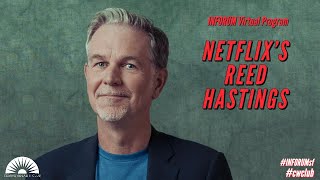
Reed Hastings on Decision Making
Reed Hastings sees good decision making as pushing choices to informed owners, encouraging candid dissent, and using judgment over rigid process so the company can adapt quickly.
- Push decisions to the people closest to the facts, not up a hierarchy
- Seek honest debate and dissent because candor lowers the chance of costly mistakes
- Use process sparingly; too much of it weakens innovation and judgment
- Make bold calls, but stay humble because bravery can also produce big errors
- Decision quality depends heavily on talent density and clear performance standards
The best decisions come from informed owners, not top-down control
Hastings’s default is to keep decision authority low in the organization and let the person closest to the issue act as the owner. He explicitly says he aims to make very few decisions himself and prefers a model where the decision maker gathers broad input before deciding12.
This approach fits his broader view of freedom and responsibility. When people have context, trust, and ownership, they can move faster than a system that waits for approval from the top on every meaningful call31.
Candor improves decisions because honest disagreement surfaces risk
Hastings treats open disagreement as a practical tool, not a cultural nicety. He argues that people should have wide license to be honest when the goal is helping each other, and he favors talking openly about negatives because that reduces the odds that blind spots turn into disasters45.
That makes dissent part of the decision process itself. Instead of protecting harmony or status, the goal is to get the real concerns on the table early enough to improve the final call45.
Too much process makes decisions safer in the short term and worse over time
A central Hastings idea is that process solves some problems while quietly creating others. He learned from Pure Software that when talent density falls, companies add rules to prevent mistakes, but those same rules push out high performers and make the organization less productive and less adaptive6.
He later turned that lesson into a broader principle: process can suffocate innovation. In creative and knowledge work, over-management filters out performance and creativity, so the organization has to operate near the edge of chaos rather than optimize everything for control789.
That does not mean no structure at all. It means using just enough structure to keep the company functional while preserving room for judgment, speed, and last-minute course correction8.
Bold decisions are necessary, but bravery can also become overconfidence
Hastings is unusually clear that ambitious decision making carries real danger. He says aggressive moves should feel uncomfortable, and he also admits that the same bravery that enables innovation can nearly sink a company when judgment goes wrong1011.
This is why his model is not simply 'be bold.' It is be bold while staying alert to what comes next, because fast-moving environments punish complacency and punish misplaced certainty too12111.
He also shows a willingness to revise tactics when outcomes prove him wrong. His framing is that core goals stay fixed while tactics can change, which keeps decisions anchored without becoming stubborn13.
Decision quality starts with talent density and clear standards
Hastings does not think a weak team can be rescued by a better decision process. His view is that strong judgment is downstream of having excellent people, and that declining talent density leads directly to more rules, more error-avoidance, and worse decisions6.
That is why Netflix emphasized performance, growth, and achievement over loyalty as an organizing principle. He frames the company more like a championship team than a family, which makes it easier to keep decision authority with capable people and to avoid building systems around protecting mediocre performance1415.
He also pairs high standards with humanity. He wants people around him who are generous of spirit, which suggests that strong decision cultures need both excellence and the interpersonal trust required for candid debate1617.
Hastings on decision making, in his own words
“…the captain of the ship makes the decisions, but it's good for them to collect a lot of information.”
Where to watch
 Reed Hastings on Talent Density: Building Great Teams at Netflix2023 · 62 min · full transcriptBest single discussion of informed captains, edge-of-chaos management, and why over-management weakens judgment.
 Reed Hastings on Netflix Culture: Talent, Candor, and Judgment2024 · 70 min · full transcriptStrong on judgment, performance standards, and why process can undermine innovation.
 Reed Hastings on Netflix Culture: Why Rules Need Reinvention2018 · 38 min · full transcriptBest for understanding candor, feedback, and how honesty improves decisions in creative work.
 Reed Hastings on Leadership & Culture: Big-Hearted Champions2023 · 59 min · full transcriptShows how Hastings thinks about aggressive bets, mistakes, and the risks of overconfidence.
 Reed Hastings on Netflix Culture: Freedom, Candor, and Bold Bets2017 · 21 min · full transcriptA concise overview of freedom and responsibility, fast change, and why leaders should avoid making too many decisions.
Questions people ask
- What did Reed Hastings say about Netflix advertising and why he changed his mind?
- What did Reed Hastings say about Netflix culture and taking bold risks?
- What did Reed Hastings say about loyalty vs performance?
- What did Reed Hastings say about talent density at Netflix and Pure Software?
- What does Reed Hastings mean by managing on the edge of chaos?
- What does Reed Hastings say are the risks and benefits of AI?
Sources
Every quote above, word for word from the transcripts. Numbers match the text.
“Yeah, absolutely. We did have one advantage, which is we were born on DVD, and we knew that that was going to be temporary. No one thought we'd be mailing discs for 100 years. So then you have a lot of paranoia about what's coming next, and that's part of the founding ethos, is really worrying about what's coming next. So that's an advantage. And then in terms of the culture, it's very big on freedom and responsibility. I pride myself on making as few decisions as possible in a quarter.”
“…the captain of the ship makes the decisions, but it's good for them to collect a lot of information.”
“It's very big on freedom and responsibility.”
“…we want to get people to realize if it's about helping each other, you have wide license, to be honest…”
“I'm part of the anthropic camp where it's good to talk about the negatives, not because we think they're gonna happen, but because we'll lower the chance of them happening if we're honest and talk about them. So I don't think the AI boomer and doomer thing is that useful. I think we all want to acknowledge there's some pretty significant risks, but they're not dispositive, and that we humans may be able to capture tremendous benefit by harnessing AI for higher quality of life on a global basis. I'm on team human for making that happen. But I would say that's the biggest, you know, swing factor of the next fifty years is how well we do that.”
“So I founded Pure Software in 1990 and grew kind of typical great software company doubling. I wasn't careful about it, and I would say talent density declined. That company, we went public in '95, got acquired in '97. And when I analyze looking back what happened, one of the major things was declining talent density. And then with declining talent density, you need a bunch of rules to protect against the mistakes, and that only further drives out the high caliber people. And so it was through that experience that I realized, okay, I've tried to run software like a manufacturing plant and reducing error and putting in process. And then that doesn't get high productivity or high talent.”
“Processes can be the death of innovation.”
“If you over manage, for example, a tight process or specific hours that you have to be in the office or a wide variety of things, you filter out performance and creativity. And the looser that you can run, the more creative that the organization will be. So we talk about it as managing on the edge of chaos. You don't actually wanna fall into chaos. Okay? In chaos, the product barely gets released. It's full of bugs. People are upset. Payroll's not made. Lots of bad things happen. But it's getting us close to that edge of chaos where there's last minute saves and a lot of dynamism as you can possibly tolerate as opposed to, say, a semiconductor factory, which is trying to reduce variation and reduce error to get rid of variants.”
“We talk about it as managing on the edge of chaos.”
“…we had to be so aggressive that it should make the hair on the back of our neck stand up…”
“…the same bravery that allows us to be innovative is the bravery that almost killed us…”
“That's the bitch about the internet -- it moves fast, you know?”
“Look, I've got two religions: customer satisfaction and operating income, and everything else is a tactic. Okay, so you're right to say I didn't believe in the ad-supported tactic for us, and I was wrong about that. Hulu really proved that you could do that at scale and offer consumers lower prices, and that that was a better model. So we did switch on that, and credit to Hulu and Jason Kilar for figuring that out, and I wish we had flipped a few years earlier on it, but we'll catch up in a couple years. We won't remember when we started it.”
“Ultimately, it was about performance, and that helped us clarify our own values—that we were more valuing growth and achievement than we were, say, lifetime loyalty. Which is different than a family company or other relationships that we have where we value loyalty in our friendships, in our marriage, and other things. We value loyalty over performance.”
“And viewing our task in building organizations like a championship team. And for 10,000 years, the primary organizational unit of society has been family, okay, all the way through kings and companies and family companies. So, so many assumptions we have are built around this 10,000 years of human history where organizations and families are the same thing, okay? And it's only this patina of corporations, and that's a thin layer over that that's different. And so we were the first ones to just lay it out there, to say adequate performance gets a generous severance package.”
“…we want to be around people who are generous of spirit and have a big heart…”
“We're not gonna guarantee you a lot, but we'll guarantee that it will always surround you with great people and have you work on hard problems.”
How this guide was made: drafted with AI from the full transcripts of the recordings cited, then checked: every quotation must match a transcript word for word and be the speaker's own words, and an independent review gates accuracy. Methodology and corrections.