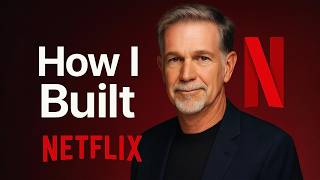
Reed Hastings on Leadership
Reed Hastings sees leadership as building a high-talent team, giving people honest feedback and clear context, and then resisting the urge to control them.
- Hire and keep exceptional people; leadership starts with talent density.
- Give context, not control, so strong people can make decisions without micromanagement.
- Tell people the truth directly and humanely; candor is part of respect.
- Treat the company like a high-performance team, not a family bound by loyalty alone.
- Strong leadership keeps culture evolving instead of freezing it into dogma.
Leadership begins with who is on the team
Hastings’s basic leadership lesson is that organizational performance depends first on the quality of the people, not on managerial technique layered on top of weak hiring. He says Netflix became clearer about what it valued when it realized the core was working with exceptional people on hard problems, and that this should shape everything else in the company.12
This conviction came from failure as much as success. Looking back at Pure Software, Hastings concluded that as talent density fell, the company added rules to compensate, which then pushed out stronger people and reduced productivity further. For him, leadership is not mainly designing better process; it is protecting a team standard that makes heavy process less necessary.34
That is why he prefers the metaphor of a championship team over a family. Families are built to preserve loyalty; high-performing organizations are built to achieve demanding goals, and that requires being much clearer about performance and fit.567
The leader’s job is to set context, not make every decision
Hastings repeatedly argues that leadership is strongest when it creates clarity about goals and constraints, then lets capable people act. He describes the ideal as managing by setting context and letting people run, and he takes pride in making fewer decisions rather than more.89
This is not abdication. It assumes the leader has already built a strong team and made the company’s principles clear enough that people can exercise judgment well. His logic is simple: exceptional people do not want to be micromanaged, and creative work suffers when management tries to supervise too tightly.11011
He also links this style to the kind of company Netflix wanted to be. If the goal is important ideas and meaningful output rather than visible compliance, leadership has to optimize for independent judgment instead of control.1213
Candor is a leadership skill, not a personality trait
Hastings treats honesty as central to leadership because people can handle difficult truths better than leaders often assume. He says a major turning point in his own development came from learning, through marriage counseling, to talk more directly and openly.14
That candor is meant to coexist with humanity. Hastings wants colleagues who are generous of spirit and big-hearted, which shows that directness is not supposed to become cruelty or ego. His ideal leader is both clear and considerate.15
He extends the same principle beyond one-on-one management into organizational learning. Writing culture down makes it discussable and debatable, rather than a vague sermon from the top, so leadership becomes a continuing conversation about standards and behavior.16

“Going through marriage counseling 20 years ago was really how I moved to become a a better manager and leader, really.”TED-format interview, 2017 · full transcript →
Creative leadership runs near the edge of chaos
Hastings believes creative organizations need more freedom and variation than industrial-style management usually allows. If leaders overmanage through detailed process, fixed hours, and rigid supervision, they filter out creativity and high performance.174
But he is not arguing for disorder. He describes the goal as operating near the edge of chaos: loose enough to allow dynamism, initiative, and last-minute saves, but not so loose that execution collapses. In his view, some failure is evidence that the organization is taking real creative risks.181917
That helps explain why he favors inspiration over management in knowledge work. Leadership, for Hastings, is not about removing all uncertainty; it is about creating the conditions where talented people can do original work without being smothered by bureaucracy.1110
Great leaders keep culture alive by improving it
Hastings does not see culture as something a leader defines once and then preserves forever. He explicitly rejects trying to pickle a culture, arguing instead that the job is to keep making it better.2021
That view also shapes how he thinks about leadership identity. He warns against trying to imitate some famous founder exactly, which means effective leadership has to be principled without being performative. You need real convictions, not borrowed mannerisms.2223
In practice, this means leaders should make expectations explicit, invite debate, and let the culture evolve with the business. Strong cultures are not weak because they change; they are strong because they are clear enough to adapt without dissolving.1624
Hastings on leadership, in his own words
“Going through marriage counseling 20 years ago was really how I moved to become a a better manager and leader, really.”
Where to watch
 Reed Hastings on Talent Density: Building Great Teams at Netflix2023 · 62 min · full transcriptBest on the leadership logic behind talent density, candid exits, and why too many rules are a symptom of weaker teams.
 Reed Hastings on Freedom & Responsibility: Building Netflix2014 · 59 min · full transcriptBest single discussion of freedom and responsibility, including context over control and how Hastings thinks about decision-making.
 Reed Hastings on Leadership & Culture: Big-Hearted Champions2023 · 59 min · full transcriptShows how Hastings connects leadership to hard lessons from Pure Software, bold strategic moves, and the need for big-hearted high performers.
 Reed Hastings on Culture and Talent Density: Context, Not Control2016 · 81 min · full transcriptBest for understanding how written culture, talent density, and strong expectations help leadership scale.
 Reed Hastings on Company Culture and Leadership: Honesty, Creativity, Risk2017 · 7 min · full transcriptShort and memorable on honesty as a learned leadership practice and why creative work requires risk.
Questions people ask
- What did Reed Hastings say about freedom and responsibility at Netflix?
- What did Reed Hastings say about loyalty vs performance?
- What did Reed Hastings say about talent density at Netflix and Pure Software?
- What did Reed Hastings say about why Netflix wrote down its culture deck?
- What does Reed Hastings mean by managing on the edge of chaos?
- Why does Reed Hastings say Netflix is a team, not a family?
Sources
Every quote above, word for word from the transcripts. Numbers match the text.
“Yeah, up until 2002, all we focused on was survival. And then once we got public and, and we're profitable we started thinking, wow, this thing might last. And the, the cruelest irony would be to not want to work there. You know to let it become a place we didn't want to be. And so we tried to think through what do we really care about? We realized what we really care about is working with incredible people on hard problems and that, that was the essence. So we should organize everything around supporting that of working with, you know, just incredibly talented people. And so that led us to freedom and responsibility, because incredible people don't wanna be micro managed.”
“We're not gonna guarantee you a lot, but we'll guarantee that it will always surround you with great people and have you work on hard problems.”
“So I founded Pure Software in 1990 and grew kind of typical great software company doubling. I wasn't careful about it, and I would say talent density declined. That company, we went public in '95, got acquired in '97. And when I analyze looking back what happened, one of the major things was declining talent density. And then with declining talent density, you need a bunch of rules to protect against the mistakes, and that only further drives out the high caliber people. And so it was through that experience that I realized, okay, I've tried to run software like a manufacturing plant and reducing error and putting in process. And then that doesn't get high productivity or high talent.”
“Processes can be the death of innovation.”
“We’re a team, not a family…”
“Ultimately, it was about performance, and that helped us clarify our own values—that we were more valuing growth and achievement than we were, say, lifetime loyalty. Which is different than a family company or other relationships that we have where we value loyalty in our friendships, in our marriage, and other things. We value loyalty over performance.”
“And viewing our task in building organizations like a championship team. And for 10,000 years, the primary organizational unit of society has been family, okay, all the way through kings and companies and family companies. So, so many assumptions we have are built around this 10,000 years of human history where organizations and families are the same thing, okay? And it's only this patina of corporations, and that's a thin layer over that that's different. And so we were the first ones to just lay it out there, to say adequate performance gets a generous severance package.”
“…manage through setting context and letting people run…”
“I take pride in making as few decisions as possible as opposed to as many as possible…”
“…our culture is designed at inspiring and motivating creative people…”
“We should manage software much more artisanally with inspiration rather than management.”
“…we really want people to focus on ideas, on generating important work…”
“…we should organize everything around supporting that…”
“Going through marriage counseling 20 years ago was really how I moved to become a a better manager and leader, really.”
“…we want to be around people who are generous of spirit and have a big heart…”
“One of the great things about putting things in writing is that makes it more debatable. And so it's not just hearing a sermon and it's like, "Okay, that's nice," but you can comment on, you know, this part here that we wrote down doesn't really seem appropriate or doesn't seem what we do, or, you know, to some degree it's a bill of rights for employees, which is here's a set of things that we, the company, want to and aspire to operate by, and if we don't, you.”
“If you over manage, for example, a tight process or specific hours that you have to be in the office or a wide variety of things, you filter out performance and creativity. And the looser that you can run, the more creative that the organization will be. So we talk about it as managing on the edge of chaos. You don't actually wanna fall into chaos. Okay? In chaos, the product barely gets released. It's full of bugs. People are upset. Payroll's not made. Lots of bad things happen. But it's getting us close to that edge of chaos where there's last minute saves and a lot of dynamism as you can possibly tolerate as opposed to, say, a semiconductor factory, which is trying to reduce variation and reduce error to get rid of variants.”
“We talk about it as managing on the edge of chaos.”
“…the sign that you're right at the edge of chaos, the edge of creativity, is that some stuff doesn't work.”
“To preserve something—to pickle it is the wrong solution.”
“…we're not trying to preserve the culture; we're trying to make it better…”
“…you've got no hope if you try to pretend to be Reed Hastings or Mark Zuckerberg or Bill Gates…”
“I'm always interested in kind of core fundamental principles.”
“…strong cultures work and weak cultures are diffused…”
How this guide was made: drafted with AI from the full transcripts of the recordings cited, then checked: every quotation must match a transcript word for word and be the speaker's own words, and an independent review gates accuracy. Methodology and corrections.