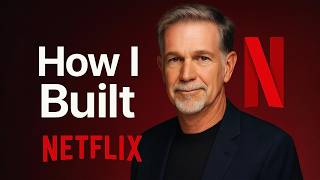
Reed Hastings on Management
Reed Hastings’s management style is to replace bureaucracy with talent density, candor, and freedom guided by strong context and judgment.
- Manage creative work with context and inspiration, not heavy supervision.
- Keep talent density high; too many average performers create rules, managers, and slower execution.
- Give people freedom, but expect strong judgment and accountability.
- Candor is a management tool: leaders should teach, invite dissent, and make honesty safe and useful.
- Culture is what gets rewarded and what gets people let go, so management style must be enforced in decisions, not slogans.

“…we want to be around people who are generous of spirit and have a big heart…”Stanford Graduate School of Business interview, 2023 · 23:01
Creative companies need a different management model
Hastings’s core claim is that management should fit the kind of work being done. Factory work benefits from control, supervision, and error reduction, but creative work needs inspiration, flexibility, and room for independent thinking. He argues that many leaders still run knowledge work with industrial-era habits, and that this suppresses the very creativity they say they want.123
That is why he favors a style built to motivate strong people rather than monitor them. He says the aim is to help people focus on important ideas and important work, not on complying with layers of process. In his view, culture is a practical engine of innovation, not an HR side issue.456
Talent density is the foundation of his management style
Hastings does not think great management starts with better rules. He thinks it starts with surrounding people with exceptional colleagues and keeping the performance bar high. That is why he describes the company as a team rather than a family and compares it to a professional sports team.78
His reasoning is blunt: when talent density falls, managers compensate with more rules and more process, which then drives away stronger people and further weakens the organization. He learned this from Pure Software, where he says declining talent density led to bureaucracy and lower adaptability. Management, in his framework, gets simpler and lighter when the team gets stronger.101112
This also explains his emphasis on performance over loyalty in the workplace. He sees that as different from family relationships, and he tries to make the standard clear rather than sentimental. The management lesson is that clarity about expectations is kinder and more effective than pretending every role should be permanent.1314
Context, not control, is how leaders should operate
Hastings’s preferred role for a manager is not to approve every move but to create clarity about goals, tradeoffs, and the broader situation. Once that context is in place, the decision owner should act. He describes decision-making as the captain of the ship making the call after collecting lots of information.15
This only works if employees are trusted to use judgment. Hastings repeatedly comes back to judgment as the big operating principle, because rules cannot cover every situation in a fast-moving creative business. His version of freedom is not looseness for its own sake; it is disciplined autonomy in service of better decisions.166
He also warns that freedom has a limit. The goal is not disorder, but getting as close as possible to the edge where flexibility and dynamism are highest without tipping into chaos. For him, overmanagement filters out creativity, while smart looseness preserves it.1718
Candor is a managerial responsibility, not a personality trait
Hastings thinks honesty has to be built into how managers lead. He wants leaders to be great teachers, which means giving direct feedback, sharing difficult truths, and helping people improve rather than avoiding discomfort. Candor, in his view, is useful when it is in service of helping each other.1920
Because hierarchy makes honesty hard, he believes leaders have to actively invite dissent. He talks about rewarding feedback, praising people who challenge decisions, and creating explicit ways to surface disagreement. That turns candor from random bluntness into a repeatable management practice.2122
This emphasis on candor also connects to culture being explicit. Writing values down matters because people can debate them, improve them, and hold leaders to them. Hastings prefers a culture that is strong enough to be clear and argued over rather than vague and merely agreeable.24
High standards work best when paired with generosity and humility
Hastings’s management style can sound hard-edged, but he pairs high standards with an expectation of decency. He wants colleagues who are generous of spirit and big-hearted, not just brilliant. He also praises being proud of the organization while staying personally humble.2526
That combination shows up in how he thinks about exits. If a company is going to prioritize performance, it should be upfront about that and treat people well when there is no longer a fit. He presents that as more honest than pretending loyalty is the top value when the company is actually optimizing for achievement and growth.13
The broader management point is that freedom and high performance are sustainable only when people trust the intent behind them. Hastings does not describe a soft culture or a bureaucratic one; he describes a demanding culture that tries to be clear, humane, and energizing at the same time.61225
“…we want to be around people who are generous of spirit and have a big heart…”Stanford Graduate School of Business interview, 2023 · full transcript →
Hastings on management, in his own words
“…company culture is the behaviors that get you promoted or get you. let go…”
“We should manage software much more artisanally with inspiration rather than management.”
Where to watch
 Reed Hastings on Freedom & Responsibility: How Netflix Runs Creative Work2017 · 62 min · full transcriptBest single overview of his management model: talent density, candor, and freedom with responsibility.
 Reed Hastings on Talent Density: Building Great Teams at Netflix2023 · 62 min · full transcriptBest for understanding why talent density reduces rules and how he thinks about the edge of chaos.
 Reed Hastings on Culture and Talent Density: Context, Not Control2016 · 81 min · full transcriptBest for context over control and how culture becomes a practical management system.
 Reed Hastings on Netflix Culture: Why Rules Need Reinvention2018 · 38 min · full transcriptBest for why creative companies need fewer rules and more honest feedback.
 Reed Hastings on Culture and Innovation: Reinvention at Netflix2018 · 64 min · full transcriptBest for how culture shows up in rewarded behavior and why process can suffocate reinvention.
Questions people ask
- What did Reed Hastings say about loyalty vs performance?
- What did Reed Hastings say about talent density at Netflix and Pure Software?
- What did Reed Hastings say about why Netflix wrote down its culture deck?
- What did Reed Hastings say about why creative work should not be run like a factory?
- What does Reed Hastings mean by managing on the edge of chaos?
- How does Reed Hastings encourage candor at Netflix?
Sources
Every quote above, word for word from the transcripts. Numbers match the text.
“…for creative work there's a different model.”
“In a factory, you control people, you supervise them, but in creative work, you want to inspire them, you want to excite them. And that's completely different. And yet many people still run creative firms almost as if they wanted to be a factory. I know because I did it in our first company in pure software. Every time something went wrong, I would put a process in place to try to make sure that thing didn't go wrong again. And that works in the short term, but it makes you very rigid. And then the market shifted. In that case, it was C++ to Java, but they all shift in some way. And we were unable to adapt,…”
“…if you wanna stimulate creativity, which is making a lot of mistakes and those kinds of things, then that's a different model…”
“…we really want people to focus on ideas, on generating important work…”
“At root, we do think it's the culture that really enables that kind of innovation.”
“…our culture is designed at inspiring and motivating creative people…”
“We’re a team, not a family…”
“…we try to model ourselves like a professional sports team…”
“So I founded Pure Software in 1990 and grew kind of typical great software company doubling. I wasn't careful about it, and I would say talent density declined. That company, we went public in '95, got acquired in '97. And when I analyze looking back what happened, one of the major things was declining talent density. And then with declining talent density, you need a bunch of rules to protect against the mistakes, and that only further drives out the high caliber people. And so it was through that experience that I realized, okay, I've tried to run software like a manufacturing plant and reducing error and putting in process. And then that doesn't get high productivity or high talent.”
“What's different about Netflix is the keeper tests.”
“We're not gonna guarantee you a lot, but we'll guarantee that it will always surround you with great people and have you work on hard problems.”
“Ultimately, it was about performance, and that helped us clarify our own values—that we were more valuing growth and achievement than we were, say, lifetime loyalty. Which is different than a family company or other relationships that we have where we value loyalty in our friendships, in our marriage, and other things. We value loyalty over performance.”
“We were more valuing growth and achievement than we were, say, lifetime loyalty.”
“…the captain of the ship makes the decisions, but it's good for them to collect a lot of information.”
“…the macro thing is, use good judgment.”
“We talk about it as managing on the edge of chaos.”
“If you over manage, for example, a tight process or specific hours that you have to be in the office or a wide variety of things, you filter out performance and creativity. And the looser that you can run, the more creative that the organization will be. So we talk about it as managing on the edge of chaos. You don't actually wanna fall into chaos. Okay? In chaos, the product barely gets released. It's full of bugs. People are upset. Payroll's not made. Lots of bad things happen. But it's getting us close to that edge of chaos where there's last minute saves and a lot of dynamism as you can possibly tolerate as opposed to, say, a semiconductor factory, which is trying to reduce variation and reduce error to get rid of variants.”
“We want our leaders to be great teachers…”
“…we want to get people to realize if it's about helping each other, you have wide license, to be honest…”
“But in particular in feedback, because of the power dynamics, you really have to create an openness for people to give you feedback by giving them psychological rewards. That was so great, by lauding them. And we do things to farm for dissent. So let's say there's a decision about, you know, what should we do about the pandemic, and, you know, what should we, you know — then we would open it up for discussion, and then we want each person to weigh in with: do they think it's a good idea or bad idea to say, close down or whatever the issue is. Another thing we do is run an exercise: what would be different if you were CEO instead of me? And it's a…”
“…company culture is the behaviors that get you promoted or get you. let go…”
“…strong cultures work and weak cultures are diffused…”
“…we want to be around people who are generous of spirit and have a big heart…”
“…you want to be super proud of the organization and personally humble…”
How this guide was made: drafted with AI from the full transcripts of the recordings cited, then checked: every quotation must match a transcript word for word and be the speaker's own words, and an independent review gates accuracy. Methodology and corrections.