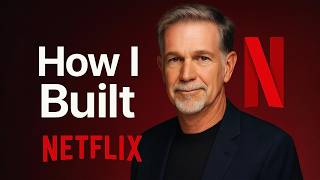
Reed Hastings on Business Strategy
Reed Hastings treats business strategy as a constant effort to improve customer satisfaction and operating income by anticipating where entertainment is going, then adapting Netflix’s model before the old one runs out.
- Start with enduring goals, not fixed tactics: satisfy customers and build operating income.
- Compete for viewing time, not just subscribers, by making the product simple, flexible, and compelling.
- Pivot early when technology or consumer behavior changes, but do not move so far ahead that customers reject it.
- Stay focused on what you do best instead of copying every rival.
- Use originals, global storytelling, and product simplicity to build a distinctive entertainment brand.

“I’ve got two religions: customer satisfaction and operating income, and everything else is a tactic.”New York Times Events interview, 2024 · 4:24
Strategy starts with two priorities, not a pile of tactics
Hastings reduces strategy to a small number of core goals. His clearest formulation is that customer satisfaction and operating income are the real north stars, while specific moves such as ads or password policies are tools, not beliefs in themselves. That makes his view unusually practical: strategy is not loyalty to a format or ideology, but discipline about what outcomes matter most.12
He also connects strategy to investor alignment. If a company is clear about what it is trying to build and candid about performance, it attracts backers who understand the long game rather than forcing short-term distortions.34
This same logic appears inside the company. Hastings wants the organization arranged around working with very strong people on hard problems, because he sees talent density and autonomy as supports for better strategic adaptation over time.56
“I’ve got two religions: customer satisfaction and operating income, and everything else is a tactic.”New York Times Events interview, 2024 · full transcript →
The real competition is for people’s evenings
Hastings does not define competition narrowly. He says the important measure is time spent, because entertainment businesses are really competing for what consumers choose to do with their free time each night. That is why he talks about evenings and relaxation, not just market share inside streaming.789
This leads to a broader strategic frame. Netflix is not only up against cable or one streaming rival; it also faces YouTube, games, and even sleep. That is why subscriber totals alone are incomplete. The deeper question is whether people keep choosing Netflix often enough to justify revenue and profits over time.110
Seen this way, strategy is about earning repeated consumer choice. Hastings emphasizes pleasing consumers rather than obsessing over competitors, because attention follows satisfaction better than mimicry does.1112

“How do consumers vote, um, with their evenings?”DealBook Conference interview, 2019 · full transcript →
Great strategy anticipates the next platform shift
One of Hastings’s strongest patterns is betting on where consumer behavior is headed before the transition is complete. Netflix began in DVDs, but he says the company always understood that mailing discs was temporary and kept worrying about what would come next. That paranoia about the next wave is central to his idea of strategy.13
For him, the big shift was from scheduled, linear television to internet TV: on-demand, personalized, and available across devices. He repeatedly argues that consumers want control and freedom, and that the winning model is simple access rather than friction-filled distribution.14151617
The DVD-to-streaming transition illustrates the point. Hastings describes streaming as becoming the core of the business because it better fits where technology and user expectations were going. He treats such pivots as necessary reinventions, not optional extensions of the old model.171819
Adapt aggressively, but do not confuse bravery with wisdom
Hastings is not romantic about bold moves. He values aggressive decision-making, yet he also admits that innovation can become overreach. His warning is that the same courage that helps a company invent can also push it into mistakes.2021
That matters for understanding Netflix’s later changes. He openly says he was wrong to resist advertising and that Hulu demonstrated a better model for reaching some consumers at lower prices. In his framework, changing your mind is not a strategic failure; clinging to a tactic after the facts change is the real failure.2
The lesson is timing. Move early enough to catch the shift, but not so far ahead of customers that the product breaks trust or creates unnecessary confusion. Hastings’s strategic style is adaptive, not stubborn.2013

“…the same bravery that allows us to be innovative is the bravery that almost killed us…”MEDIA CONVENTION Berlin, 2015 talk · full transcript →
Focus wins: do what fits your advantage and brand
Hastings repeatedly argues against trying to be everything. Netflix should compete for attention, but it should not assume every form of attention is winnable in the same way. He is explicit that the company does not beat a game like Fortnite by imitating it, and that it is hard to out-YouTube YouTube.2210
That leads to a focused view of scope. Netflix aims to be the most exciting entertainment brand through film, series, and selected adjacent bets, while accepting that other players may lead in sports, news, or user-generated video. Strategy here means choosing the arena where your strengths matter most.232425
This focus also shaped content choices. Hastings highlights binge viewing as a distinct advantage in series, and later expands into films because Netflix sees them as close enough to its core entertainment mission to exploit shared capabilities.264

“It's hard to out-YouTube YouTube…”On with Kara Swisher interview, 2021 · full transcript →
Build global scale by combining simplicity, originals, and local stories
Hastings’s strategy is not only about platform transitions; it is also about how scale compounds. A simple proposition makes adoption easier, and larger membership supports more investment in content, which improves the service and strengthens the brand.2723
Original programming plays a strategic role because it gives Netflix stronger brand identity and more control over rights. That helps the company launch shows more broadly and reduce dependence on fragmented licensing structures that frustrate consumers.516
He pairs that with global storytelling. Hastings describes a model where shows are produced locally but shared internationally, reflecting his belief that internet audiences have growing awareness of other cultures. In his strategy, global scale does not mean making one universal product; it means connecting many local stories to a worldwide audience.289

“No, I think there's much more connectivity, at least amongst the internet segment. You know, we're not serving the whole audience. We're serving those people on the internet, and there's more awareness of other cultures and interests. And so, you know, we've got a series in India, Sacred Games, based on a book, and hopefully that will carry. Now, it may not be the biggest thing in the US, but it will be bigger than it would have been. And so, it's very much produced locally and then shared around the world.”Code Conference interview, 2017 · full transcript →
Hastings on business strategy, in his own words
“I’ve got two religions: customer satisfaction and operating income, and everything else is a tactic.”
“How do consumers vote, um, with their evenings?”
“…the same bravery that allows us to be innovative is the bravery that almost killed us…”
“It's hard to out-YouTube YouTube…”
Where to watch
 Reed Hastings on Streaming Wars: Ads, Passwords, and Competition2024 · 34 min · full transcriptBest single explanation of Hastings’s strategic principles: customer satisfaction, operating income, ads, and why tactics can change.
 Reed Hastings on Streaming Wars: Competing for Viewing Time2019 · 31 min · full transcriptShows how he defines competition as a battle for viewing time and consumer choice each evening.
 Reed Hastings on Freedom & Responsibility: Building Netflix2014 · 59 min · full transcriptExplains how Netflix’s pivots from DVDs to streaming to originals required different capabilities and management systems.
 Reed Hastings on Internet TV: The Future of Television2015 · 53 min · full transcriptBest for his long-term thesis that internet TV replaces linear TV and for his warning about bold mistakes.
 Reed Hastings on Streaming Strategy: Winning with Better Content2021 · 56 min · full transcriptClarifies the strategic power of the flat-fee on-demand model and why Netflix should not try to copy YouTube.
 Reed Hastings on Streaming Wars: Movies, Global Growth, and Net Neutrality2017 · 33 min · full transcriptUseful for understanding how Netflix extends its strategy into films and global production without losing focus.
Questions people ask
- What did Reed Hastings say about Netflix advertising and why he changed his mind?
- What did Reed Hastings say about Netflix culture and taking bold risks?
- What did Reed Hastings say about freedom and responsibility at Netflix?
- What did Reed Hastings say about making international Netflix shows?
- What did Reed Hastings say was Netflix’s most disruptive innovation?
- Why does Reed Hastings think Netflix should focus on customers instead of competitors?
Sources
Every quote above, word for word from the transcripts. Numbers match the text.
“I’ve got two religions: customer satisfaction and operating income, and everything else is a tactic.”
“Look, I've got two religions: customer satisfaction and operating income, and everything else is a tactic. Okay, so you're right to say I didn't believe in the ad-supported tactic for us, and I was wrong about that. Hulu really proved that you could do that at scale and offer consumers lower prices, and that that was a better model. So we did switch on that, and credit to Hulu and Jason Kilar for figuring that out, and I wish we had flipped a few years earlier on it, but we'll catch up in a couple years. We won't remember when we started it.”
“You get the investors you deserve.”
“…we're always trying to be candid with investors…”
“…we should organize everything around supporting that…”
“Yeah, up until 2002, all we focused on was survival. And then once we got public and, and we're profitable we started thinking, wow, this thing might last. And the, the cruelest irony would be to not want to work there. You know to let it become a place we didn't want to be. And so we tried to think through what do we really care about? We realized what we really care about is working with incredible people on hard problems and that, that was the essence. So we should organize everything around supporting that of working with, you know, just incredibly talented people. And so that led us to freedom and responsibility, because incredible people don't wanna be micro managed.”
“The real measurement will be time.”
“How do consumers vote, um, with their evenings?”
“We want you anytime you want to relax, you're in front of the TV and you think, you know, do I turn on the cable, uh, linear TV, do I turn on YouTube, do I turn on Netflix?”
“It's hard to out-YouTube YouTube…”
“We're both trying to please consumers.”
“No, it's really focusing, which is we have to please our members and the big task is, you know, avoiding sort of competitive focus just because we grow doesn't mean people aren't gonna love, you know, Disney more or less, any more than if we grow, they're gonna love, you know, football more or less, you know, these are different entertainment centers. And what we should do is just focus on how do we please, our members.”
“Yeah, absolutely. We did have one advantage, which is we were born on DVD, and we knew that that was going to be temporary. No one thought we'd be mailing discs for 100 years. So then you have a lot of paranoia about what's coming next, and that's part of the founding ethos, is really worrying about what's coming next. So that's an advantage. And then in terms of the culture, it's very big on freedom and responsibility. I pride myself on making as few decisions as possible in a quarter.”
“…more and more consumers want control. They want freedom.”
“…the future TV will look like a large iPad…”
“It's on the internet. It's the way it ought to be.”
“…streaming is the core of our business…”
“Streaming is much bigger than DVD for us now…”
“…the internet is going to become the basis for all social interaction…”
“…the same bravery that allows us to be innovative is the bravery that almost killed us…”
“…there's no one path to imitate…”
“We don't compete with Fortnite, say, better by doing something like that because we're not very good at that.”
“We want the brand to be the most exciting entertainment on Earth.”
“Well, we want the brand to be the most exciting entertainment on Earth, the place you go when you really want emotional stimulation. And for us, that's around film, series, and games. Two of those were strong and one were just beginning on games. And the fact that people, if you look at the Nielsen data, YouTube on TV is equal to us in viewing. Like, there's a lot. That doesn't mean we're going to get into the user-generated business, right? And then there's sports, there's news, so—…”
“Well, it's evolving rapidly to be, it'll all be internet centric. So obviously, movies and TV shows will be purely on demand. News is 24 hours, happens all the time. You know that'll be on demand. And then sports is one of the most interesting. We won't do sports, but other people will. And then, you know, there's the whole what team are you rooting for. There's the, all the microsports. There's so much that will be on internet delivery done on a very personalized basis of the sport, even though it's, you know, the game is on at 4 p.m. And everybody is watching at the same time. The experience people get can be enhanced a lot through personalization. So I think they'll be a lot of, you know, great worked on the, the internet for sports.”
“…binge viewing is a very novel thing that we pioneered…”
“…we think that just makes for a simple proposition…”
“No, I think there's much more connectivity, at least amongst the internet segment. You know, we're not serving the whole audience. We're serving those people on the internet, and there's more awareness of other cultures and interests. And so, you know, we've got a series in India, Sacred Games, based on a book, and hopefully that will carry. Now, it may not be the biggest thing in the US, but it will be bigger than it would have been. And so, it's very much produced locally and then shared around the world.”
How this guide was made: drafted with AI from the full transcripts of the recordings cited, then checked: every quotation must match a transcript word for word and be the speaker's own words, and an independent review gates accuracy. Methodology and corrections.