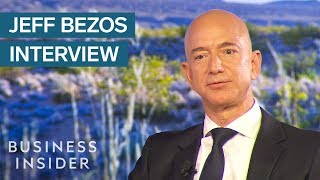
Jeff Bezos on Long-Term Thinking
Bezos treats long-term thinking as a practical advantage: ignore short-term noise, anchor on durable customer needs, and make bold bets that compound over decades.
- Long-term thinking lets you solve problems that look impossible in the short run.
- Ignore daily market noise and build something that will be judged by lasting weight, not momentary votes.
- Start with customers and stable needs, because those endure longer than competitors or headlines.
- Big decisions often require intuition and conviction, plus willingness to be misunderstood.
- Keep a Day 1 mindset: start small, stay nimble, and let small bets compound.

“In the short run, the stock market is a voting machine. In the long run, it's a weighing machine.”Economic Club of Washington interview, 2018 · 0:54
Long-term thinking is a lever, not a slogan
Bezos sees long-term thinking as a concrete advantage, not a personality trait. His core claim is that some problems become solvable only when you extend the time horizon far enough. Most institutions struggle to think beyond a few years, but he argues better outcomes come from stretching that horizon to ten, fifteen, twenty, or twenty-five years.1
That longer horizon also changes what looks possible. He connects ambitious building to a habit of treating supposedly impossible things with caution, because time, persistence, and invention can pull big goals closer.2
This is why he is comfortable putting energy into projects measured in decades, including space infrastructure. He explicitly says that on a very long view, over many decades or even centuries, his most important work may be the work aimed at enabling humanity’s future in space.45
Ignore short-term noise and optimize for what lasts
A big part of Bezos’s approach is refusing to let short-term signals run the company. He draws a sharp distinction between temporary popularity and durable value, and says leaders should not spend time fixating on daily stock moves.67
That mindset frees a company to make decisions whose payoff arrives later. If you are trying to please the moment, you will underinvest in things that compound slowly, like customer trust, infrastructure, culture, and invention.67
He applies the same logic beyond markets. Backlash, criticism, or misunderstanding do not automatically mean a decision is wrong; sometimes they are the cost of acting on a longer view.89
“In the short run, the stock market is a voting machine. In the long run, it's a weighing machine.”Economic Club of Washington interview, 2018 · full transcript →
Customer obsession gives long-term thinking a stable anchor
For Bezos, long-term thinking is not vague patience. It needs an anchor, and that anchor is the customer. He repeatedly argues that leaders should put their energy into customers rather than competitors, because competitors do not define the durable direction of the business.101112
This works because customer needs are more stable than almost anything else in business. He advises builders to focus on what will not change over the next decade and to start with the customer and work backwards from there.1314
The result is a powerful form of alignment: a company should win only when customers win. That orientation helps explain why he sees customer obsession as a long-term advantage rather than just a service principle.151617
He also adds an important nuance: customers cannot always specify the breakthrough. You should listen carefully, but you also have to invent on their behalf using judgment, intuition, and imagination.18

“…what's not going to change in the next 10 years…”AWS re:Invent fireside chat, Las Vegas, 2012 · full transcript →
Long horizons require bold decisions and tolerance for misunderstanding
Bezos does not think long-term builders can wait for perfect certainty. He says the most important decisions in life and business are not made by analysis alone; they also require instinct, taste, heart, and gut.19
That matters because innovative ideas often look odd at first. If you cannot tolerate being misunderstood, he argues, you will not do anything genuinely new.920
His decision style is helped by distinguishing reversible choices from the few large, hard-to-reverse ones. Since most decisions are reversible, organizations can move faster, experiment more, and avoid treating every choice as equally consequential.2122
This combination—strong conviction on the big direction, fast movement on reversible decisions, and emotional steadiness under criticism—is central to how he links action with a long time horizon.2119

“If you can't afford to be misunderstood, then for goodness sake, don't do anything new or innovative.”Berlin interview, 2018 · full transcript →
Day 1 means starting small and letting compounding work
Bezos often ties long-term thinking to a Day 1 mentality. The point is to preserve the speed, heart, and entrepreneurial energy of a small company even as an organization grows.2425
He emphasizes that everything he has built started small. That is not just biography; it is a principle. Small beginnings make experimentation easier, and over time the right bets can grow into very large institutions.2426
This is one reason he likes to think of projects as if they are still small even after they scale. It helps resist bureaucracy and stasis, both of which are enemies of long-term compounding.2625

“Well, so day one, this is a phrase that we use at Amazon all the time. I've been using it in my first annual shareholder letter from twenty years ago. And we say it's always day one, and it needs to be day one for the reason that you just mentioned. And how do you so the real question for me is how do you go about maintaining a day one culture? It's great to have the scale of Amazon. We have financial resources. We have lots of brilliant people. We can accomplish great things. We have global scopes. We have operations all over the world. But the downside of that is that you can lose your nimbleness. You can lose your entrepreneurial spirit. You can lose your that kind of heart that small companies often have. And so if you could have the best of both worlds, if you can have that entrepreneurial spirit and heart, while at the same time having all the advantages that come with scale and scope, think of the things that you could do.”Forum on Leadership, Dallas, 2018 · full transcript →
Think from the end of life, not just the end of the quarter
One of Bezos’s clearest long-term frameworks is regret minimization. Instead of asking what looks best right now, he projects himself forward to old age and asks which choice will leave fewer regrets.2728
This framework pushed him toward action because he believed future regret would come more from not trying than from trying and failing. He says most regrets are omissions rather than commissions.2829
That lens helps explain his comfort with bold moves. A long-term life horizon favors meaningful attempts over short-term safety, especially when the opportunity feels unusually important.3028

“Was what I called—which only a nerd would call—a regret minimization framework. So I wanted to project myself forward to age 80 and say, okay, now I'm looking back on my life. I want to have minimized the number of regrets I have. And, you know, I knew that when I was 80 I was not going to regret having tried this. I was not going to regret having wanted, you know, trying to participate in this thing called the Internet, that I thought was going to be a really big deal. I knew that if I failed, I wouldn't.”Academy of Achievement interview, 2001 · full transcript →
Bezos on long-term thinking, in his own words
“Long term thinking is a giant lever. You can literally solve problems if you think long term that are impossible to solve if you think short term. And we aren't really good at thinking long term. As... You know, it's not really... You were kind of... You know, five years is a tough time frame for most institutions to think past. And we probably need to stretch that to ten years, and fifteen years, and twenty years, and twenty five years. And we'd do a better job for our children or our grandchildren if we could stretch those thinking horizons.”
“In the short run, the stock market is a voting machine. In the long run, it's a weighing machine.”
“If you can't afford to be misunderstood, then for goodness sake, don't do anything new or innovative.”
“…what's not going to change in the next 10 years…”
“Was what I called—which only a nerd would call—a regret minimization framework. So I wanted to project myself forward to age 80 and say, okay, now I'm looking back on my life. I want to have minimized the number of regrets I have. And, you know, I knew that when I was 80 I was not going to regret having tried this. I was not going to regret having wanted, you know, trying to participate in this thing called the Internet, that I thought was going to be a really big deal. I knew that if I failed, I wouldn't.”
Where to watch
 Jeff Bezos on Long-Term Thinking: Space, Decisions, and Mortality2023 · 132 min · full transcriptBest overview of why Bezos treats long time horizons as a way to make the impossible practical.
 Jeff Bezos on Leadership and Long-Term Thinking2018 · 71 min · full transcriptBest single interview on ignoring short-term market noise, Day 1, and how big decisions really get made.
 Jeff Bezos on Customer-Centric Innovation: AWS, Flywheels, and Space2012 · 42 min · full transcriptBest explanation of anchoring long-term strategy in stable customer needs and working backwards.
 Jeff Bezos on Leadership: Customer Obsession and Day One2018 · 56 min · full transcriptBest for understanding how customer obsession, invention, and Day 1 fit together as an operating system.
 Jeff Bezos on Regret Minimization: Why He Chose Books1997 · 14 min · full transcriptBest short account of regret minimization and how Bezos uses an 80-year-old viewpoint to make choices.
Questions people ask
- How does Jeff Bezos describe himself?
- What did Jeff Bezos mean by Day 1?
- What did Jeff Bezos say about customer obsession and intuition?
- What did Jeff Bezos say about finding your calling?
- What did Jeff Bezos say about regret minimization when he left Wall Street?
- What did Jeff Bezos say about his most important long-term work?
Sources
Every quote above, word for word from the transcripts. Numbers match the text.
“Long term thinking is a giant lever. You can literally solve problems if you think long term that are impossible to solve if you think short term. And we aren't really good at thinking long term. As... You know, it's not really... You were kind of... You know, five years is a tough time frame for most institutions to think past. And we probably need to stretch that to ten years, and fifteen years, and twenty years, and twenty five years. And we'd do a better job for our children or our grandchildren if we could stretch those thinking horizons.”
“I have come to use the word impossible with great caution.”
“But long term, the thing, if you take a really long run view, many decades, maybe even a couple of hundred years, I think the most important work that I'm doing, and I get increasing conviction on this with every passing year, is the work I'm doing at Blue Origin on space travel.”
“I believe and I get increasing conviction with this with every passing year, that Blue Origin, the space company, is the most important work I'm doing.”
“In the short run, the stock market is a voting machine. In the long run, it's a weighing machine.”
“Never spend any time thinking about the daily stock price. I don't.”
“This was the right decision. We made the right decision.”
“If you can't afford to be misunderstood, then for goodness sake, don't do anything new or innovative.”
“…you need to harness that energy primarily on your customers instead of on your competitors…”
“…customer obsession as opposed to competitor obsession…”
“The number one thing that has made us successful by far is obsessive compulsive focus on the customer as opposed to obsession over the competitor. And I talk so often to other CEOs and some other CEOs and also founders and entrepreneurs. And I can tell that even though they're talking about customers, they're really focusing on competitors. And it is a huge advantage to any company if you can stay focused on your customer instead of your competitors. So then you have to identify who is your customer.”
“…what's not going to change in the next 10 years…”
“…start with the customer and work backwards…”
“…we should only win when our customers win…”
“…to be Earth's most customer-centric company…”
“That early stage, by the way, of Amazon.com, where we were so unprepared, is probably one of the luckiest things that ever happened to us because it formed a culture of customer service in every department of the company, every single person in the company, because we had to work with our hands so close to the customers making sure those orders went out. Uh, really set up a culture that served us well, and that is our goal: to be Earth's most customer-centric company. And then a second round of fundraising about a year later or so, we raised a million dollars, and I had to talk to…”
“The touchstone, the thing you always go back to is those customer needs. So that's the only way that I could advise any founder or entrepreneur is to deeply understand what are the big ideas that their customers want. And you can't you should ask them, ask your customers, but it's not sufficient. You also have to invent on their behalf because the biggest breakthroughs, the most important ideas customers don't know to ask. They don't know to ask for those things. That's why... Dream. You have to dream, and you have to use your intuition and your gut and your heart. All of the data that gets used in business is essential.”
“All of my best decisions in business and in life have been made with heart, intuition, guts, analysis. When you can make a decision with analysis, you should do so. But it turns out in life that your most important decisions are always made with instinct, intuition, taste, heart. And that's what we'll do with this Day one Foundation, too.”
“…you have to be willing to be misunderstood…”
“Most decisions are two way doors.”
“And the reason is you start making all decisions as if they're all the same size. It's like one size fits all thinking. And you know if you have a one size fits all robe, it never fits. And so there are different decisions that should be made in different ways. There are giant decisions which are consequential and irreversible or almost irreversible. Super hard to reverse.”
“Day one. Everything I've ever done has started small.”
“Well, so day one, this is a phrase that we use at Amazon all the time. I've been using it in my first annual shareholder letter from twenty years ago. And we say it's always day one, and it needs to be day one for the reason that you just mentioned. And how do you so the real question for me is how do you go about maintaining a day one culture? It's great to have the scale of Amazon. We have financial resources. We have lots of brilliant people. We can accomplish great things. We have global scopes. We have operations all over the world. But the downside of that is that you can lose your nimbleness. You can lose your entrepreneurial spirit. You can lose your that kind of heart that small companies often have. And so if you could have the best of both worlds, if you can have that entrepreneurial spirit and heart, while at the same time having all the advantages that come with scale and scope, think of the things that you could do.”
“It's day one. Everything I've ever done has started small. Amazon started with a couple of people and, Blue Origin started with five people. And, the budget at Blue Origin was very, very small. Now the budget at Blue Origin approaches $1,000,000,000 a year. Next year, will be more than $1,000,000,000. So in Amazon, it literally was 10 people. Today, it's zero five million people, but you, it's hard to remember for you guys. But for me, it's like yesterday, I was driving the packages to the post office myself and, hoping one day we could afford a forklift. And so for me, I've seen small things get big and it's part of this day one mentality. I like treating things as if they're small. Amazon, even though it is a large company, I wanted to have the heart and spirit of a small one.”
“It was a regret minimization framework.”
“Was what I called—which only a nerd would call—a regret minimization framework. So I wanted to project myself forward to age 80 and say, okay, now I'm looking back on my life. I want to have minimized the number of regrets I have. And, you know, I knew that when I was 80 I was not going to regret having tried this. I was not going to regret having wanted, you know, trying to participate in this thing called the Internet, that I thought was going to be a really big deal. I knew that if I failed, I wouldn't.”
“Most regrets, by the way, are acts of omission and not commission.”
“I don't go in for carpe diem. I go in for regret minimization framework, absolutely.”
How this guide was made: drafted with AI from the full transcripts of the recordings cited, then checked: every quotation must match a transcript word for word and be the speaker's own words, and an independent review gates accuracy. Methodology and corrections.