Jeff Bezos on Amazon
Bezos sees Amazon as a company built by betting early on the internet, then growing through customer obsession, invention, low prices, and a Day 1 culture.
- Amazon started because Bezos saw explosive web growth and chose books as the best first online category.
- He says Amazon’s success came from customer obsession: listening, inventing, and personalizing.
- Amazon’s model is to use technology and scale to improve experience and keep prices low.
- Day 1 means staying fast, inventive, and willing to be misunderstood as the company gets bigger.
- Bezos argues Amazon expanded its store with third-party sellers because that created a better customer experience and a growing pie for all.
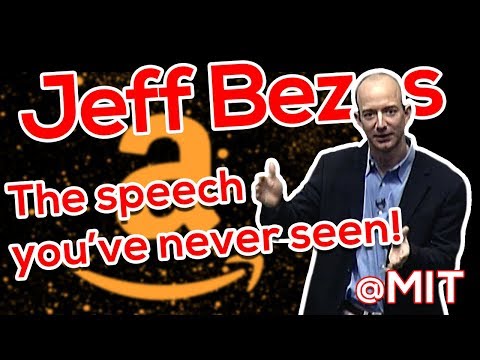
“…our number one-- the number one thing we've invested in at amazon.com has been technology…”MIT talk, 2011 · 7:08
Amazon began as a practical bet on the internet
Bezos presents Amazon’s origin as a response to a specific fact: web usage was growing at an extraordinary rate, and he wanted a business model that fit that growth. His decision to leave Wall Street was not framed as romance or impulse, but as a choice shaped by a regret-minimization approach that pushed him toward trying something that seemed historically important.1234
He chose books as Amazon’s first category because they fit online retail especially well. Books offered huge selection, were easy to catalog, and highlighted an internet advantage: an online store could offer breadth that physical stores could not.51
He also viewed the period as very early in online commerce, which helps explain Amazon’s experimental style in its first years. In his telling, the company was built to match a new medium that was still taking shape.6
Customer obsession is the center of Bezos’s view of Amazon
Across years and settings, Bezos returns to one idea more than any other: Amazon works when it is pulled forward by customers rather than by rivals. He describes the company’s mission as becoming the most customer-centric company and says customer obsession is what drove Amazon’s success.7891011
For Bezos, customer centricity has three parts: listen, invent, and personalize. Listening matters, but it is not enough; Amazon also has to invent on customers’ behalf and tailor the experience so the store fits the individual rather than forcing every customer through the same experience.121314
This is also why he prefers customer reality over abstraction. He says customers are never finished; they keep wanting better experiences, which creates a constant pressure to improve. That dissatisfaction is not a problem to eliminate but an engine that keeps Amazon moving.1516
Technology and low prices are tools for serving customers better
Bezos does not describe Amazon mainly as a marketing machine or a traditional retailer placed on the web. He says the company’s biggest investment has been technology, suggesting that software, systems, and technical infrastructure are what let Amazon improve the customer experience at scale.17
That technology shows up in personalization and operational intelligence. Bezos’s vision is not one generic store for everyone, but many stores effectively customized to individual customers, with software taking on more of the work of understanding needs and reducing friction.1418
He pairs that technical ambition with a simple economic promise: keep prices low. Bezos argues Amazon is not trying to exploit scale by pushing prices upward; instead, the company aims to use scale and efficiency to keep making the offer to customers better.192021
“…our number one-- the number one thing we've invested in at amazon.com has been technology…”MIT talk, 2011 · full transcript →
Day 1 means preserving startup speed even at massive scale
Bezos’s phrase Day 1 captures how he thinks Amazon should behave as it grows. The risk of success, in his view, is not only competition but internal drift: a large company can become slow, complacent, and detached from the entrepreneurial energy that made it useful in the first place.22
So Day 1 is a discipline against stasis. Bezos wants Amazon to keep its nimbleness, heart, and willingness to experiment, even when that means taking paths that outsiders do not immediately understand.2223
That forward-leaning posture is tied to his broader view that companies should move toward the future, not defend the past. Amazon’s best protection, in this framework, is continued invention driven by changing customer needs.2425
Amazon grows by widening the store, not just owning more inventory
Bezos describes Amazon’s early retail model as a mix of stocked inventory and fast replenishment, which let the company offer broad selection without needing every item physically on hand from the start. That approach matched the original promise of an online store: much more choice than a physical shelf could hold.
Later, he says Amazon made a major strategic decision to invite outside sellers into the store because that would create a better experience for customers. His argument is that combining Amazon’s store with third-party selection made the whole offering more useful and that growth did not have to be zero-sum.2627
When challenged about seller treatment, Bezos draws a distinction between unacceptable individual cases and the overall structure of the marketplace. He says poor treatment is not acceptable, while also arguing that third-party sellers as a group have done very well on Amazon and that abuse is not the systematic rule he sees.28293031
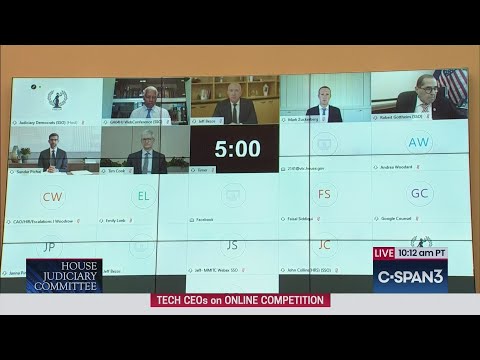
“20 YEARS AGO, WE MADE THE DECISION TO INVITE OTHER SELLERS TO SELL IN OUR STORE. TO SHARE THE SAME VALUABLE REAL ESTATE WE SPEND BILLIONS TO BUILD MARKET AND MAINTAIN. WE BELIEVE THAT COMBINING THE STRENGTHS OF AMAZON'S STORE WITH THE VAST SELECTION OF PRODUCTS OFFERED BY THIRD PARTIES WOULD BE A BETTER EXPERIENCE FOR CUSTOMERS. AND THAT THE GROWING PIE OF REVENUE AND PROFITS WOULD BE BIG ENOUGH FOR ALL. WE WERE BETTING THAT IT WAS NOT A ZERO SUM GAME. FORTUNATELY, WE WERE RIGHT. THERE ARE NOW 1.7 MILLION SMALL AND MEDIUM U SIZED BUSINESSES SELLING ON AMAZON.”House Judiciary Committee hearing, 2020 · full transcript →
Bezos on amazon, in his own words
“We want to be Earth's most customer-centric company.”
Where to watch
 Jeff Bezos on Customer Centricity: Listen, Invent, Personalize2011 · 82 min · full transcriptBest single overview of how Amazon grew around customer centricity, technology, invention, and personalization.
 Jeff Bezos on Leadership: Customer Obsession and Day One2018 · 56 min · full transcriptBest explanation of Day 1, customer obsession, and how Bezos thinks Amazon should operate at scale.
 Jeff Bezos on Day One: The Early Amazon Vision1997 · 6 min · full transcriptBest short account of why Amazon started with books and what made online retail different in the beginning.
 Jeff Bezos on Customer Centricity: Invent, Lower Prices, Scale2000 · 52 min · full transcriptBest statement of Amazon’s mission, low-price logic, and the idea of customizing the store to each customer.
 Jeff Bezos on Antitrust and Market Power: Amazon, Customers, Day One2020 · 327 min · full transcriptBest defense of Amazon’s scale and marketplace model in Bezos’s own terms.
Questions people ask
- What did Jeff Bezos say about Amazon's early chaos and customer obsession?
- What did Jeff Bezos say about how Amazon became successful?
- What did Jeff Bezos say about how he came up with Amazon?
- What did Jeff Bezos say about regret minimization when he left Wall Street?
- What did Jeff Bezos say about third-party sellers on Amazon?
- What did Jeff Bezos say customer centricity means at Amazon?
Sources
Every quote above, word for word from the transcripts. Numbers match the text.
“Well, three years ago, I was in New York City working for a quantitative hedge fund when I came across the startling statistic that web usage was growing at 2,300% a year. So, I decided I would try and find a business plan that made sense in the context of that growth. And I picked books as the first best product to sell online, while making a list of like 20 different products that you might be able to sell. And books were great as the first best because books…”
“It was a regret minimization framework.”
“Was what I called—which only a nerd would call—a regret minimization framework. So I wanted to project myself forward to age 80 and say, okay, now I'm looking back on my life. I want to have minimized the number of regrets I have. And, you know, I knew that when I was 80 I was not going to regret having tried this. I was not going to regret having wanted, you know, trying to participate in this thing called the Internet, that I thought was going to be a really big deal. I knew that if I failed, I wouldn't.”
“Most regrets, by the way, are acts of omission and not commission.”
“I picked books as the first best product to sell online…”
“This is the Kittyhawk stage of electronic commerce…”
“We want to be Earth's most customer-centric company.”
“Customer obsession has driven our success.”
“…customer obsession as opposed to competitor obsession…”
“…the core of the company is customer obsession as opposed to competitor obsession…”
“…to be Earth's most customer-centric company…”
“It means listen, invent, and personalize.”
“It means listen, invent, and personalize. The basic idea is you can't really run a business of any kind, I think in most people's opinion, if you're not going to listen to your customers. That sort of fundamental. But invention is equally important. And invention, it goes far beyond listening to customers. Because oftentimes, customers don't really know what it is that they want. It's your job to invent on their behalf and we've done a tremendous amount of invention and innovation of different kinds in the company. I'll tell you a little bit more about that when I give you the live demo. And then finally personalization. The notion of customer centricity is to build a place where each individual customer has his or her own website. And to do that in large part, not by explicit information that the customer provides, but through implicit observation of their behavior on the website.”
“We want to have 20 million different stores, each store customized for that individual customer.”
“…customers are always dissatisfied. They always want more…”
“…what we want to do is have the world's best customer experience…”
“…our number one-- the number one thing we've invested in at amazon.com has been technology…”
“…the software knows more about your business than you do…”
“We're not going to raise prices. So if you're waiting for us to raise prices, give up now.”
“What is unusual is the scale at which we're doing it.”
“I WALKED AWAY FROM A STEADY JOB ON WALL STREET INTO A SEATTLE GARAGE TO FIND AMAZON, FULLY UNDERSTANDING THAT IT MIGHT NOT WORK. IT FEELS LIKE JUST YESTERDAY I WAS DRIVING THE PACKAGES TO THE POST OFFICE MYSELF, DREAM THAG ONE DAY, WE MIGHT AFFORD A FORKLIFT. CUSTOMER OBSESSION HAS DRIVEN OUR SUCCESS. I TAKE IT AS AN ARTICLE OF FAITH THAT CUSTOMERS DO THE RIGHT THING. YOU EARN TRUST SLOWLY OVER TIME BY DOING HARD THINGS WELL. DELIVERING ON TIME. OFFERING EVERY DAY LOW PRICES.”
“Well, so day one, this is a phrase that we use at Amazon all the time. I've been using it in my first annual shareholder letter from twenty years ago. And we say it's always day one, and it needs to be day one for the reason that you just mentioned. And how do you so the real question for me is how do you go about maintaining a day one culture? It's great to have the scale of Amazon. We have financial resources. We have lots of brilliant people. We can accomplish great things. We have global scopes. We have operations all over the world. But the downside of that is that you can lose your nimbleness. You can lose your entrepreneurial spirit. You can lose your that kind of heart that small companies often have. And so if you could have the best of both worlds, if you can have that entrepreneurial spirit and heart, while at the same time having all the advantages that come with scale and scope, think of the things that you could do.”
“…you have to be willing to be misunderstood…”
“You have to always be leaning into the future.”
“Never, ever, ever lean away from the future.”
“We were betting that it was not a zero sum game.”
“20 YEARS AGO, WE MADE THE DECISION TO INVITE OTHER SELLERS TO SELL IN OUR STORE. TO SHARE THE SAME VALUABLE REAL ESTATE WE SPEND BILLIONS TO BUILD MARKET AND MAINTAIN. WE BELIEVE THAT COMBINING THE STRENGTHS OF AMAZON'S STORE WITH THE VAST SELECTION OF PRODUCTS OFFERED BY THIRD PARTIES WOULD BE A BETTER EXPERIENCE FOR CUSTOMERS. AND THAT THE GROWING PIE OF REVENUE AND PROFITS WOULD BE BIG ENOUGH FOR ALL. WE WERE BETTING THAT IT WAS NOT A ZERO SUM GAME. FORTUNATELY, WE WERE RIGHT. THERE ARE NOW 1.7 MILLION SMALL AND MEDIUM U SIZED BUSINESSES SELLING ON AMAZON.”
“It does not at all to me seem like the right way to treat her…”
“…third-party sellers in aggregate are doing extremely well on Amazon…”
“I do not think that's systematically what's going on…”
“Well, I say that's not acceptable. If we aren't listening to you, I'm not happy about that at all. And, but I do, you know, if you allow me to disagree a little bit with a piece of this, I do not think that's systematically what's going on, and the evidence that I would suggest would be useful for you to consider in that regard.”
How this guide was made: drafted with AI from the full transcripts of the recordings cited, then checked: every quotation must match a transcript word for word and be the speaker's own words, and an independent review gates accuracy. Methodology and corrections.


