Jeff Bezos on Customer Centricity: Invent, Lower Prices, Scale

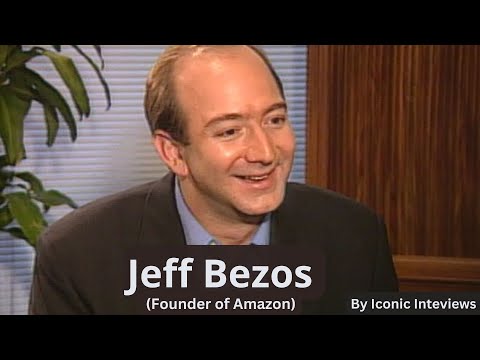
What Bezos talks about
Jeff Bezos gave this interview on Charlie Rose in 2000 about Amazon’s customer-centric strategy, long-term growth, pricing, scale, and the dot-com crash.
Also known as: Jeff Bezos Interview on Charlie Rose; Jeff Bezos in Conversation on Amazon and Innovation; Charlie Rose Rewind.
Jeff Bezos argues that Amazon’s mission is to be “Earth’s most customer-centric company,” built around listening to customers, inventing for them, and personalizing the experience. He says the goal is not to copy physical retail online, but to create new advantages the internet makes possible.
He also makes the case that the dot-com crash is separating lasting businesses from “flash in the pan” companies. Bezos emphasizes sustainable pricing, growing market share, and using scale to improve service while lowering costs.
The interview also shows his long-term thinking: investments in new categories and geographies, the importance of execution, and a belief that technology will keep empowering individuals and changing commerce.
Charlie Rose interviews Bezos, with audience questions near the end.
In his words
“We want to be Earth's most customer-centric company.”
“Listen, invent, and personalize.”
“We want to have 20 million different stores, each store customized for that individual customer.”
“We're not going to raise prices. So if you're waiting for us to raise prices, give up now.”
“What is unusual is the scale at which we're doing it.”
Key points
- Amazon is not changing its business model; it is lowering prices while others raise them.
- He distinguishes lasting companies from short-lived “flash in the pan” internet stocks.
- Amazon’s mission is to be Earth’s most customer-centric company.
- Customer centricity means: listen, invent, and personalize.
- Online retail wins by using technology and scale, not by copying physical stores.
- Lower prices can increase customer count and total dollar margins.
- Execution risk, not market hype, is the biggest worry during rapid growth.
Full transcript: Jeff Bezos, Charlie Rose interview (2000)
(music) We continue from Aspen, Colorado with Jeff Bezos. He has been called a pioneer, a visionary, and an entrepreneurial genius. He is Chairman and CEO and founder of Amazon.com. It is the world's largest retail on the internet with more than 16 million customers and $1.64 billion in sales last year. Jeff was named Time magazine's Person of the Year in 1999. The magazine wrote then, Bezos's vision on the online retailing universe was so complete it became from day one the point of reference for anyone who had anything to sell online. I am pleased to have him here because there's a lot of talk about what's happening in the stock market, there's a lot of talk about the future of e-commerce, who the winners and
losers will be, and there's no one better to talk to than Jeff Bezos. He joins me now from Aspen. Uh, let me start with what is everybody's talking about today: it is what is happening to e-commerce, the sense that business plans are changing, this sense that e-commerce retailers are having to up their prices in order to generate profits. From where you sit, are you changing your business plan? Are you changing your business model? And what do you expect to happen to Amazon over the next 12 months? So we're not changing our business plan or business model. In fact, if you read that New York Times article as you go through it, they say Amazon.com is the exception
to this because we actually are lowering prices while other people are raising prices. So there really are two kinds of internet companies out there, and there are a lot of companies that are really working hard to build lasting companies, and there are a lot of companies that were working hard to build lasting stocks or maybe flashing the pan stocks. And you're starting to see that differentiation. So in 1999, a lot of internet companies used what I would say are unsustainable customer acquisition techniques; in other words, you know, below cost pricing, all kinds of crazy things to get customers. What happens when you do that is you get the wrong customers, and when you raise prices those customers go away. So you think you have a business and you really don't, and
we're in a completely different position. In fact, we have just started reducing prices in our electronics store. We went through the top 1,000 bestselling electronics items and actually made those things cheaper. So we're kind of countering that trend. People look at what happens to Amazon as a kind of bellwether as to where things are going. Well, through one of the things that'll happen this year for the first time is that over the next, uh, nine months, through the rest of this year combined, our cash flow from operations will actually be positive. So that is a, a big event. The other thing that will happen this year is that our oldest businesses, which are US Books, Music, and Video businesses as a segment, will be profitable for the first time. That's what we expect to happen, and in fact, in
Q1 of this year, those businesses did about $400 million in revenues and lost $2 million, so they were almost break even in Q1 this year. Can you in any way—even though your stock has gone from a high of 113 to 30, whatever it is as we speak—uh, can you in any way say something is healthy about this? And this puts me back to a time when we were building this company, and all of the attention and all of the activity and all of the focus on the stock market, which was so distracting, although profitable, is a good thing. I absolutely think that's true, and in fact, I—you know, these stocks, internet stocks, Amazon.com definitely included, are incredibly volatile and it's good to have that
reminder so that people know when they join an internet company or uh, when they invest in an internet company, they have to—it's good to be cognizant of that risk and know what you're doing. You know, back in 1995, nobody wanted to hear from Amazon.com, and the kinds of people that we attracted were people who just wanted to be on the mission that we wanted to be on. They were there, they had no idea whether their stock options were ever going to be worth anything, and they were doing this because they really wanted to be part of that. Uh, I think in 1999 you, there was enough of kind of, uh, mania for it to be very difficult to, uh, for people who maybe really weren't interested in that kind of life to resist it, and so
that's one of the things that I think we may get back to is a little bit of normalcy in that regard and be very healthy. What happens to e-commerce? The internet and e-commerce are probably bigger than people think they are, even at the height— even bigger than they thought they were at the height of the 1999 mania. But it's gonna—but we don't know which companies are going to be the winners. So that's one of the things for investors, there's a lot of confusion, but that's about Wall Street. If you talk about customers, and if you talk about building something that's, you know, something that really improves the lives of millions of customers, that's going to happen. Think about the fundamentals of this for a second. The Amazon.com is in a marketplace; it's a $5 trillion dollar market. It's worldwide
retail. It's a very, its market size unconstrained, and the technology that we employ to do our business improves every day. It fundamentally gets better, and so then we get to, uh, kind of ride on the coattails of that technology and it gets cheaper too. You know, physical space for retail stores doesn't get cheaper every year; it gets more expensive, whereas your operational costs get less. That's right, everything, all the stuff that we employ gets more, it gets, you know, microprocessors get cheaper, bandwidth gets cheaper. We basically get to trade real estate for technology, and that's a great trade. What's the biggest misconception about Amazon? Well, you know, I think there are quite a few. Let me, let me widen that to the biggest misconception about the internet, and I
Still firmly believe this is — I think many people increasingly believe that there are going to be just a few winners. I think there are going to be many, many winners. I think this is a huge myth. I think there are also, by the way, going to be thousands and thousands of failures, and that's, you know, these things should go in lock step because this thing is so important that every experiment should be tried. This book goes back to your Cambrian metaphor, does it? That's right. Explain that. Well, 550 million years ago, when single life first became multi life, every experiment was tried, and it was the greatest rate of speciation ever seen. But it was also the greatest rate of extinctions ever seen. And that's what you see going on here. How would you then
characterize what the business of amazon.com is today? Well, we are first of all, we want to be Earth's most customer-centric company. So we think of ourselves as a customer company. We want our brand to be known for this abstract notion of starting with the customer and working backwards. I think those abstract brands provide more flexibility and are more robust than brands that are associated with concrete things like product categories. And then within that context of building Earth's most customer-centric company, we're working to build a place where people can come to find and discover anything that they might want to buy online. Now, we're not going to be able to do that alone. In fact, we're going to do it through thousands of partnerships so that we can
really get to that Holy Grail one day. And this is a multi-decade project of universal selection. Universal selection is—is it possible? Can you make the argument that old economy companies like Walmart, as they move to have an online presence, you know, and as you have certain demands for brick and mortar, whatever they might be, that you're becoming similar? Well, I think we're very different. And, you know, people always say to me, "Do you want to be the Walmart of the web?" Exactly. And I say, no, we don't. We want to be the amazon.com of the web. And we have a different approach because what we're doing is we're personalizing. I'd like to be the
Walmart of the web. I mean, that would be pretty good. You're already the Walmart of online, of talk shows, right? Billions and billions and billions dollars of profit. But go ahead. Now you're distracting. No, no, want to be the amazon.com—the amazon.com of the world. What that means is that we want to personalize the—there are all these things that you can only do online, like personalize. We have 20 million customers today. We want to have 20 million different stores, each store customized for that individual customer. And that's something you can't even begin—how many stores? 20 million stores. If we have 20 million customers, you want 20 million stores. The Charlie Rose store should not be the
same as the Jeff Bezos store because we undoubtedly have some different interests and different products to sell, and different—you'll be interested in different things than I will. Yeah. What has been, in a sense, the most surprising thing about this experience for you? Apart from Time Magazine, which had to be one of the biggest surprises—being Man of the Year—but the whole experience that you have gone through in just five years. July 16th you celebrate the fifth anniversary of amazon.com. That's right. Five years. Well, so the thing that's the most surprising is the growth rates and where we are today. We did not anticipate this. And if you look at our business plan, what you see is that our business
plan called for us to build a small and profitable company. And of course what we've done is build a large and unprofitable company. And that has been—that has been a conscious decision based on the fact that we, in the early years, we saw that this was working so much better than we ever anticipated. In fact, we were profitable in December of 1995, six months after opening, and that was the worst mistake anyone could have made. Because when you are growing week over week at such high growth rates, and clearly have a value proposition that customers love, you need to be figuring out how to invest in that. So for us, that meant investing in new
geographies, which is very expensive. You know, we have amazon.co.uk and amazon.de. We're doing more in that regard and investing in new product categories, new stores. So we've built an electronics store, we've built a toy store, we've built a tool store, and kitchen is our most recent. At some point, the Oxo salad spinner—that's my tip. It's a—it's a good— All of this talk in the paper is about profitability and that what's separating companies now is profitability. I read down the line, "The future belongs to companies that can deliver, of all things, real profits." So at some point that has to become—does it not, in today's environment—a higher priority? Well, what I would claim is that
that has always been true. This notion that there was an era when companies didn't have to have a plan for how they were going to be profitable is a false notion. There is no new math in the new economy. The new economy works the same way as the old economy in that regard. So companies are ultimately going to be valued on P/E ratios. Companies have to have profits. That's the way business works, or you don't get to keep doing anything. I assume the way they evaluate your company, though, Wall Street is growth margins. What they actually do, what the smart analysts do, is they try to project our cash flow, and then they discount that cash flow back to today and get a present value of the company. So which is a little bit different than just looking at the gross.
Margins. So that's what— that's the right way to try and value companies. I think it's important to think about it this way: investment is not something that's new. Investment is a time-honored thing. I know it’d be great if any of us could claim to have invented investment, but that's not, and so what's unusual— if you could patent that, it'd be great. You’d really have something if you, I own the rights to investment. But if you think about what's going on with Amazon.com, investing isn't unusual, which is all we're doing. What is unusual is the scale at which we're doing it and the fact that we're doing it as a publicly traded company. Those two things are unusual and I think
that's what has focused some of this attention and I think it's right for people to be focused on it. What worries you the most? The biggest issue for a company growing this fast is execution. It's simple execution risk. With that many new customers, that many new transactions and the kind of customer service bar that we have a reputation for, that's the thing that we're most proud of and the thing that we most want to preserve is our reputation for service and doing the right thing for customers. And that, when you're growing that fast, we've done a great job so far of not only just holding that bar but raising it every year. And that's the standard we set for ourselves. That's hard, and that's the thing I worry the most. When you look over the last five years, what's the biggest mistake you've made?
Well, first of all, there have been many, and thank you for not asking me to catalog them. Um, I think the biggest mistake is probably— I would have nine months ago, maybe ten months ago at this point— we needed to put in place a lightweight but formal planning process for the company. We had reached a size where that—we're doing that now, but I think it's about nine months too late. And we've always done a good job of planning with a fairly informal process, and I'd say we even did a pretty good job over the last nine months of doing that. But I think we could have gotten even more accomplished. You know, we launched half a dozen stores or so in that time period, so we got a
lot done, but I think we could have gotten even more done if we'd have had a lightweight, non-bureaucratic but formal planning process. And why didn't you? Just because your CEO blew it. Is that right? He just didn't have time. He was too busy. He was doing other things. I think that's right. Yeah. I just read a story about Napster over the weekend, and there was a quote from Andy Grove saying, "You know, that the technology that's coming out of companies like Napster could change the nature of the internet as we know it." Do you see any— do you see that at all? Well, I think— I don't know if it can. I think there's
some maybe more profound thing about Napster. I think Napster is very profound. The thing that I think is amazing about it is it's an indication of how a single person can influence the world when the world is as networked as it is now. Becoming a single person who's 19 years old. That's right. So this story— this is a 19-year-old with no team acting as an individual in his college dorm room who builds—a 19 years old who builds a piece of software and releases it to the world, and several, just a short number of months later, every record label is suing him. Five years ago, you could not possibly, no matter how hard you tried as an individual, have gotten every major
record label to sue you. There’s nothing you could have done. No, you couldn't have done it. They would have ignored you and you’re irrelevant. They wouldn't have given you the pleasure. That's right. Right. So this is truly a remarkable indication of the ability of a single person in this networked world, a single person with a powerful idea, exactly to change the world. But does it also suggest that around the corner— I mean, is the threat of somebody who could come along, not the threat that somebody could come along, because everybody just like this, and dramatically change the notion of the way we know the web today? I think that it is. I think that is the—or I think that's the world we live in. I think the world we live in is, you know, the sort of the length of time that a
generation of technology is likely to continue to be important is going to continue to shrink and shrink and shrink. And what that means is that companies have to put an ever increasing emphasis on speed of response and flexibility. What do you do, though, as a leader of a major online company to make sure that you are in touch with people like some 19-year-old in his bedroom with a computer, changing profoundly so much that all the record companies want to see him? How do you stay in touch with that kind of experimentation and that kind of
energy? Hire smart people. And how do you go about that? If you don't hire — because you know a single individual cannot keep in touch with the plethora of, you know, new things happening. So what you have to do is you have to put in place a recruiting process that attracts and retains smart, talented, hardworking people who want to be a part of your mission, whatever it is. Then, but then, when you talk to them, when they bring out the CEO to talk to these people, what's the mission statement you tell them first? It's "Earth's most customer-centric company." And we have a very — and I explain what we mean by that because we have a very precise definition for customer-centric. It means listen, invent, and personalize. So first you have to
Listen to customers. Companies that don't listen to customers fail. Second, you have to invent for customers, because companies that only listen to customers fail. It's not the customer's job to invent for themselves; it's our job at Amazon.com to invent things like one-click and other things like sales rank going from 1 to 18 million, those kinds of things that customers really like. That's our job, not theirs, to think of that. And third is personalize—take every individual customer and put them at the center of their own universe. And then, when we talk about Earth's most customer-centric company, we mean that in a very broad way. This is bigger than Amazon.com. What we want to do is sort of
uplift the worldwide standards for customer service and customer centricity. So this is sort of like Sony. Sony sort of was born right after World War II, too. It is a company that set out, if you go and look at their early mission statement, it was not to be known for quality; it was to make Japan known for quality, not Sony, Japan. And that's sort of what we want to do. We want to do something bigger than Amazon.com to make what would define it for me— it would be that we set a new example for customer service and customer centricity that other companies look at, admire, and want to emulate. And that is a mission that people can get excited about. I've talked to a lot of people who have created
great companies. Most of them believe in, at least in conversation with me, that if they had to start over, they could do it again. My question to you: if you had to start over, what would you do? Well, so first of all, I believe that as hard as we have worked at Amazon.com, and I'm talking about all 7,000 of us, we have also been incredibly lucky. So I believe because of timing, or because timing is the main thing, there are lots of things, even decisions we made that were the wrong decision that somehow miraculously worked out anyway. So there are—I believe that all startup companies require huge amounts of luck. So certainly, if you don't work hard and if you don't have a good plan, no amount
of luck will save you. But there are lots of companies that work hard, lots of companies with smart folks, and lots of them don't succeed. When did this dream start for you? So when I—so I don't really remember the exact day or anything, but when I was in college is when I started thinking about wanting to be, uh, an entrepreneur someday. So it was—I was not the kid with the lemonade stand, you know. I didn't—I wasn't one of these kids who was always trying to raise money. I always wanted to be a scientist when I was little and, uh, went to Princeton to study physics and realized halfway through quantum mechanics that I was going to be a mediocre physicist. So, um, so that, you know, that was not the dream of mine, and
but also always loved computers. I was lucky because at my age this is unusual to have access to a mainframe computer from my elementary school when I was in fourth grade, and, uh, quickly learned that there was a pre-programmed Star Trek game on that computer. And then I never did anything except play Star Trek with the computer. So I don't know how formative that was. It certainly led—it certainly helped my Star Trek knowledge considerably. And—but I've always loved computers. Somewhere in college, I started watching some of the people who were like setting up, you know, college pizza delivery services and, you know, the kind of the core entrepreneurs and thinking, you know, this looks like a really fun thing to do. If you weren't the CEO of Amazon.com
today, what would you like to do or be? Well, so if I could do anything—and it turns out this is a very hard technical problem—yeah, so I—I don't actually hold out great hopes. But if I could do anything, I would like to go, uh, help explore space. Tell me more. I mean, what would you do? How would you go about it if you weren't doing this? Well, I, you know, the picture I have is that I would get in a rocket ship, um, go up into space and, like, you know, go check out a few things. Now, this—this is why I mentioned at the beginning this is a very hard technical problem. Yeah, it is. But I—but I would think if you put your mind to it, you could probably figure out a way that
we could do this. Well, it—it's very hard. Your board of directors and your stockholders might not be happy. It's very hard. It's really—I mean, so, you know, who knows what 20 years from now, if there's some significant changes in the technology, maybe such things will get easier. But we haven't made significant improvements in, you know, space transportation systems really since the Apollo program. All right, we'll take a break with Jeff Bezos, take some questions from this audience and some more questions I have, but we'll be right back from Aspen, Colorado. Stay with us. (music) We're back in Aspen with Jeff Bezos, taking some questions from our audience.
Here with us? Yes. So, Jeff, you talked about the individual 19-year-old at Napster who really impacted the whole music industry. We're seeing increasing examples of that—that yourself, the Yahoo folks. Do you think, if you nominally think today in America, there's 100,000 people that significantly changed the outcome of the country, that over time, fewer and fewer people will be able to have more and more impact? And if you talk about 70% of the change that is driven in the country as a whole, that you might see that 100,000 people number decline to maybe 10,000 or 5,000 people—fewer people?
Having increasingly larger impact on the country. I don't, I don't think so. So, you know, these are the kinds of things that are incredibly hard to predict. I would actually predict it would go the opposite direction because I really do think the kinds of technologies that we're deploying today mostly empower the individual. And so I really do believe that you're going to see more and more people having the ability to impact their environment. And I think you're going to see niches. So I think people are going to be able to powerfully affect maybe not the whole world—you can't have, there aren't going to be, I guess, there, you know, almost by definition there can't be, you know, billions of people affecting everybody, right? That probably doesn't make sense. But there're going to be these very powerful groups of, but are
concentrated in particular areas of, you know, domain expertise, where they're going to have huge leverage through the tools that technology gives them. If I can just follow up, you know, in the business space we've seen a few large companies, so an aggregation towards a bimodal distribution—a few very large players and then lots and lots of highly diverse niche players. Uh, we tend to see that in the kind of impact individuals are having too. So it just seems that while it is power to the people, the people who have disproportionately more to contribute, driven by the power of their ideas, uh, seem to be having more impact than everybody else. And we might end up with
a bimodal distribution. I, I don't know if you agree or disagree. I, my guess is I disagree, but I think it's very, very hard to know. Jeff, in your search for the Earth's most customer-centric experience, what have you learned about the things that you can do well over the Internet versus those you can't do? And how is that affecting the way you're approaching your customer-centric, uh, so that is a great question. I, the, what I think the mistake that I see companies make all the time is trying to closely emulate physical world experiences. So, you know, we started out from the very beginning knowing that an important part of book shopping was fun. People like to
have fun in bookstores, but the kinds of things that bookstores do—physical bookstores do—to create a fun experience are not replicable online. And if you try to replicate them, I can't tell you how many times I have had people ask me how we're going to replicate book signings online. And book signings don't work online. You're trying to meet the author—that's kind of the whole point of a book signing. And you can do, you—but you can do wonderful things online that are just as much fun. So you have to find the new things. So it really is all about invention and not replication. That's why the physical world metaphors can be so misleading. Many of the intuitions built
out of that experience just turn out to be wrong. So where does that lead you in terms of thinking about the selection of things that you offer? I mean clearly there's going to be some limit. Something sells better—evening gowns. I don't think evening gowns are going to do well online. I'm a big seller of evening gowns online in terms of, you know, not thinking it'll work. We're not going to sell evening gowns online. So, you know, there—but I do think that most products, to one degree or another, will work very well online. Somebody once said to me, you know, cement? You'll never—they were thinking of fresh cement that you would like dispatch to a construction site—that, you'll never sell that at Amazon. I think that's the perfect product to sell at Amazon.com because that always gets delivered
anyway, you know. So there are ways. When I see cement being sold on Amazon, I would not hold your breath. That's not high on our priority list. At what point can the Earth's best customer experience start raising prices? We're not going to raise prices. So if you're waiting for us to raise prices, give up now. But we are going to lower prices. So let me, let me jump in on that because I, I think that's an important point not partly because of questions that everybody raises about cash flow and profitability but because it looks like shopping online is not price sensitive. In other words, all this reports that I read about people who were forced to raise their prices in order to generate more cash—they're finding that customers are continuing to
buy online. So price point sensitivity doesn't seem to be a critical factor. Just because you could raise prices doesn't mean you should. So we have huge economic advantages over physical stores in terms of a centralized distribution model, in terms of not having expensive retail real estate. We have never been one of those companies that lowered prices to unreasonable levels, I know that. And so our pricing is sustainable. And as we get more efficient, and as we get more scale, and as we're buying cooperative not for 20 million customers but for 40 million customers, we're going to be able to lower prices even further. And that's a good idea. But I'm just asking if in fact, if in fact you could sell your products
at a higher price and customers would be willing to pay a higher price, you wouldn't do it? No. You would generate more cash? Not necessarily. So think about, the, what, the thing that benefits us most. So there's an equation here. When you lower prices, you also increase the number of customers you have, you increase the level of revenues you have. One of the things that people make a mistake on is they think that you're trying to optimize for percentage margins. You know, they think you're trying what you're— which is not, not what you're trying to do. You're actually trying to maximize dollar margins. And those, if you if you try to maximize dollar margins, oftentimes that causes you to want a lower price, not increased price. Another point I would make is that, unlike physical world retailing, which is
A variable cost business. So if you double your sales, you double your costs, right? Online retailing is a fixed cost business, much more so. So when you double your sales, you don't come anywhere near to doubling your cost. As a result, one of the intuitions that's wrong about the physical world — we all know in the physical world that whatever place has the best service can't have the lowest prices. Online, I think that's wrong. I think online you can have the best service and lowest prices if you have enough scale. Let me rephrase the question: How important do you think it is to the future of your company to maintain and reduce prices, as you suggested earlier, you're doing in
electronics? So I think we could raise prices, but I think it would be a strategic mistake, because what I mean — I still don't understand. Because it would — I think that on balance, on balance — so one of the things that happens is it's an — it's to our — so if you think about it strategically, the longer the transition from sort of offline to online takes, the more it benefits the incumbents. And so as the sort of the pioneer, the startup company in this space, we prefer to see a rapid transition, where, you know, it's not going to be 100%, it's going to be like 15%. We're talking about getting 15% of the 5 trillion dollar retail marketplace hopefully to move online over the next 10 plus years. We'd like to
see that happen as fast as possible, which means you want to give customers as many real advantages as you can. Don't give them unsustainable advantages, give them real advantages. All right? But I mean, I understand. Even though I didn't go to business school, I do understand the notion of market. Neither did I, Charlie. Yes, so you too can create a television program. Um, did you go to talk show host school? I didn't do that either. I didn't, and it shows. No, it doesn't. Market share is important, clearly, is it not? Yes, it is. Market share is important in a scale business. In other words, where fixed costs are high and variable costs are low, market share is very important if customers are willing to pay more for quality, mhm, and
willing to pay more, uh, and you can use market share for leverage in terms of your own expenses, the purchase of the books. But it's that market share that allows us to have a lower cost structure than anybody else, which allows more leverage with the publishers. It's not just with the — with the vendors; it's actually, it's actually a lot of it comes from our — the economies we get. Let's — let's say, let's take software development, a huge expense of ours, because we've worked so hard to make our systems easy to use. These 20 million customers are not computer experts, okay? Right. That's a big expense to develop those e-commerce systems. Now once you develop them, it costs you the same to develop them whether you have 10
customers or 20 million customers. So you get to spread the cost of those systems across an ever-increasing customer base. That is a very powerful economic advantage. So it really has more to do with that and less to do with the vendor side. Some analysts argue about Amazon that you got to go to the cap, that you're going to run out of cash, you know, and you're going to have to go back to the capital market. Do you try to reassure one? I know of one analy — I only know one. Do you have to go to, in terms of the stock, because you are a public company, you got to care about it. What do you have to do? What message do you have to speak to them, those people?
Because of what's happened in the last 12 months, because of what happened, you know, last week in the New York Times, analysts talk and Amazon, do sharff, all that stuff, what message do you have to convince them of? Well, so I think one of the key things that, you know, a piece of misinformation that, you know, just really on Friday started circulating is that amazon.com is going to be out of cash by December and out of cash and out of business unless they can raise cash somewhere else. This is complete hogwash. So, you know, I don't — I'm not usually so direct and straightforward with my criticism, yeah, but I really believe this is so, uh, far afield from the truth that it has to be handled directly and people have to know it's unadulterated craziness. We have a billion dollars in cash as at the end of the last quarter,
and we expect, over the rest of this year, to actually generate cash from operations. So our, our, our operational cash will be positive. And if they then come back to you and say, when will this be a profitable company? When will I see in your annual report bottom line profit? So we will tell them, thanks for asking, but we're not going to share that information because what we're doing is more important to us in the long-range health of this company. No, that's not — so just to be clear, no one cares more about profitability than amazon.com. And we're actually putting more focus on it today internally than we did a year ago. Why? The reason is that our, the scale of our
business is such. So now, you know, we have annualized revenues of about two and a half billion dollars a year. Let me give you, and that means that if you can make a 1% improvement in efficiency, believe me, we have these little 1% improvements laying all over the place to be picked up. It's, it's an opportunity. And if you make a 1% improvement, that's $25 million to the bottom line. If you had a company with, you know, a few thousand in annual revenue or a million dollars or 10 million, to spend any time at all on trying to get that 1% improvement in efficiency would be crazy. You shouldn't be spending your time trying to get a 1% improvement in
Efficiency. When you have $10 million in revenue, you should be spending that time trying to get more revenue so that you have more operating leverage. So that then, when you do the operating efficiency improvements—so the simple answer to your question is so that you get more leverage. The simple answer is we just have such a big company now in terms of revenues that it would be, uh, irresponsible not to focus on efficiency, right? I understand. Now, I had some more questions out here. Lots of them. Yes. Um, you, uh, you talk about customer focus and, uh, one of the aspects of that I would assume is responsiveness in terms of delivery time. If that's true, there's a pipeline associated with
the production of material and the delivery to customers. Somebody has to carry that inventory. If that's true, are you going to at some point be compelled to put in physical facility and inventory to meet that need? And in a 10-year time frame, does that risk beginning to make you look like Walmart? Well, this is one of the myths of Amazon.com. People don't know that we have always carried inventory, and, uh, so we have never had a complete, a quote-unquote completely virtual model. We did analysis early in the company's history and found that customers actually want to receive the products that they buy from us, and so we always built distribution centers. If you're distributing physical products,
you have to physically move the things. And so, we have today 4 million square feet of distribution center space around the world. We built more than 3 million of that just last year in a single 12-month period. So, and we, we are, uh, dedicated to put it—now we still have a huge cost advantage over places that have physical stores. If you take a big chain, you mentioned Walmart, but you could take anyone. They not only have the physical stores, where they have to store co-inventory, but they also have the distribution centers that service the stores. So, we don't get to skip the distribution centers, but we do get to skip the stores. And believe me, the stores are a lot more expensive than the
distribution centers. Also, if you have a thousand stores in your network, you have to carry a thousand copies of inventory, whereas if you have half a dozen distribution centers, you only have to carry half a dozen copies of your inventory. When you look at the capital dynamics and how many inventory turns you can get—and this is one of the pieces of our model that's poorly understood broadly, well understood by a large number of Wall Street analysts but poorly understood by, you know, sort of I'd say a large group of lay people. What about Napster? Um, what do you think's really going to happen there? And, uh, you know, the protection of the artist down the road? Uh, what's your prediction? Well, I so I think that, you know, uh, I don't—so I don't know how Napster
makes money, and I don't spend all day trying to figure it out, so they may have a plan. I just don't know what it is. I do know what I suspect is going to happen at some point is that some of the laws will change to make it harder for companies that—so the N, I believe, and I'm not an expert on this, I know a little about it, just enough to be dangerous—but I believe the argument that Napster makes is some of our users might use Napster illegally, but Napster isn't illegal. So, it's sort of like, you know, radar detectors aren't illegal but speeding is illegal. Now, my guess is that this is such a, uh, an important sector of our economy—intellectual property, uh, and its music and its films and its
books—and, and my guess is that as a society we do want the artists and authors and directors and so on to make money from the intellectual property. And so, as a result, I suspect that Congress will pass laws over the coming years to make things that, you know, like Napster, uh, responsible for collecting somehow payment for the—for the artists. As interested as I am in that question about artist and copyright and all of that, I'm—the technology interest argument interests me is to whether the way that there is a new idea, a kind of different architecture for exchanging information coming from Napster, like
technology. Have you thought about that? Do you think about that? And does what does it represent? So, I think it's an important addition. So, so the way the web works today is it's very centralized. So, Amazon.com has these big central servers, right? And when you buy something from Amazon.com, you're coming—you're basically using a very thin piece of software on your PC that connects to our big fat servers that do all the work. There is coming out of Silicon Valley today, you know, this real distinction between visionaries and mercenaries. And clearly, you are a visionary in terms of creating this company. There is also this notion, uh, of people either being Rockefeller or Edison. Rockefeller being a company builder, Edison being an inventor. Where do you put yourself in
that second category? I mean, you think of yourself more as a businessman than a technologist? The thing I love is the inventing. So, I, you know, I, I, I do the business and I enjoy it, but I don't love it. The thing that I love is getting with one of our product teams and figuring out things like, you know, the next generation of customer reviews or how we're going to let trusted friends see each other's purchases, which is the latest feature we rolled out, and or, you know, wish list. We now have over, uh, you know, two million people with wish lists. It's getting big enough now that when you go and search to see if somebody has a wish list, you're starting to, you know, you know now one time out of
Five, the answer is yes. So that is starting to be a, uh, a really—that's a big deal. Those are the things that really turn me on, turn you on, said in another way is all is how I can use this technology new and more interesting ways. Absolutely. That are part of the overall. Do you have any regrets over the fact, thinking of the AOL Time Warner merger, that you didn't use your market value at its optimum in the merger and acquisition game? No. Why not? Because we, if we thought there—you don't make—we wouldn't know how to spend it. We didn't, you know, we wouldn't know. You—no company you wanted to buy that would make your overall business effort better? No, people.
Kept urging us to buy like a big physical retail or a big chain of physical stores, and the problem is we wouldn't know how to improve that experience. And we don't want to do anything that's already well served that we don't know how to improve. So if you take our electronic store, right, we don't want to have physical electronic stores because I think that's a bad experience and I don't know how to improve it. So why would we want to own that? And if those people who are in competing business with you—those bookstores and those people selling all these products—if they come to you and say, "So what's our future?" what do you say to them? If they say, "Give us some free advice, Jeff," you're coming down the road and we know how fast you're going—physical stores. Well, the first thing I
would say is it's—we're talking about 15%, not 100%. Yeah. So I think even over 10-plus years. The second thing I would say is figure out what your strengths are and emphasize those. One of the things I do think you see is companies that are great in the physical world spending too much time, energy, and attention online. And I think, you know, they should have a certain amount of skepticism when I say this because of course I'd like them not to do that, but I really do believe it's the truth, right? I really do believe that they could, you know, that if you have—let's say you have two big competitors in the physical world and one of them decides to go whole hog for the internet and the
other one says, "You know what? We're going to do is we're gonna just try to get a bigger piece of that 85% and really focus on our physical world business while our competitor is distracted." I actually think that would be a very good strategy, and it's what I might do if I were in their position. Are you serious? Yeah. So you'd say to Barnes & Noble and Borders, "Forget this online stuff and just take care of your own business." Business. Well, I might—I would certainly say that, but I—but I—but I actually do believe that the skill sets are so different. You know, I've always said, but that's a different reason. They can't acquire the skills; they can acquire them but slowly. And meanwhile, if they had, see what? Right now they're not getting hurt very much because I think all of the—you know, if you take a segment like books, you know, I think Borders and
Barnes & Noble are equally distracted with online but I'd say if one of them had decided to just focus on their physical world business while the other one was distracted with online, that could have been a tactical advantage. So you're saying Barnes & Noble, for example, probably by so focusing and looking what to do to your challenge and getting online, probably lost some. I do think that's true, and I think that—I think that, and I've always said too that it would—in my opinion it would have been easier for Barnes & Noble, and by the way, I picked them because they're a greater retailer and they know a lot about how to sell books—they do a fantastic job, probably one of the best physical world. You compare them to electronics guys, right, who I love to compete with because I think they're
terrible. Yeah, exactly. But Barnes & Noble's always done a great job. But I think it would have been easier for them to open a new chain of hardware stores than it was to sell. They found a better place to spend their and time. Two businesses are actually so similar; you know, selling hardware in the physical world is very similar in many ways. They could have done that, but this is hard. Talk to me about the marketing. I mean, have you noticed when you look at a magazine today, most of the ads are ads? You know, when you look at television, an increasing number are. That won't be true anymore. So because they have no money or—yes. So in in the fourth there was a very irrational set
of behaviors. In 1999, there were companies who would raise $60 million. There were lots of rational companies too. Okay? So but there were lots of irrational ones and they would raise $60 million in venture capital and spend half of it, half of their cash in a single quarter. Yeah, right. Or a single ad in the Super Bowl or something. That's right. And that is—and what—and what the—see, so the way the market works, the market learns, and then the market teaches. And what the market learned in Q4 of '99 is you cannot build a well-recognized national brand for $30 million spent in a single quarter. It actually takes years and hundreds of millions. I'm here to tell you that's true. You don't get it overnight. Yes, Jeff. One.
Of the advantages you had when you started is if you look at your average order size, it was perfect for Visa, Mastercard, Discover, whatever you want. Um, I think a lot of people, like my 16-year-old who uses Napster, would be willing to pay 9 cents if they could. We need a new payment system for things like next-generation electronic intelligence and data. So, I suspect that there will be — I mean of course there are lots of — it's a really interesting question because I would say in theory, yes, but I would also say in practice there have been dozens of companies that have gone down in flames trying to create these new payment systems, and not through lack of technology. That's part two of my question. So, I don't know the answer to that. It's something I've puzzled over.
Myself, I think there — it's a hard nut to crack because I think it's a chicken and egg kind of problem. No merchants want to use the payment system until millions of customers are using it, and no customers want to use it until merchants are using it. So, these are tricky things that probably get established very slowly. Perhaps it's going to take American Express or Visa or something like that. We'll have to wait and see how that develops. Probably some major market participant will have to really lead the way there. Yes, Jeff, what impact do you think that the internet sales tax moratorium has had on the ramp-up of e-commerce, and what happens in a few years, five years if the laws change with respect to sales tax? Well, I — so it's very hard to know what, if any, effect it has had, uh, and so you know, our point of view
on this is, look, you know, e-commerce is an important sector of the economy. Let's not mess with it just now. So, we like the moratorium. Um, I also believe that there's an argument to be made that if there are, uh, you know, states where we don't have any business operations, that those states should not be able to force us to be tax collectors for them because we're not getting any services from those states. They're not paying for, you know, our kids to go to school, they're not paying for, uh, ambulance and fire protection for our employees. So, I think there's a strong argument to be made there that it actually isn't fair to force us to collect sales tax in states where we get no services. But that will get sorted out over the next, you know, probably over the next 5 to 10 years. Who knows? Who's your biggest
competitor? So really, is it an idea or a company or a what? Well, I think it's different in all the categories. So, if you — there are different ways of thinking about competitors. There are competitors that we learn from, and those tend to be other online companies that we can try to see, you know, how are they servicing their customers, what are they doing right, what are they doing wrong, how can we learn from that? And then there are competitors who have customers, so those are usually physical world companies. So, when we look at, you know, where our next, you know, 10 million customers are going to come from, they're not going to come from other online companies because those companies today are too small, um, to really provide that kind of
customer base. They're going to come from the physical world. So, most of the time, I would say, we look at the physical companies. We have a tradition at amazon.com, which I think is very healthy, and I’m a broken record on this inside the company of asking people to be terrified not of our competitors but of our customers because, though, and trying to be a customer-obsessed company as opposed to a competitor-obsessed company. What we love is if we're heads down focused on our customers and our competitors are heads down focused on us, that's our preferred state of the world. What percentage of your sales come from outside the United States? 22%. And you and what do you think the possibilities of that growth is? So, over time, so I mean, with 3, 5 years from now, it'll be 50% or 60%? Well, I don't want to
attach a time frame to it, but I think that over a long period of time it may be 50%. Wow, outside the U.S. Doesn't it make you feel like this when you think about all those people in China? I — I like to see — I'd like to see them be a democracy first, and India — yeah, let's one step at a time. Yes, what's the next really big thing that's not incremental in the world of a planet where everybody's connected to everybody? Well, so first of all I think there are some amazing inventions to be made in this world that I think would, would, will shock people, and some of those we've already got on the drawing board and are working on in the roll out over the next couple of
years. So, that is — I mean, there's still stuff in e-commerce that people will be startled by, um, even kind of in the realm of where it is today. I think if you take the next big step, I believe that for mobile commerce, the thing that's going to be the biggest part of that is voice. And I think there's a lot that can happen where when you're on the run and you need to get something done on your to-do list, you should be able to talk to amazon.com. So, you know, people should be able to call amazon.com and talk to an automated voice, and not in the short term it'll be kind of a stilted, special-purpose language for talking to amazon.com, but in the long term it could even be natural language.
Processing. I think that is a real mind bender. What do you take this remarkable thing—luck, hard work, good ideas—has put you in a special place in America? What are you going to do with it? Well, long term, I would—you know, I think that there's a responsibility. I have a responsibility to be a philanthropist, assuming we can make Amazon a lasting company, which we're not done with yet. And by the way, this was not a childhood dream of mine. I did not grow up expecting, hoping to be a philanthropist one day. I never expected to have the means, for one thing. But I do think that when, you know, when you do get that kind of luck, there is an obligation to do that. And I believe that there are a lot of ways to do that.
Poorly. And I think if you really do it in a focused way, if you do it right, you probably have to put as much energy and attention into it as you did into building a business. And even then, with philanthropy, to have a major impact on the world, you probably also have to get lucky. So, even giving away money isn't easy, right? So, that's certainly something that would happen. And, you know, assuming again that we can make Amazon.com what all of us at Amazon.com want it to be, my thanks to Jeff Bezos. We're in Aspen. See you next time.
From YouTube captions, lightly punctuated for readability. Timestamps link to the video above. Errors are possible.
Cite this recording
Jeff Bezos, “Charlie Rose interview (2000)”, 2000. Transcript and video: Thinkers Archive, https://thinkersarchive.com/jeff-bezos/customer-centricity-charlie-rose-2000/
Quoting a passage? Link to its exact moment: every timestamp above has its own anchor (for example https://thinkersarchive.com/jeff-bezos/customer-centricity-charlie-rose-2000/#t-133).