Jeff Bezos on Market Power
Bezos argues Amazon’s scale should be understood as the result of customer obsession, low prices, and a marketplace built to expand choice rather than choke competition.
- Bezos rejects the idea that Amazon’s success is mainly about monopoly power and says it comes from customer obsession and trust.
- He argues retail is a very large, competitive market with multiple major rivals and room for more than one winner.
- He says opening Amazon’s store to third-party sellers was meant to improve the customer experience and create a bigger pie for everyone.
- He acknowledges that bad seller treatment is unacceptable, but denies that abuse is the systematic pattern of the marketplace.
- He treats scale as valuable only if it preserves low prices, selection, and innovation for customers.
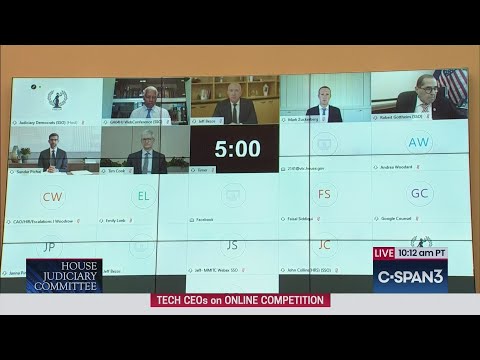
“OUR APPROACH IS WORKING. 80% OF AMERICANS HAVE A FAVORABLE IMPRESSION OF AMAZON OVERALL. WHO KNEW AMERICANS TRUST AMAZON TO DO THE RIGHT THING? ONLY THEIR DOCTORS AND THE MILITARY. THE RETAIL MARKET IS EXTRAORDINARILY LARGE AND COMPETITIVE. MORE THAN 4% OF U.S. RETAIL. THERE'S ROOM IN RETAIL FOR MULTIPLE WINNERS. WE COMPETE AGAINST LARGE PLAYERS LIKE COSTCO, KROGER AND OF COURSE, WALMART.”House Judiciary Committee hearing, 2020 · 27:00
Amazon’s power, in Bezos’s view, comes from serving customers better
Bezos’s basic answer to market power is that Amazon became large by focusing relentlessly on customers, not by starting from control. He returns again and again to customer obsession as the engine of the company’s success and links that idea to earning trust over time by doing hard things well.1
That framing matters because it shifts the test of power away from sheer size and toward customer outcomes. In his telling, the important question is whether a company keeps lowering friction, improving service, and maintaining low prices rather than whether it has simply become big.345
He also contrasts customer obsession with competitor obsession. The implication is that a company that spends its energy watching customers can keep inventing, while a company focused mainly on rivals is more likely to protect position than create value.6
He denies that Amazon sits in a winner-take-all retail market
Bezos’s antitrust defense depends heavily on market definition. He argues that retail is extraordinarily large and competitive, that Amazon represents only a small share of total U.S. retail, and that major competitors remain all around it.7
From that perspective, scale does not automatically equal monopoly. His claim is that retail has room for multiple winners, so Amazon’s size should be read as one successful position inside a broad competitive field rather than proof that competition has disappeared.7
He makes a similar point when pushed on seller alternatives, saying there are many options and that some available choices are often left out of simplified charts or narratives.8
“OUR APPROACH IS WORKING. 80% OF AMERICANS HAVE A FAVORABLE IMPRESSION OF AMAZON OVERALL. WHO KNEW AMERICANS TRUST AMAZON TO DO THE RIGHT THING? ONLY THEIR DOCTORS AND THE MILITARY. THE RETAIL MARKET IS EXTRAORDINARILY LARGE AND COMPETITIVE. MORE THAN 4% OF U.S. RETAIL. THERE'S ROOM IN RETAIL FOR MULTIPLE WINNERS. WE COMPETE AGAINST LARGE PLAYERS LIKE COSTCO, KROGER AND OF COURSE, WALMART.”House Judiciary Committee hearing, 2020 · full transcript →
The marketplace was designed to grow the pie, not keep it to Amazon alone
A central part of Bezos’s argument about market power is his story about third-party sellers. He says Amazon decided to let outside merchants sell in its store because combining Amazon’s store with outside selection would create a better customer experience.
He describes that choice as a bet that commerce on the platform would not be zero-sum. In other words, Amazon did not have to win by preventing others from succeeding; the store could become more valuable as more sellers joined and offered more products.10
This is his most direct answer to the idea that platform power must work against smaller businesses. He points to the large number of small and medium-sized businesses selling on Amazon and argues that third-party sellers, in aggregate, are doing extremely well.11
Bezos admits specific seller mistreatment can be wrong
Bezos does not answer every complaint from sellers by saying nothing is wrong. When presented with a specific anecdote about treatment of a seller, he says that kind of treatment is not acceptable and that it does not seem like the right way to treat her.12
At the same time, he separates anecdote from pattern. He says he does not fully understand the specific case as described, and he resists the conclusion that such cases prove a systematic practice of abuse across the marketplace.1415
So his position is two-part: individual failures deserve attention, but they should not be mistaken for the basic structure of the seller ecosystem. That broader structure, in his account, is one where sellers are generally thriving rather than being routinely crushed.1115

“It does not at all to me seem like the right way to treat her…”House Judiciary Committee hearing, 2020 · full transcript →
Scale is acceptable only if it keeps producing better customer outcomes
Bezos does not present scale as a virtue by itself. He treats scale as useful only when it helps a company do things customers value, such as lower prices, wider selection, personalization, and dependable execution.1645
That helps explain why he often connects market power to Day 1 culture. His worry is that large organizations can become slow, rigid, and self-protective, which would make their scale less defensible because it would stop benefiting customers in concrete ways.17
In his view, the discipline that keeps scale legitimate is preserving nimbleness, invention, and long-term thinking inside a very large company. If a big company loses those habits, it stops earning the trust that justified its position in the first place.6
Bezos on market power, in his own words
“…third-party sellers in aggregate are doing extremely well on Amazon…”
“I do not think that's systematically what's going on…”
“OUR APPROACH IS WORKING. 80% OF AMERICANS HAVE A FAVORABLE IMPRESSION OF AMAZON OVERALL. WHO KNEW AMERICANS TRUST AMAZON TO DO THE RIGHT THING? ONLY THEIR DOCTORS AND THE MILITARY. THE RETAIL MARKET IS EXTRAORDINARILY LARGE AND COMPETITIVE. MORE THAN 4% OF U.S. RETAIL. THERE'S ROOM IN RETAIL FOR MULTIPLE WINNERS. WE COMPETE AGAINST LARGE PLAYERS LIKE COSTCO, KROGER AND OF COURSE, WALMART.”
Where to watch
 Jeff Bezos on Antitrust and Market Power: Amazon, Customers, Day One2020 · 327 min · full transcriptBest single overview of Bezos’s antitrust case: customer obsession, retail competition, and why he rejects monopoly framing.
 Jeff Bezos on Amazon Marketplace Power: Antitrust Testimony2020 · 6 min · full transcriptMost direct exchange on Amazon’s marketplace power and how Bezos responds to complaints from third-party sellers.
 Jeff Bezos on Leadership: Customer Obsession and Day One2018 · 56 min · full transcriptShows the management philosophy behind his defense of scale: customer obsession, Day 1, and avoiding bureaucratic drift.
 Jeff Bezos on Customer Centricity: Invent, Lower Prices, Scale2000 · 52 min · full transcriptEarly statement of the logic Bezos later uses on market power: low prices, personalization, and customer-centric scale.
Questions people ask
- What did Jeff Bezos say about Amazon's competition in retail?
- What did Jeff Bezos say about how Amazon became successful?
- What did Jeff Bezos say about third-party sellers on Amazon?
- What did Jeff Bezos say about Amazon having monopoly power over sellers?
- What did Jeff Bezos say about Amazon not listening to small businesses?
- What did Jeff Bezos say about Amazon’s market power and monopoly claims?
Sources
Every quote above, word for word from the transcripts. Numbers match the text.
“Customer obsession has driven our success.”
“We want to be Earth's most customer-centric company.”
“We're not going to raise prices. So if you're waiting for us to raise prices, give up now.”
“What is unusual is the scale at which we're doing it.”
“…customer obsession as opposed to competitor obsession…”
“OUR APPROACH IS WORKING. 80% OF AMERICANS HAVE A FAVORABLE IMPRESSION OF AMAZON OVERALL. WHO KNEW AMERICANS TRUST AMAZON TO DO THE RIGHT THING? ONLY THEIR DOCTORS AND THE MILITARY. THE RETAIL MARKET IS EXTRAORDINARILY LARGE AND COMPETITIVE. MORE THAN 4% OF U.S. RETAIL. THERE'S ROOM IN RETAIL FOR MULTIPLE WINNERS. WE COMPETE AGAINST LARGE PLAYERS LIKE COSTCO, KROGER AND OF COURSE, WALMART.”
“Yeah, Congresswoman, with great respect, I do disagree with that. I believe that there are a lot of options, and some of them are not even listed on that chart. I just looked at it briefly, but I didn't see some that I know of, for example. So, I think there are a lot of things.”
“We were betting that it was not a zero sum game.”
“…third-party sellers in aggregate are doing extremely well on Amazon…”
“It does not at all to me seem like the right way to treat her…”
“I don't even understand what's going on in that anecdote…”
“I do not think that's systematically what's going on…”
“We want to have 20 million different stores, each store customized for that individual customer.”
“It is still Day One for this country.”
How this guide was made: drafted with AI from the full transcripts of the recordings cited, then checked: every quotation must match a transcript word for word and be the speaker's own words, and an independent review gates accuracy. Methodology and corrections.

