Jeff Bezos on Business Strategy
Bezos sees strategy as building for stable customer needs, aligning your success with theirs, and compounding advantages through experimentation, low prices, and platforms.
- Start with the customer and work backwards, not with competitors or internal preferences.
- Build strategy around durable needs like selection, low prices, and convenience.
- Create systems where you win only when customers win.
- Use platforms and flywheels to make the pie bigger, not just to take share.
- Stay in Day 1 by experimenting, moving fast, and accepting misunderstanding.
Strategy starts with customer obsession, not competitor obsession
Bezos’s core strategic idea is simple: begin with the customer and work backwards from what will genuinely make life better for them. He treats customer obsession as more fundamental than watching rivals, because customers are the most reliable source of pressure to improve.123
That leads to a specific test for strategy: are you building something that creates real customer value, or are you reacting to competitors? Bezos ties Amazon’s success to keeping promises, earning trust over time, and doing the hard work well enough that customers come back.45
Even early on, this showed up in how Amazon grew. Bezos says attention is hard to capture online, so the answer was not to rely on paid promotion but to offer enough value that customers and the press would spread the word.6
Build on what will not change
Bezos thinks strong strategy should rest on stable customer needs rather than short-term trends. He repeatedly returns to the question of what will still matter in ten years, because that is where long-lived advantage comes from.7
For Amazon, those constants are selection, low prices, and convenience. Technologies, competitive sets, and interfaces may change, but he expects those customer desires to remain stubbornly durable, which means a strategy built around them can keep compounding for a long time.8
This way of thinking also explains why he chose books first. Books made sense online because the category was vast and fragmented, which let the internet create a customer experience that physical stores could not easily match.910
Low prices and customer-aligned economics create compounding trust
Bezos does not treat low prices as a temporary tactic. He presents them as part of the strategic engine itself, because lower prices build trust, increase usage, and reinforce the value proposition over time.5
More broadly, he prefers business models where the company succeeds only when the customer does. That is why he highlights pay-as-you-go services and near-break-even hardware: they reduce friction, align incentives, and make it easier for customers to feel they are getting a fair deal.12
This view also shapes product decisions. If business terms would leave customers disappointed after purchase, Bezos would rather not sell the product that way at all. Strategy, in his framing, includes saying no to revenue that would weaken trust.13
Platforms and flywheels can make the pie bigger
Bezos sees strategy not just as selling products directly, but as building platforms that let others create value too. His defense of opening Amazon’s store to third-party sellers is that it improved selection for customers and created a larger opportunity for everyone involved.1415
That is a classic Bezos move: look for mechanisms that reinforce each other. Better selection helps customers, more customer activity attracts more sellers, and a stronger marketplace becomes harder to replicate because each side strengthens the other.1516
He argues this is not a zero-sum view of competition. In a large market, he believes multiple winners can exist, and a good strategy expands the total value created instead of assuming one player must capture everything.14
Stay in Day 1 through experimentation and patience
For Bezos, strategy is inseparable from a Day 1 mindset. As organizations scale, the danger is not only external competition but internal stasis: losing speed, nimbleness, and entrepreneurial energy.1819
That is why he links innovation to experimentation and a willingness to be misunderstood. If a company wants genuinely new outcomes, it must tolerate failed bets, unconventional ideas, and periods when outsiders do not understand what it is doing.2021
He also combines boldness with patience and disciplined execution. New fields may be at an early stage and full of possibility, but progress still comes from methodical building rather than rushing for appearances.2324
Use technology as a long-term platform, not a gimmick
Bezos treats major technologies as strategic platforms when they can change how customers interact with products for many years. His view of AI and natural language understanding is not that they replace everything else, but that they open a large new interface and set of capabilities.2526
That is why Amazon invested deeply in Alexa and opened tools for device makers and developers. The point is not just to launch a device, but to create an ecosystem that increases usefulness, attracts participation, and strengthens the platform over time.27
Even here, customer adoption is the real test. Bezos’s standard is practical usefulness, not whether a technology sounds disruptive in theory.28
Where to watch
 Jeff Bezos on Customer-Centric Innovation: AWS, Flywheels, and Space2012 · 42 min · full transcriptBest single overview of Bezos’s strategic logic: customer alignment, durable needs, flywheels, and experimentation.
 Jeff Bezos on Leadership: Customer Obsession and Day One2018 · 56 min · full transcriptShows how Day 1, customer obsession, and willingness to be misunderstood shape strategy inside a large company.
 Jeff Bezos on Customer Centricity: Invent, Lower Prices, Scale2000 · 52 min · full transcriptExplains the early Amazon model of personalization, low prices, and inventing internet-native advantages.
 Jeff Bezos on Antitrust and Market Power: Amazon, Customers, Day One2020 · 327 min · full transcriptUseful for understanding Bezos’s view of platform strategy, third-party sellers, and why scale should benefit customers.
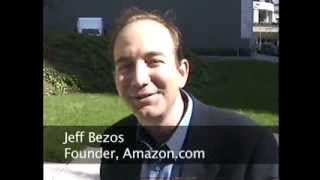 Jeff Bezos on Day One: The Early Amazon Vision1997 · 6 min · full transcriptA compact example of strategic choice: spotting a new medium and choosing an ideal first category.
 Jeff Bezos on Artificial Intelligence: We’re on the Edge of a Golden Era2016 · 80 min · full transcriptShows how Bezos thinks about turning an emerging technology into a long-term platform.
Questions people ask
- What did Jeff Bezos say about Amazon's competition in retail?
- What did Jeff Bezos say about how Amazon became successful?
- What did Jeff Bezos say about how he came up with Amazon?
- What did Jeff Bezos say about staying Day 1 at Amazon?
- What did Jeff Bezos say about the impact of artificial intelligence?
- What did Jeff Bezos say about third-party sellers on Amazon?
Sources
Every quote above, word for word from the transcripts. Numbers match the text.
“…start with the customer and work backwards…”
“…customer obsession as opposed to competitor obsession…”
“We want to be Earth's most customer-centric company.”
“Customer obsession has driven our success.”
“I WALKED AWAY FROM A STEADY JOB ON WALL STREET INTO A SEATTLE GARAGE TO FIND AMAZON, FULLY UNDERSTANDING THAT IT MIGHT NOT WORK. IT FEELS LIKE JUST YESTERDAY I WAS DRIVING THE PACKAGES TO THE POST OFFICE MYSELF, DREAM THAG ONE DAY, WE MIGHT AFFORD A FORKLIFT. CUSTOMER OBSESSION HAS DRIVEN OUR SUCCESS. I TAKE IT AS AN ARTICLE OF FAITH THAT CUSTOMERS DO THE RIGHT THING. YOU EARN TRUST SLOWLY OVER TIME BY DOING HARD THINGS WELL. DELIVERING ON TIME. OFFERING EVERY DAY LOW PRICES.”
“We didn't do any paid advertising…”
“…what's not going to change in the next 10 years…”
“The last 10 years, our competitive set has changed and the technologies have changed. So many things change, but the basic drivers of our business, the core things that customers want, do not change. You know, we know that what customers want are selection, low prices, and convenience. And I guarantee you that 10 years from now, they're still going to want selection, low prices, and convenience. We are not going to wake up 10 years from now and have customers say, "This is all well and good. I love this thing, Amazon.com, but could you make it a little less convenient?" It's just not going to happen.”
“I picked books as the first best product to sell online…”
“Well, three years ago, I was in New York City working for a quantitative hedge fund when I came across the startling statistic that web usage was growing at 2,300% a year. So, I decided I would try and find a business plan that made sense in the context of that growth. And I picked books as the first best product to sell online, while making a list of like 20 different products that you might be able to sell. And books were great as the first best because books…”
“…we should only win when our customers win…”
“And so you can always get the player on the device. The question is, can you do so with acceptable business terms? And if you can't, then we don't want to sell it to our customers because they're going to be buying it thinking they can watch Prime Video, and then they're going to be disappointed, and they're going to return it.”
“We were betting that it was not a zero sum game.”
“20 YEARS AGO, WE MADE THE DECISION TO INVITE OTHER SELLERS TO SELL IN OUR STORE. TO SHARE THE SAME VALUABLE REAL ESTATE WE SPEND BILLIONS TO BUILD MARKET AND MAINTAIN. WE BELIEVE THAT COMBINING THE STRENGTHS OF AMAZON'S STORE WITH THE VAST SELECTION OF PRODUCTS OFFERED BY THIRD PARTIES WOULD BE A BETTER EXPERIENCE FOR CUSTOMERS. AND THAT THE GROWING PIE OF REVENUE AND PROFITS WOULD BE BIG ENOUGH FOR ALL. WE WERE BETTING THAT IT WAS NOT A ZERO SUM GAME. FORTUNATELY, WE WERE RIGHT. THERE ARE NOW 1.7 MILLION SMALL AND MEDIUM U SIZED BUSINESSES SELLING ON AMAZON.”
“…third-party sellers in aggregate are doing extremely well on Amazon…”
“Well, so day one, this is a phrase that we use at Amazon all the time. I've been using it in my first annual shareholder letter from twenty years ago. And we say it's always day one, and it needs to be day one for the reason that you just mentioned. And how do you so the real question for me is how do you go about maintaining a day one culture? It's great to have the scale of Amazon. We have financial resources. We have lots of brilliant people. We can accomplish great things. We have global scopes. We have operations all over the world. But the downside of that is that you can lose your nimbleness. You can lose your entrepreneurial spirit. You can lose your that kind of heart that small companies often have. And so if you could have the best of both worlds, if you can have that entrepreneurial spirit and heart, while at the same time having all the advantages that come with scale and scope, think of the things that you could do.”
“It is still Day One for this country.”
“If you want to be an innovative company…”
“…you have to be willing to be misunderstood…”
“…slow is smooth, and smooth is fast…”
“The short answer to the question is when it's ready.”
“I think natural language understanding, I think machine learning in general, artificial intelligence, this it's probably hard to overstate how big of an impact it's going to have on society over the next twenty years.”
“Well, I think it's gigantic. I do. I think natural language understanding, I think machine learning in general, artificial intelligence, this it's probably hard to overstate how big of an impact it's going to have on society over the next twenty years. So it is big. It is it doesn't mean that phones are gonna go away or anything like that. It's not it's not like natural... It's not like voice interfaces are gonna replace screens. So, you know, people have eyes and as long as people have eyes, they will also want screens and then we have fingers, we'd like to touch things and so on. But it has been a dream ever since people started in the early days of science fiction to have a computer that you can talk to in a natural way and actually have a conversation with and ask it to do things for you.”
“We have more than 1,000 people dedicated just to Alexa and the Echo ecosystem.”
“…only thing that's disruptive is customer adoption…”
How this guide was made: drafted with AI from the full transcripts of the recordings cited, then checked: every quotation must match a transcript word for word and be the speaker's own words, and an independent review gates accuracy. Methodology and corrections.


