Jeff Bezos on Day One: The Early Amazon Vision
What Bezos talks about
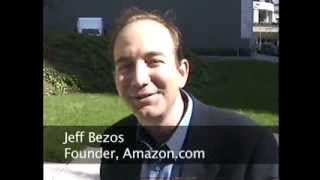
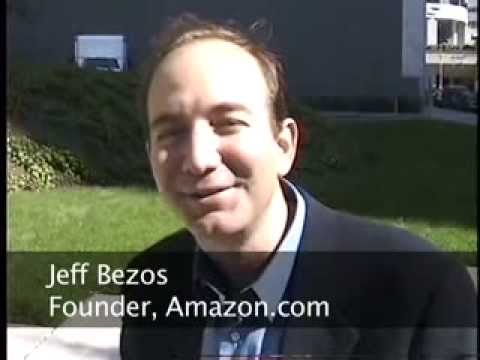
Jeff Bezos gave this interview at the Special Libraries Association conference in June 1997, explaining Amazon’s early vision, why books were its first product, and how online retail could offer unmatched selection.
Also known as: Jeff Bezos 1997 Interview (Chuck Severance); the "lost" Jeff Bezos 1997 interview; 1997 Interview with Jeff Bezos the Founder Of Amazon.
Jeff Bezos explains how he came up with Amazon by noticing explosive web growth and looking for a product category that made sense online. He argues books were ideal because the category is enormous, fragmented, and suited to an internet store that traditional retail could not match.
He also describes Amazon’s early inventory strategy, from bestselling books on hand to millions of titles supplied through wholesalers, publishers, and out-of-print searches. The interview shows how Bezos thought about selection, logistics, and customer value from the start.
Beyond books, Bezos talks about attention, word of mouth, and the importance of doing something genuinely useful and new. He frames the moment as “day one” for e-commerce, capturing the urgency and optimism of Amazon’s early culture.
An interviewer asks the questions while Bezos answers throughout.
In his words
“I picked books as the first best product to sell online”
“Attention is the scarce commodity of the late 20th century”
“We didn't do any paid advertising”
“This is day one”
“This is the Kittyhawk stage of electronic commerce”
Key points
- Bezos saw web usage growing extremely fast and looked for a business that fit that growth.
- He chose books first because the category has far more titles than almost any other product category.
- Amazon combined stocked inventory with fast, electronically ordered replenishment and direct publisher supply.
- He says capturing attention online is hard, so real customer value drives word of mouth and media exposure.
- Early Amazon advertising was minimal, but online ads became attractive because they were easy to track.
- Bezos describes the era as “day one” and compares e-commerce to the Kitty Hawk stage of aviation.
Full transcript: Jeff Bezos, Special Libraries Association interview (1997)
(music) Hi there. Who are you? I'm Jeff Bezos. And what is your claim to fame? I'm the founder of Amazon.com. Where did you get an idea for Amazon.com? Well, three years ago, I was in New York City working for a quantitative hedge fund when I came across the startling statistic that web usage was growing at 2,300% a year. So, I decided I would try and find a business plan that made sense in the context of that growth. And I picked books as the first best product to sell online, while making a list of like 20 different products that you might be able to sell. And books were great as the first best because books
are incredibly unusual in one respect, and that is that there are more items in the book category than there are items than any other category by far. Music is number two. There are about 200,000 active music CDs at any given time. But in the book space, there are more than 3 million different books worldwide active and in print at any given time across all languages, more than one and a half million in English alone. And so when you have that many items, you can literally build a store online that couldn't exist any other way. And that's important right now because the web is still an infant technology. Basically, right now, if you can do things using a more traditional method, you probably should do them using the more traditional method. What kind of inventory do you keep? We inventory, uh
the bestselling books. At any given time, we're inventorying in our own warehouse only a couple of thousand titles. And then we have—we do almost in-time inventory for another 400,000 titles or so. We get those from a network of electronic—we order electronically from a network of wholesalers and distributors. We order those today. They're on our loading dock the next morning. Then for another, uh, 1.1 million titles, we get those directly from 20,000 different publishers. And those can take a couple of weeks to get. And then there are a million out-of-print books in our catalog. We have a catalog of two and a half million books altogether. Those million out-of-print books, some of them we can get and some of them we can't, but we
find them, uh, if we can, and then we ship them to our customers. We do kind of a search on those. What's almost in-time inventory? Almost in-time inventory is the phrase we use to describe a whole selection of books that we offer. It's basically the things that are, you know, below the 2,000th bestselling book up to the 400,000th bestselling book. Those are titles that we can get from a network of more than a dozen different wholesalers. So, if a customer orders a book from us today, we order that book from our wholesalers today and the book shows up on our loading dock the next morning and then we can ship it to the customer. They say one of the toughest things to do on the internet is to capture mind share. What was your secret? How did you do that? Yeah, even more generally, I agree with you that
you know, capturing mind share on the internet is extremely difficult. Even more generally, it's the late 20th century, not just the internet. You know, capturing attention. Attention is the scarce commodity of the late 20th century. And we, one of the ways that you can do that, and it's the way that we did it, was by doing something new and innovative for the first time that actually has real value for the customer. That's a hard thing to do. But if you do do that, then newspapers will write about you, what you're doing, customers will tell other customers, and you'll get a huge sort of word-of-mouth fanout and that can really drive and accelerate businesses, and that's what happened with us in the first year of opening Amazon.com to the public. We didn't do any paid advertising and all of our growth was fueled by word of
mouth and media exposure. I saw little ads at the bottom of the column of the New York Times. That was our very first advertising. Um, we don't do that anymore, but at the very beginning, we did little tiny ads at the bottom of the front page of the New York Times. I thought that was very clever. It's sort of using a URL as a macro because I read then it expands. We're a bookstore. Click here. Right? That's a great way to think of it. And it worked very well, apparently. I don't know. You know, the problem with that kind of advertising is it's extremely difficult to track. Um, put a different URL for every—uh, that's the problem is that you want people to start to learn your URL. So you don't want to actually use a different one. And it's very, uh, easy.
One of the great things about online ads, we do advertising today in maybe 40 different, uh, on different websites. We do banner ads and that advertising is very easy to track in terms of knowing how effective it is. So, we know for each piece of creative in each venue, not only how many clickthroughs we get, but how many sell-throughs we get and how many dollars of revenue it generates per ad dollar spent on that creative in that venue. And that is a sort of a marketer's, uh, you know, nirvana in a certain sense. Well, it's an exciting place to be on the web right now. Oh, it absolutely is. I mean, it's just incredible. This is what's really incredible about this: this is day one. This is the very beginning.
This is the Kittyhawk stage of electronic commerce. We're moving forward in so many different areas, and lots of different companies are as well. And the late 20th century is just a great time to be alive. You know, we're going to find out that, I think, a millennia from now, people are going to look back and say, "Wow, the late 20th century was really a great time to be alive on this planet." (music)
From YouTube captions, lightly punctuated for readability. Timestamps link to the video above. Errors are possible.
Cite this recording
Jeff Bezos, “Special Libraries Association interview (1997)”, Special Libraries Association conference, June 1997. Transcript and video: Thinkers Archive, https://thinkersarchive.com/jeff-bezos/day-one-interview-1997/
Quoting a passage? Link to its exact moment: every timestamp above has its own anchor (for example https://thinkersarchive.com/jeff-bezos/day-one-interview-1997/#t-133).