Jeff Bezos on Entrepreneurship
Bezos treats entrepreneurship as a customer-obsessed bet on the future: start small, ride big technological shifts, make bold choices you won’t regret, and keep building for the long term.
- Take the shot when a big change creates a rare opening, because missed chances create the deepest regrets
- Founders should focus energy on customers, not competitors, and earn trust by solving real problems
- Great companies begin small and compound over time if they keep a Day One mindset
- Rapid technological change is good for startups because it weakens incumbents and rewards nimble builders
- Entrepreneurship requires invention, intuition, and the courage to be misunderstood when doing something new
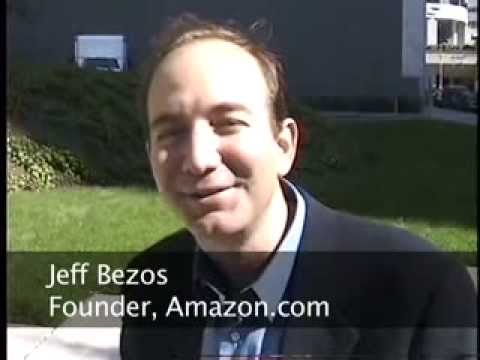
“I picked books as the first best product to sell online…”Special Libraries Association conference interview, 1997 · 0:02
Entrepreneurship starts with a choice to act before certainty arrives
Bezos’s view of entrepreneurship begins with a decision rule: when a rare opportunity appears, do not wait for perfect safety. He left a secure Wall Street job because he believed the internet created an unusually large opening, and he judged the decision by whether he would regret not trying when looking back later in life1234.
That makes entrepreneurship less about bravado and more about avoiding the biggest long-term mistake: inaction. He argues that trying and failing is often easier to live with than never attempting the thing that mattered to you, especially when you can see a major trend forming536.
The founder’s main job is obsession over customers, not competitors
Bezos returns again and again to one operating principle: put attention on customers instead of rivals. He sees this as a real advantage because many founders say they care about customers while actually reacting to competitors, which pulls energy away from invention and service78910.
In his account, customer focus is not a slogan but the source of durable success. Trust is earned slowly by doing difficult basics well, and a company grows by delivering value people genuinely want rather than by spending its time in defensive moves against other firms11.
That same logic also explains strategic choices that look generous or risky at first. He says Amazon opened its store to third-party sellers because a broader selection would be better for customers, and because entrepreneurship can create expanding markets rather than treating every gain as someone else’s loss1314.
Pick a wedge that fits the technology, then start very small
Bezos did not begin with a vague desire to build a company; he began by noticing explosive web growth and asking what kind of business fit that reality. He chose books because the category was exceptionally well suited to online retail, with more selection than physical stores could carry, making the internet meaningfully better for customers from the start1516.
That is a practical founder lesson: do not just chase excitement around a technology; find a first market where the technology creates a clear advantage. His earliest view of e-commerce was that it was still in its experimental stage, which meant founders had room to learn, adapt, and establish habits before the category matured1716.
He also emphasizes that meaningful ventures usually begin tiny. His Day One mindset is that every large institution once started with just a handful of people, and founders should stay comfortable with small beginnings because compounding comes later1819.
“I picked books as the first best product to sell online…”Special Libraries Association conference interview, 1997 · full transcript →
Build for the long term and ignore short-term noise
For Bezos, entrepreneurship is inseparable from long-term thinking. A founder who constantly reacts to daily signals, public chatter, or immediate market judgments will struggle to build something substantial, because durable value takes time to show up2021.
That long-term posture affects both strategy and temperament. He favors building a company that will be judged by what it truly becomes over time, not by short-run popularity, and he pairs that with unusual patience about starting small and letting progress accumulate2018.
This is also why he thinks founders must be willing to endure misunderstanding. If a new idea is actually new, some people will misread it, criticize it, or dismiss it, and a founder who cannot tolerate that pressure will default to convention22.
Entrepreneurs win in periods of rapid change if they stay inventive and optimistic
Bezos sees fast technological change as especially favorable to startups. His argument is straightforward: stable periods protect incumbents, while rapid change lowers the advantage of established players and gives nimble companies room to move faster2324.
That is why he is unusually optimistic about entrepreneurship. He believes moments of disruption create founder-friendly conditions, but only for builders who keep their attention on real customer needs rather than getting distracted by fashion, drama, or the current thing252624.
In practice, this means combining analysis with judgment. He says the most important decisions in business often require instinct, taste, heart, and guts alongside data, because breakthrough ideas are often things customers cannot yet ask for directly2627.
Character matters: resourcefulness, kindness, and courage shape the company you build
Bezos does not treat entrepreneurship as purely analytical. He repeatedly connects building to personal qualities: resourcefulness, the courage to try, and the discipline to make hard choices rather than relying only on talent or intelligence2829.
One of his most consistent moral claims is that kindness matters more than cleverness. For founders, that idea points to culture as much as ethics: how you treat people, how you respond under stress, and whether you uplift others become part of the institution you are creating31283233.
He also frames entrepreneurship as deeply personal work. The strongest ventures often come from genuine interest and calling, not from chasing whatever is fashionable, because conviction helps you persist through the long periods when the path is unclear3435.
Bezos on entrepreneurship, in his own words
“There's never been a better moment to be an entrepreneur.”
“…you need to harness that energy primarily on your customers instead of on your competitors…”
Where to watch
 Jeff Bezos on Customer Obsession: Why Amazon, Not Competitors, Wins2018 · 49 min · full transcriptBest single statement of his founder philosophy: customer obsession over competitor obsession, plus the need to tolerate misunderstanding.
 Jeff Bezos on Regret Minimization: Why He Chose Books1997 · 14 min · full transcriptBest short explanation of the regret minimization framework and why he chose to start Amazon.
 Jeff Bezos on Regret Minimization: Why He Left Wall Street2001 · 48 min · full transcriptAdds the fuller story of leaving Wall Street, seeing web growth, and building Amazon step by step.
 Jeff Bezos on Leadership and Long-Term Thinking2018 · 71 min · full transcriptBest on long-term thinking, Day One, and the role of intuition in major entrepreneurial decisions.
 Jeff Bezos on Day One: The Early Amazon Vision1997 · 6 min · full transcriptShows how he matched a huge technological trend with a specific first product and go-to-market logic.
 Jeff Bezos on AI and Space Futures: Optimistic, Long-Term, Bold2025 · 64 min · full transcriptMost direct on why rapid change favors startups and why this is a strong moment to build.
Questions people ask
- What advice did Jeff Bezos give college graduates about choosing a career?
- What did Jeff Bezos mean by Day 1?
- What did Jeff Bezos say about customer obsession and intuition?
- What did Jeff Bezos say about dealing with competitors and criticism?
- What did Jeff Bezos say about finding your calling?
- What did Jeff Bezos say about regret minimization when he left Wall Street?
Sources
Every quote above, word for word from the transcripts. Numbers match the text.
“It was a regret minimization framework.”
“I don't go in for carpe diem. I go in for regret minimization framework, absolutely.”
“Most regrets, by the way, are acts of omission and not commission.”
“Was what I called—which only a nerd would call—a regret minimization framework. So I wanted to project myself forward to age 80 and say, okay, now I'm looking back on my life. I want to have minimized the number of regrets I have. And, you know, I knew that when I was 80 I was not going to regret having tried this. I was not going to regret having wanted, you know, trying to participate in this thing called the Internet, that I thought was going to be a really big deal. I knew that if I failed, I wouldn't.”
“I didn't think I'd regret trying and failing, and I suspected I would always be haunted by a decision to not try at all.”
“Seen in that light, it really was a difficult choice. But ultimately, I decided I had to give it a shot. I didn't think I'd regret trying and failing, and I suspected I would always be haunted by a decision to not try at all. After much consideration, I took the less safe path to follow my passion. And I'm proud of that choice.”
“…you need to harness that energy primarily on your customers instead of on your competitors…”
“Look, it's okay to be afraid but don't be afraid of our competitors…”
“I said, "Look, it's okay to be afraid "but don't be afraid of our competitors "because they're never gonna send us any money, "be afraid of our customers. "And if we just stay focused on them "instead of obsessing over this big competitor "that we just got, we'll be fine." And I really do believe that. I think that if you stay focused and the more drama there is and everything else, no matter what the drama is, whatever the external distraction is, your response to it should be to double down on the customer, satisfying them, not just satisfying them, delighting them.”
“The number one thing that has made us successful by far is obsessive compulsive focus on the customer as opposed to obsession over the competitor. And I talk so often to other CEOs and some other CEOs and also founders and entrepreneurs. And I can tell that even though they're talking about customers, they're really focusing on competitors. And it is a huge advantage to any company if you can stay focused on your customer instead of your competitors. So then you have to identify who is your customer.”
“Customer obsession has driven our success.”
“We were betting that it was not a zero sum game.”
“20 YEARS AGO, WE MADE THE DECISION TO INVITE OTHER SELLERS TO SELL IN OUR STORE. TO SHARE THE SAME VALUABLE REAL ESTATE WE SPEND BILLIONS TO BUILD MARKET AND MAINTAIN. WE BELIEVE THAT COMBINING THE STRENGTHS OF AMAZON'S STORE WITH THE VAST SELECTION OF PRODUCTS OFFERED BY THIRD PARTIES WOULD BE A BETTER EXPERIENCE FOR CUSTOMERS. AND THAT THE GROWING PIE OF REVENUE AND PROFITS WOULD BE BIG ENOUGH FOR ALL. WE WERE BETTING THAT IT WAS NOT A ZERO SUM GAME. FORTUNATELY, WE WERE RIGHT. THERE ARE NOW 1.7 MILLION SMALL AND MEDIUM U SIZED BUSINESSES SELLING ON AMAZON.”
“I picked books as the first best product to sell online…”
“Well, three years ago, I was in New York City working for a quantitative hedge fund when I came across the startling statistic that web usage was growing at 2,300% a year. So, I decided I would try and find a business plan that made sense in the context of that growth. And I picked books as the first best product to sell online, while making a list of like 20 different products that you might be able to sell. And books were great as the first best because books…”
“This is the Kittyhawk stage of electronic commerce…”
“Day one. Everything I've ever done has started small.”
“It's day one. Everything I've ever done has started small. Amazon started with a couple of people and, Blue Origin started with five people. And, the budget at Blue Origin was very, very small. Now the budget at Blue Origin approaches $1,000,000,000 a year. Next year, will be more than $1,000,000,000. So in Amazon, it literally was 10 people. Today, it's zero five million people, but you, it's hard to remember for you guys. But for me, it's like yesterday, I was driving the packages to the post office myself and, hoping one day we could afford a forklift. And so for me, I've seen small things get big and it's part of this day one mentality. I like treating things as if they're small. Amazon, even though it is a large company, I wanted to have the heart and spirit of a small one.”
“In the short run, the stock market is a voting machine. In the long run, it's a weighing machine.”
“Never spend any time thinking about the daily stock price. I don't.”
“If you can't afford to be misunderstood, then for goodness sake, don't do anything new or innovative.”
“There's never been a better moment to be an entrepreneur.”
“And of course, startup companies, small companies thrive in moments of great and rapid change. Stability favors incumbents and rapid change favors small, dynamic, nimble startup companies. And so the world is so rapidly changing right now. There's never been a better moment to be an entrepreneur. There has never been a better moment to be a startup company.”
“I have never been more optimistic about our future.”
“The touchstone, the thing you always go back to is those customer needs. So that's the only way that I could advise any founder or entrepreneur is to deeply understand what are the big ideas that their customers want. And you can't you should ask them, ask your customers, but it's not sufficient. You also have to invent on their behalf because the biggest breakthroughs, the most important ideas customers don't know to ask. They don't know to ask for those things. That's why... Dream. You have to dream, and you have to use your intuition and your gut and your heart. All of the data that gets used in business is essential.”
“All of my best decisions in business and in life have been made with heart, intuition, guts, analysis. When you can make a decision with analysis, you should do so. But it turns out in life that your most important decisions are always made with instinct, intuition, taste, heart. And that's what we'll do with this Day one Foundation, too.”
“Cleverness is a gift. Kindness is a choice.”
“In the end, we are our choices.”
“It's harder to be kind than clever.”
“It's harder to be kind than it is to be clever.”
“If you're... If meaning only... If you only get meaning because you're the best in the world or something, then very few of us are gonna have meaning in our lives. There isn't gonna be a lot of meaning. And, really, your meaning is coming from your relationships, know, uplifting people. So like, if you if you think about... By the way, the uplifting can be very local. Do you think... It's like if you're just uplifting your brother and sister, you're uplifting your kids, you're uplifting, you know, your friends and and the people in your community, you're gonna get meaning from that.”
“Well first of all, what I would say is-- the best advice I can give somebody, is do something that you think is interesting. And let the waves catch you. Something that I see people do, which I don't think is a good idea, is they try to chase the current thing.”
“You don't choose your passions, your passions choose you. And all of us are gifted with certain passions, and the people who are lucky are the ones who get to follow those things. And I always advise our young employees and meet with interns and so on, you can have and my kids to you can have a job or you can have a career or you can have a calling. And if you can somehow figure how to have a calling, you have hit the jackpot because that's the big deal. And most people don't ever get there. You're very lucky if you have a career. A lot of people end up with a job. And for me, I have been interested in rockets, space travel, propulsion since I was a five year old boy, and I have spent a tremendous amount of time thinking about it.”
How this guide was made: drafted with AI from the full transcripts of the recordings cited, then checked: every quotation must match a transcript word for word and be the speaker's own words, and an independent review gates accuracy. Methodology and corrections.


