Jeff Bezos on Customer Obsession
Bezos treats customer obsession as a practical operating system: focus on enduring customer needs, invent on their behalf, and let that pull the company forward over the long term.
- Start with customers, not competitors
- Customer centricity means listen, invent, and personalize
- Build around needs that do not change: low prices, selection, and convenience
- Innovation requires long-term thinking and willingness to be misunderstood
- A company should only win when customers win

“…you need to harness that energy primarily on your customers instead of on your competitors…”Berlin interview, 2018 · 1:45
Customer obsession means aiming your energy at customers, not rivals
Bezos draws a sharp line between customer obsession and competitor obsession. His basic claim is that companies gain an advantage when they put their attention on what customers need instead of reacting to rival moves123.
He does not say competitors are irrelevant. He says fear and urgency should be directed toward serving customers better, because competitors do not sustain a business; customers do45.
This is also how he explains Amazon’s success. He repeatedly ties the company’s progress to an unusually intense focus on customers rather than to market power or defensive strategy6.
“…you need to harness that energy primarily on your customers instead of on your competitors…”Berlin interview, 2018 · full transcript →
His formula for customer centricity is listen, invent, and personalize
Bezos gives a simple three-part definition of customer centricity: listen, invent, and personalize89. Listening matters because companies need direct contact with what customers value and where they feel friction89.
But listening alone is not enough in his view. He argues that customers often cannot specify the biggest breakthroughs in advance, so companies must invent on their behalf and use judgment, intuition, and imagination to create what will truly help them109.
Personalization completes the model. Bezos wants customer experiences shaped to the individual rather than treated as one-size-fits-all, which is why he emphasizes customized stores and tailored experiences at scale1112.

“It means listen, invent, and personalize.”MIT talk, 2011 · full transcript →
Obsessing over customers works because customer needs stay stable
A big reason Bezos trusts this approach is that many important customer desires barely change. He says the core things customers want remain stable even as technologies and competitors change131415.
The stable needs he points to are selection, low prices, and convenience. His logic is that if you build around those durable wants, you can make long-term investments with confidence because customers will not suddenly ask for worse convenience or higher prices15.
This is why customer obsession is not just a slogan for him. It becomes a strategic anchor: identify what will still matter in ten years, then organize invention and operations around delivering more of it1413.

“…the core things that customers want, do not change.”D6, Carlsbad, 2008 · full transcript →
Customer obsession demands invention, experimentation, and courage
Bezos connects customer obsession directly to invention. If customers always want better experiences, then a company has to keep creating new solutions instead of merely protecting what already works1617.
That leads to a culture of experimentation. He argues that innovative companies need a high rate of experiments, and that teams must be willing to try new things even when the path is unclear or critics disagree1920.
He also links this to working backward from the customer. Sometimes invention starts with a known customer problem; other times a new technology appears and a team works backward to find the right customer use for it2122. In both cases, the test is whether the result genuinely improves the customer experience2324.

“…start with the customer and work backwards…”AWS re:Invent fireside chat, Las Vegas, 2012 · full transcript →
In practice, this shows up in prices, platform choices, and long-term trust
Bezos treats customer obsession as something customers can feel in concrete outcomes. He ties trust to doing hard things well over time, including reliable delivery and everyday low prices25.
He also uses it to justify big business design choices. For example, he says Amazon invited third-party sellers into its store because combining Amazon’s store with broader outside selection would create a better experience for customers, and he believed the gains would not have to be zero-sum2627.
The same logic appears in his product thinking. Kindle was designed around the specific job of long-form reading rather than trying to be everything at once, which reflects his habit of defining the customer clearly and building to that need24. Across businesses, the pattern is the same: Amazon should only win when customers win29.
“…we should only win when our customers win…”AWS re:Invent fireside chat, Las Vegas, 2012 · full transcript →
Bezos on customer obsession, in his own words
“…you need to harness that energy primarily on your customers instead of on your competitors…”
“It means listen, invent, and personalize.”
“…we should only win when our customers win…”
“…start with the customer and work backwards…”
“…the core of the company is customer obsession as opposed to competitor obsession…”
“…customers are always dissatisfied. They always want more…”
Where to watch
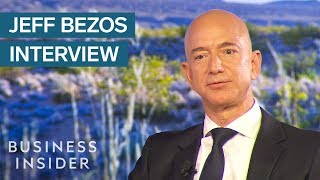 Jeff Bezos on Customer Obsession: Why Amazon, Not Competitors, Wins2018 · 49 min · full transcriptBest single explanation of why Bezos wants leaders to focus on customers instead of competitors.
 Jeff Bezos on Customer Centricity: Listen, Invent, Personalize2011 · 82 min · full transcriptMost complete definition of customer centricity as listening, inventing, and personalizing.
 Jeff Bezos on Customer Obsession: Leaning Into the Future2016 · 37 min · full transcriptShows how customer obsession creates constant pressure to keep inventing and leaning into the future.
 Jeff Bezos on Customer-Centric Innovation: AWS, Flywheels, and Space2012 · 42 min · full transcriptExplains how working backward from the customer shapes business models, incentives, and experimentation.
 Jeff Bezos on Leadership: Customer Obsession and Day One2018 · 56 min · full transcriptConnects customer obsession to Day 1 culture, leadership, and staying nimble at scale.
 Jeff Bezos on Innovation at Amazon: Customer-Centric Experiments2008 · 50 min · full transcriptUseful for understanding how Bezos links invention and cheap experimentation to better customer outcomes.
Questions people ask
- What did Jeff Bezos say about customer obsession and intuition?
- What did Jeff Bezos say about dealing with competitors and criticism?
- What did Jeff Bezos say about how Amazon became successful?
- What did Jeff Bezos say about staying Day 1 at Amazon?
- What did Jeff Bezos say about third-party sellers on Amazon?
- What did Jeff Bezos say customer centricity means at Amazon?
Sources
Every quote above, word for word from the transcripts. Numbers match the text.
“…you need to harness that energy primarily on your customers instead of on your competitors…”
“…customer obsession as opposed to competitor obsession…”
“The number one thing that has made us successful by far is obsessive compulsive focus on the customer as opposed to obsession over the competitor. And I talk so often to other CEOs and some other CEOs and also founders and entrepreneurs. And I can tell that even though they're talking about customers, they're really focusing on competitors. And it is a huge advantage to any company if you can stay focused on your customer instead of your competitors. So then you have to identify who is your customer.”
“Look, it's okay to be afraid but don't be afraid of our competitors…”
“I said, "Look, it's okay to be afraid "but don't be afraid of our competitors "because they're never gonna send us any money, "be afraid of our customers. "And if we just stay focused on them "instead of obsessing over this big competitor "that we just got, we'll be fine." And I really do believe that. I think that if you stay focused and the more drama there is and everything else, no matter what the drama is, whatever the external distraction is, your response to it should be to double down on the customer, satisfying them, not just satisfying them, delighting them.”
“Customer obsession has driven our success.”
“It means listen, invent, and personalize.”
“It means listen, invent, and personalize. The basic idea is you can't really run a business of any kind, I think in most people's opinion, if you're not going to listen to your customers. That sort of fundamental. But invention is equally important. And invention, it goes far beyond listening to customers. Because oftentimes, customers don't really know what it is that they want. It's your job to invent on their behalf and we've done a tremendous amount of invention and innovation of different kinds in the company. I'll tell you a little bit more about that when I give you the live demo. And then finally personalization. The notion of customer centricity is to build a place where each individual customer has his or her own website. And to do that in large part, not by explicit information that the customer provides, but through implicit observation of their behavior on the website.”
“The touchstone, the thing you always go back to is those customer needs. So that's the only way that I could advise any founder or entrepreneur is to deeply understand what are the big ideas that their customers want. And you can't you should ask them, ask your customers, but it's not sufficient. You also have to invent on their behalf because the biggest breakthroughs, the most important ideas customers don't know to ask. They don't know to ask for those things. That's why... Dream. You have to dream, and you have to use your intuition and your gut and your heart. All of the data that gets used in business is essential.”
“We want to have 20 million different stores, each store customized for that individual customer.”
“What is unusual is the scale at which we're doing it.”
“…the core things that customers want, do not change.”
“…what's not going to change in the next 10 years…”
“The last 10 years, our competitive set has changed and the technologies have changed. So many things change, but the basic drivers of our business, the core things that customers want, do not change. You know, we know that what customers want are selection, low prices, and convenience. And I guarantee you that 10 years from now, they're still going to want selection, low prices, and convenience. We are not going to wake up 10 years from now and have customers say, "This is all well and good. I love this thing, Amazon.com, but could you make it a little less convenient?" It's just not going to happen.”
“…customers are always dissatisfied. They always want more…”
“You have to always be leaning into the future.”
“If you can't afford to be misunderstood, then for goodness sake, don't do anything new or innovative.”
“…you have to be willing to be misunderstood…”
“…start with the customer and work backwards…”
“You see a new technology or there's something out there, some new understanding in the world, and you work backward from a solution to find the appropriate problem.”
“…what we want to do is have the world's best customer experience…”
“Our job is to design a perfect device.”
“We're not going to raise prices. So if you're waiting for us to raise prices, give up now.”
“We were betting that it was not a zero sum game.”
“20 YEARS AGO, WE MADE THE DECISION TO INVITE OTHER SELLERS TO SELL IN OUR STORE. TO SHARE THE SAME VALUABLE REAL ESTATE WE SPEND BILLIONS TO BUILD MARKET AND MAINTAIN. WE BELIEVE THAT COMBINING THE STRENGTHS OF AMAZON'S STORE WITH THE VAST SELECTION OF PRODUCTS OFFERED BY THIRD PARTIES WOULD BE A BETTER EXPERIENCE FOR CUSTOMERS. AND THAT THE GROWING PIE OF REVENUE AND PROFITS WOULD BE BIG ENOUGH FOR ALL. WE WERE BETTING THAT IT WAS NOT A ZERO SUM GAME. FORTUNATELY, WE WERE RIGHT. THERE ARE NOW 1.7 MILLION SMALL AND MEDIUM U SIZED BUSINESSES SELLING ON AMAZON.”
“…we should only win when our customers win…”
How this guide was made: drafted with AI from the full transcripts of the recordings cited, then checked: every quotation must match a transcript word for word and be the speaker's own words, and an independent review gates accuracy. Methodology and corrections.


