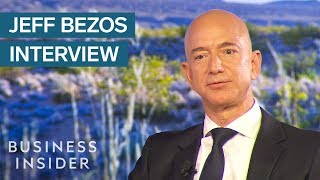
Jeff Bezos on Innovation
Bezos sees innovation as customer-driven experimentation: keep inventing around durable customer needs, make many low-cost bets, and accept misunderstanding on the way to long-term wins.
- Innovation starts with customers, not competitors.
- More invention requires more experiments, and many failures are the price of a few big wins.
- The best innovators focus on what will not change in customer needs over long periods.
- New technology creates opportunity, but it still has to solve a real problem for customers.
- Innovators must move fast on reversible decisions and be willing to be misunderstood.

Innovation begins with customer obsession
For Bezos, innovation is not mainly about having novel technology first. It starts by orienting the whole company around customers rather than rivals, because customers create the clearest and most durable pull toward better products and services. That is why he defines the core stance as customer obsession, not competitor obsession.123
This mindset changes how ideas are generated. Instead of asking what competitors are doing, he asks what customers need and then works backward from that. He also ties innovation to alignment: a company should succeed when the customer succeeds, not by trapping customers or exploiting short-term advantages.45
He believes customers are a powerful engine for invention because they never stop wanting better experiences. Their dissatisfaction is useful: it keeps a company leaning into the future instead of defending the present.67
Great innovation anchors on needs that do not change
Bezos pairs invention with a surprisingly conservative question: what will still matter in ten years? His point is that while technologies and competitors change constantly, some customer desires are stable enough to build around for decades. That stability gives innovators a strong foundation for long-term bets.89
He repeatedly returns to the idea that customers will keep wanting better selection, lower prices, and more convenience. If you know those needs are enduring, you can keep inventing toward them with confidence. Innovation then becomes less about chasing fashion and more about serving durable human preferences better and better.1011
This also explains why he is comfortable making large investments in new platforms or capabilities. The surface form may change, but the underlying job for the customer stays recognizable.126
More experiments are the engine of invention
Bezos is unusually explicit that invention is a numbers game. If you want more innovation, you need more experiments over time. That means the practical challenge is not only generating ideas, but building an organization where trying things is normal and affordable.13
He treats failure as inseparable from this process. Many experiments will not work, and that is acceptable because a small number of successes can more than compensate for many misses. The implication is that companies kill innovation when they demand certainty too early or punish every failed test as if it were bad execution.1415
That is why he favors making experiments cheap and accessible to small teams. When the cost of trying goes down, the pace of learning goes up, and invention spreads beyond a small central group.13
Innovation needs structures that help ideas survive bureaucracy
Bezos does not think experimentation happens automatically in large organizations. Big systems tend to slow ideas down, flatten decision types together, and push everything through the same hierarchy. His answer is to create multiple paths to yes so promising ideas can move forward without needing perfect top-down sponsorship from the start.16
He also distinguishes between different kinds of decisions. Reversible decisions should be made quickly, because the cost of delay often exceeds the cost of being wrong. Irreversible decisions deserve slower, more careful judgment. Treating every decision as heavyweight is, in his view, a major innovation killer.17
This is part of his broader Day 1 logic. As organizations grow, they gain resources but risk losing nimbleness and entrepreneurial spirit. Protecting speed and initiative is therefore not a cultural extra; it is central to continued invention.18
“You want multiple paths to yes.”Air, Space and Cyber Conference, 2018 · full transcript →
Innovators must tolerate misunderstanding and lean into new technology
Bezos connects innovation with a social cost: if you are doing something genuinely new, some people will not understand it for a while. He treats that as normal rather than alarming. The willingness to be misunderstood is part of the psychological equipment needed for original work.19
At the same time, he is enthusiastic about major technological shifts because they open new building blocks for entrepreneurs. He sees fields like AI and machine learning as transformative, not because novelty is good by itself, but because new capabilities can unlock entirely new customer experiences.12202122
Still, he does not equate innovation with technology theater. New capabilities matter when they help real adoption and solve real problems. In that sense, even disruptive technologies are judged by whether customers actually embrace them.232425

“…you have to be willing to be misunderstood…”Forum on Leadership, Dallas, 2018 · full transcript →
Bezos on innovation, in his own words
“…you have to be willing to be misunderstood…”
“The winners, when you're doing these experiments, winners pay for thousands of losers.”
“Never, ever, ever lean away from the future.”
Where to watch
 Jeff Bezos on Innovation and Leadership: Experiment, Decide Fast2018 · 50 min · full transcriptBest single explanation of Bezos's operating logic for innovation: experiment more, separate decision types, and create paths to yes.
 Jeff Bezos on Innovation at Amazon: Customer-Centric Experiments2008 · 50 min · full transcriptShows how Bezos thinks invention starts, why cheap experiments matter, and how customer-focused innovation works in practice.
 Jeff Bezos on Customer-Centric Innovation: AWS, Flywheels, and Space2012 · 42 min · full transcriptConnects innovation to customer alignment, long-term thinking, stable needs, and willingness to fail.
 Jeff Bezos on Leadership: Customer Obsession and Day One2018 · 56 min · full transcriptExplains the cultural side of innovation: customer obsession, Day 1, and being willing to be misunderstood.
 Jeff Bezos on Customer Obsession: Leaning Into the Future2016 · 37 min · full transcriptA concise view of why customers keep pulling a company to invent and why you must lean into the future.
 Jeff Bezos on Artificial Intelligence: We’re on the Edge of a Golden Era2016 · 80 min · full transcriptUseful for seeing how Bezos evaluates emerging technology as a platform for future innovation.
Questions people ask
- What did Jeff Bezos say about customer obsession and intuition?
- What did Jeff Bezos say about staying Day 1 at Amazon?
- What did Jeff Bezos say about why this is a great time to start a company?
- What did Jeff Bezos say customers want from Amazon?
- Why does Jeff Bezos say large companies make decisions slowly?
- What did Jeff Bezos say about his most important long-term work?
Sources
Every quote above, word for word from the transcripts. Numbers match the text.
“…customer obsession as opposed to competitor obsession…”
“…the core of the company is customer obsession as opposed to competitor obsession…”
“We want to be Earth's most customer-centric company.”
“…start with the customer and work backwards…”
“…we should only win when our customers win…”
“You have to always be leaning into the future.”
“…customers are always dissatisfied. They always want more…”
“…what's not going to change in the next 10 years…”
“…the core things that customers want, do not change.”
“The last 10 years, our competitive set has changed and the technologies have changed. So many things change, but the basic drivers of our business, the core things that customers want, do not change. You know, we know that what customers want are selection, low prices, and convenience. And I guarantee you that 10 years from now, they're still going to want selection, low prices, and convenience. We are not going to wake up 10 years from now and have customers say, "This is all well and good. I love this thing, Amazon.com, but could you make it a little less convenient?" It's just not going to happen.”
“We're not going to raise prices. So if you're waiting for us to raise prices, give up now.”
“I think natural language understanding, I think machine learning in general, artificial intelligence, this it's probably hard to overstate how big of an impact it's going to have on society over the next twenty years.”
“If you want to have more invention, you need to do more experiments per week, per month, per year, per decade.”
“The winners, when you're doing these experiments, winners pay for thousands of losers.”
“If you want to be an innovative company…”
“You want multiple paths to yes.”
“And the reason is you start making all decisions as if they're all the same size. It's like one size fits all thinking. And you know if you have a one size fits all robe, it never fits. And so there are different decisions that should be made in different ways. There are giant decisions which are consequential and irreversible or almost irreversible. Super hard to reverse.”
“Well, so day one, this is a phrase that we use at Amazon all the time. I've been using it in my first annual shareholder letter from twenty years ago. And we say it's always day one, and it needs to be day one for the reason that you just mentioned. And how do you so the real question for me is how do you go about maintaining a day one culture? It's great to have the scale of Amazon. We have financial resources. We have lots of brilliant people. We can accomplish great things. We have global scopes. We have operations all over the world. But the downside of that is that you can lose your nimbleness. You can lose your entrepreneurial spirit. You can lose your that kind of heart that small companies often have. And so if you could have the best of both worlds, if you can have that entrepreneurial spirit and heart, while at the same time having all the advantages that come with scale and scope, think of the things that you could do.”
“…you have to be willing to be misunderstood…”
“I think we're on the edge of a golden era.”
“There's never been a better moment to be an entrepreneur.”
“And of course, startup companies, small companies thrive in moments of great and rapid change. Stability favors incumbents and rapid change favors small, dynamic, nimble startup companies. And so the world is so rapidly changing right now. There's never been a better moment to be an entrepreneur. There has never been a better moment to be a startup company.”
“You see a new technology or there's something out there, some new understanding in the world, and you work backward from a solution to find the appropriate problem.”
“…only thing that's disruptive is customer adoption…”
“The touchstone, the thing you always go back to is those customer needs. So that's the only way that I could advise any founder or entrepreneur is to deeply understand what are the big ideas that their customers want. And you can't you should ask them, ask your customers, but it's not sufficient. You also have to invent on their behalf because the biggest breakthroughs, the most important ideas customers don't know to ask. They don't know to ask for those things. That's why... Dream. You have to dream, and you have to use your intuition and your gut and your heart. All of the data that gets used in business is essential.”
How this guide was made: drafted with AI from the full transcripts of the recordings cited, then checked: every quotation must match a transcript word for word and be the speaker's own words, and an independent review gates accuracy. Methodology and corrections.