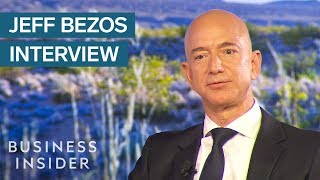
Jeff Bezos on Space
Bezos sees space as long-term infrastructure for moving heavy industry and energy generation off Earth so civilization can keep growing while preserving the planet.
- Space is not an escape from Earth; Earth must be saved while space helps relieve its constraints.
- His core goal is a space economy: reusable transport, lunar resources, orbital industry, and large habitats over time.
- He thinks the Moon is the practical next step because it can support operations farther out.
- The bottleneck is not one heroic rocket but scalable, reliable infrastructure and manufacturing.
- His whole case depends on long-term thinking, experimentation, and refusing to call ambitious goals impossible too quickly.

Space is for preserving Earth, not abandoning it
Bezos’s starting point is that Earth is irreplaceable. He argues that humanity does not get a backup planet and should treat saving Earth as non-negotiable, even while building beyond it12.
That leads to a specific role for space: not a luxury side project, and not a fantasy of escape, but a way to move some energy-intensive and polluting industry off the planet over the long run23. In his view, space expansion is a tool for protecting Earth while allowing civilization to keep advancing12.
“There is no plan b. We have to save Earth.”CNBC Squawk Box interview, 2026 · full transcript →
His real vision is a vast space economy
Bezos is not mainly talking about isolated missions. He imagines an economy in space with manufacturing, energy production, computing, and settlement spread across the solar system34.
At the largest scale, he describes millions to billions more people living off Earth, including in large O’Neill-style habitats built from extraterrestrial materials4. He sees those habitats as more scalable than simply spreading across planetary surfaces, and he expects industry and infrastructure to be built from lunar, asteroid, and near-Earth resources43.
This is why he frames his work around enabling infrastructure rather than just launching rockets. The destination is not a single landing; it is a durable industrial system that lets human activity expand beyond Earth without exhausting Earth itself5.
Reusable infrastructure is the foundation
For Bezos, the basic technical requirement is lowering the cost of access to space through true reusability. He emphasizes operations that can fly again with minimal refurbishment, more like an airline than a bespoke expedition.
He treats reliability and operational discipline as essential, especially for human flight. Progress should be careful enough to be dependable, because the point is not a dramatic one-off success but a system that can be used repeatedly at scale.
That is also why he focuses on manufacturing capacity and system-building. His argument is that space progress will come from producing hardware repeatedly, learning from each flight, and building the organizations and factories that sustain high flight rates.
The Moon comes before Mars in his roadmap
Bezos argues for a moon-first strategy. The reason is practical: the Moon is closer, easier to reach, and useful as a staging ground for later expansion.
He points in particular to lunar resources, especially water ice that could eventually be processed into oxygen and hydrogen for propellant and life support uses. In his framework, the Moon is not just a destination to visit; it is an early supply base for a broader space economy3.
So while he includes Mars in the long-term future, he does not treat Mars-first as the most efficient path. He prefers building step by step, using nearby resources to create a sustainable operating architecture3.

“I totally disagree with this point of view.”VivaTech conference talk, Paris, 2026 · full transcript →
The mindset is long-term, experimental, and optimistic
Bezos’s space thinking rests on a broader philosophy: ambitious problems become solvable when people extend their time horizon. He argues that long-term thinking changes what can be built and that institutions usually think on far too short a scale8.
He also believes progress requires experimentation and many attempts, because breakthroughs pay for many failures. That makes space development less about a single perfect plan and more about sustained trial, learning, and iteration910.
Underlying all of this is a strong optimism about invention. He is wary of declaring big goals impossible and sees hard technical challenges as things that can be pulled forward with persistence, inventiveness, and enough repetitions111213.
Bezos on space, in his own words
“There is no plan b. We have to save Earth.”
“I have come to use the word impossible with great caution.”
“Space travel is a solved problem for six decades.”
Where to watch
 Jeff Bezos on Long-Term Thinking: Space, Decisions, and Mortality2023 · 132 min · full transcriptBest single overview of why Bezos cares about space, how Apollo shaped him, and why he thinks on civilization-scale timelines.
 Jeff Bezos on Space Economy: Moon First, Build in Space2026 · 171 min · full transcriptBest for his concrete roadmap: reusability, manufacturing, the Moon-first case, and building a real space economy.
 Jeff Bezos on Reusable Spaceflight: New Shepard and New Glenn2017 · 27 min · full transcriptBest for understanding his operational view of reusable spaceflight and why routine flight matters more than spectacle.
 Jeff Bezos on Growth and Space: Save Earth, Build Upward2026 · 66 min · full transcriptBest for the Earth-first part of his argument: space development is meant to help preserve Earth, not replace it.
 Jeff Bezos on Innovation and Leadership: Experiment, Decide Fast2018 · 50 min · full transcriptBest for the management logic behind the space vision: experiment more, decide well, and create paths for bold ideas.
Questions people ask
- What did Jeff Bezos say about building compute and industry in space?
- What did Jeff Bezos say about long-term thinking?
- What did Jeff Bezos say about whether there is a plan B for Earth?
- What is Jeff Bezos's vision for humanity in space?
- What did Jeff Bezos say about his most important long-term work?
- What does Jeff Bezos think about the future of humanity?
Sources
Every quote above, word for word from the transcripts. Numbers match the text.
“There is no plan b. We have to save Earth.”
“No. We have to save... So so first of all, there is no plan b. We have to save Earth. So we've sent robotic probes to all of the planets in this solar system. This is the good one. And and we must save it. We cannot... Look. We can live. We can choose how we want to live. We could... It is not impossible. If you think about climate change and so on, some of the issues that we face here because of the way way we're doing things currently, you could imagine a world with enough technological sophistication where we can turn Earth into sort of a giant spaceship, you know, like air conditioned…”
“First, Mars and everywhere else too. And we'll build large O'Neill, Jerry O'Neil style colonies in space as well. Yeah. And and we'll build big, you know, we'll use asteroids and near earth objects and the moon and so on to build compute in space and solar cells in space and so on. And a lot of our compute will be done in space. It will make more sense. And ultimately, we even manufacture the chips that the compute runs on. And then the answers can just be beamed back to us here. And this planet, Dave said it before, but our long term vision, our dream is that all the polluting industry can be done off Earth. If space travel gets reliable enough and inexpensive enough and we can get materials from asteroids and near Earth objects and the moon, then this garden planet can be returned to its pre industrial revolution state.”
“Yeah. The only way to get to that vision is with giant space stations. You know, the planetary surfaces are just way too small. So you can... I mean, unless you turn them into giant space stations or something. But but, yeah, we will take materials from the moon and from near earth objects and from the asteroid belt and so on, and we'll build giant O'Neill style colonies, and people will live in those. And they have a lot of advantages over planetary surfaces. You can spin them to get normal earth gravity. You can put them where you want them. I think most people are gonna wanna live near Earth, not necessarily in Earth orbit, but in, you know, Earth... But near Earth vicinity orbits. And so they can move, you know, relatively quickly back and forth between their station and Earth.”
“But long term, the thing, if you take a really long run view, many decades, maybe even a couple of hundred years, I think the most important work that I'm doing, and I get increasing conviction on this with every passing year, is the work I'm doing at Blue Origin on space travel.”
“Long term thinking is a giant lever. You can literally solve problems if you think long term that are impossible to solve if you think short term. And we aren't really good at thinking long term. As... You know, it's not really... You were kind of... You know, five years is a tough time frame for most institutions to think past. And we probably need to stretch that to ten years, and fifteen years, and twenty years, and twenty five years. And we'd do a better job for our children or our grandchildren if we could stretch those thinking horizons.”
“If you want to have more invention, you need to do more experiments per week, per month, per year, per decade.”
“The winners, when you're doing these experiments, winners pay for thousands of losers.”
“I have come to use the word impossible with great caution.”
“This attitude, this approach to life that any problem is solvable.”
“There's never been a better moment to be an entrepreneur.”
How this guide was made: drafted with AI from the full transcripts of the recordings cited, then checked: every quotation must match a transcript word for word and be the speaker's own words, and an independent review gates accuracy. Methodology and corrections.