Jeff Bezos on Competition & Criticism
Bezos treats competition and criticism as distractions unless they reveal a real customer problem, and he thinks the right response is to stay customer-obsessed, invent boldly, and accept misunderstanding.
- Focus energy on customers more than competitors
- Fear disappointing customers, not rival companies
- Real innovation requires willingness to be misunderstood
- Use criticism to fix genuine problems, but do not let outside drama set your agenda
- He sees markets as large and not zero-sum, with room for multiple winners

“I said, "Look, it's okay to be afraid "but don't be afraid of our competitors "because they're never gonna send us any money, "be afraid of our customers. "And if we just stay focused on them "instead of obsessing over this big competitor "that we just got, we'll be fine." And I really do believe that. I think that if you stay focused and the more drama there is and everything else, no matter what the drama is, whatever the external distraction is, your response to it should be to double down on the customer, satisfying them, not just satisfying them, delighting them.”Berlin interview, 2018 · 17:17
His basic rule: obsess over customers, not competitors
Bezos’s starting point is simple: a company should direct its energy toward customers instead of rivals. He returns to this contrast again and again, presenting customer obsession as a practical advantage, not a slogan. In his view, competitors can distract you, while customers keep showing you what matters next1234.
He treats this as one of Amazon’s deepest operating principles. He says the company’s success came from obsessive focus on customers, and he defines the mission in customer-centric terms rather than market-share terms. That means listening, inventing, and working backward from what customers need567.
Competition matters, but the real danger is losing touch with customers
Bezos does not argue that competition is irrelevant. His point is that fear gets misdirected when leaders fixate on rival companies. He says the thing to be afraid of is customers, because they can leave, demand more, and expose stagnation faster than any competitor can910.
This view rests on his belief that customers are never fully satisfied. Because they always want better prices, less friction, more selection, and better service, they create a constant pull toward improvement. For Bezos, that pressure is healthier than reacting to competitor moves because it keeps a company leaning into the future111213.
That is also why he presents Amazon’s best defense as nimbleness, invention, and long-term orientation. A company stays strong not by watching every rival move, but by moving faster on things customers will keep caring about over long periods141512.
“I said, "Look, it's okay to be afraid "but don't be afraid of our competitors "because they're never gonna send us any money, "be afraid of our customers. "And if we just stay focused on them "instead of obsessing over this big competitor "that we just got, we'll be fine." And I really do believe that. I think that if you stay focused and the more drama there is and everything else, no matter what the drama is, whatever the external distraction is, your response to it should be to double down on the customer, satisfying them, not just satisfying them, delighting them.”Berlin interview, 2018 · full transcript →
He sees markets as non-zero-sum more often than people assume
Bezos often pushes back on the idea that business is mainly about crushing an opponent. He argues that good opportunities can enlarge the pie rather than just redivide it. His example is opening Amazon’s store to third-party sellers because more selection would improve the customer experience and create value for both Amazon and sellers1617.
That same logic shapes how he talks about retail competition more broadly. He describes retail as extraordinarily large and competitive, with space for multiple winners rather than a single final victor. The practical implication is that companies should spend less time on rivalry theater and more time building something customers repeatedly choose.
Even Amazon’s pricing posture is framed this way. He contrasts Amazon’s approach with firms that protect themselves by raising prices, arguing instead for earning trust slowly through low prices and reliable execution. In his view, customer trust is a stronger long-term moat than defensive behavior toward rivals19.
On criticism, separate true signals from noise
Bezos’s stance toward criticism is not to ignore it automatically. When a criticism points to a real failure, he says the company should take it seriously and fix it. In the exchange about seller treatment, he calls the described behavior unacceptable while also resisting the jump from one anecdote to a sweeping conclusion202122.
That shows a broader pattern in how he handles critics. He is willing to concede a specific problem, investigate it, and correct it, but he does not want outside accusation alone to define the overall reality. He looks for whether the criticism reveals something systematic or whether it is a partial picture that should not derail the core approach232422.
This is the practical balance in his worldview: be stubborn on vision, flexible on facts. If critics are identifying a genuine customer or operating problem, change course. If they are reacting to scale, drama, or self-interest, keep the company focused on serving customers better12024.
Being misunderstood is the price of invention
Bezos repeatedly links criticism to innovation. His view is that if you are doing anything genuinely new, some people will misunderstand it, dislike it, or judge it too early. So the ability to tolerate criticism is not optional for inventors; it is part of the job252615.
This does not mean enjoying contrarianism for its own sake. The point is to keep building when your conviction comes from customer needs and long-term logic rather than from immediate applause. A company that cannot tolerate misunderstanding will stop doing original work and drift toward safe imitation25712.
That is why he connects invention with a Day 1 mindset. To stay nimble and entrepreneurial at scale, leaders have to resist the urge to become overly polished, defensive, or bureaucratic. Speed, experimentation, and some messiness are signs that a company is still willing to learn in public rather than merely protect itself from criticism2728.
Bezos on competition & criticism, in his own words
“Look, it's okay to be afraid but don't be afraid of our competitors…”
Where to watch
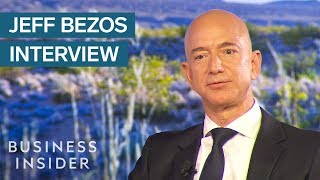 Jeff Bezos on Customer Obsession: Why Amazon, Not Competitors, Wins2018 · 49 min · full transcriptBest single overview of his view that leaders should fear disappointing customers more than rivals and accept misunderstanding when innovating.
 Jeff Bezos on Leadership: Customer Obsession and Day One2018 · 56 min · full transcriptShows how customer obsession, Day 1 thinking, and willingness to be misunderstood fit together as a leadership philosophy.
 Jeff Bezos on Customer Obsession: Leaning Into the Future2016 · 37 min · full transcriptExplains why customer dissatisfaction keeps companies innovating and why leaning into the future beats competitor obsession.
 Jeff Bezos on Customer-Centric Innovation: AWS, Flywheels, and Space2012 · 42 min · full transcriptUseful for understanding how long-term customer alignment and experimentation shape his response to competition.
 Jeff Bezos on Amazon Marketplace Power: Antitrust Testimony2020 · 6 min · full transcriptBest short clip on how he handles criticism: acknowledge a specific problem, but question whether it reflects the whole system.
 Jeff Bezos on Antitrust and Market Power: Amazon, Customers, Day One2020 · 327 min · full transcriptShows his broad defense against critics of Amazon’s power: success comes from customer trust in a large, competitive market.
Questions people ask
- What did Jeff Bezos say about Amazon's competition in retail?
- What did Jeff Bezos say about dealing with competitors and criticism?
- What did Jeff Bezos say about how Amazon became successful?
- What did Jeff Bezos say about staying Day 1 at Amazon?
- What did Jeff Bezos say about third-party sellers on Amazon?
- What did Jeff Bezos say about Amazon not listening to small businesses?
Sources
Every quote above, word for word from the transcripts. Numbers match the text.
“…you need to harness that energy primarily on your customers instead of on your competitors…”
“…customer obsession as opposed to competitor obsession…”
“…the core of the company is customer obsession as opposed to competitor obsession…”
“The number one thing that has made us successful by far is obsessive compulsive focus on the customer as opposed to obsession over the competitor. And I talk so often to other CEOs and some other CEOs and also founders and entrepreneurs. And I can tell that even though they're talking about customers, they're really focusing on competitors. And it is a huge advantage to any company if you can stay focused on your customer instead of your competitors. So then you have to identify who is your customer.”
“Customer obsession has driven our success.”
“We want to be Earth's most customer-centric company.”
“…start with the customer and work backwards…”
“Look, it's okay to be afraid but don't be afraid of our competitors…”
“I said, "Look, it's okay to be afraid "but don't be afraid of our competitors "because they're never gonna send us any money, "be afraid of our customers. "And if we just stay focused on them "instead of obsessing over this big competitor "that we just got, we'll be fine." And I really do believe that. I think that if you stay focused and the more drama there is and everything else, no matter what the drama is, whatever the external distraction is, your response to it should be to double down on the customer, satisfying them, not just satisfying them, delighting them.”
“…customers are always dissatisfied. They always want more…”
“You have to always be leaning into the future.”
“Never, ever, ever lean away from the future.”
“…what's not going to change in the next 10 years…”
“If you want to be an innovative company…”
“We were betting that it was not a zero sum game.”
“20 YEARS AGO, WE MADE THE DECISION TO INVITE OTHER SELLERS TO SELL IN OUR STORE. TO SHARE THE SAME VALUABLE REAL ESTATE WE SPEND BILLIONS TO BUILD MARKET AND MAINTAIN. WE BELIEVE THAT COMBINING THE STRENGTHS OF AMAZON'S STORE WITH THE VAST SELECTION OF PRODUCTS OFFERED BY THIRD PARTIES WOULD BE A BETTER EXPERIENCE FOR CUSTOMERS. AND THAT THE GROWING PIE OF REVENUE AND PROFITS WOULD BE BIG ENOUGH FOR ALL. WE WERE BETTING THAT IT WAS NOT A ZERO SUM GAME. FORTUNATELY, WE WERE RIGHT. THERE ARE NOW 1.7 MILLION SMALL AND MEDIUM U SIZED BUSINESSES SELLING ON AMAZON.”
“We're not going to raise prices. So if you're waiting for us to raise prices, give up now.”
“It does not at all to me seem like the right way to treat her…”
“I don't even understand what's going on in that anecdote…”
“Well, I say that's not acceptable. If we aren't listening to you, I'm not happy about that at all. And, but I do, you know, if you allow me to disagree a little bit with a piece of this, I do not think that's systematically what's going on, and the evidence that I would suggest would be useful for you to consider in that regard.”
“…third-party sellers in aggregate are doing extremely well on Amazon…”
“I do not think that's systematically what's going on…”
“If you can't afford to be misunderstood, then for goodness sake, don't do anything new or innovative.”
“…you have to be willing to be misunderstood…”
“Well, so day one, this is a phrase that we use at Amazon all the time. I've been using it in my first annual shareholder letter from twenty years ago. And we say it's always day one, and it needs to be day one for the reason that you just mentioned. And how do you so the real question for me is how do you go about maintaining a day one culture? It's great to have the scale of Amazon. We have financial resources. We have lots of brilliant people. We can accomplish great things. We have global scopes. We have operations all over the world. But the downside of that is that you can lose your nimbleness. You can lose your entrepreneurial spirit. You can lose your that kind of heart that small companies often have. And so if you could have the best of both worlds, if you can have that entrepreneurial spirit and heart, while at the same time having all the advantages that come with scale and scope, think of the things that you could do.”
“I am very skeptical if the meeting is not messy. At one time, it doesn't happen very often because it's kind of verboten at Amazon. And... But I could I could tell in the meeting that that the team had rehearsed the meeting. That happens. And I and I A lot. I I could just feel it. Like, I... It could... You can tell the little tiny cues. And I I turned to them and said, did you guys rehearse this meeting? And they're like, yes. I was like, don't do that again. You don't need to. Because here's what... Maybe you would rehearse a sales meeting. Right? If you're going... You know, if if you're gonna go visit, you know, a customer and you're trying to sell them a new product or something, maybe you wanna have all your ducks in a row, and you wanna put your best foot forward.”
How this guide was made: drafted with AI from the full transcripts of the recordings cited, then checked: every quotation must match a transcript word for word and be the speaker's own words, and an independent review gates accuracy. Methodology and corrections.

