Jeff Bezos on Risk & Failure
Bezos treats risk as the price of invention: move fast on reversible bets, stay customer-focused, and accept many failures so a few big wins can matter.
- Innovation requires lots of experiments, so failure is normal and necessary.
- Not all risks are equal: fast decisions fit reversible choices, while irreversible ones need care.
- He prefers the risk of trying over the regret of not trying.
- Customer focus makes risk smarter by giving experiments a stable compass.
- Doing new things means being misunderstood for a while.

“And the reason is you start making all decisions as if they're all the same size. It's like one size fits all thinking. And you know if you have a one size fits all robe, it never fits. And so there are different decisions that should be made in different ways. There are giant decisions which are consequential and irreversible or almost irreversible. Super hard to reverse.”VivaTech conference talk, Paris, 2026 · 29:24
For Bezos, invention and failure come together
Bezos does not talk about failure as an embarrassing side effect of innovation. He treats it as part of the mechanism. If you want more invention, you need more experiments, and once you increase the number of experiments, many of them will not work.123
This is why he consistently links progress to a high rate of trying things rather than to perfect prediction. A few big successes can outweigh a long list of misses, so the goal is not to eliminate failure but to make sure you are running enough meaningful experiments.23
Take risks where the downside is reversible
A central part of Bezos's thinking is that leaders should not treat every decision as equally dangerous. Some choices are consequential and hard to undo, while others can be reversed. When organizations blur that distinction, they become slow and overly cautious.4
His practical rule is speed for reversible decisions and more deliberation for irreversible ones. That lets people keep experimenting without turning every move into a crisis. In effect, he wants boldness with judgment: a company should preserve energy for the truly one-way-door decisions and move quickly on the rest.4
“And the reason is you start making all decisions as if they're all the same size. It's like one size fits all thinking. And you know if you have a one size fits all robe, it never fits. And so there are different decisions that should be made in different ways. There are giant decisions which are consequential and irreversible or almost irreversible. Super hard to reverse.”VivaTech conference talk, Paris, 2026 · full transcript →
The biggest long-term risk is often not trying
Bezos's personal framework for major life and career risk is regret minimization. He projects forward and asks which choice he is less likely to regret later. By that logic, action can be safer than caution, because many of life's deepest regrets come from omission rather than commission.56
That is how he explains leaving a secure job to start Amazon. He believed he could live with failing, but not with never having tried. So risk is not just about the chance of visible failure; it is also about the hidden cost of inaction.768
This view makes his tolerance for failure easier to understand. Failure in pursuit of an important opportunity may be acceptable, but passing on the opportunity can create a more durable regret.57
Customer obsession makes risk disciplined, not reckless
Bezos does not advocate random boldness. He wants risk tied to something stable: customer needs. His advice is to put energy on customers instead of competitors and to work backward from what customers need over the long run.91011
That customer anchor helps decide which experiments are worth running. Technologies, rivals, and headlines change, but he believes core customer desires are much more durable. So the best risks are the ones that serve needs likely to remain important for years.121314
This also explains why he is relatively unconcerned with short-term noise. If you know who the customer is and what they will keep valuing, you can tolerate volatility, criticism, and failed attempts along the way.151617
Expect misunderstanding when you do something new
Bezos sees social friction as part of risk, too. New ideas often look wrong, odd, or premature before they work. That means innovators need the ability to tolerate being misunderstood for long periods.18
This matters because fear in organizations often comes less from the experiment itself than from judgment by others. Bezos's answer is to stay grounded in customer value instead of external drama. When criticism is loud, he argues for doubling down on serving customers rather than becoming competitor-obsessed or approval-seeking.17199
So in his framework, resilience is not stubbornness for its own sake. It is the willingness to endure misunderstanding while you test whether an idea genuinely creates value.1817
Bezos on risk & failure, in his own words
“If you want to have more invention, you need to do more experiments per week, per month, per year, per decade.”
“The winners, when you're doing these experiments, winners pay for thousands of losers.”
Where to watch
 Jeff Bezos on Innovation and Leadership: Experiment, Decide Fast2018 · 50 min · full transcriptHis clearest explanation of why invention requires experimentation, how to separate experimental failure from other failure, and why decision speed should match reversibility.
 Jeff Bezos on Gifts and Choices: Build Yourself a Great Story2010 · 17 min · full transcriptBest short statement of his personal risk philosophy: trying and failing can be better than living with the regret of not trying.
 Jeff Bezos on Regret Minimization: Why He Left Wall Street2001 · 48 min · full transcriptShows how regret minimization shaped his leap from Wall Street to Amazon and why omission worries him more than many mistakes.
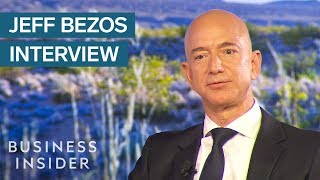 Jeff Bezos on Customer Obsession: Why Amazon, Not Competitors, Wins2018 · 49 min · full transcriptExplains how customer obsession makes risk smarter and why innovators must be willing to be misunderstood.
 Jeff Bezos on Customer-Centric Innovation: AWS, Flywheels, and Space2012 · 42 min · full transcriptConnects experimentation to customer alignment and long-term thinking about what will not change.
Questions people ask
- What did Jeff Bezos mean by Day 1?
- What did Jeff Bezos say about Amazon's early chaos and customer obsession?
- What did Jeff Bezos say about customer obsession and intuition?
- What did Jeff Bezos say about dealing with competitors and criticism?
- What did Jeff Bezos say about regret minimization when he left Wall Street?
- Why does Jeff Bezos say focus on the customer instead of competitors?
Sources
Every quote above, word for word from the transcripts. Numbers match the text.
“If you want to have more invention, you need to do more experiments per week, per month, per year, per decade.”
“The winners, when you're doing these experiments, winners pay for thousands of losers.”
“If you want to be an innovative company…”
“And the reason is you start making all decisions as if they're all the same size. It's like one size fits all thinking. And you know if you have a one size fits all robe, it never fits. And so there are different decisions that should be made in different ways. There are giant decisions which are consequential and irreversible or almost irreversible. Super hard to reverse.”
“Most regrets, by the way, are acts of omission and not commission.”
“Was what I called—which only a nerd would call—a regret minimization framework. So I wanted to project myself forward to age 80 and say, okay, now I'm looking back on my life. I want to have minimized the number of regrets I have. And, you know, I knew that when I was 80 I was not going to regret having tried this. I was not going to regret having wanted, you know, trying to participate in this thing called the Internet, that I thought was going to be a really big deal. I knew that if I failed, I wouldn't.”
“I didn't think I'd regret trying and failing, and I suspected I would always be haunted by a decision to not try at all.”
“Seen in that light, it really was a difficult choice. But ultimately, I decided I had to give it a shot. I didn't think I'd regret trying and failing, and I suspected I would always be haunted by a decision to not try at all. After much consideration, I took the less safe path to follow my passion. And I'm proud of that choice.”
“…you need to harness that energy primarily on your customers instead of on your competitors…”
“…start with the customer and work backwards…”
“The number one thing that has made us successful by far is obsessive compulsive focus on the customer as opposed to obsession over the competitor. And I talk so often to other CEOs and some other CEOs and also founders and entrepreneurs. And I can tell that even though they're talking about customers, they're really focusing on competitors. And it is a huge advantage to any company if you can stay focused on your customer instead of your competitors. So then you have to identify who is your customer.”
“…what's not going to change in the next 10 years…”
“…the core things that customers want, do not change.”
“The last 10 years, our competitive set has changed and the technologies have changed. So many things change, but the basic drivers of our business, the core things that customers want, do not change. You know, we know that what customers want are selection, low prices, and convenience. And I guarantee you that 10 years from now, they're still going to want selection, low prices, and convenience. We are not going to wake up 10 years from now and have customers say, "This is all well and good. I love this thing, Amazon.com, but could you make it a little less convenient?" It's just not going to happen.”
“In the short run, the stock market is a voting machine. In the long run, it's a weighing machine.”
“Never spend any time thinking about the daily stock price. I don't.”
“I said, "Look, it's okay to be afraid "but don't be afraid of our competitors "because they're never gonna send us any money, "be afraid of our customers. "And if we just stay focused on them "instead of obsessing over this big competitor "that we just got, we'll be fine." And I really do believe that. I think that if you stay focused and the more drama there is and everything else, no matter what the drama is, whatever the external distraction is, your response to it should be to double down on the customer, satisfying them, not just satisfying them, delighting them.”
“If you can't afford to be misunderstood, then for goodness sake, don't do anything new or innovative.”
“Look, it's okay to be afraid but don't be afraid of our competitors…”
How this guide was made: drafted with AI from the full transcripts of the recordings cited, then checked: every quotation must match a transcript word for word and be the speaker's own words, and an independent review gates accuracy. Methodology and corrections.


