Jeff Bezos on Economics
Bezos treats economics as a practical problem of growth, competition, customer value, and policy design that solves root causes instead of punishing symbols.
- Growth is the main way to solve big national problems, not an excuse to lower ambition.
- Competition matters, but he argues big success can come from customer focus rather than monopoly power.
- He sees marketplaces and innovation as positive-sum when they create more value for customers and sellers.
- On inequality, he favors more progressive taxes but says politicians should fix underlying costs and incentives, not just attack the rich.
- His economic instinct is to invent, scale, and keep prices low.

Growth is the first economic lever
Bezos’s broadest economic instinct is pro-growth. He argues the United States is unusually well positioned to expand because it has the capital, entrepreneurial culture, and willingness to fund bold ideas, so the right response to national challenges is to increase output and opportunity rather than retreat into smaller ambitions.12
That growth mindset is not just corporate. He extends it to the country as a whole, pairing optimism with the claim that America still has room to build, invent, and solve hard problems. In his framing, growth is not a side issue in economics; it is the mechanism that makes other solutions possible.341
“This country is so set up to grow.”CNBC Squawk Box interview, 2026 · full transcript →
Customer value is the engine of durable success
When Bezos explains economic success, he starts with the customer rather than market share. He says Amazon’s success came from earning trust slowly, doing difficult operational work well, and keeping prices low, which implies that long-run performance should come from better service and execution, not from extracting rents.57
This view helps explain why he puts such weight on price, convenience, and personalization. His model of a strong business is one that listens, invents, and tailors the experience for individuals while scaling those benefits broadly. In economic terms, he treats innovation and lower prices as the foundation of demand, loyalty, and growth.8910
Markets can be positive-sum, not just winner-take-all
A central Bezos idea is that good markets do not have to be zero-sum. He says Amazon invited third-party sellers onto its platform because combining Amazon’s store with outside selection would improve the customer experience, and he presents that decision as a bet that a larger pie could support many participants.1112
That is his answer to the fear that scale automatically means domination. He argues retail is large and competitive, with room for multiple winners, and he points to the success of third-party sellers as a sign that a big platform can create opportunity rather than merely absorb it.14
At the same time, he does not deny that bad treatment can happen. In the antitrust setting, he says a specific seller story was unacceptable while pushing back on the idea that abuse is systematic, which shows his basic position: investigate concrete failures, but do not assume every large-scale outcome is anti-competitive by nature.151617
Inequality is real, but villain politics misses the point
On taxes and inequality, Bezos sounds less like a pure low-tax advocate than many people expect. He says the country is living through a tale of two economies, with some people thriving while others struggle to pay for rent and groceries, so he clearly sees economic distress as real and politically important.18
His preferred response is not simply to denounce wealthy people. He argues that turning rich individuals into villains distracts from solving the actual problems that are making life unaffordable, and he is explicit that the tax system could be more progressive, even to the point that the bottom half should pay zero federal taxes.20
But he also adds that the deeper issue is on the spending side of government. So his economics here has two parts at once: make taxation more progressive at the bottom, and force policymakers to confront structural fiscal choices instead of using class conflict as a substitute for governing.2021

“…it’s kind of a tale of two economies…”NYT DealBook Summit interview, 2024 · full transcript →
Optimism, invention, and scale shape his economic worldview
Bezos’s economics is ultimately future-oriented. He repeatedly returns to invention, operational scale, and long time horizons, suggesting that prosperity comes from building systems that make life better at lower cost and larger reach.210
That is why his rhetoric is so optimistic even when the issues are large. He talks as if countries and companies should keep a Day One mentality: stay inventive, keep solving, and assume that disciplined growth can expand what is possible.34
Seen this way, his positions on competition, prices, taxes, and regulation all connect back to one core belief: economics should reward creation, widen opportunity, and address real constraints instead of getting stuck in symbolic fights.5111821
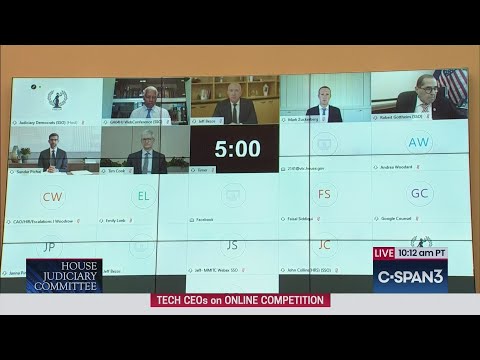
“It is still Day One for this country.”House Judiciary Committee hearing, 2020 · full transcript →
Bezos on economics, in his own words
“This country is so set up to grow.”
“…it’s kind of a tale of two economies…”
“…i think it should be zero…”
Where to watch
 Jeff Bezos on Tax Progressivity: Who Should Pay?2024 · 6 min · full transcriptBest short statement of his views on inequality, tax progressivity, and why politics should solve causes instead of picking villains.
 Jeff Bezos on Growth and Space: Save Earth, Build Upward2026 · 66 min · full transcriptBest overview of his growth-first outlook and why he thinks America is structurally set up to expand.
 Jeff Bezos on Antitrust and Market Power: Amazon, Customers, Day One2020 · 327 min · full transcriptBest for understanding how he links competition, customer obsession, and positive-sum market creation.
 Jeff Bezos on Customer Centricity: Invent, Lower Prices, Scale2000 · 52 min · full transcriptShows the early economic logic behind low prices, personalization, and scaling customer value.
 Jeff Bezos on Amazon Marketplace Power: Antitrust Testimony2020 · 6 min · full transcriptUseful if you want his most direct defense against claims that Amazon systematically mistreats sellers.
Questions people ask
- What did Jeff Bezos say about Amazon's competition in retail?
- What did Jeff Bezos say about how Amazon became successful?
- What did Jeff Bezos say about third-party sellers on Amazon?
- What did Jeff Bezos say about wealth inequality in America?
- What did Jeff Bezos say about Amazon not listening to small businesses?
- What did Jeff Bezos say about Amazon’s market power and monopoly claims?
Sources
Every quote above, word for word from the transcripts. Numbers match the text.
“This country is so set up to grow.”
“I think of myself as an inventor.”
“It is still Day One for this country.”
“I have never been more optimistic about our future.”
“Customer obsession has driven our success.”
“We're not going to raise prices. So if you're waiting for us to raise prices, give up now.”
“We want to be Earth's most customer-centric company.”
“We want to have 20 million different stores, each store customized for that individual customer.”
“What is unusual is the scale at which we're doing it.”
“We were betting that it was not a zero sum game.”
“20 YEARS AGO, WE MADE THE DECISION TO INVITE OTHER SELLERS TO SELL IN OUR STORE. TO SHARE THE SAME VALUABLE REAL ESTATE WE SPEND BILLIONS TO BUILD MARKET AND MAINTAIN. WE BELIEVE THAT COMBINING THE STRENGTHS OF AMAZON'S STORE WITH THE VAST SELECTION OF PRODUCTS OFFERED BY THIRD PARTIES WOULD BE A BETTER EXPERIENCE FOR CUSTOMERS. AND THAT THE GROWING PIE OF REVENUE AND PROFITS WOULD BE BIG ENOUGH FOR ALL. WE WERE BETTING THAT IT WAS NOT A ZERO SUM GAME. FORTUNATELY, WE WERE RIGHT. THERE ARE NOW 1.7 MILLION SMALL AND MEDIUM U SIZED BUSINESSES SELLING ON AMAZON.”
“…third-party sellers in aggregate are doing extremely well on Amazon…”
“It does not at all to me seem like the right way to treat her…”
“I do not think that's systematically what's going on…”
“Well, I say that's not acceptable. If we aren't listening to you, I'm not happy about that at all. And, but I do, you know, if you allow me to disagree a little bit with a piece of this, I do not think that's systematically what's going on, and the evidence that I would suggest would be useful for you to consider in that regard.”
“…it’s kind of a tale of two economies…”
“…i think it should be zero…”
“…we actually have a spending problem…”
How this guide was made: drafted with AI from the full transcripts of the recordings cited, then checked: every quotation must match a transcript word for word and be the speaker's own words, and an independent review gates accuracy. Methodology and corrections.