Daniel Kahneman on Thinking Fast And Slow
Kahneman’s central claim is that most of the mind runs on fast, automatic intuition, while slower reasoning can correct it only sometimes, which is why human judgment is both impressive and predictably error-prone.
- Most mental life is generated by fast, automatic System 1, not deliberate reasoning.
- Slow thinking matters, but it is effortful, limited, and often too lazy to check intuition.
- Many mistakes come from answering an easier question than the one we were asked.
- Confidence is a feeling, not reliable proof that a judgment is accurate.
- Better judgment often means broadening the frame, using the outside view, and sometimes replacing judgment with rules or algorithms.

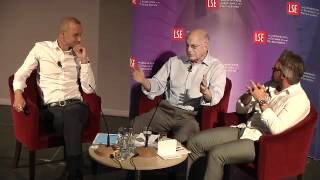
“…the hero of the book is really System One…”LSE book launch conversation, Paris School of Economics, 2012 · 11:18
The core idea is two modes of thought
Kahneman explains Thinking, Fast and Slow through a contrast between two ways the mind operates. Fast thinking is automatic and intuitive; slow thinking is deliberate and effortful1234.
His deeper point is that fast thinking is not a sideshow. It generates most of what we experience as mental life: impressions, interpretations, feelings, and quick judgments arrive before reasoning gets involved567.
That is why the book is not mainly a celebration of careful analysis. It is an attempt to show how much of life is steered by processes that happen on their own, outside deliberate control38.
“…the hero of the book is really System One…”LSE book launch conversation, Paris School of Economics, 2012 · full transcript →
Fast thinking is useful, but it also jumps too quickly
Kahneman does not treat intuition as nonsense. Fast thought is often effective, and in skilled settings it can reflect real learning and recognition910.
But System 1 also works by quickly building a coherent interpretation from whatever is immediately available. Once that story feels coherent, people tend to believe it and move on111213.
This is why the mind so often jumps to conclusions. The problem is not just speed; it is that automatic thinking supplies an answer before we have checked whether it is the right answer or whether the evidence is enough147.
A major source of bias is answering the wrong question
One of Kahneman’s most important ideas is substitution: when a hard question is difficult, the mind silently answers an easier one instead. People usually do not notice that the switch happened1516.
That helps explain classic failures of judgment. In the bat-and-ball problem, an answer comes to mind immediately, feels right, and many people accept it without checking1718.
Slow thinking can catch the error, but only if it is engaged. Since effort is costly and attention is limited, people often accept the first plausible answer produced by intuition192.
Confidence feels convincing, but it is often misleading
A recurring lesson in Kahneman’s view is that confidence should not be confused with accuracy. He is unusually blunt on this point: the feeling of certainty is not dependable evidence that a judgment is correct202122.
Why does confidence mislead? Because it grows from the coherence of the story in our heads, not necessarily from the quality of the evidence. When the mind constructs a simple, compelling account, certainty follows naturally231224.
That is especially dangerous in prediction. In complex domains, people can sound highly assured while knowing very little, and the world itself may not be predictable enough to support their claims25.
The practical lesson is to widen your view and distrust naked intuition in prediction
Kahneman’s advice is not to stop using intuition altogether. It is to know where it works and where it does not. Intuition is stronger when the environment is regular enough for genuine learning; it is weaker in noisy, long-range forecasting and one-off projects1025.
For better decisions, he repeatedly urges people to broaden the frame. Instead of treating a choice as an isolated case, compare it to similar cases and use the outside view.
He also favors procedures that reduce the sway of momentary judgment. When possible, rules and algorithms can outperform unaided intuition, and when they cannot be used, slowing down is itself a practical safeguard.
Kahneman on thinking fast and slow, in his own words
“Most of what happens in our mind is really system 1.”
Where to watch
 Daniel Kahneman on Thinking Fast and Slow2012 · 67 min · full transcriptBest single overview of the book’s architecture: System 1 and System 2, narrow framing, loss aversion, and overconfidence.
 Daniel Kahneman on System 1 and System 2: Fast and Slow Thinking2018 · 78 min · full transcriptStrongest explanation of how automatic association creates coherent stories that we too easily believe.
 Daniel Kahneman on System 1 and System 2: Fast Thinking, Flawed Confidence2013 · 56 min · full transcriptEspecially useful on why confidence feels strong even when judgment is weak.
 Daniel Kahneman on System 1 and System 2: Why We Misjudge2012 · 31 min · full transcriptBest for the inside view versus outside view and why prediction goes wrong in real life.
 Daniel Kahneman on System 1 and System 2: intuition, bias, and confidence2011 · 62 min · full transcriptClear introduction to intuition, expertise, and the limits of forecasting.
Questions people ask
- What did Daniel Kahneman say about System 1 and System 2?
- What did Daniel Kahneman say about how people answer hard questions?
- What did Daniel Kahneman say about improving decision making?
- What did Daniel Kahneman say about intuition and judgment under uncertainty?
- What did Daniel Kahneman say about intuition and when you can trust it?
- What did Daniel Kahneman say about the demand for overconfidence?
Sources
Every quote above, word for word from the transcripts. Numbers match the text.
“System one is the intuitive one.”
“System two is the effortful one, the one that's the deliberate one.”
“…fast thinking is something that happens to you primarily, and slow thinking is something that you do…”
“System one is the fast one. System two is the slow one.”
“Most of what happens in our mind is really system 1.”
“System One is the origin of our mental life.”
“What comes to mind automatically is sometimes marvelous, sometimes flawed, and always automatic, and you have no control over it.”
“…the hero of the book is really System One…”
“I call them along with others. It's not my term either, system one and system two. One of which, is the intuitive, rapid, associative, uncontrolled, automatic kind of thinking, and the other one is the rule governed. You know, that's the way you you fill your income tax form or compute seventeenth and 24 or read a map. And so we we are able to think in this way, but most of the time, we run on the software system one that is automatically and with little thought and by and love with remarkable success and accuracy.”
“There is really no difference between the physician recognizing a disease, a particular disease from a facial expression or something, a little trial learning pointing to something and saying doggy. The little trial has no idea what the clues are. But he just said, he just knows this is a dog without knowing why he knows. And once you think about it this way, this really demystifies intuition to a very considerable extent. And it also leads you to a sort of a solution to the problem that Gary Klein and I were trying to solve, when can you trust intuition and when can't you. And then it becomes an issue of in the world, regular enough so that you can learn to recognize things or and then did that particular individual have an opportunity to learn the regularities of the world.”
“…we believe what we see. We believe what we think.”
“What is characteristic of the way associative memory works is that it produces an interpretation of the world that is coherent.”
“What you see is all there is…”
“Well, yes. I mean, what we studied was intuitive thinking in the domain of judgment under uncertainty versus how we started, that is how do people assess the probability of events and how do they forecast the future intuitively. And our idea was that people use heuristics, are basically shortcuts. And in in my lecture, it's a phrase I coined this week, but I'm going to use it. Mhmm. I I did speak of the mind as a machine for jumping to conclusions. And And we figured out some other ways that this is done. I think the most important one that we studied in the first years of our work was something that I now call substitution. That is you... You're asked a difficult question, you cannot answer it, but another answer comes to mind, and it's an answer to a related question which is simpler.”
“People jump to conclusions by answering the wrong question.”
“And the general idea is very straightforward. When we're asked a question that we cannot answer, typically, System one is going to come up with the answer to a related question that is easier and it's going to use that answer to the wrong question, to the question that hasn't been asked in place of the question that was asked. We call that a mechanism of substitution, It's substituting an easier question for a hard one. It happens automatically. People are not aware that it happens. And it is the source of many intuitions that don't come from expertise and they are much less likely to be correct than the intuition that do come from expertise, but they come with equal confidence or just about.”
“A bat and a ball together cost a dollar 10. The bat cost a dollar more than the ball. How much does the ball cost? Now let me make a prediction. Every one of you, I would think, has thought of the number, and the number is 10¢. That's been in everybody's mind. Now that makes the problem interesting because 10¢ is false. You know? If if it were 10¢ and you... And then the bat would be a dollar more, it would be a dollar 10, and the dollar 10 and 10¢ would be a dollar 20. So 10¢ is not the answer. But now what is interesting is when you put that question to Princeton students, half of them say 10¢. Now... And they do even when you give them time.”
“The point about this riddle is that the number came to your mind. And the number is $0.10 And everybody, just I think, maybe here, maybe there are exceptions, very few exceptions.”
“The law of least effort is really a fundamental psychological principle.”
“Subjective confidence is not a good indicator.”
“…confidence is not a guide to accuracy…”
“Confidence is a feeling. It is not really a judgment.”
“…the world that we construct in our minds is much simpler than reality.”
“Your thinking flows along causal lines. This happens intuitively and it's not... And one of these feels okay. It feels more coherent. And the coherence that we experience can be turned into a judgment of probability. That is the confidence that we experience is a judgment of probability. Now I'm going to skip the other example. And I said earlier that people have intuitions that are not necessarily true and that people are confident in judgments that are not necessarily true. And I would like to sort of present a tentative theory about how that happens.”
“The world is probably not predictable.”
How this guide was made: drafted with AI from the full transcripts of the recordings cited, then checked: every quotation must match a transcript word for word and be the speaker's own words, and an independent review gates accuracy. Methodology and corrections.