Daniel Kahneman on System 1 and System 2
Kahneman’s basic view is that most of the mind runs on fast, automatic System 1, while slower, effortful System 2 can check it but often does too little, too late.
- System 1 is fast, automatic, associative, and generates most impressions and intuitions.
- System 2 is slower, effortful, and used for checking, reasoning, and self-control, but it is limited and often lazy.
- Many mistakes happen because System 1 jumps to conclusions, suppresses ambiguity, and answers an easier question than the hard one asked.
- Confidence is a feeling produced by coherence, not a reliable sign of truth or accuracy.
- Intuition can be trusted mainly when people have learned real patterns in regular environments with clear feedback; in noisy prediction, it often fails.

“…fast thinking is something that happens to you primarily, and slow thinking is something that you do…”Long Now lecture, 2018 · 9:03
Most thought is fast and automatic, not deliberate
Kahneman’s starting point is that the mind has two modes. System 1 is the quick, automatic side of thought, while System 2 is slower and effortful123.
He treats this as the basic architecture of everyday thinking: fast thinking mostly happens to us, while slow thinking is something we actively do4. Most of mental life comes from System 1, which he describes as the source or origin of what appears in the mind first56.
This is why fluent activities like recognition, language, and many skilled responses feel immediate. If people had to rely on effortful reasoning for everything, they would be too slow to function well in the world7.
“…fast thinking is something that happens to you primarily, and slow thinking is something that you do…”Long Now lecture, 2018 · full transcript →
System 2 can correct System 1, but often does not
System 2 matters because it can monitor, compute, compare, and restrain impulses. It is the mode used when a task requires attention, rule-following, or mental work, but it is capacity-limited and effortful2.
Kahneman stresses that effort is costly for the mind. The tendency to conserve mental effort means people frequently accept the first answer that comes to mind instead of checking it carefully.
That is why obvious-seeming intuitive answers can survive even when they are wrong. The bat-and-ball problem shows the point clearly: an answer appears immediately, and many people do not engage the extra effort needed to test it1011.

“A bat and a ball together cost a dollar 10. The bat cost a dollar more than the ball. How much does the ball cost? Now let me make a prediction. Every one of you, I would think, has thought of the number, and the number is 10¢. That's been in everybody's mind. Now that makes the problem interesting because 10¢ is false. You know? If if it were 10¢ and you... And then the bat would be a dollar more, it would be a dollar 10, and the dollar 10 and 10¢ would be a dollar 20. So 10¢ is not the answer. But now what is interesting is when you put that question to Princeton students, half of them say 10¢. Now... And they do even when you give them time.”Hitchcock Lecture at UC Berkeley, 2007 · full transcript →
System 1 jumps to conclusions by building coherent stories
A central claim in Kahneman’s account is that the mind is built to reach quick interpretations. He describes it as a machine for jumping to conclusions, and says this quick process suppresses ambiguity rather than dwelling on doubt121314.
System 1 works through associative memory, producing an interpretation that feels coherent. Once a coherent picture forms, people tend to believe what they see and what they think, even when important information is missing151617.
One major mechanism behind error is substitution. When faced with a hard question, System 1 often answers an easier related question instead, and people usually do not notice the swap181920.
“What you see is all there is…”Long Now lecture, 2018 · full transcript →
Confidence is not proof that an intuition is right
Kahneman repeatedly warns that confidence should not be mistaken for accuracy. He says directly that confidence is not a guide to accuracy and that subjective confidence is a poor indicator2122.
His reason is that confidence is a feeling, not a valid test of evidence. People feel sure when a story hangs together causally and coherently, even if the judgment is weakly supported2324.
This helps explain why bold forecasters and pundits can sound convincing without actually being better at prediction. In many important domains, especially long-range forecasting, high confidence can coexist with poor performance26.

“Confidence is a feeling. It is not really a judgment.”UBS Center public lecture, University of Zurich, 2013 · full transcript →
Intuition is real skill in some settings and a trap in others
Kahneman does not dismiss intuition. He thinks some intuitions are genuine expertise: rapid recognition learned from experience in an environment that has stable patterns people can actually pick up.
The key condition is regularity plus feedback. When cues are valid and feedback is quick and clear, people can learn skilled System 1 responses; when the world is noisy and unpredictable, they cannot rely on the same confidence.
That is why he is cautious about trusting experts in forecasting and similar domains. Where judgment is inconsistent or noisy, simple rules can outperform people because rules apply the same logic every time293031.
The practical lesson is to design checks, procedures, and better questions
Kahneman’s practical lesson is not that people should try to become pure System 2 thinkers. Fast thinking is indispensable, and much of it works remarkably well, but important judgments need structure because unaided intuition is vulnerable to bias and inconsistency32.
For individuals, one useful habit is to slow down when stakes are high, especially when an answer arrives too fluently or with unusual confidence. Another is to resist forming an intuition too quickly and gather more information before settling on a view33.
For organizations, his emphasis is even stronger: improve procedures rather than merely exhorting people to think better. Standardization, delayed intuition, and rule-based judgment can reduce both bias and noise more reliably than trusting personal impressions alone3431.
“…you want to resist forming an intuition too quickly…”UNSW in conversation, 2021 · full transcript →
Kahneman on system 1 and system 2, in his own words
“…fast thinking is something that happens to you primarily, and slow thinking is something that you do…”
“System One is the origin of our mental life.”
“What comes to mind automatically is sometimes marvelous, sometimes flawed, and always automatic, and you have no control over it.”
“What you see is all there is…”
“…confidence is not a guide to accuracy…”
“People jump to conclusions by answering the wrong question.”
Where to watch
 Daniel Kahneman on System 1 and System 2: intuition, bias, and confidence2011 · 62 min · full transcriptA strong overview of the basic distinction, with classic examples of intuition, substitution, confidence, and when expertise can be trusted.
 Daniel Kahneman on System 1 and System 2: Fast and Slow Thinking2018 · 78 min · full transcriptBest for seeing how fast thinking generates coherent interpretations automatically and why effortful checking is so limited.
 Daniel Kahneman on System 1 and System 2: Fast Thinking, Flawed Confidence2013 · 56 min · full transcriptEspecially useful on flawed confidence, answering the wrong question, and why intuitive certainty can mislead.
 Daniel Kahneman on Intuition and Bias: System One, System Two2007 · 56 min · full transcriptShows how ambiguity gets suppressed and why Kahneman sees the mind as quick to jump to conclusions.
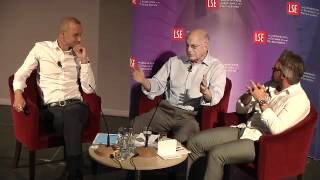 Daniel Kahneman on System One and System Two: Thinking, Fast and Slow2012 · 63 min · full transcriptGood on the relation between System 1, System 2, confidence, expert intuition, and the limits of forecasting.
 Daniel Kahneman on Noise and Judgment2021 · 61 min · full transcriptUseful for the later, more practical side of Kahneman’s view: slow organizations, delayed intuition, and reducing noisy judgment.
Questions people ask
- How does Daniel Kahneman distinguish noise from bias?
- What did Daniel Kahneman find when he combined structured ratings with intuition?
- What did Daniel Kahneman say about System 1 and System 2?
- What did Daniel Kahneman say about algorithms versus human judgment?
- What did Daniel Kahneman say about artificial general intelligence?
- What did Daniel Kahneman say deep learning lacks?
Sources
Every quote above, word for word from the transcripts. Numbers match the text.
“System one is the intuitive one.”
“System two is the effortful one, the one that's the deliberate one.”
“System one is the fast one. System two is the slow one.”
“…fast thinking is something that happens to you primarily, and slow thinking is something that you do…”
“Most of what happens in our mind is really system 1.”
“System One is the origin of our mental life.”
“System two useful. If we if we're dependent on system two for survival, we wouldn't survive very long because it's very slow.”
“A bat and a ball together cost a dollar 10. The bat cost a dollar more than the ball. How much does the ball cost? Now let me make a prediction. Every one of you, I would think, has thought of the number, and the number is 10¢. That's been in everybody's mind. Now that makes the problem interesting because 10¢ is false. You know? If if it were 10¢ and you... And then the bat would be a dollar more, it would be a dollar 10, and the dollar 10 and 10¢ would be a dollar 20. So 10¢ is not the answer. But now what is interesting is when you put that question to Princeton students, half of them say 10¢. Now... And they do even when you give them time.”
“The point about this riddle is that the number came to your mind. And the number is $0.10 And everybody, just I think, maybe here, maybe there are exceptions, very few exceptions.”
“…the mind as a machine for jumping to conclusions…”
“The way the system works, it suppresses ambiguity.”
“Now this system guides interpretations. So let me show you how this works. Now you can read that silently, and you know what that is. And you can read that, and you know what that is. And, of course, the b and the 13 are physically identical. I mean, it's the same object, but you were not aware of this. The context determined how you read the words, and you were not aware that there was ambiguity. You were not aware that you had suppressed the ambiguity. You were not aware that there was another way of seeing what you saw. The way the system works, it suppresses ambiguity. Doubt and ambiguity is mostly a function of system two. System one doesn't have much doubts. It makes choices, and it delivers to our conscious experience the choices that it has made, and we're not aware of having made the choice.”
“…we believe what we see. We believe what we think.”
“What is characteristic of the way associative memory works is that it produces an interpretation of the world that is coherent.”
“What you see is all there is…”
“People jump to conclusions by answering the wrong question.”
“And the general idea is very straightforward. When we're asked a question that we cannot answer, typically, System one is going to come up with the answer to a related question that is easier and it's going to use that answer to the wrong question, to the question that hasn't been asked in place of the question that was asked. We call that a mechanism of substitution, It's substituting an easier question for a hard one. It happens automatically. People are not aware that it happens. And it is the source of many intuitions that don't come from expertise and they are much less likely to be correct than the intuition that do come from expertise, but they come with equal confidence or just about.”
“Well, yes. I mean, what we studied was intuitive thinking in the domain of judgment under uncertainty versus how we started, that is how do people assess the probability of events and how do they forecast the future intuitively. And our idea was that people use heuristics, are basically shortcuts. And in in my lecture, it's a phrase I coined this week, but I'm going to use it. Mhmm. I I did speak of the mind as a machine for jumping to conclusions. And And we figured out some other ways that this is done. I think the most important one that we studied in the first years of our work was something that I now call substitution. That is you... You're asked a difficult question, you cannot answer it, but another answer comes to mind, and it's an answer to a related question which is simpler.”
“…confidence is not a guide to accuracy…”
“Subjective confidence is not a good indicator.”
“Confidence is a feeling. It is not really a judgment.”
“Your thinking flows along causal lines. This happens intuitively and it's not... And one of these feels okay. It feels more coherent. And the coherence that we experience can be turned into a judgment of probability. That is the confidence that we experience is a judgment of probability. Now I'm going to skip the other example. And I said earlier that people have intuitions that are not necessarily true and that people are confident in judgments that are not necessarily true. And I would like to sort of present a tentative theory about how that happens.”
“I think there is a very good reason for the demand for experts. Was referring to a particular book that you may want to read or you may want to look for The New Yorker review of that book. It's a book by Phil Tetlock on political judgment, where he studied forecasts in the time range of ten, fifteen years of political forecasts. And one of the interesting observations is who are the people that we like to listen to as pundits. And there are people with very high confidence who think they understand the world. Now they actually are worse than chance. I mean they are worse than people who are more hesitant. But we want them, we need them. And so there is a real demand for overconfidence.”
“…whenever there is judgment, there is noise…”
“Noise is a characteristic of a set of judgments, it's a statistical concept…”
“That is, when you apply an algorithm or a rule to the same case on different occasions, you are going to come up with exactly the same answer. That's noise free. It turns out there is so much noise in human judgment that for that reason alone rules tend to be superior in many cases to human judgment and in some cases vastly superior. Now, that's even - that was true even before artificial intelligence. It was true applying simple statistical rules and even imperfect statistical rules just applied consistently will do better than people.”
“What comes to mind automatically is sometimes marvelous, sometimes flawed, and always automatic, and you have no control over it.”
“…you want to resist forming an intuition too quickly…”
“Absolutely. And altogether - I mean, this is the orientation that I have in general, and I had it I think even in the previous book, that organisations - it's much easier to improve the thinking and the decision making of organisations than to improve the thinking and the decision making of individuals. Organisations think slowly, they have procedures, you can intervene in the procedures, you can standardise procedures, and there is a chance of improving things that really doesn't exist when you're trying to improve your own thinking.”
How this guide was made: drafted with AI from the full transcripts of the recordings cited, then checked: every quotation must match a transcript word for word and be the speaker's own words, and an independent review gates accuracy. Methodology and corrections.