Daniel Kahneman on System One and System Two: Thinking, Fast and Slow

What Kahneman talks about
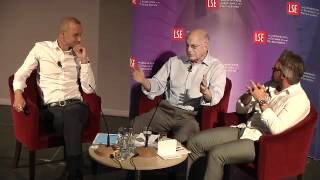
Daniel Kahneman spoke in this LSE conversation in 2012 about Thinking, Fast and Slow, covering System 1 and System 2, judgment errors, expert intuition, algorithms, and the experiencing versus remembering self.
Also known as: In Conversation with Daniel Kahneman (LSE); LSE book launch conversation.
Daniel Kahneman discusses the core ideas behind *Thinking, Fast and Slow*, especially the contrast between fast, intuitive System 1 and slower, effortful System 2. Using puzzles, examples, and policy cases, he shows how people jump to conclusions and why confidence is a poor guide to accuracy.
He also explains why experts can be right in regular environments but unreliable in unpredictable ones, and why simple algorithms can beat human judgment in some settings. The conversation then moves to happiness, where Kahneman distinguishes the experiencing self from the remembering self and shows how that shapes life satisfaction and public policy.
Evan Davis moderates, Paul Dolan comments, and audience members ask questions; Kahneman is the main speaker.
In his words
“The hero of the book is really System One”
“Confidence is not a guide to accuracy”
Key points
- System 1 is fast, automatic, and usually effective, but it can make predictable mistakes.
- System 2 monitors and can correct System 1, but it is often lazy and requires attention and effort.
- Confidence does not reliably indicate accuracy; it often reflects a good story rather than good evidence.
- Expert intuition works best in regular environments with stable rules, not in noisy or unpredictable ones.
- Simple rules or algorithms can outperform human experts in some judgment tasks.
- The remembering self and experiencing self are different, and people often confuse them when judging happiness.
- Income raises moment-to-moment well-being only up to a point, while life satisfaction can keep rising.
Full transcript: Daniel Kahneman, LSE conversation on Thinking, Fast and Slow (2012)
Confess I'm Evan Davis, BBC presenter. Welcome to this event jointly organized by the London School of Economics and Hay Festivals, and I'm delighted that we are here to discuss Daniel Kahneman's book *Thinking, Fast and Slow*. This is, in fact, a book launch. This is the launch of the paperback version of the book. By and large, this is not going to be a feisty argument. We're here to praise the book, not to bury it. Unfortunately, it's extremely easy to do that. Can I just ask how many of you have actually read the book? It has been out in hardback. Wow, a lot of you. How many of you have not read the book just so we can get... okay, so about 60, 40
have not read it. Well, what it does is put a lot of Professor Kahneman's thinking together in one place. There are lots of books on irrationality and behavioral economics, but I have to say this one, I think, does step it up a level in its degree of analysis. I present a program called *Dragon's Den*. I'm sure a lot of you have seen it. It's a very popular investment show with five expert investors being pitched at by entrepreneurs, and then the dragons decide whether to invest in the entrepreneur. I have noticed that one or two of the investors, the dragons, are analytical, do
calculations, and work out whether this is a good investment, and one or two of them are intuitive. Duncan Bannatyne, if any of you know the program, Duncan Bannatyne is very intuitive. Having watched this over several hundred people coming in, I've tended to think I would always go with the intuitive guy rather than the calculating one; somehow, just the intuitive ones just seem to get there, notwithstanding the sophistication of the calculations. I, however, fear I'm a more calculating person than an intuitive one. That is very much the theme of the book. Quite a lot of it relates to that very issue. Well, you will know Professor Kahneman
is often seen as the father of behavioral economics, the man who, with his counterpart, the late Amos Tversky, noticed that people do not conform to the economic model of decision making, particularly under uncertainty. So one might say, while talking of television, that he's had a career devoted to working out the behavior people exhibit on *Deal or No Deal* if you watch it, and it turns out that that generates insights into almost every aspect of all our lives. Professor Kahneman was the recipient of the 2002 Nobel Prize in Economics for his work in this area. He's also written a lot about happiness, and
there's about 30 or 40 pages in the book of great direct relevance to that. Also with us is Paul Dolan, who, if you like, is representing the home team, the London School of Economics. He's in the Department of Behavioral Science. He's a professor of Behavioral Science in the Department of Social Policy here. Paul is going to comment on the book, and Paul is someone who has worked with Daniel Kahneman. Paul has been on the Nudge Unit, the Behavioral Insights Team here in London. He's been helping advise on measuring happiness and well-being, and some of his current work actually is looking at the happiness effect of the London Olympics, which we might get to because that's going to be
rather interesting. Now we have an hour. We'll have half an hour of chat up here; then we will open up to the floor. You, of course, can converse about the event via Twitter. We're promoting the hashtag Kahneman. We are podcasting the event and videoing it, so subject to no technical difficulties, it'll be online on the LSE website in one or two days. And I should say the book is available just... not to top with the mic. The book is going to be available outside, and there will be a signing after the event.
But let's talk about the book. And just to get you started, I wanted to just take one little exercise in the book, and this I'd like to restrict to people who haven't read the book. Better if the ones of you who read the book just keep your hands by your sides. A simple puzzle: don't try to solve it, just listen to your intuition. A bat and a ball cost £1.10. The bat costs a pound more than the ball. How much does the ball cost? How many of you thought 10p? All of them, everyone
did, if they were being honest. If they were being honest, we've either got a very clever audience or we've got one who have intuitive abilities to solve simultaneous equations or to... But right, Professor Kahneman, tell us about the bat and ball problem and what that tells us. The answer is 5p, by the way. Yeah, don't spend time working it out. A lot of the book is about how memory works, how associative memory works. And you know, when I say 2 plus 2, four comes to mind. When I say the capital of France, Paris comes to mind. When struggling to hear, should we pull the microphone up a little bit? Is that better? Yeah, or am I just
disconnected? Is it okay now? This is not good. Take a bit higher? Okay, all right, carry on, and they'll let us know if it's not working. Okay. Associative memory sort of delivers things to us. We're not really aware of how it works. We don't decide for it to work, and in this particular instance, for some reason, it's very clear the first thing that comes to mind for just about everybody's mind is 10p, the number 10 comes to mind. Now, what's interesting about this problem is
Uh, about 50% of students at Princeton and MIT and Harvard, uh, I suppose LC, uh, will say 10p when asked that question. And, you know, something truly important about those people is that if they write 10p as their answer, they didn't check their answer. Because if they had checked, they would know it's wrong. Because it's very, very easy to add 10p to a dollar and to a pound and 10, uh, and not checking is interesting. And checking is a function of what you know. In the book, I, following others—it's not those are not my terms—uh, we call it System Two. And System Two is the one that, that...
Monitors what system one is doing, and it's effortful and its work, and I describe system two as lazy. And that's why, uh, when you have an answer that comes to mind and you're confident in it, and it, you know, it looks about right, something, uh, when it looks about right, you just say it. And, uh, the laziness of system two is part of the answer, and in fact, that's the reason that we have that problem in there. So just draw the distinction then, because there's system one and system two. Just tell people what system one thinking is and system two thinking, because this is the—well, system one thinking is fast thinking, you know.
That's in the title: System Two Thinking is slow thinking. But mostly, System Two is defined by an investment of attention and effort. So any mental activity that has effort for, we classify as a System Two activity. I should add that those are metaphors. I don't really believe that there is a System One part of the brain and a System Two part of the brain. Certainly, it is not a System Two part of the brain that we know for sure, but those are very convenient metaphors. My hope in writing the book is that by when you've read it, you sort of know these characters. They may be fictitious characters, but you get a sense for what System One does and for what System Two.
Does, and that's the idea that the mental life is an interaction between those fictitious characters, and that you understand it better if you know that. And so Malcolm Gladwell, who wrote Blink, that was really a book about how System 1 thinking is really, really top and really good, and we should trust our intuition. And your book is about how System 1 and System 2 interact. That's right. And it’s also about what I call the marvels and the flaws of System 1. I mean, Blink was mainly about the marvels, and you know, the marvels that he quotes are real. And indeed, you know, it's a marvelous machine, but it's also flawed sometimes, and it's...
Flawed, predictably, so you can tell when—when—when mistakes will be made. I mean, at least in principle, if you know the situation, you know situations in which very likely the first response will be correct, as in that puzzle. Okay, I'll tell you what. I think we need to point that microphone up to your mouth. What are you doing? You are the expert. I'm the expert. Let's see if we can get this. It's not that great. I think it's got to be like that. Just try that. Well, uh, is that better? I mean, you know... Thank you. Glad I'm serving. I thought I was talking very loudly. Yeah, no, we could hear perfectly up here, actually. It was, uh, okay, so we've been...
Describing System One and System Two types of thinking: the more intuitive, instant, fast thinking is System One. The slower thinking, the more calculated, is System Two thinking. And the book is about the interaction between the two. The crucial thing about System One is that it makes mistakes, but it doesn't know when it's making mistakes. Well, you know, I would say the crucial thing about System One is that it's wonderful. That is, you know, most of the time we run on System One. I mean, we feel that we're reasoning creatures and that we believe things because we have reasons for believing them. We are, we're
Acutely aware of what we pay attention to, and attention is associated with System Two. But, you know, in the book, the hero of the book is really System One. And System Two sort of thinks that he or she is the hero of the book, but it's not. System Two is more of a side character who corrects. But a lot of the action, if you want to understand why we believe what we do and why we do what we do, you have to understand System One. And most of the time what we do is just fine. You know, I mean, we couldn't live if we depended on constant analysis, so we live on, you know, fast thinking.
And fast thinking is usually fine, except it sometimes makes mistakes. And, Paul, this distinction is widely accepted and useful. Uh, yes, and yes, I think I mean the, um, the interesting thing is that System 1 is always present; that 2 plus 2 question, you can't help yourself but engage System 1. But, of course, as is said, you know, you only have access most of the time to your consciousness, which is System 2. So you think that most of your behavior is being influenced by System 2, and a lot of policy design and policy interventions are, you know, based around the idea: if only we can influence and change System 2, we can change people's
Behavior, and given that so much of our behavior comes from System One that's not always effective, so more effective interventions to change individual behavior may come from trying to influence the automatic processes. So that's where I think it's incredibly helpful. There's quite a lot of the book that relates to experts and their intuition, and you point out, and it's a very interesting section, that often experts with their intuition are worse than very, very simple algorithms. So if you ask marriage counselors to predict whether a marriage will survive, they get a certain success rate, but not as good as a very simple calculation based
On the frequency of lovemaking minus the frequency of quarrels and make a note of that formula, right? It is—no, it's in the book, it's in the book. It's very—it doesn't take into account the ones where the lovemaking and the quarrels are one and the same event. But it's, uh, tells us about experts and their intuition, because experts are slightly different, two experts. Do have intuition and you do respect their intuition, their System 1 thinking. But their System 1 thinking's slightly different to everyday—well, actually, it's not, because all of us are experts. You know, I mean, I give the example that I can recognize, you know, my wife's mood from one word on the telephone, you know that? And that is
true expertise. We are all expert at driving and we do that and it has the characteristics of a System 1 action because it's effortless. We can drive and talk at the same time, unless, you know, it's very complicated, unless we're making a turn into traffic. Then stop talking. We turn the radio down, the radio down because our capacity for effort is limited. So we all have expertise and that's what I meant when I said that, you know, System 1 runs our lives now. We are tremendously impressed by people who have expertise that we don't have, like, you know, a master chess player who instantly sees strong moves or the
physician who can recognize an illness, you know, at a glance, make a diagnosis at a glance. And I've been—I spent actually a few years trying to figure out what are the boundaries between those cases of expertise and the case of people who think they're experts, who talk like experts, but who in fact are no better than chance or than monkeys throwing darts at scoreboards. And there are a lot of those in the financial world, and there are a lot of those among the political pundits. And, you know, we have a lot of people who think they have expertise and who genuinely think they have expertise, but in fact they're not terribly good at
what they're doing. And so we try to understand, you know, what are the conditions under which you can trust an expert, and what are the conditions under which you should be suspicious? And there is one thing you should not trust and this is how confident they are, because they all are confident. I mean, there are many people who are very confident when in fact they don't know, because confidence is a characteristic of the story that you tell or the story that System 1 generates automatically. If that's a good story, you have confidence in it. That's not the same thing as evaluating evidence. But that's where confidence and what we call overconfidence comes from. So why are
their chess experts? Why are they good at what they do and why are stock pickers not very good at what they do? And it's not the stock pickers' fault. They live in a much more complicated world than chess players. In fact, they live with a world which, to a good first approximation, is unpredictable. So if you live in a truly unpredictable world, the amount of practice at making decisions in that world is going to do nothing for you. But if you play tennis, which has rules, if you play chess, which has rules, or if you interact with your spouse and that has rules, you will develop expertise. And so it's a matter of looking not at how confident people are, but at the world in which they live and
whether that world is regular enough to support expertise. And that is actually not the way that we evaluate experts. We tend to take them at their self-evaluation, and that's often a mistake. And confidence is not a guide to accuracy; it is one of the absolute, absolute key points. In a way, the theme of the book is: jumping to conclusions is a good thing if you jump to the right conclusions, and it sucks if you jump to the wrong conclusion, basically. And if you have a tendency to jump to the wrong conclusion, discuss it. Fair enough. Uh, uh, I mean, you
know, I describe System 1 as a machine for jumping to conclusions, you know, that's what it is. And it's really, awfully, awfully good at it. I mean, I, uh—my favorite example in the book, and those who have read it will recognize it, uh—is people listening to a sentence. I think, actually, the experiment was done either in Europe or in the United States, not in the UK, and events in their brain are measured at the same time. And they hear a sentence in an upper-class British male voice, which I will not try to mimic for you, and it says, "Nor will you no, no," exactly, uh. And
it says, "I have large tattoos all down my back," and within about a third of a second, the brain responds in a very characteristic way which indicates surprise. Now, if you think of what it takes to generate that response, surprise, in one-third of a second, it's a lot. You have to recognize that voice as upper-class British male. You have to bring up the stereotype of upper-class British males. You have to put that together with having large tattoos all down their back and say, "Well, that probably is not a characteristic of upper-class British males." And there is an incongruity that generates surprise
that mobilizes a System 2. No, that's a very, very good system indeed. So the marvels ought to be more impressive than, right? The surprises from System 1, and that mobilizes System 2 to kind of picture that this is an incongruous person or an unusual person who doesn't conform to the stereotype. Yeah. Um, Paul, one of the things the book sets out to do is to increase our vocabulary because I think you say, you say—you want us to—you want us to have words to think about our thinking in more constructive ways. Give us—I just want you to run through some of the words and phrases that you think it would be useful for people to have, lay people rather than trained
Psychologists help understand just by giving us some of the words and what they mean, and then people can write them down and look them up on Wikipedia thereafter. Bloody hell. Um, some of the words—think of two or three. Well, I mean, you must know what anchoring is, I think. Well, I was going to—well, I was going to use this as an opportunity to publicize Mindspace, as, you know, it could have took me 25 minutes to get that in. Um, it is to think about the System One drivers actually, because I think, as I said, you know, coming back to the earlier point that actually as we increasingly recognize that so much of how behavior is influenced by System One, it may be possible and much more cost-effective to influence behaviors by
changing the way that System One acts in the situation that it's in. And it moves us away—I mean, one of the great marvels of the work—and we'll maybe talk about a bit more about this when we move on to, you know, happiness and wellbeing—is that it moves the discussion away from individuals towards contexts. So, we stop seeing the world as people marching through life as a very consistent, coherent system-to-actor but as a System One, you know, influenced, you know, clearly influenced, markedly by System One—um, you know, local influences, situational factors, contextual factors. And one of the challenges for policymakers is to understand something about the robustness of those
local situational factors. So, one of the things that we tried to do, building on, you know, some of this work, is to kind of gather those up. So, Mindspace was our attempt to set out as a checklist or a toolkit the set of robust influences on System One. So, just picking one of those, N for Norms, let's say Norms. So, we're heavily influenced by what other people do. We want to be like people like us. This is a great example of actually where if you were to ask System Two that question you would get a very different answer: "I'm special, I'm unique, people follow me," rather than the other way around. Well, that's nonsense in terms of System One. System One likes to be like
people like you. So, we can design policy interventions, as has been, you know, kind of, you know, as we've been doing here, to influence people's behavior. For example, late taxpayers get letters that said, "You've been a naughty boy. We're going to fine you £100, and then we'll fine you some more if you don't pay your taxes." Doesn't really work. If you say, "94% of people in Exeter pay their taxes on time," that has a much greater effect on late tax payment. And people won't—this is the really important point—the System Two answer to why they paid their taxes won't be, "I was influenced by 94% of people like me." It would be, "It's about time I paid my tax; I'm late; it's overdue."
It's a very conscious cognitive reason for why they did what they did when the driver of the behavior was an automatic process. So, I think that's... in a sense, I think we're moving much more towards trying to understand the robustness—if there is any—of the System One influences, rather than trying to look for coherence in the System Two. Norms—that was a good one. That gives us some of the words you think people should have. I'm not reducing what you said. I mean, I think that, but that is a very important one and they do influence us, but there are loads of them. I mean, the book is just full of them. I just want you to give us—yeah, there is, you know, the book actually is, to a very
large extent, an introduction to a language. And, you know, I explained that my aim is to educate gossip, and the idea is that we're much better at observing the thought processes of other people than we are at examining our own, and that our chances of detecting mistakes are a great deal better if we examine other people than if we examine ourselves. And so there are—and words are tools. So, you know, a word like anchoring—so, there is such a thing as an anchoring effect, there is such a thing as a priming effect, uh, there you know, and I will just mention base rate and
regression to the mean, and there are lots of words that are not in the language, but I think that if they enter your language; if you think with those categories in mind, you probably will think better about thinking. And I talk of educating gossip because you will primarily use those words in describing the mistakes of other people. But if all of us lived in a culture that was more sophisticated about human behavior and human thinking, the quality of gossip would be better. And can I just ask—can I just ask something on that, though? No? Not yet. Okay. And the point about the quality of gossip is
that every one of us, when we make important decisions, we anticipate the gossip of other people. And I think that if we anticipate intelligent gossip, we're going to make better decisions, raise our... yeah, than if we anticipate foolish gossip or malicious gossip. So, that's the idea of educating gossip. Now, Paul, now, so my question—or challenge, since we need to try and find something to disagree about—is how successful do you think we can be in that? I mean, you've—and I know you've said many times, you know, that you—you probably clearly know more about any of this than anyone else living. Um, but yet you're still subject to these biases and influenced by them. Um, and we all are because we just cannot
We just cannot bring ourselves to really, really understand the kind of fallibility of our decision-making. So, how hopeful are you about us being able to really do that? I'm really completely pessimistic. Uh, is this a self-help book? It is not a self-help book, and, you know, I know that from experience because, you know, as you say, I've been studying this stuff for about 45 years, and I really haven't improved one bit. I mean, it's not, uh, my intuition. And actually, the work began that way. The study of the work is my collaboration with Oski started when we examined our wrong intuitions. We were
both teaching statistics, and we both had had intuitions that were not in accord with what we were teaching. And that was the game, actually, is discovering where our intuitions diverge from the rules. And nothing happens to System One as a result of it. You can't teach System One, basically. You can, you can exercise System Two, and you can make System Two more aware of when not to trust System One. And that's the thing—you can recognize cues. You can recognize cues that tell you, "Oh, here I'm likely to be making a mistake." Yeah. And it's a rare event that you do it, and then the answer typically is to slow
yourself down. That is to bring System Two into the picture. Sometimes the best answer is actually not to rely on your System Two, but to ask somebody else. And there are many situations in life where you're better served by looking at what other people are doing or at what other people have experienced than trying to work things out by yourself, right? So, we, we— we've done System One and System Two. The book is about System One and System Two. So, I hope you've sort of mastered the, uh, the distinction for those who haven't read the book of the sort of intuitive and more calculating sides. Now, the book confuses a little bit by then going on to another distinction, uh, which is two kinds of selves that are not System One and System Two, but it's a different distinction which
is the experiencing self and the remembering self. And, um, that's much more important to the topic of happiness, which is another huge area of yours. So before we open up to the floor, I just want you to explain in two minutes happiness, the two selves, and what the relevance of these two selves is to happiness. Well, uh, you know, there are really two types of questions that we can use, and they are very widely confused. I mean, I can ask you, how do you feel right now? And I can ask you, how was it? How did you feel, you know, during the concert or during that lecture? And people are not truly aware of the distinction between these two kinds of questions. And I'll give you one
brief example, which is something that happened, uh, in a lecture I gave where somebody reported an experience, and he said that he had been listening to a symphony on his record player. It was quite a few years ago, and, uh, it was fine. The symphony was glorious. And at the end, there was a terrible screeching sound. And then he added, “And it ruined the whole experience.” And this is interesting because it didn't ruin the whole experience. He had had the experience. What it ruined was the memory of the experience. So he was not distinguishing between the experience itself which he had had and the memory, which is all that
he had gotten to keep from that episode. And it is true that the screeching sound ruined the memory, but it didn't ruin the experience. And it's that kind of distinction between—I call the experiencing self the one, the one who does the living, and the remembering self is the one that grades it later or remembers or thinks about it. And it's very important in holidays, for example, isn't it? Because people have a memory of a holiday completely different to the experience at the time. Oh, and, and actually, that's been studied. People choose the holiday in terms of their memories of the past holidays, and their memories are frequently quite inaccurate. So if you collect a diary and you evaluate how good the
vacation was from the diary and then you ask people, "How good was it?" you find major discrepancies. And you find that people decide it's the remembering self that makes the decisions, and it's the experiencing self that has to live with the results. So that's, and the point, the point on happiness is you can be happy in one dimension and unhappy in the other. So we need to really think about when we say, "Is somebody happy?" or "Is their well-being high?" Which one of the two are we talking about? And, and, you know, there are differences because it's not the same things that cause us to be happy in the moment and that cause us to be satisfied with our life when we think
about it. So, you know, we know a lot about what makes you happy in the moment, and it's primarily being with people you like or love. I mean, that's very fundamental, and it's spending time with people, and it's the amount of time. Because when you think of the experiencing self, time is a key element of it. You know, the more, the more happy time, the happier a person is. But in memory, that's not the way it works. In memory, we represent whole episodes by an event, or by a single, uh, moment. As opposed to time, what determines life satisfaction is completely different—it's primarily whether you live up to your goals, and so
Goals are very important, and it turns out that, for example, how rich you are makes a pretty big difference to life satisfaction. So it increases. But how household income in terms of experience happiness, at least in the United States, it's a stranger remarkable result. Being poor is terrible, so people really are unhappy in the moment when they are poor. And this is in substantial part because every misfortune of life is worse when you're poor. And then it increases with household income, and at a household income of about $75,000, which is about
50,000 in the UK, it stops rising, and it's flat beyond that. Absolutely no effect, and I mean no effect. So clearly something happens beyond 75, and by the way, life satisfaction goes on rising, but happiness in the moment, as we measure it, doesn't. So clearly something happens, and it may turn out the best guess I think that we have is that beyond that level of income, you can buy new pleasures of course we do, but you derive less pleasure from the small pleasures of life, and so it evens out.
And so beyond that point there is no gain in real-time happiness, although there continues to be a gain in life satisfaction. But I mean, it's worth saying that this is the solution to the paradox that some of you will recognize, the Easterlin Paradox, which is why sometimes happiness seems to be correlated to incomes and why it doesn't grow over time, why we don't grow happier over time even though we become richer over time. And it is because you're measuring two different types of happiness; one of them is correlated to income and one of them isn't correlated to income, and you're just flipping between the two. It's in part. Yeah, that is certainly part of the story. It's a more complicated... it is a complicated story. Okay, well, let's not—we're not even going to get into the E Paradox, I think.
What Danny's, um, focus, I think, largely on experiences, is moves us away from thinking about a kind of good fortune index, which is basically what the life satisfaction measures pick up. It's kind of, you know, how well do you think things are going or have gone? Referenced against some expectations. The experiencing itself brings the focus away from what you have to what you do, basically, and so, um, we start focusing much more on how people use their time, um, and it's—it's kind of quite remarkable really that a lot of policy discussions are not actually about time use, yet it is the ultimate scarce resource. I mean, you can beg, borrow, and steal money, but you can't get
lost time back. And so focusing on happiness as a flow of experience over time really recasts that, you know, in that way, just in a—in a sentence. I'm going to open to the floor—we're running late—but in a sentence, Olympic Games making us happy or are not? Yeah, they make us happy, I think they will, and memories. I mean, that's the key bit about them, as you said earlier, Evan, um, which I didn't know, uh, it's going to cost every taxpayer about 1 pound to host the Games. You think of all the things that policymakers spend £100 of your money on. On your deathbed, you will remember that they spent it on the 2012 Games, um, and I think, you know, once in a while it's fine to throw a party. It was 1948,
we hosted it last time. We wait another 60 years and host it again. It wasn't actually—it wasn't every taxpayer. It's every man, woman, and child. Every man, woman, and child. Okay, well, right, come on, let's open up. You've got the basic layout there: System One, System Two, Remembering Self, and, uh, Experience Self. Two different types of uh way of interpreting happiness. We're going to take questions. They are going to be roving microphones. My glamorous assistants will be running around. I can see somebody—did I see a lady down right here? And we'll take this one first and then the, uh, lady in the pink, pink sweater over there who's passed it along. Do tell us who you are, 'cause it's interesting for us to know who you are, unless you're embarrassed about who you are, in which case it's not obligatory.
I'm—I'm Sarah Smith, um, and I'm a student at UCL, actually psychology. And Professor Kahneman, I—one of the things I loved about the book was some insights into your relation, working relationship with Amos, and I wondered about the interplay of System One and System Two in that relationship and what makes a working relationship like that so creative and special. Well, well, um, you know, I was extraordinarily lucky. I mean, my collaborator—I many people thought he was the most intelligent people they'd met. So he was just brilliant. He was also very
funny, and, and we just liked each other. So we liked each other's company a lot, and that was really—and between the two of us, when we were alone, there was never competition. When, when, in, when we were in public, sometimes we would compete and that would spoil things. But when we were by ourselves, it was completely—there was no defensiveness. You could say anything. And the secret of it, of what made this so enjoyable and, and actually so creative, is that many a time when you do, you know, when you think for a living, you say things and you don't understand what you have said. It takes years for many
theorists to understand things that they actually formulated years earlier. Now, when two people are doing this, it goes much faster. So the characteristic thing was I would say something that I didn't understand but that, you know, it sounded plausible, and Amos would see it very clearly and understand it much, much more clearly than I did. And it's that type of interaction, when you're lucky enough to have it, that that makes a collaboration, you know, much—I mean, we were together much better than either of us were separately. We knew it more than the sum of the parts. Yeah, he does get a lot of references in, but you're very generous in sharing the, uh, attribution of the thoughts. Yes, the lady in the, um, pink.
There, yeah, and then we'll take just—see, ah, I'm sorry about the sound problems, by the way. This is—this comes from here, I think. No, I think that might be the mics out there, I see. Um, and then the one in blue—the lady in blue over there. But yes, in pink first. Uh, my name is Deborah Booth, and I'm here today on behalf of the DEDTRUM, which was founded by Lord David Owen to counter out the negative effects of hubris amongst our top decision makers. You're here on behalf of a trust that's, uh—indeed. Just a quick question, though: don't—don't—don't give us too much of a spe—w. Um, bring the mic slightly closer to your mou—right. Okay. Um, Professor Kahneman, your work clearly
shows us that we privilege fast action, but in doing so, we hide the risk of error in our decision making from our conscious awareness. In times of widespread upheaval and change, the risk of this error is magnified, uh, both by the obsolescence of the intuitive skill of our decision makers and by an increased pressure to make quick decisions, which our anxiety causes them. What I want to ask you is: how would you advise our political and business organizations to
protect themselves from the inevitably disastrous decision making by their leaders? Okay, sorry about the noise. Um, Paul, do you want to just have a quick stab at that? Because I—I know you think quite a lot about policy. Um, yeah, I think—I think one of the—one of the major challenges for, for all of us—and it's not just policy makers but especially policy makers—is that they think the way that they think will be the way that other people think, um, and, uh, first of all, they're often not really aware of why and how they think the way they do anyway. And insofar as they do, it's not very representative of the populations that they're serving oftentimes. So a
much greater understanding and observation of real people in the real world is the only way. Really, you can only get—that's the only real way in which you can understand behavior: is to observe people in their natural—so get out a bit more is tip number one—their natural environment. You know, I mean, the question is, what do you gain by slowing down? I mean, it's very clear that the public likes decision makers who act quickly. The speed of decision making turns out to be a very desirable quality. You know, we like decisive leaders, and that is not very good if we want a lot of deliberation, uh, so you know, they need to slow down.
And there are a few ideas in the book and elsewhere about, you know, what are—the procedures? There is a real question, and I think it's a deep question, that arises if we accept human nature, and it has to do with the nature of the threats with which we're confronted and whether human nature is really well adapted to dealing with those threats. And I'm going to take global warming as an example. So it's a distant threat; it's an abstract threat. Now, System 1 is really very good at reacting to threats when they're immediate and concrete. Now, the nature of the global warming threat is that by the time it becomes immediate and concrete, it may be too late, and—and so the
question of whether human nature is adapted to the types of challenges that are really upon us is, you know, I'm not about to solve that problem, but it—it is a very, very pressing question, I think. Whereas if there was an immediate—for democracies especially—immediate crises, we probably better cut out to—uh, it better cut out to deal. I think we had someone in blue, and then there was a gentleman somewhere—gentleman in the middle of the row there with an iPhone in his hand. That's it. If we can just get the mic down to this guy. Yes. Madam, hello, my name is Jennifer Harris from a firm called Board Intelligence, and we specialize in working with boards to make them more effective. My question is something on a—of a build on the last question. Sounds like you're coordinated.
I apologize. If you were the chairman of a FTSE 100 board, what might you do differently to make that board more effective and to make its decisions of a better quality? That is interesting. We've got very practical, focused people here. This is good. They—they've obviously—they want, you know, to—to learn and get—get through the book. What's your answer? I don't know the institution that you're talking about, the chairman of the of a board of a company. So you've got a company, the board running it. The chairman is responsible for making the board function well. Well, uh, one possibility that I've thought about, but the chairman—the board are not necessarily going to like it—is what
I call Quality Control of decision making. So, you know, an organization and a board is basically in the business of producing decisions, and now we have mechanisms of quality control for other products. And in this instance, the quality control is in part reviewing the evidence, but there is another aspect to quality control, which this book is, you know, leads to, I think, and this is considering the process—that is, what actually went on as the decision was made, and what biases were likely as the decision was made. And in principle, I think control of decision making is
possible, at least for some—some kinds of decisions. Uh, whether it's going to be adopted is a very difficult question, because the answer might not be to the leader's liking. It has to be independent. It has to be independent. Well then, and, and, you know, leaders just do not like people looking over their shoulder, and they do not like to be second guessed. And so even if I think it is possible to develop a recipe for quality control that would actually, you know, it wouldn't save the situation, but it would eliminate a few mistakes, and it would be very cheap, so it would be very well worth doing. But you will find a lot.
Of resistance in organizations to the idea of that happening, I think you would. Yes. Uh, so we had gentlemen here that— we've got someone closer to the back. Yes, there's a guy right up in the back row there, right at the back. Yes, sir. Keep your hand up, keep your hand up at the back and the mic will come your way. Yes, sir. Hello, my name is Ross Simpson. Um, I have a question really for the panel, which is, in your experience, by having a better understanding of System One and Two thinking, um, how can this help us identify intervention triggers, um, or interventions to trigger behavioral change? And which is better financially for businesses? I mean, that's the question.
That Paul was dealing with earlier. I mean, you get two very different conceptions of how to intervene and how to change behavior if you think that behavior is guided by arguments, which is by System Two type thinking, or by context, which is System One thinking. I'm just repeating what Paul was saying earlier, so those implications are fairly direct. It makes a very significant difference. I was talking last week to the National Academy of Sciences in Washington, in the context of how to communicate science to the public, and normally we communicate evidence but you—
Know, people—that's not how people believe. Uh, and what convinces people are stories. Now, the stories had better be true, and they had better be representative, but they are stories. And furthermore, they shouldn't come from scientists, so it's people already know who they believe and who they trust, and if stories, relevant stories, came from these people, that would have a much larger impact than giving people statistical evidence. Yeah, and I think just to— just to add to that, it just makes us, I think, it should make us very humble about what we know because we're constantly looking for consistency, robust effects, and you know, given that—
You know, it's— it's— it's— I think it's almost impossible to overstate the importance of the local context, the local situation within which actors are acting. And so when you think you found something robust and you transfer it across into what on the face of it appears to be a very similar situation and you get a different result, it appears odd. So again, the only way to really understand is just to keep testing and learning, testing and learning, testing and learning, iterating to an answer if there is an answer through understanding some of those local contexts, much more context. We're not saying that System One is emotions clouding judgment, is it? There's a difference between System One and emotions letting—
The— well, you know, when you ask yourself why you believe what you believe, you know, why do I believe that global warming is real? I have no idea. I mean, I believe it because people whom I believe, whom I trust, tell me to believe it. And this is true of almost everything I believe. I mean, and I think it's true for all of us. So if we recognize that the central issue is who do people trust and why do they trust them, yeah, that changes the nature of the debate and it changes the nature of how you think about, you know, where do things come from in our social life. And very interestingly—
It means that actually politicians and a lot of people go completely the wrong way, because by being stridently sure of your view, you make it sound like you're trying to sell something and the audience is thinking, "I trust this person less," whereas if they said, say, debating nuclear power— pretty difficult whether we should have nuclear power stations or not— on balance, "I don't really like them, but on balance, I think probably we should," you might trust that person, and that would be more persuasive than trying to make a strong understanding. Where trust comes from is important, and, you know, but there is a fine balance because the balance is between cynicism and—
Realism. What worries me about this line of argument is that if we say, "Well, you know, you've got to speak to System One because System One is—" there is a sense that you're missing out on something that is important to have a culture where evidence counts, and it's important to have a culture where you're not sort of, when you don't express contempt for the population by the way you address them. And what is the balance between showing respect to the population and communicating effectively? How we find that without cynicism? But that's a very difficult problem—the whole thing is balance between System One and System Two. You—
Don't just want System One. You don't just want System Two. Right. We have a gentleman at the back, I hope, with a microphone. Yep. Tell us who you— and then we'll take the person right over at the side there. Keep your hand up. Yeah, the one in front. Yes, sir. Hi. Um, my name is Pacam. Um, I'm still a stu— A-level student at Stassium College in Enfield. Welcome. Um, hopefully I still remember my question. Um, but um, I yeah, it was sort of like knowing that System One type of thinking is sort of the quick, fast thinking and the one where you're prone to mistakes, how do you then know when to like activate your System Two thinking if sort of use because through everyday life you System One think and you think you're right, how do you then know when's the right time to activate—
The System Two thinking and just not carry on going, living life just through System One? Question right at the— yeah, thank you. Right at the core of the question, yeah. How do you know when to slow yourself down? And the answer is really to identify situations where you know you're likely to make a mistake. So, for example, I know that I'm very prone, I've always been, to making extreme predictions with very high confidence. Now, you know, I do that; very little happens as the result of my predictions. But when it becomes important, for example, when you're—
Considering candidates for a job, and it's your responsibility to participate in those decisions, then you slow your System 2 down. Then you, you put your intuitions in balance. Then you give more weight to more solid evidence and less weight to your impressions. Uh, and so there are situations that you can learn to recognize to some extent, and as I was saying, you especially can recognize them for other people, but to some extent, a very limited extent, it occurs—it happens to me, you know, that, oh, somebody is manipulating me in that particular way or I'm falling for this, or, uh, or quite
often I will say, "I'm really sure that something happens," but I'm also chronically overconfident. So, you know, I'm not sure I should be sure this is—and then you invoke System 2, to slow down, think about it more. There's a great Wikipedia page on this—I think it's called Cognitive Biases List—and it just goes through every possible cognitive bias ever mentioned anywhere. It's great, actually. And if you read it, you can sort of see all the things you might be subject to. Um, right, we had one. I want to mention a phrase because it's relevant to our conversation, and the phrase is "paralysis through analysis." I mean, this is, you know, what happens if you really try to invoke System 2 all the time. It's absolutely impossible, both
for individuals and for organizations. Uh, we had the guy over there, didn't we? Yeah. And then I think we'll have time for one more, and we'll take the gentleman over there in the, um, check shirt. Oh, and then we'll take one down here who's very vocal. And so obviously, all got a question. Yes, sir. Thanks very much. My name is Gavin Charles. I'm a student here at the LSE. I, I'm wondering about happiness and, in particular, uh, if our experienced and remembered impressions of happiness are so different, are there steps we can take to train ourselves to better remember our actual experiences so that a bad ending doesn't supposedly ruin that
experience for the long term? Very good question. Yeah, I think it's an excellent question. I hadn't thought of that before. Uh, the memories we form are not something that we control. I mean, so, you know, we tend to score episodes at the end. So when there is something, we wait for scoring it, but at the end a score is generated, as it was in the incident I talked—I talked about. Now, what you said is very interesting: could it, in some cases, when I say, "Oh, this was awful," uh, remembering that there were 20 very good minutes of music, uh, before that? Yeah, it would be an interesting
exercise, and it would change things. Whether, you know, this is likely to happen as a result of my publishing the book? No, I don't think so. But, uh, but it would be good, I think. But who's—well, is it? Who's to say that there's a better memory, a worse memory, or you need to correct your memories? I mean, this—because reason—because you do so much in terms of your memory. You know, I, I, I have a phrase that the experiencing self doesn't have a voice. So there's a tyranny of the remembering self, you know, that sort of makes decisions and then exposes the experiencing self to experiences that, you know, it isn't
asking for. So there is a problem. Yeah, I mean, memories are experiences; they are experiences. So when someone says that symphony was ruined, what they probably mean is that every time I—well, what they absolutely mean, as you said yourself, is they remember—when they remember the experience, they remember it's ruined. Now, if we, if we're going to take happiness data seriously, which I think we ought to naturally, um, then we will be taking seriously the full flow of experience over time. And so, as a substantive question, it's, are all the times that you then subsequently think about that symphony being spoiled—does the, does the kind of weighted sum of all those memories and the experiences at the
time outweigh the 19 minutes of pleasure that you got first of all? And that's the substantive question. It's incredibly difficult to answer, of course, but that at least helps us frame how we would go about answering it. And I think that's time weights the experience in the memory. Time weights the experience in the memory, exactly. Yeah, right. Well, let's take the last two questions very quickly back to back: so sir there, and then lady here. Yes, go ahead. Hello, my name is James Shan. I work for a very large, um, Chinese telecommunications vendor called Huawei. And I'm just interested to understand whether, when you've been talking about System 1 and System 2, whether you've been kind of giving a kind of Western kind of opinion about System 1 and System 2, and whether there are
cultural differences. Um, there has been talk about Asians think differently from Anglo-Saxons or Europeans. I'm just curious to know whether you might think there's a separate System 1 and System 2 for different cultures around the world. Very interesting. Hold that thought. We'll just take the question down here as well. And I just—can you hear? Do I need to push? No, just speak into it. Okay. My name is Susan Wolf. I'm a retired social historian, and I've had to retire from my professional life because this, this, this does get into the larger picture. But I'm going to—I had a brain tumor which has affected my System 1 and the cognitive, and I have become very aware of cognitive processes, and I've also become very aware of the medical community
where you deal with expertise. Your expertise as a human being on yourself is completely dismissed by the medical community, because they have expertise that they think—and the, and the not listening. And as with all of the changes in the policies and the, the NHS systems and what's happening in the States with medicine and all of this, how do we integrate all of this? I mean, that is a very big question for us to finish on, and I think a good one on which we can finish. But, I—before you address that, which is life, the universe, and everything in a way, um, just a quick one on the cultures, the cultural point. Well, there is a lot of research to be done, uh, the
Basic distinction between System One and System Two, I'm quite convinced, is that's universal. You have the same optical illusion, so there are things that are universal. The content of System One, that is going to be quite different in different cultures. Different cultures involve different contexts, and people's behavior is profoundly influenced by the cultural context in which they operate. So, and certainly cultures differ in System Two in, you know, what you learn, how you're taught, what you learn, how you're taught to reason, how much you're taught to reason, how much respect you give
to reason as against intuition, and so on. Those are very much cultural contexts, and they vary among social strata within any one culture. But basically, the story about the two systems, you know, it would be very surprising if it were different across culture. No. Just to say quickly, I think it's probably—I mean, as any academic would say—we need more research and more money to do the research. Obviously, lots more money. But System One effects will probably be consistent, in so far as we're all influenced by primes, we're all influenced by norms, we're all influenced by, you know, a range of robust effects. But the way those manifest
themselves will vary through cultures. So the different types of priming, different types of norms, even though those effects themselves will be similar across cultures. And it's probably the System Two that, most markedly, you know, the way that people think about things will probably vary much more. Slow thinking will differ more than the fast, the instinctive, I think. So, don't you think so? I think there was the last question, but I could not answer it. So, Paul, if the last question is the relationship between System One experts—how we improve that, a medical expert, and the NHS? Oh, you're passing the question. You really are passing it on. This is a real contrast effect, isn't it? Well, I mean, you know, that really is
a challenge. I again—it comes back. I think it does come back to the recognition of where those biases exist in yourself. I mean, that's the real challenge, isn't it? I think that as we build up more and more expertise, we think we understand more stuff, and we understand more stuff, principally about System Two processes. But we don't have access to the System One. So, no matter how expert you are, in fact, sometimes, often, the more expert you are, the kind of further away, in a sense, you are from System One. So I think that's what this work, Danny's book, does: it kind of tries to bring them together, in some sense. I mean, you know, I think a question was raised about what physicians do about what patients experience, and
that's an important question, because it's fairly clear that what the patients experience is not always in physicians' minds. And, you know, what they think is good for the patient and what the patient thinks is good need not be the same. So, there are very complex questions, some of which are researchable. And, you know, the one thing that I took from working with you—one word I took from working with you was 'attention.' I mean, that's the key to a lot of behavior. It's a key to understanding happiness as well. And the things that patients and doctors focus on at the time they're making a decision may not necessarily be—often aren't—the things that matter in the experience of life. And that's where bringing the insights from understanding behavior to
understanding experiences and happiness together is, you know, the next step of work, I think. Integrating the two, the two bit—well, we could carry on. I know there are a lot of questions out here. I have to say, I think the book is terrific, and I do think it is—not a self-help book, but as you say, just becoming more aware where your intuitions might be misleading you. And then just saying, hang on a minute, I need to just give a little bit more attention to those kinds of moments where I shouldn't be trusting myself. And the vocabulary that it gives you on that, very much to be recommended, which is a way of saying go out and buy a copy now. They're available outside. Professor Kahneman is available to sign,
to sign some of them. I think there are a lot of people here who are going to buy it. And I don't know, you've only got about half an hour to sign, so if he doesn't give you 15 minutes personally as you seek to have your book signed, do forgive him. He's got a pretty busy day. But it's a really fascinating thing, and I hope we've given you just a taste of System One, System Two, which turns out to be a distinction of really very important and very useful. Maybe we can just thank Paul Dolan, and especially
From YouTube captions, lightly punctuated for readability. Timestamps link to the video above. Errors are possible.
Cite this recording
Daniel Kahneman, “LSE conversation on Thinking, Fast and Slow (2012)”, 2012. Transcript and video: Thinkers Archive, https://thinkersarchive.com/daniel-kahneman/system-one-system-two-thinking-fast-and-slow-2012/
Quoting a passage? Link to its exact moment: every timestamp above has its own anchor (for example https://thinkersarchive.com/daniel-kahneman/system-one-system-two-thinking-fast-and-slow-2012/#t-139).