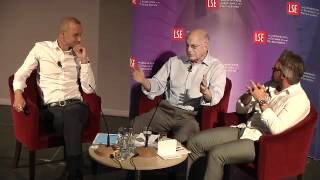
Daniel Kahneman on Well-Being
Kahneman treats well-being as at least two different things—how life feels while you live it and how it looks when you remember and evaluate it—and he argues that confusing them leads to bad choices and bad measurement.
- Well-being is not one thing: the experiencing self and the remembering self can diverge.
- Memory is shaped by peaks and endings more than duration, so people often misremember what was actually lived.
- Many choices serve the remembering self, not moment-to-moment experience.
- Money reduces misery at the low end more clearly than it raises experiential happiness, while life satisfaction follows a different pattern.
- For better personal and policy decisions, measure suffering directly and use slower, more structured judgment.

“There is an experiencing self who lives in the present and knows the present.”TED2010 talk · 2:57
Well-being has two sides: lived experience and evaluated life
Kahneman’s central move is to split well-being into two different subjects. One is the experiencing self, which lives moment by moment; the other is the remembering self, which later summarizes, scores, and narrates a life. When people use one word like happiness for both, they blur distinctions that matter for research, policy, and everyday choice.12345
This distinction changes the basic question. Being happy in your life is not the same as being happy about your life. A person can have many pleasant moments yet tell a disappointing life story, or endure difficult moments and later judge the life as meaningful or satisfying.45
“There is an experiencing self who lives in the present and knows the present.”TED2010 talk · full transcript →
What we remember is not what we lived
Kahneman argues that remembered experience follows its own rules. In painful episodes, what gets stored is not a running total of suffering. Memory gives special weight to the peak and the ending, and overall duration can fade from the final evaluation.678
That is why a longer experience can sometimes be remembered as better than a shorter one, even when it contained more total pain. The difference comes from how the episode ended, not from the total amount of discomfort while it was happening. This is one of his clearest demonstrations that living and remembering are separate psychological processes.789
More broadly, stories are organized around changes, standout moments, and endings. The remembering self compresses life into that structure, which makes memory useful for narrative but unreliable as a record of experienced well-being.102

“This is not what is happening. It is not a sum, rolling sum of the pain that a person experiences, that's not what happens. What happens is that what gets stored is an average of the pain that was experienced. And it's a weighted average. And in that weighted average, two moments have particular weight, the peak pain that was experienced and the end. And if you know the peak and you know the end, you can predict with a great deal of accuracy how people will evaluate the experience as a whole. And there is one detail you don't need to know, and this is how long the colonoscopy lasted. Because when people provide an overall evaluation, it turns out that that detail goes. In the memory representation, the colonoscopy is represented by sort of an average moment, a moment of pain.”UCTV lecture on well-being, 2008 · full transcript →
Much of decision-making serves the remembering self
Kahneman’s view is strikingly skeptical about how people choose. He says the experiencing self has little voice in many decisions, because people often choose among memories or anticipated memories rather than among future moments of actual experience. That means choices can be organized around the story life will leave behind instead of how life will feel as it is lived.119
This helps explain why people pursue experiences that are taxing in real time but valuable as memories. Vacations are one example he uses to show that people may accept burdens on the experiencing self because the remembering self values the narrative, the highlights, and the ending.11
It also connects to the focusing illusion. When imagining the future, people exaggerate the importance of one salient factor and neglect the rest of life that will continue around it. As a result, they make predictable errors about what will improve well-being.1213
“The experiencing self has no voice in this choice. We actually don't choose between experiences. We choose between memories of experiences. And even when we think about the future, we don't think of our future normally as experiences. We think of our future as anticipated memories. And, basically, you can look at this, you know, as a tyranny of the remembering self, and you can think of the remembering self sort of dragging the experiencing self through experiences that experiencing self doesn't need. I have that sense that when we go on vacations, this is very frequently the case. That is that it's... We we go on vacations to a very large extent in the service of our remembering self. And this is a bit hard to justify, I think.”TED2010 talk · full transcript →
Income matters differently for misery, emotion, and life satisfaction
Kahneman does not treat money as irrelevant to well-being, but he separates its effects. Lack of money clearly brings misery, and that misery can be measured in experiential terms. Yet more money does not keep producing more moment-to-moment emotional well-being in the same way, while life satisfaction continues to tell a different story.15
That distinction matters because policy and personal ambition can chase the wrong target. If the goal is to reduce suffering, then attention should go to the conditions that create intense misery and to the share of time people spend in unpleasant states. If the goal is status or a better life story, then satisfaction measures may move even when experienced happiness does not.1615
So for Kahneman, debates about whether money buys happiness are usually too crude. The answer depends on which self is being measured and whether the question is about misery, emotion, or life evaluation.154
“$120,000 a year, people are unhappy, and they get progressively unhappier the poorer they get. Above that, we get an absolutely flat line. I mean, I've rarely seen lines so flat. Clearly, what is happening is money does not buy you experiential happiness, but lack of money certainly buys you misery, and we can measure that misery very, very clearly. In terms of this... The other self, the remembering self, you get a different story. The more money you are, the more satisfied you are. That does not hold for emotion.”TED2010 talk · full transcript →
A better approach is to measure suffering and make decisions more slowly
Kahneman’s practical lesson is that well-being should be measured in ways that match the question being asked. He is especially interested in identifying the sources of intense misery and in reducing the time people spend suffering, because that gives a concrete and meaningful population target.16
For personal and institutional decisions, he warns against fast, confident intuition. People form impressions too quickly, and those impressions are often noisy or distorted. A better process is to break options into dimensions, assess them separately, and delay the final intuition until more information is on the table.1718192021
When possible, he thinks rules and algorithms improve judgment. That advice is not only about business or forecasting; it also applies to choices that shape well-being, because people are systematically poor at predicting what will make them happy and at evaluating experiences accurately.222324
Kahneman on well-being, in his own words
“There is a difference between living and thinking about it…”
“There is an experiencing self who lives in the present and knows the present.”
“…the remembering self is a storyteller…”
“What defines a story are changes, significant moments, and endings.”
“Nothing in life matters quite as much as you think it does while you are thinking about it.”
“Don't trust yourself too much.”
Where to watch
 Daniel Kahneman on Well-Being: Living and Thinking About It2008 · 59 min · full transcriptBest single overview of Kahneman’s well-being framework, including experience vs memory, misprediction, income, and the measurement of suffering.
 Daniel Kahneman on Experience vs Memory: The Two Selves2010 · 21 min · full transcriptMost vivid explanation of the experiencing self and remembering self, with memorable examples of why endings dominate memory.
 Daniel Kahneman on Noise and Bias: Why Judgment Fails2021 · 69 min · full transcriptShows how memory and life satisfaction can outweigh moment-to-moment happiness in the choices people actually make.
 Daniel Kahneman on Judgment and Noise: Delay Intuition2021 · 67 min · full transcriptUseful for applying Kahneman’s ideas: how to make better judgments when intuition about well-being is unreliable.
 Daniel Kahneman on Noise and Judgment: Why Doubt Yourself2021 · 42 min · full transcriptA concise later reflection on why fast confidence misleads us and why experience and memory should be kept apart.
Questions people ask
- How does Daniel Kahneman say memories of painful experiences are formed?
- What did Daniel Kahneman mean by the focusing illusion?
- What did Daniel Kahneman mean by the tyranny of the remembering self?
- What did Daniel Kahneman say about how to measure suffering and well-being?
- What did Daniel Kahneman say about money and happiness?
- What did Daniel Kahneman say about the difference between living and remembering?
Sources
Every quote above, word for word from the transcripts. Numbers match the text.
“There is an experiencing self who lives in the present and knows the present.”
“…the remembering self is a storyteller…”
“There is a difference between living and thinking about it…”
“Turns out that the word happiness is just not a useful word anymore because we apply it to too many different things. I think there is one particular meaning to which we might restrict it, but by and large, this is something that we'll have to give up, and we'll have to adopt a more complicated view of what well-being is. The second trap is a confusion between experience and memory. Basically, it's between being happy in your life and being happy about your life or happy with your life. And those are two very different concepts, and they're both lumped in the notion of happiness. And the third is it's the focusing illusion, and it's the unfortunate fact that we can't think about any circumstance that affects well-being without distorting its importance.”
“There is an experiencing self who lives in the present and knows the present. It's capable of reliving the past, but, basically, it has only the present. It's the experiencing self that the doctor approaches, you know, when the doctor asks, does it hurt now when I touch you here? And then there is a remembering self. And the remembering self is the one that keeps score and maintains the story of our life, and it's the one that the doctor approaches in asking the question, how have you been feeling lately, or how was your trip to Albania, something like that. Those are two very different entities, the experiencing self and the and the remembering self, and getting confused between them is part of the mess about the notion of happiness.”
“…what gets stored is an average of the pain that was experienced…”
“…the memory they stored is worse when the experience ended at a high level of pain…”
“This is not what is happening. It is not a sum, rolling sum of the pain that a person experiences, that's not what happens. What happens is that what gets stored is an average of the pain that was experienced. And it's a weighted average. And in that weighted average, two moments have particular weight, the peak pain that was experienced and the end. And if you know the peak and you know the end, you can predict with a great deal of accuracy how people will evaluate the experience as a whole. And there is one detail you don't need to know, and this is how long the colonoscopy lasted. Because when people provide an overall evaluation, it turns out that that detail goes. In the memory representation, the colonoscopy is represented by sort of an average moment, a moment of pain.”
“This is telling us that there is a difference between living and thinking about it or between living and remembering it. Because if you think about the experience, clearly the longer experience is worse. But if you think of the memory that people keep, then the longer experience is actually better. It is not as bad. And notice that the choices that people make are guided by their memory. They're not guided by the reality of the experience. They are guided, in this case, by what I would describe as an inaccurate memory of what actually happened to them. So, there have been many experiments of that kind, and that's the background, actually, for my interest in the study of well-being.”
“What defines a story are changes, significant moments, and endings.”
“The experiencing self has no voice in this choice. We actually don't choose between experiences. We choose between memories of experiences. And even when we think about the future, we don't think of our future normally as experiences. We think of our future as anticipated memories. And, basically, you can look at this, you know, as a tyranny of the remembering self, and you can think of the remembering self sort of dragging the experiencing self through experiences that experiencing self doesn't need. I have that sense that when we go on vacations, this is very frequently the case. That is that it's... We we go on vacations to a very large extent in the service of our remembering self. And this is a bit hard to justify, I think.”
“Nothing in life matters quite as much as you think it does while you are thinking about it.”
“For example, you know, a large refrigerator, a large car, a large house, et cetera. Those are goods that people think are going to make a very large difference in their life. We call that a focusing illusion. People exaggerate the importance that this is going to have in their life. Now what's happening here is the following. There are different kinds of consumption goods. There are consumption goods such as a refrigerator that you're completely unaware of unless, you know, something happens to it and it stops functioning.”
“$120,000 a year, people are unhappy, and they get progressively unhappier the poorer they get. Above that, we get an absolutely flat line. I mean, I've rarely seen lines so flat. Clearly, what is happening is money does not buy you experiential happiness, but lack of money certainly buys you misery, and we can measure that misery very, very clearly. In terms of this... The other self, the remembering self, you get a different story. The more money you are, the more satisfied you are. That does not hold for emotion.”
“That is, what are the sources of intense misery? This is something that you get to because that U Index is actually an interesting measure, that is has some metric properties, that it makes sense to say that we have reduced the time that people spend suffering by five percent or 10 percent. If we achieved that change, we have achieved something for the population. That is, I think, quite meaningful.”
“Don't try to form an intuition quickly, which is what we normally do.”
“So, actually, I have same idea, really, that when you are making decisions, you should think of options as if they were candidates. So you should break break it up into dimensions, evaluate each dimension separately, then look at the profile, and and the key is delay your intuition. Don't try to form an intuition quickly, which is what we normally do. Focus on the separate points. And then when you have the whole profile, then you can have an intuition, and it's going to be better. Because people make form intuitions too quickly, and the rapid intuitions are not particularly good. So if you delay intuition until you have more information, it's going to be better.”
“…confidence is not a guide to accuracy…”
“Don't trust yourself too much.”
“Overconfidence is really the enemy of good thinking.”
“If you really want to improve the quality of decision making, use algorithms.”
“Wherever there is judgment, there is noise and more of it than you think.”
“If you really want to improve the quality of decision making, use algorithms. I mean, when... Wherever you can. If you can replace judgments by by rules and algorithms, they'll do better. There... There's big social costs to trusting, allowing algorithm to make decisions, but but the decisions will likely to be better. So that's one thing. If you can't use algorithms, then you slow yourself down. And then there are things that you can do for certain types of problems, and there are different types of problems. So one class of problems like forecasting problems, our friend Phil Tetlock, you know, has that book on super forecasters where he identifies with people who are good at forecasting the future, what they do that makes them good, and, you know, he tries to train people and they can improve people.”
How this guide was made: drafted with AI from the full transcripts of the recordings cited, then checked: every quotation must match a transcript word for word and be the speaker's own words, and an independent review gates accuracy. Methodology and corrections.