Daniel Kahneman on Noise
Kahneman argues that many bad decisions come not only from bias but from noise: unwanted variability in human judgment that can be reduced with rules, structure, and delayed intuition.
- Noise is unwanted variability in judgments that should be the same.
- Kahneman thinks noise is widespread and usually underestimated.
- Bias and noise are different, but both create inaccuracy.
- Rules, algorithms, and structured processes often beat informal expert judgment.
- Good decision hygiene means delaying intuition, using independent assessments, and standardizing procedures.

“…noise is unwanted variability in judgments that should be identical…”Talking Feds interview, 2021 · 2:12
Noise is inconsistency in judgments that should match
Kahneman defines noise as unwanted variability in judgments that should come out the same. If two professionals look at the same case and reach meaningfully different conclusions, or if the same person would judge the same case differently on another day, that is noise.123
He treats noise as different from bias. Bias is about the direction of error on average, while noise is about spread and inconsistency across judgments, so you cannot spot noise by looking at a single decision in isolation.35
That is why noise is often missed. People focus on whether a judgment seems reasonable case by case, while the real problem only appears when you compare many judgments across people or occasions.23
“…noise is unwanted variability in judgments that should be identical…”Talking Feds interview, 2021 · full transcript →
He thinks noise is everywhere, and more of it than people realize
Kahneman's central warning is that whenever there is judgment, there is noise. He repeats this across settings because he believes people badly underestimate how variable expert judgment really is.6789
Part of the reason is overconfidence. People assume they are seeing stable expertise when in fact luck, context, and unnoticed influences are shaping outcomes far more than they admit.1011
This matters because noisy systems can become lotteries while still looking professional. In areas like hiring, sentencing, insurance, medicine, and performance evaluation, similar cases can get dissimilar treatment for no good reason.19
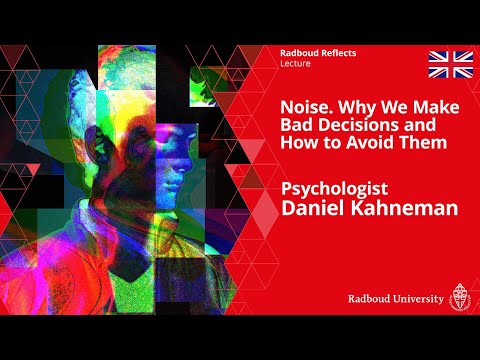
“…wherever there is judgment there is noise, and there is more of it than you think.”Radboud Reflects lecture and Q&A, 2021 · full transcript →
Noise matters as much as bias because both make decisions less accurate
Kahneman does not argue that bias is unimportant. His point is that bias has received far more attention than it deserves relative to noise, even though both contribute to error.1213
He borrows the logic of measurement. Bias is the average error, noise is the variability of judgments and errors, and overall inaccuracy reflects both.513
He also notes that noise can arise from variability in biases across judges or occasions. That helps explain why a system can contain no single shared distortion and still produce large, costly inconsistency.145

“The mean squared error is simply the sum of bias squared and noise squared…”Learning from Leaders webinar, 2021 · full transcript →
His practical answer is decision hygiene, not faith in intuition
Kahneman's practical response is decision hygiene: procedures that reduce the chance that irrelevant influences will enter judgment. The basic idea is not to trust an overall impression formed too early.151617
Instead, he recommends breaking a judgment into dimensions, evaluating each dimension separately, and delaying intuition until the end. That makes the final judgment less vulnerable to snap impressions and more responsive to the full profile of the case.181716
He is especially interested in organizational fixes because organizations can standardize procedures more easily than individuals can rewire their minds. Better process design, not just better intentions, is his route to better judgment.1915

“So, actually, I have same idea, really, that when you are making decisions, you should think of options as if they were candidates. So you should break break it up into dimensions, evaluate each dimension separately, then look at the profile, and and the key is delay your intuition. Don't try to form an intuition quickly, which is what we normally do. Focus on the separate points. And then when you have the whole profile, then you can have an intuition, and it's going to be better. Because people make form intuitions too quickly, and the rapid intuitions are not particularly good. So if you delay intuition until you have more information, it's going to be better.”The Knowledge Project podcast interview, 2021 · full transcript →
Algorithms and independent judgments usually improve decisions
Kahneman is strikingly direct on one point: if you want to improve decisions, use algorithms wherever you can. His reason is simple: rules are consistent, and consistency removes a major source of error that plagues human judgment.2021
Even simple statistical rules can outperform people because they produce the same answer for the same case every time. Human judges do not, and that variability alone often makes them worse.23
When algorithms are not available or acceptable, he favors independent assessments and aggregation. Combining independent judgments can cancel noise, though it does not by itself remove bias.
He is not utopian about this. Reducing noise has costs, and eliminating it completely can be expensive, so the goal is not perfection but cleaner, fairer, more reliable judgment where the stakes justify it.2515
Kahneman on noise, in his own words
“…noise is unwanted variability in judgments that should be identical…”
“…wherever there is judgment there is noise, and there is more of it than you think.”
“…decision hygiene will prevent unseen forces from introducing variability in your decisions…”
“The mean squared error is simply the sum of bias squared and noise squared…”
Where to watch
 Daniel Kahneman on Noise in Judgment: Why Decisions Vary2021 · 90 min · full transcriptBest single overview of what noise is, how it differs from bias, and why it matters for accuracy.
 Daniel Kahneman on Judgment and Noise: Delay Intuition2021 · 67 min · full transcriptBest for applying the idea: delay intuition, break judgments into parts, and use algorithms when possible.
 Daniel Kahneman on Noise and Decision Hygiene2021 · 58 min · full transcriptBest for decision hygiene and Kahneman's measurement-style explanation of bias, noise, and error.
 Daniel Kahneman on Human Judgment Variability: Noise Everywhere2021 · 44 min · full transcriptBest for concrete examples of noisy judgment in law, insurance, and group decision-making.
 Daniel Kahneman on Noise Reduction: Why Experts Disagree2016 · 53 min · full transcriptBest earlier talk showing why expert disagreement and overconfidence make noise so costly in organizations.
Questions people ask
- How does Daniel Kahneman distinguish noise from bias?
- What did Daniel Kahneman say about whether organizations can reduce noise in judgment?
- What did Daniel Kahneman say is the best way to reduce noise?
- What did Daniel Kahneman say about delaying intuition when making decisions?
- What did Daniel Kahneman say about algorithms versus human judgment?
Sources
Every quote above, word for word from the transcripts. Numbers match the text.
“…noise is unwanted variability in judgments that should be identical…”
“Noise is a characteristic of a set of judgments, it's a statistical concept…”
“So that's the concept of noise. It's completely different from the concept of bias. Bias is a concept within individual psychology. That is, we think of bias as a psychological process and we detect or identify bias sometimes in a particular error in a particular judgment, but we cannot identify noise in a particular judgment. Noise is a characteristic of a set of judgments, it's a statistical concept, and in that way it's very different from bias.”
“…noise is the standard deviation of judgments and of errors.”
“…whenever there is judgment, there is noise…”
“Wherever there is judgment, there is noise…”
“…wherever there is judgment, there is noise…”
“…wherever there is judgment there is noise, and there is more of it than you think.”
“…the core reason why we make these mistakes is the perniciousness of overconfidence…”
“Among other things. But go ahead. I mean, we tend—and there is good psychological reasons for that—we tend to underestimate the role of luck in human affairs. We tend to think that people are responsible for outcomes when, in fact, they have limited control over outcomes. And we’re built that way, and it's good that we're built that way because, you know, we want to extract as much variance as possible from what is regular in the world. But, in fact, it leads us to underestimate consistently the role of uncertainty, the role of luck, and it causes us to be overconfident. To close a loop that you started earlier. Mhm, mhm. Well, and part of it is that we—…”
“…bias has been overestimated at the expense of noise.”
“The mean squared error is simply the sum of bias squared and noise squared…”
“What produces noise is variability in biases.”
“…decision hygiene will prevent unseen forces from introducing variability in your decisions…”
“…you want to resist forming an intuition too quickly…”
“Don't try to form an intuition quickly, which is what we normally do.”
“So, actually, I have same idea, really, that when you are making decisions, you should think of options as if they were candidates. So you should break break it up into dimensions, evaluate each dimension separately, then look at the profile, and and the key is delay your intuition. Don't try to form an intuition quickly, which is what we normally do. Focus on the separate points. And then when you have the whole profile, then you can have an intuition, and it's going to be better. Because people make form intuitions too quickly, and the rapid intuitions are not particularly good. So if you delay intuition until you have more information, it's going to be better.”
“Absolutely. And altogether - I mean, this is the orientation that I have in general, and I had it I think even in the previous book, that organisations - it's much easier to improve the thinking and the decision making of organisations than to improve the thinking and the decision making of individuals. Organisations think slowly, they have procedures, you can intervene in the procedures, you can standardise procedures, and there is a chance of improving things that really doesn't exist when you're trying to improve your own thinking.”
“If you really want to improve the quality of decision making, use algorithms.”
“If you really want to improve the quality of decision making, use algorithms. I mean, when... Wherever you can. If you can replace judgments by by rules and algorithms, they'll do better. There... There's big social costs to trusting, allowing algorithm to make decisions, but but the decisions will likely to be better. So that's one thing. If you can't use algorithms, then you slow yourself down. And then there are things that you can do for certain types of problems, and there are different types of problems. So one class of problems like forecasting problems, our friend Phil Tetlock, you know, has that book on super forecasters where he identifies with people who are good at forecasting the future, what they do that makes them good, and, you know, he tries to train people and they can improve people.”
“…rules are more accurate than people…”
“We think that eliminating noise completely is costly…”
How this guide was made: drafted with AI from the full transcripts of the recordings cited, then checked: every quotation must match a transcript word for word and be the speaker's own words, and an independent review gates accuracy. Methodology and corrections.


