Daniel Kahneman on Noise in Judgment: Why Decisions Vary

What Kahneman talks about
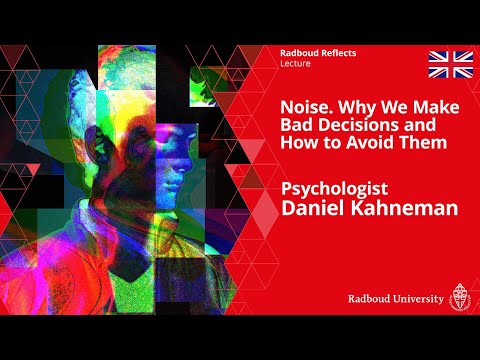
Daniel Kahneman gave this Radboud Reflects lecture in 2021 on noise in judgment, explaining why decisions vary across areas like medicine, hiring, sentencing, and insurance.
Also known as: Noise. Why We Make Bad Decisions and How to Avoid Them; Psychologist Daniel Kahneman - Noise; Radboud Reflects lecture.
Daniel Kahneman argues that noise is unwanted variability in judgments that ought to be consistent. Using examples from insurance, sentencing, medicine, and hiring, he shows that people are far less consistent than they realize.
He contrasts noise with bias, explains why both matter equally in accuracy, and shows how measurement theory and mean squared error help quantify their effects. He also discusses why rules, formulas, and some AI systems can outperform human judgment because they eliminate noise.
In the discussion with audience and panelists, Kahneman clarifies that not all variability is bad: diversity can be valuable, but when institutions need consistency, noise is costly and often hidden.
Lisa Johnson hosts the event, Kahneman gives the lecture, and Noelle Arts, Daniel Vic Boulders, and audience members join the Q&A.
In his words
“Wherever there is judgment there is noise, and there is more of it than you think.”
“The human mind is the scale”
“Rules are more accurate than people”
“What produces noise is variability in biases.”
Key points
- Noise is unwanted variability in judgments that should ideally be the same.
- Bias is average error; noise is the spread or variability of errors.
- In mean squared error, bias and noise matter equally for accuracy.
- Insurance underwriters, judges, physicians, and hiring systems all show substantial noise.
- Simple rules and algorithms often outperform people because they are noise-free.
- In sentencing, Kahneman distinguishes level noise, occasion noise, and pattern noise.
- Not all disagreement is bad; diversity can be useful, but not when identical cases require identical judgments.
Full transcript: Daniel Kahneman, Radboud Reflects lecture on Noise (2021)
Imagine, imagine that you have committed a crime. I know you wouldn't, of course, but for the sake of just imagining, do you know that you should wish for your case being heard in court either at the beginning of the day or just after lunch? Because judges tend to be milder in their rulings at those moments of the day. This lack of consistency in judgments in all cases—so not only in court, but all kinds of judgments—is called noise. And noise is also the title of the
long-awaited follow-up of Thinking, Fast and Slow by the famous Nobel Prize winner Daniel Kahneman. We are honored and tremendously happy that he is here with us today through Zoom. Daniel Kahneman is Professor of Psychology and Public Affairs Emeritus, Princeton School of Public and International Affairs. His résumé is so impressive that I wouldn't know where to start or end, and since I guess you haven't come to hear me talking here tonight, I will confine myself by remarking his membership of the National Academy of Science, the Nobel Prize in Economic Sciences that he received in 2002,
and has numerous awards, prizes, and honorary degrees at universities all over the world. Thanks for joining us here today live here at Theater the Lindenberg in Nijmeger or through live stream. My name is Lisa Johnson. I am a program writer for Hot Dot Reflects, and I'll be your host today. After a short lecture, Professor Kahneman will talk to two scholars of Jhardberg University: Novella Arts and Daniel Vikvaldes. Novella Arts is a professor of social ecological relations—interactions, sorry, social ecological interactions—at Rutgers University and affiliated to the Institute for Science in Society, and she studies inter-human
processes and communication in creating space for sustainable change. Dania Vicbaldus is a professor of social cognition with a specialization in person perception in general and stereotyping and prejudice in particular, and he's also the president, president of the Rabat University Executive Board. Well, the outline of tonight's event is pretty straightforward: we will first listen to a short lecture by Professor Kahneman, and after which he will discuss the topic of noise in more detail with Novella Arts and Daniel Vicbaldus. There will be, of course, ample time for your own questions as well, and for those of you here in the lecture hall, you can
just, when time is there, raise your hand and my colleagues will come with microphones. And for those of you who are joining us through livestream, you can go to the website www.mente.com, and if you enter there the code that you can see on your screens just now, you can enter your questions and I will get them on my tablet. Well, I think we can start. Let's give a big applause to Professor Kahneman. Well, I'm Danny Kahneman. Thank you for that introduction, and so
on that screen we have an introduction to the topic of today and you can imagine four teams shooting arrows at the target, and what you have are the marks of the hits under target. And we distinguish four major types of results. So the top left is, of course, accurate. Most of the shots are on target, actually all of them. The bottom left is a bias shot, and what this means is that the arrows are clustered clearly; they're off the target, but they're off the
targets and clustered together so that all the errors seem to be in the same direction. So this is a bias. The top right is the topic of this talk: the top right is noise, and what you have in noise is clearly those shooters are not very good. In fact, they're probably less good than the bias shooters in this particular instance, but they're not biased in particular. There is no particular direction to the errors; they're scattered. And this scatter of a shot, like the scatter of judgments that we'll be talking about for the rest of the
time, that is noise. And of course, you can have a combination of both bias and noise, and that's what you have at the bottom right. So those are the basic topics, the basic concept is noise and bias, and you can see that noise applies not to one shot, but it applies to a set of thoughts. And the set of thoughts, when it is scattered, we say that there is noise. Now let me tell you how my research on this topic, how the book Noise actually began. A number of years ago, I was consulting with an insurance company,
and I had the idea for a kind of experiment that today we would call a noise audit. And what we did there was we presented the same problem of assessment to about 50 underwriters, so they had the same and they had a few problems which were very realistic, the kind of problems that they dealt with in their normal job. And they were given a sufficient amount of time to work on each of these cases that have been constructed for them, and then they set a dollar value of the premium that they would suggest
is appropriate for that risk. And I did something else. I asked executives in the company, and I invite you to think for yourself, because I'm asking you to suppose you take two underwriters at random and, but how much do you expect them to differ in percentages? So what that means is you take the two underwriters, you look at the two premiums that they sent, you take the difference, you take the average, you divide the difference by the average, and so how much would you expect them to differ in a well-run insurance company?
Now the executives had a favorite number, and it turns out that that favorite number is very common. We've asked thousands of people since then that basic question, and the favorite number is ten. Ten looks like a reasonable amount of variation for a judgment. You know that because this is a judgment problem, they cannot be expected to agree perfectly, but you don't want them to agree widely, and ten percent looks like a tolerable amount of disagreement. In fact, the amount of disagreement between two average, two random underwriters was
About fifty percent, five zero five times as large as what people with executives unexpected. And what was striking here was actually there were two things that were striking. One was that the difference was much larger than we had expected and clearly much larger than they had expected. But the second and most striking observation, whether this was a new problem so far the insurance company was concerned, they did not know that they had a noise problem. In fact, they were very surprised, and yet, when they realized that they did—
Have a noise problem, it was immediately obvious to them that the noise problem is costly. It cost them, cost the company money. And it's easy to see, if premiums are scattered and there is an ideal level for a premium — we don't know what it is, but just assume there is an ideal — and you scatter around it. Now, if the underwriter sets a premium that's too high, the company is likely to lose the business to a competitor that will set a more reasonable price. If the company sets a premium that's too low, if the underwriter sets a premium that's too low, the company leaves money on the table, and—
Actually, this is pretty much guaranteed to lose money. So noise is costly, and the insurance company was not aware of noise. And it's that combination of there being a lot of noise and people not being aware of it that caused me to want to write a book about it. And then I had two great collaborators, Rusell Bonini and Cass Sunstein, and, well, a few years later there was a book. So what I said is knowing, I spoke about noise in judgment, and—
We speak of judgment where some disagreement is expected. So if people had to compute, had a rule, and they could compute a premium, that would not be an operation of judgment, and you would not be willing to tolerate any disagreement because there is a correct answer. The correct answer can be computed, and that's all there is to it. But the judgment problem is essentially defined by the fact that reasonable people can disagree, but they shouldn't disagree by too much. And clearly, the underwriters disagreed by too much. There was a lot more noise than was—
Expected. So that's basically the thesis of the book: that wherever there is judgment there is noise, and there is more of it than you think. And both parts of that thesis, I think, are well defended. People find the amount of noise surprising and shocking. And we have yet to find a problem where there is real judgment rather than computation without a significant amount of noise. So the theory that we developed for to look at noise, to understand noise, is to think of judgment as a kind of measurement, and—
There is a definition for measurement. Measurement: you take an object, you have a scale, which could be a scale of weight, a scale of length, or, or, or scale, a judgment scale. And you take an object, and you assign the object a value on a scale. And this is actually also what judgments do. The technical definition of judgment fits the definition of a measurement. Judgment summarizes, is the summary of an attribute or the value that is put on an object on a scale. So we speak of judgment—
As a measurement, and where the measuring instrument is the human mind. So the human mind is the scale, it's the weight, it's the — it's what generates judgments, and it is what generates noise and judgment and errors in judgment. Now let me go back to bias and noise, which I introduced earlier. We have a set of measurements, and we assume that we know the true values for each of these measurements, so that we're measuring, you know, the height of the group of six-year-olds. And for each of these, we have the exact scientific value, and then we take a—
Measurement, an informal kind of measurement. So there is an error for each measurement, and the errors can be positive or negative, and the bias is simply the average error. So that's very straightforward. The noise is the variability of errors. And this is just like I presented you know, when in the targets that, when the errors are scattered: some of them positive, some of them negative, some of them much higher than the bias, than the average error, and some of them much lower. Then we have noise. And for those who want to know the statistics of it, the noise in—
The standard deviation of theirs. Now, that the idea of treating judgment as a kind of measurement was that there is a theory of measurement, the theory of measurement error, and we can bring it to bear on judgments. And that theory is really very well established. And the key problem is to evaluate the amount of error in a set of measurements. And you can think of it like, for example, if you have two scales to measure weights, and you want to calibrate the scale or to evaluate how accurate they are, and you have—
A set of errors of measurement for each of the two scales, how are you going to compare and decide which of the two scales is more accurate? So that's the problem: evaluate the amount of the error, the inaccuracy of accuracy—obviously their complement—evaluate the amount of error in a set of measurements. And the solution goes back more than 200 years, and it goes back to a very famous mathematical prodigy called Friedrich Gauss. And (music) the context in which Gauss dealt with that problem was astronomy. A lot of developments in—
Measurement come from astronomy in the 17th and 18th century, and they wanted a way, when you take repeated measurements, they wanted a way to figure out what is the best way to combine measurements and what is the best way of comparing instruments of measurements in terms of their accuracy. So what the proposal that Carl Friedrich Gauss offered on how to solve that problem is actually generally accepted at the basis of scientific measurement in all disciplines, and it's also the basis of much statistics. This holds true—you measure the idea that I'm going to
Introduce when the goal is accuracy. So, when you want to be as accurate as possible, that is the problem for which Gauss proposed an answer, and the answer with this is that the overall error is the mean of the squared errors. That is, you have a set of errors, positive, negative, and it’s when you look at how much an error contributes to the overall inaccuracy, to the overall error, what Gauss proposed was that an error should be squared so that 4 becomes 16 and 5 becomes 25.
You square each error and minus 5 also becomes 25, and its mean of the squared errors is the measure, and that is called MSE, mean of squared errors. And now there is a formula that sort of decomposes the mean of squared error, and it is really the intellectual foundation of the book, and it’s completely trivial, but here it is: the mean of squared error is equal to the square of the bias plus the square of the noise. So, we know how to compute bias — it’s the average error. We know how to compute
noise as the standard deviation of the errors, and mean squared error is the sum of the squares of these two forms of noise. And that is, I think, quite surprising as well as important. And the surprise is that bias and noise in that formula have equal weights. That is, you can see MSE is bias square plus noise square. What you can learn from this, that they have equal weight, is that you can improve accuracy by reducing bias or by reducing noise. And actually, reducing bias and reducing
noise have, in principle, the same effect. If you reduce bias by one half, or you reduce noise by one half, if they were equal to begin with, then the effect, the improvement of accuracy, is constant. Bias and noise then have equal weights, but they don’t have equal weights in our mind when we think of error. In our minds, when we think of errors, bias is central and noise is ignored and neglected. And that was actually a key reason for writing the book: to correct an imbalance in the treatment of bias and noise.
That, you know, there are hundreds of articles on bias, and we speak of bias all the time, and there is very little treatment of noise. And yet, as we see in Gauss’s formula, bias and noise have equal weight when the objective is to minimize error. The objective is accuracy. So, this equivalence is very non-intuitive, and it’s not intuitive even when you look at results. So, here is a comparison: you have a true value, and the true value is the boundary between the blue region and the white region.
And so you have one case which is high bias, low noise. That’s on the right. I didn’t—I made a mistake in labeling that graph. And on the bottom you have low bias and high noise. Now, have a look carefully and what is your impression? Which of these is worse? And most people would say that the one at the upper right is clearly worse because almost all the cases, all the errors, are of the same kind. And yet, mathematically, when you apply Gauss’s formula, the two are identical in terms of mean
squared error. It is. And that is a surprising effect, and you have to accept it because that’s the mathematics of it. That if you follow your intuition, you are not going to get there. But this is a case where you have to put the mathematics ahead of your intuition. So, that’s the basic theory, and that puts noise and bias as equivalently important in some basic way. And then I want to link that to studies of the quality of human judgment.
And it turns out that humans are noisy, and, of course, rules are not. And I’ll explain how that works. So, a famous psychologist, Paul Meehl, a long time ago in 1954, published a book called Clinical and Actuarial Prediction, where he compared cases of predictions like, you know, the amount of time patients will stay in hospital or whether a marriage will endure or not. Problems of that kind, where there was a set of information about each case, and then he had people make judgments
about each case. And he also applied a formula, he developed a predictive formula that was applied. And on the basis of that information, the formula typically used less information than was available to the people. But the basic finding, and it’s been replicated many, many, many times, simply true, is that the rules are more accurate than people, and very simple rules turn out to be more accurate than people. Now, this is disappointing, but we know why.
Actually, and we know at least one of the main reasons why formulas and rules can be more accurate than people, and this is because formulas and rules are not noisy. When you present a formula with the same problem, the same data twice, it will come up with the same answer. But when you take different people, or you take the same person on two occasions, you present the same information, you’re not necessarily going to get the same error. That’s noise. So, another important psychologist, Lou Goldberg, ran an experiment that’s very clever, but I’ll have to
speak slowly so that you know exactly what I’m talking about. So, again, you have, say, to, to make it a little more concrete, we’re trying to predict how successful students will be in graduate school, and we have a lot of data about each of these students, and we have people who are professors or clinical psychologists or what have you. They’re people, and they make predictions about the success of these students. I notice here that I use Model of Man. This was the original way that Goldberg
Wrote the article. Today, we would speak, of course, of the model of human, uh, but gender language was common when Goldberg did his work, which was in the 1970s. So, we have judges making predictions about these cases, and now we develop a formula, a predictive formula, and there is a mathematical way of optimizing, finding the best possible formula. But instead of using the formula to predict the success of the graduate students, we use a formula where we develop a formula.
To predict the judgment that people will make. So, for each judge, you develop a model that judge—how that judge uses the information, how much weight that judge gave to one aspect or the other of information, and you predict what the judge will say. You don't predict the graduate success. However, you now can do an interesting experiment, and that's the purpose of the study. You can compare the accuracy of the judge to the accuracy of the model that predicts the judge, and it turns out that the model is more
accurate than the model of a person. A particular judge is more accurate than that judge in predicting the final outcome. Now, how could that be? That's really very strange, and what it could be is that because we've built a model, a predictive equation to use the information, because we have built a model that, uh, has the characteristics of a rule, of an algorithm, it produces—it's not noisy; it is noise-free. And just eliminating the noise from the predictions is sufficient to overcome the fact all
the subtleties that the people think that they apply when they're making their judgments are lost in that model. And it turns out that losing the intuitive subtleties using the clinical judgment—just taking a, a very simple mathematical model of the, of the human, of the judge himself—turns out to be, uh, more accurate than the judge. Now, many people find these results shocking, and they find the result shocking because people think of rules as sort of crude and they lack subtlety; and a clinical
psychologist can pick up subtlety and can use subtle cues. That's the feeling that we have when we understand—or we think we understand—complicated problems, and we think we can see things that are unique to this particular case, and we can see what the particular configuration of observations in a case, what it implies. Well, it turns out that subtlety—you think you're adding subtlety if you're a human, but actually mostly you're adding noise. And that's a humiliating, uh, conclusion for people, but it's a
conclusion that we have to take on board because it's true that people are very noisy, and that just eliminating the noise from their judgments—which eliminates a lot of subtlety from their judgment—will improve the quality, the predictive quality of the judgments by the mean square error criteria. That's, that's an important finding about the limitations of the human mind, and it's extremely important when we think of the future of artificial intelligence or how people will interact with machines. It turns out that just eliminating the noise causes such a big improvement
that a rule or a machine can be superior to people if you take basically what the person is doing but add, eliminate the noise from it. So, there are recent developments that confirm this idea, mainly in artificial intelligence, that artificial intelligence models in recent years are really beating people at a lot of judgment tasks. So, for example, there is a decision that judges make in the United States about parole, uh—not about parole, about bail—which is whether a person who has been
arrested for, uh, is suspected of the crime, whether he'll spend the time waiting for trial in prison or at home. And, and people, so there are judges, bail judges, who make those decisions, and clearly the objective in that case is to minimize the crimes that people will commit. I mean, that's the fear, and the reason you put criminals in prison to wait for trial is that you are afraid that if you leave them free, they will commit more crimes. On the other hand, of course, you don't want to send to keep in prison somebody
who would not commit crimes. Well, it turns out that the rule of artificial intelligence model—development, hundreds of thousands of judgments—can improve the decisions of bail judges by a lot. That is, it can keep the crime level constant and reduce the amount of time that people spend in prison, the number of cases that are spent in prison; or it can keep the number of people who are sent to prison the same, and then crime will be reduced. So, that's a big improvement, and there are lots of studies of positions and many other judgments where machines, rules, algorithms—which are
noise-free and based on a lot of data—are actually superior to human judgment. And knowing being noise-free is a big part of that story. Now, I'll give you an example which I think is a shocking example of noise; it's noise and justice, and it's a classic study where it's—it's also quite old. It was a long time ago that things had not improved. They took 208 federal judges in the United States, and they constructed 16 cases. Some of the cases were robbery, others were fraud, and details were given about
about the crime that was committed and about the defendant. It was those were schematic cases, very simple, and the judges were asked to set a sentence for each of the 16 cases. And now you can ask the same question that I asked about the underwriters: if you take the same case, by how much will two judges selected at random differ? And here is the answer: if you take a case where the average judgment is seven years in prison, and you have
Two judges whose average say was seven years, the typical difference between them will be four years. That is, it can go, when the average is seven, it can be seven, and when the average is seven, it can be five or it can be nine, completely at random depending on which judge sees your case. So it turns out when you look at the results of that study that there is a lottery in the justice system that a defendant actually faces a lottery.
And this is a very uncomfortable idea for people. It's especially an uncomfortable idea for judges, and they really resist that idea, and they resist actually—the judges tend to resist anything that would impose any constraints on the way that they make judgments that would reduce noise. Although, in my view at least, the amount of noise that is documented in this study and in others of the same kind is truly shocking. It's enormous. Now, we can analyze where does noise come from, or what are the different kinds of
noise, and we can use this experiment to analyze it. So what are the forms of noise? And there are actually three forms of noise in sentencing and in any other judgment. So one form of noise that we call level noise is, on average, some judges are severe and others are lenient. So their average sentences are—some judges’ sentences are higher than the average sentences of others. And that's well known, that you have some judges—there called "hanging judges"—who are very severe and set high sentences, and you have other judges who are softer and more lenient. So this is level noise.
And there is a lot of it. In that particular study, the results were, as you would have expected, more conservative judges set higher sentences; judges in the south of the United States set higher sentences than judges in the north; and then there are individual differences within any region—that some judges are severe about temperament and others seem to be lenient. That's one kind of noise. Another kind of noise that we call occasion noise is that if you present the same case to the same judge—a very similar case to the same judge—on two different
occasions, the judge will not return the same sentence on both occasions. That's called occasion noise. And there are random factors that cause this noise. For example, we know that the sentences judges set depend on temperature: when on hot days, sentences tend to be more severe; sentences tend to be more lenient, at least in some parts of the United States. If the judge’s football team won on the Sunday, then on Monday they tend to be more lenient in their sentencing.
And those are small effects, but they just show you where what we call occasional noise can arise. Occasional noise means that it's not only that you've selected a judge who is severe or lenient—there is that lottery—but there is another lottery: you're selecting the judge in a particular state or on a particular occasion, and that has a big effect. So that's occasional noise, and we call it within-person noise—that the same individual will not return the same judgment on different occasions. And then there is an effect that we call pattern noise.
And pattern noise is actually what it is is that when you compare two judges, it's not that one of them is more severe than the other for all cases. There are differences, and actually judges seem to differ in their tastes. And what I mean by that is that some judges are very severe for violent offenses; other judges are very severe when the victim is an old person. Those are stable, and there are huge differences. It turns out that pattern noise—those differences in taste—we call them differences in
judgment personality. That is the biggest source of noise, and it includes things which are stable but completely personal. So if, for example, a judge is lenient to somebody who reminds her of her son, then, you know, that's a stable characteristic. Any defendant who reminds that judge of her son will get a somewhat more lenient judgment. This is stable; it is not like occasional noise; it's not random; it's not variable within person; it's stable but it's different from one individual to the next. And it turns out that pattern noise,
from the information that we have and in the cases that we have, tends to be the biggest source of noise; that is, people just see the world differently. And that, I think, is an important conclusion: that people who look at the world, who look at a particular case with the data, they think that they see the case as it is because that's the way it is, but in fact each person sees the world differently from other people, and we find that difficult to imagine. And we find that difficult to imagine because we feel that what we see is reality, but in fact
each person has their version of reality, which is different from other people, and those differences are what creates noise. So those are the major sources of noise. I'll bring this to a close because I'm talking a little too long. These three forms of noise create noise in organizations. So you have, in systems—you have the justice system, and the justice system is noisy because different judges will make different judgments for any one of these three reasons. The medical system is noisy: different
physicians in the emergency room are going to give different diagnoses. And there is a lot of error in medicine—a huge amount of error in medicine. There is noise in the system of patent approval. There is noise in the system in the hiring system. It turns out that who interviews a person, there is a lot of noise. A person, a candidate, could be hired by one person in human resources and not by another. So there is system noise, and the system noise is produced by these three kinds of noise, and there is more of it than you would
Think. And there are various things that can be done to improve things or to reduce noise, but I think they'll come up in the conversation, so I will stop there. Thank you. (applause) Thank you so much, Professor Kahneman, for shedding a lot of light on the topic of noise for all of us. You may not see the people here at the theater hall, but they are about—well, I'm not very good at estimating—there will be a lot of noise.
In my estimation, but I think about 150 people only here in the theater hall, and a lot more at home through live stream. I would like to introduce you, first of all, to two scholars of Hotbed University: Noelle Artz and Daniel Vic Boulders. And I think I'll start with you, Noella, because you, as an anthropologist, you study the communication processes between people, in between groups of people. How do you see—do you see noise in those communication processes, and how do you evaluate it? Yeah, yeah. First of all, Professor Kahneman, thank you very much for your wonderful story and your beautiful new book, and I feel actually very honored to have
the opportunity to talk to you here. In my work, I indeed gratefully use the many rich insights you have developed, for example from your book *Thinking, Fast and Slow*, about how people make decisions. And I think the idea of exploring the phenomenon of noise from the point of view of psychology and behavioral economics is really fascinating, and it generates many important and interesting thoughts and questions, as we can read in your book. They are full of them. As a cultural anthropologist, I'm trained as a cultural anthropologist and a communication scientist. The concept of noise is indeed familiar with me as well, but in a different way. I have to
say for a long time, and you may know that communication processes—they have been interpreted from the well-known Shannon and Weaver model of a sender who sends a message to a receiver via a certain medium. And if the message doesn't come across as intended, there is noise. In this model, noise is indeed seen as a nuisance, and it should be reduced. But soon there was also a sort of insight that in this model the own activity and the creativity of the so-called receiver is sort of ignored. Well, they always play, as you also say,
a decisive role. So, after all, that's what we learned: people are not empty vessels in which we so-called objective knowledge is processed. Instead, what was the insight? We construct our own message from information, and this is a message in which all kinds of contexts are integrated. So, what happened before? With whom does the interaction take place? And how do we experience each other? Is it morning, afternoon, night? What does the power balance look like? And what are the goals of the ones involved? What are my own goals? And not
less important, which—what important publics do we have in mind in our heads that also participate in the discussion? And so on. So many, many different contexts. So, therefore, a new model of communication was developed, a model in which the distinction between receivers and senders was rejected, and the interaction between involved actors became the unit of analysis as a space of constructing knowledge and information. So, from a communication science perspective, what is called noise in the first model is called meaningful context in the second model.
So, you mean to see that noise can — we can interpret noise as something negative, but we can also see it as something that creates something new. So, that would be my— that would be my point. Understanding those contexts, that is sort of the work of anthropologists, you could say. And from our point of view, that adds important insights into human behavior in specific contexts. Moreover, knowing and understanding those contexts provides not only with, indeed, with obstacles, but also opportunities that may come out. So, I would like to ask you, shouldn't we also investigate noise from a positive, a more functional perspective
as well, so that we can also develop maybe tools to use noise in a positive way? Uh, well, the word noise, as is illustrated in this conversation, is very ambiguous. There are many, many meanings to noise. The word noise, as it's applied in channels of communication, is completely different from the word noise as we use it. We use noise, and actually, we define it that way. We define noise as unwanted variability that—as we define noise as error. And, you know, this is so weird. We do not doubt that diversity
is important. We do not doubt that creativity is important, but what we have in mind is a situation in which you have a system that produces judgments or that produces decisions, like the justice system. And I think many people would agree that you would want the justice system to speak in one voice, that having a lottery that determines how many years somebody will spend in prison is not a good thing. So, we—but I completely agree with you that there are many situations in which disagreement is very important, and in
which diversity is very important. And indeed, we try to make the point that diversity is important in the process—in the process of generating a judgment. So, for example, if you have an organization that sets up a committee to make a decision or a judgment at the end, you don't want that committee to be composed of people all alike and with agree with one another. You actually want to represent different points of view, different lines of expertise. So that is completely agreed, but at the end, there is a judgment where noise is an error, and that is the one that we are just
Focusing on entirely, so there is no disagreement between us, except whether how narrowly to use the word boys. And if you use the word noise as narrowly as I do, by definition, it's a bad thing. But if you use it more broadly, as you do, then it's not necessarily bad. Daniel, you are a specialist in stereotyping and prejudice. Do you see, is—well, let's say, what's the difference between prejudice and stereotyping on one hand, and then noise on the other? Is there an interplay, or
Are they strictly different things? I think that there's clearly an interplay here. So, interestingly, when we form an image of someone else, when we see someone for the first time, there can be a lot of bias involved. In fact, I make a kind of judgment of you very quickly when I see you for the first time—the first impression—and we know there can be biases involved based on cultural stereotypes, based on prejudices, based on whether you are part of my group or the other group. Then the bias would, for example, be: you're a woman, so you probably—you will be more or less—all kinds of biases, like, for instance, gender bias. Yes.
But, and that interests me a lot, in the concept of noise as defined by Professor Kahneman, also when we make judgments of other people, first judgments of other people, there will be noise. It may depend on the time of day whether I like you or not. It may depend on previous experiences that I have, whether you look a little bit like an aunt or not—that I have—or like my brother, or whoever. So there are all these other concepts independent of cultural stereotypes that may be there that I also bring with me as a person, which can be really idiosyncratic but which may also influence what I see in you and
Subsequently, how I behave towards you. Is that a good or a bad thing? It's a thing. So, we know it's there, and it becomes bad especially—and I think these are the situations that Professor Kahneman also refers to in the book—many of them. It's especially a bad thing when you have to make professional judgments of others. But also in my own life, if I want to get to know you, of course I want to be unbiased, and sometimes it takes time before I can have an unbiased view of you that supersedes my own prejudices and
Stereotypes. And it may also take time for me to go further than the noise in the judgment. I need to see you multiple times. And that I think is very interesting. But also, if I look at the way the noise problem can be solved, that's the second part of the book that you did not come to yet, there you also see that having multiple judgments and averaging those, for instance, then you mean out the error and I can get a better judgment of you also. So, I see a lot of parallels there. Let me also take the opportunity to—well, it's an honor for me to
Meet you via—assume, Professor Kahneman—as a student, I was forced to read yours and Tversky's articles, and I did so with much pleasure. And when I became a teacher myself, I forced my students to read the papers, and it was a joy to read the book. I do have a question also for you, if I may. So, I see the point of the definition of noise and the way you define it in terms of error. What sometimes wondered me while reading the book is, interestingly,
You also start to explain the error. There can be reasons for the error. You can explain some parts of the error because the judgment is made in the morning or in the afternoon. You can explain some part of the error because of who I met earlier on, or the TV show I watched last night. The moment I can explain the error, is it still error? And then is it still noise or not, in your definition of noise? Oh, I would say explaining error doesn't change its status. It's still an error.
In general, when you explain an error and when you explain noise, you actually explain noise in terms of biases. So, for example, you can think of it as a psychological bias if you're more lenient in the morning than in the afternoon. It turns out that—let's look at medical judgment—there is an example that I find really worrying: physicians that, they prescribe, they're more likely to prescribe antibiotics in the afternoon than in the morning, and this is because they're tired, and it's just easier to give the
Patient the antibiotics that the patient wants when you're tired. But in the morning, you're better able to resist it. Now, that means that it's luck who the patient comes in, will get different treatment depending on time of day. That's noise, and I can explain it. It's still bad. So, but I think both you and the previous question, you connect to a discomfort I think that people have, and the idea is that not all disagreement is bad, and that
Actually, this disagreement can be very interesting and be very useful. And here, I think that we should have emphasized that much more in the book than we did, because in fact it's missing in the book—that we have in the book the idea of a noise audit, which is an experiment in which you just measure the amount of noise of people. What we don't have in the book, which I definitely would add now, in part in view of comments that people have made, is that after a noise audit, for example between underwriters or between judges, you want them to discuss where the noise comes from. You want to
Try to understand where the noise comes from. In order, but here it's important, in order to achieve to reduce noise, you want to understand where people come from and then try to improve the judgments of the system as a whole, which will reduce noise. So, uh, and I wanted to comment on something else, the word bias. It's not only the worst noise; it has many meanings. The word bias has a lot of different meanings. So we speak of psychological biases — that's a psychological mechanism that produces errors. The way I use the word bias in this talk
or in the book is completely different. For me, bias is the average error, and there is no obvious necessary connection between the two. Clearly, biases produce errors, that's true, but it doesn't make the concept identical. Thank you. Yeah, if I may, it also has to do with the concept of error, and that's something that is hard for an anthropologist to talk about errors because we think more in terms of differences, because error sounds as if there is a sort of
ideal that should be met. And then, of course, noise is always negative because you should reduce to come to this ideal. However, when you don't think in terms of error but a bit more in terms of the value, maybe, of differences — that indeed, when discussed in your... I was very, indeed, intrigued by the noise audits and that you can also use to discuss and together develop a sort of new sort of ideal. So maybe, and to, to, to, to a low sort of noise is good for innovation also because that's what we need: some tension, some conflicts, some disagreement
in order to come to some innovation. That's what often happens, isn't it? How would you think of that? Well, um, were you finished with your question, though? Yes. (laughter) Question mark. Well, clearly, clearly, the anthropological point of view is very different because the anthropological point of view really doesn't — you don't like the notion of an error because it presupposes that there is a true answer, and if the answers are culturally determined then the notion of error is problematic. It clearly is,
but the point that I make about, you know, when I speak of noise being undesirable is really the point about the operation of the system and whether you want that kind of random variability in the operation of the system. And the answer is quite interesting: sometimes you do, most of the time you don't. And it depends on one thing, and this is whether you can learn from the period. So variability is the engine of evolution, and if there was no variability, there would be no — if there were no mutation, there would be no progress, no development. So clearly, but it's not the case that when
underwriters give, make different judgments, that anybody learns anything. There is no mechanism in place in the insurance company to turn those differences into a learning experience. Shouldn't we develop that kind of mechanism? I would think that this — and it's true, certainly in the context of justice — that what you would want the judges to do: they're negotiating; there is no true value, true center. They want to negotiate what is the best answer that the system of justice will give, what is the most just end,
and clearly they will start from different points of view, and clearly they would disagree, and also, clearly, I think it is unfair for a defendant to face a lottery. So we have to balance those different considerations. But, you know, in general, of course, I agree with you that the concept of noise is applicable when we have a clear reason not to want variability. And in many situations, variability is very welcome and then we don't talk about it. Yes, I think maybe there's a good moment to switch to the solutions for noise because I think your book here you mentioned the two-way system: it's either
via the wisdom of the crowd or via AI. Let me start with you both: what do you think is the best solution? Yeah, I wanted to ask Professor Kahneman: so I'm a social psychologist, social cognitive psychologist by origin, who got away from the true path and ended up being a president of the university. I have to make judgments all day, yes, and I experienced the difference between knowing things and actually doing things all day, and I'm all the judgment errors that I read about in your articles,
I make them every day. So my question would be: now that we know this, now that I know this already for decades, how can I do a better job in my daily job as a president of the university making judgments about people, about processes, and so on? Well, that's a hard question. We proposed in the book — and that's really, I didn't discuss it, I misjudged the time, so I didn't discuss it — we present a notion of what we call decision hygiene, which is a better way, if possible, to make judgments. And the idea of decision hygiene and why it's related
to noise: that's — the word is unpleasant, and that's quite deliberate. When we're dealing with judgment biases, we normally think it's like a disease and then we have vaccination or we have medication, and they're specific to the disease. Washing your hands is non-specific: you don't know which germs you're killing and you will never know, and yet some procedures are better than others. Now, in terms of what decision hygiene consists of, we thought of it again
mostly in terms of organizations, not in terms of individuals, and that's because organizations can set up procedures for making judgments, rules for the way they conduct meetings and how they resolve disagreements. And so we developed the notion of decision hygiene primarily for the thinking of organizations. But it's also true that, so I'll give you an example of the major procedural process that we propose in decision hygiene, which is not the major innovation: it's the idea of breaking up problems, and when you have a complicated problem try to break it up into its elements and make
Judgments separately about the elements, and do not jump to conclusions. Do not, uh, get to the final judgment before you have assembled and analyzed all the information. Now that is clearly something that an organization can do in many situations. That is, it can set up procedures for reaching judgments that will involve this kind of breaking down problems. It’s, I think it applies also—the same idea would apply to your decisions in principle because, uh, my colleague Olivier Bonito— the line that I really like a lot and this is in
contrasting the unique problems that you face with the repeated problems that organizations face. And if you had the phrase, which I find beautiful, that as a singular event, is a repeated event that happens only once. So the logic of how you would improve decisions in the repeated context, like of judges or physicians or hiring people, in principle that applies also to individual decisions. And the principle, which I don’t think is very, you know, you’re president of university
you make many decisions a day, and it would be absurd for you to try to improve the way that you make the decisions. You make many of them intuitively, and you make most of them very well, I’m sure. So, but there are some decisions, and as an expert on biases maybe you can identify them, there are some decisions where you want to slow down, there are some decisions where you want to adopt a different process rather than, you know, the kind of decision that you make all day long that you have to make quickly. But the trick, of course then, is to know which ones you need to slow down.
That’s the trouble. But I really do recognize also in the book the fact that the first judgment is there very quickly based on intuition or whatever, and the trick is to have the first part of getting all information there. Yeah, you already start selecting biased information, of course, the moment you have your judgments already ready. So you really need to be profound in making this first judgment. And what I also enjoy in the book is the tip: if you have a more group decision-making, like in an executive board that I am part of, to give somebody explicitly the role to judge the process.
Judge the process of decision making: Are we not going too quickly here? Are we overcoming our own biases? And, just if I may add, I also like that one a lot, but I could imagine that both solutions that have been suggested are extremely getting more difficult in the society where we have to, you know, we have to give results 24 hours a day. We have to work, and, well, there’s more and more pressure on us. So, slowing down and dividing somebody or needing to know when to slow down becomes really difficult. Yes? Yeah, yes, I think the
I think there is a way. Maybe when I’m rarely optimistic, but different. If I’d be optimistic about this, it is there is a way of recognizing situations in which your judgment is likely to be biased. So my example is an example of visual illusions. So there are familiar digital illusions: you have two lines, and you stake arrows to the end of the lines in one direction or another and they were of equal length and they don’t look equal. But when you see that battle, you know that you shouldn’t trust your judgment because what you see is likely to be biased. So there are situations
where you can recognize that you are likely to make an error. And I’ll give you just a couple of examples. One is in making predictions on the basis of information. We tend to make predictions that are too extreme and too confident. And just knowing that if I’m making a prediction on the basis of little evidence, I’m likely to make a judgment that’s much too extreme. This is something that in principle a person could be able to recognize. Another one is anchoring, that when there’s—and that applies in negotiations: if the other side gives me a number that is absurd, I should know that I’m likely to take that number too seriously and I have to
resist being anchored on the number that the other side gives me. So there are ways of recognizing biasing situations. When you spoke of predictions, and I will also make one: my prediction is that there are a lot of questions from the audience. So I will start with questions from people who are watching at home. Let me see if you have any questions. You can still send them to Menti. Yes, there are a lot. Somebody says, "Can data be noise?" Well, data can be noisy, of course, if they are generated by a noisy process. But
again, this is using the word noise in a different way than I’m using it. That is, there is sampling noise. We speak of noisy situations. So there are many ways in which we use the word, and our use is very narrow. And it’s a problem for us because it’s very easy to misunderstand what we’re saying because there are so many associations to the word noise. So, yes, data can be noisy, and it’s not what I’ve been talking about. Thanks. Um, somebody else asks: Is noise also affected by framing? Well, framing can produce knowledge if different people
view the situations or frame the situation differently. Then, of course, they’re going to vary in their final judgments and this is going to produce noise. So framing is interesting precisely because you can take the same situation and frame it in different ways, which means that individuals can look at the same situation and see very different things. And that is one of the processes that produce noise. If you want to add, feel free. Yeah, perhaps sort of—perhaps about the noisy data one question I also had. It’s interesting.
You probably know more about this than I do, but AI programs, artificial intelligence programs—you refer to AI also in the book, of course—so they are learning themselves now. And in my understanding, more recently, those researchers have started to add noise in the AI parameters to make it easier for the program to learn because you get a variability that the program can learn from. I find that interesting. Of course, your answer will be, my concept of noise is more narrow than that, but still, I find that an interesting question. Big point, because that's the
rule-based part. It's really rule-based, the AI programs. And for them to learn, noise needs to be added. Absolutely right. And, you know, it's a technical aspect of learning—that you want to increase the variance in the situation because there are more opportunities to learn if the situation is variable. And it is very interesting, and I am very interested in it, and it's not the noise we're talking about (laughter). Another question is, do you—do you see machines taking over the jobs of judges? Oh, now it's gone. Wait, it's here. Do you see machines taking over the jobs of
judges in the future, and would that be an improvement according to you? Well, we know, and I mentioned that in my talk, we know of at least one context where machines would do a much better job than people. And this is in bail decisions. So in bail decisions, there is no question, and that's been confirmed in studies with thousands of judges and hundreds of thousands of cases, that giving the information to a formula and letting the formula decide would produce a—and would be an improvement. Now,
the bail decision is highly structured and relatively simple. The sentencing decisions are much more complicated, but at the rate at which artificial intelligence is moving, at the rate at which the range of problems that can be solved by artificial intelligence better than by human judgment increases, it's hard to set limits to it. And so clearly, not in the foreseeable future, not in the immediate future, but ultimately, when they are, I could imagine a system. And, you know, if you have a sentencing system,
you would first have to decide what is just. That is, you would have to decide what—what is right, what are the principles that artificial intelligence or human judges should obey. At the moment, the system is designed so that there are no clear principles. People are very free to interpret what is just. The judges have a lot of freedom to interpret them, but I could imagine that if noise is recognized as a problem, there will be pressure to articulate principles more clearly. And when our principles are articulated more clearly,
AI will become a candidate for applying principles because it will apply them in a noise-free way. But that's long-term. I have one more question from the live stream, and then I'll go to you people in here, in the audience, in the theater hall. And somebody is drawing upon the advice you just gave, Daniel, which builds on how should we deal with noise in our daily lives. And this person says, how to recognize that you are done breaking up one decision into smaller decisions when trying to eliminate noise. How not to get lost in the details? It's an interesting question, and actually,
there is, there is an answer. So when you want to evaluate a candidate for a job, or when you want to evaluate the performance of somebody on the job, there is a limited number of dimensions with which judges can cope. And actually, we—we have a pretty good idea of the number. It's about six or seven—certainly not—well, so, uh, there are clearly constraints on the ability of judges to keep dimensions separate so that it's worthwhile distinguishing them. And so, in that sense, thinking about what are the six most important attributes that I want to
think about when I think about the candidate for a job, that is, in principle, a feasible exercise. It would not be feasible if we were not limiting the number of dimensions. Thank you. I'm now looking at the audience in the theater hall. If you have a question, please raise your hand. One of my colleagues will come and give you the microphone so that everybody can hear your question. Yes, there's one here in the front. You can hear me? Nice. Hello. Mr. Kahneman, it's an honor to talk to you. Really, I—I read your book when I was like 13, 14, and it was amazing. It was very inspiring. So it's very nice to
be able to speak to you here. Regarding the, the, the definition of noise and about it being, your definition being the negative part, and it's something that we've stumbled upon in the discussion as well. So, so my question is, how do we decide when noise is negative and when it is, when it is, pocket positive? How do you define it? Well, I would say variability is in general useful if you can learn from it, as I was saying.
Variability that you do not learn from, variability that does not lead to improvement, may not necessarily be bad. But when you're talking about the functioning of a system, it is not good. That is—and really, I do not have a well-articulated rule as to when noise is undesirable, when variability is undesirable. But I think we can, we can recognize that. We can recognize that we don't want a defendant to face too big a lottery. We can recognize that the insurance company does not want its underwriters to be all over the place. So
In those, there are clear cases where we don't want noise, and then there are many other situations which are borderline. And when it is not clear, I think the presumption should be that variability is good. Yeah, that people should express themselves, that there should be differences, and there should be an attempt to use the variability, to make good use of it. But in some situations, which we emphasize: patterns, hiring, evaluation, medicine, justice, (music), in those situations noise is clearly undesirable, and it creates unfairness.
And inefficiency. Thank you. Another question? Yes, somebody a bit more up. I had a question about the pattern noise, because especially if you define a singular event as a repeated event that only happened once, you can also see pattern noise as an aggregate of the other two. But then, isn't it difficult to both conceptually and mathematically disentangle that from the other two? It's a fairly technical question, but the answer is yes, it is feasible, and you can see...
What will happen that is, let's ignore occasion noise for a moment. Let's just take a set of judges making one judgment about each of many cases. Then if all the—if you take two judges and they differ only in level, in that one of the judges is more severe than the others, then you have level noise and you don't have pattern noise. Pattern noise is when, actually, the judges do not agree on the ordering of cases, and if the disagreement on the ordering of cases is a stable feature of two.
Judges, that is stable pattern modes, and in principle, it is quite easy to identify and extremely easy to re—extremely difficult to reduce. Thank you. Whom else? Yes, in the middle. Is there a microphone? Somebody in the middle is a problem of waiting for anyway. Thank you. Um, first of all,
This was, uh, I think one of the few Zoom lectures that I, uh, was introduced from front to end, so, uh, thank you for that. Um, it was really interesting, uh, to show you that I was actually paying attention. Um, I wanted to come back to the very beginning, where you showed these examples of arrow shooters, right? And at first, I thought it was a very convenient example, but now after the talk, I'm thinking, are not all these different, um, aims? You should, like, these different targets you showed.
Just different examples of bias and error as you define bias as an average error and a bias and noise, sorry, and noise of variability. It's just basically different representations of bias and noise. I think you put your finger on something important about that example. Many people find this example of the targets illuminating, in that you get a sense of what bias and noise is, but it doesn't sit well with the notion that judgment is like measurement because one measurement has a single.
Dimension where the target is two-dimensional, and I think that's the problem that you were having in that it doesn't look the same. Shooting a two-dimensional target is not the same as measuring on a single scale. And, you know, it may be that I should abandon those targets because if they're confusing or difficult, then we shouldn't use them. Thank you. There was a question here in the front. Do you still have it? Yeah, somebody's coming with the microphone. It's related to the previous question. I
Think, but I'm just a little confused. There was already some discussion about explaining noise in terms of bias, and I'm still wondering. To me, it feels like level noise and pattern noise—they sound like bias to me. Can you explain why that—why I'm wrong in thinking that? You are absolutely not wrong at all. What produces noise is variability in biases. So you have judges, and the level noise is that each judge is biased in a particular way, in a particular direction. Some are biased to be more severe; others are biased to be more lenient, and it's the variability in the bias that produces noise.
And similarly, when we're talking of occasion noise, there are many biases. Like, you know, for example, for judges to be influenced by the weather, and that's a bias, but it produces noise because, at random, the judge may be pushed to give a higher sentence or a lower sentence depending on something that is completely irrelevant. So, a bias that sensitizes you to something, to an irrelevant factor, produces noise. And biases where there is variability across people produce level, produce...
Level noise and pattern noise, actually. Thank you. I think we have time for one more question from the audience. Who can I give the microphone to? Oh, sorry. Yes, sure. Thank you very much for a very fascinating story. I think I want to come back to the discussion about in what situations, you know, should we apply your thinking and your theory? And so, I think there can be different opinions. There's also different disciplinary biases, if you want, about when this applies. I remember very, in a previous life, when I was studying farmers in the Netherlands, then the economists, they had optimization models. So they said...
They had a normative view about what these farmers should be doing, right? They had optimization models, and they were looking at what farmers were actually doing, and they were seeing these scatter clouds that, you know, would resemble your target on the top right, you know, the noise thing. But if you then really went to look at and interview those farmers, then behind that noise there was a lot of meaningful variation. So what looked like noise was maybe rather clusters of biases, where these farmers had completely different logics than the economists, who were saying that they were doing something wrong.
Right, so, so we should be very careful. I agree that in the medical sector, and maybe in the judicial system, we might want to apply this kind of thinking. But I would be afraid that economists start to apply this all over the place, perhaps in situations where we really don't want this. Thank you. Well, uh, you know, I completely agree with you. We defined unwanted variability of judgments that should be identical. This is really part of the definition, so you have to have a reason to want the
Judgments to be identical. If you have different farmers facing different situations, or farmers facing the same situations but with different objectives, then the notion that they should— that variability is undesirable—clearly doesn't apply. So if they have different objectives, they may choose different courses of action. If they're in different situations, they may. So anybody who imposes a single rule on people who should be allowed to vary is doing something. Thank you. I want to add, with your question, Noel, the question that you posed: Why would I, having dinner before?
Beforehand tonight, um, and had it had little to do with noise, but it was very interesting all the same. So, well, if I may, a last remark on, on, um— No, you may not, because it's okay, sorry. Well, um, then, um, the last question. You know, um, um, you have thought and written a lot about how people make decisions and how this can be improved. But, you know, we all know that at this very moment, the world is full of major challenges. Our physical environment is at risk. We have climate change, we have biodiversity loss, etc., energy transition needed, etc. And so far, we do not—
Really know how to deal with it. We have wars coming up, so there are conflicts everywhere about what is going on and what should be done and what should not be done. And meanwhile, polarization arises almost immediately about just every issue. But sometimes great ideas and initiatives emerge, but we have not managed yet to scale them up to collective wisdom for effective collective action. So, from your lifetime of experience, what would be your advice for the collective decision-making process that is needed to calm down the world and the people? What should we do? Can you say something?
About that, and you have 30 seconds. (laughter) Help us out. It'll be another Nobel Prize for me to say I don't know. (laughter) Right? If I knew the answer, then, you know, the world would be a better place, isn't it? Yes, there was an easy way to find an answer. Evidently, that problem is too hard. Well, yeah, no solution for this, but still, thank you very much, Professor Kahneman, for being with us here tonight. You've shed a lot of light on a problem that we're all facing in our daily lives, so we're very honored you are here and we'll all give you a big applause. Relax. And, of course, thank you to Nobel Arts.
And Daniel, Vic, Boulders, and for all of you being here in the theater hall, and for you watching at home through live stream. Thanks for sharing your thoughts and your questions with us, and we hope to see you soon again at one of the events of Hubbard Reflects. Have a nice evening.
From YouTube captions, lightly punctuated for readability. Timestamps link to the video above. Errors are possible.
Cite this recording
Daniel Kahneman, “Radboud Reflects lecture on Noise (2021)”, 2021. Transcript and video: Thinkers Archive, https://thinkersarchive.com/daniel-kahneman/noise-in-judgment-lecture-2021/
Quoting a passage? Link to its exact moment: every timestamp above has its own anchor (for example https://thinkersarchive.com/daniel-kahneman/noise-in-judgment-lecture-2021/#t-140).