Carl Sagan on the Copernican Perspective: Joining the Universe

What Sagan talks about
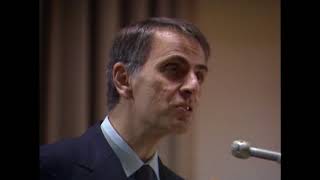
Carl Sagan gave this lecture, “Joining the Universe,” at The Worlds of Philip Morrison symposium in 1985, reflecting on the Copernican perspective, Philip Morrison’s example, and the public responsibilities of science.
Also known as: The Worlds of Philip Morrison Symposium; Carl Sagan, Joining the Universe.
Sagan argues that modern science has repeatedly dethroned human beings from cosmic center stage. From heliocentrism to evolution to SETI, he says the evidence points to a universe in which “we are nothing special,” and that this is a liberation rather than a loss.
He uses Philip Morrison’s work to connect astronomy, skepticism, and public science communication. Morrison’s role in SETI, science education, and intellectual openness becomes Sagan’s model for how scientists should think and speak.
Sagan closes by widening the lens to public responsibility: science literacy, nuclear winter, arms control, and the possibility of cooperative space exploration. The lecture is both a tribute and a plea for civilization to act with reason and courage.
Francis Lowe introduces the session and questions Sagan briefly at the end; Sagan gives the main talk and answers audience questions.
In his words
“We are nothing special.”
“It is exactly the tension between this openness and the skepticism, which I think is is one of Phil's great virtues, one well worth emulating if we can.”
“I think we are a scientific species.”
“The clearest prescription for disaster is for the public not to know about science and technology.”
“There is nothing about them that cannot be unmade by people.”
Key points
- The Copernican revolution is part of a larger pattern of “de provincializations” that remove humans from cosmic centrality.
- Belief in astrology and UFO stories reflect a desire to preserve human importance in the universe.
- SETI is a serious scientific extension of Morrison and Cocconi’s 1959 idea about interstellar communication.
- Sagan praises Morrison’s balance of openness and skepticism, especially in evaluating extraordinary claims.
- Science education matters because the public lives in a science-dependent civilization and should understand how science works.
- He argues that nuclear arms control and test bans are urgent, practical steps toward reducing the risk of catastrophe.
- Space exploration, especially a cooperative mission to Mars, could unite nations and redirect destructive technology toward a constructive future.
Full transcript: Carl Sagan, Joining the Universe (1985)
Francis LoweGood morning. Unfortunately, I'm not Vicky Byscup. Vicky was unable to come. He's recovering from a medical problem. Let me assure you, he's fine. I've talked to him this morning. He's getting better and he'll be back soon, but he simply was unable to make it today. I'm Francis Lowe and I was asked to chair instead of him. So let me welcome you to this morning's session of the worlds of Philip Morrison in which we honor and entertain and are entertained by our friend and colleague Philip Morrison. Vicky, ten years ago, wrote a piece for Technology Review, which I think one should call an appreciation.
And he was planning to read it. And it seemed to me the best thing for me to do was to read it to you. So here is Weiskopf on Morrison, Technology Review, 1976. I will change the last word. Phil Morrison is more than a person. He represents an attitude, a way of life, a symbol for what I would like to call joy of insight or a lust for knowledge. Nobody else has better demonstrated or rather embodied what it means to the human soul to perceive or recognize a new scientific discovery or a new theoretical insight. I use the word soul advisedly because Phil's character contains so much of it. Scientific knowledge and understanding is not a purely cerebral affair. It is soaked with emotion, excitement, and nervous tension as everybody knows who has heard Phil talk.
The life of a scientist would not be worthwhile were it not for those few moments, maybe two or three per year, when he feels an exhilarating joy deep in his guts of having understood something, of having seen new connections that bring things together. Now I know what it means. These moments of joy occur from time to time no matter whether it is one's own or someone else's discovery. In my life, more often than not, such a moment happened during a talk or a conversation with Phil. I remember an unforgettable talk at a Harvard evening seminar more than thirty years ago when he told us about Watson and Crick's double helix just a few weeks after they discovered it. It was the physicist Morrison who immediately recognized the immense significance of the discovery and he gave us a broad picture in his inimitable way of how this development will revolutionize biology.
We went away from it with pride to be alive at a time of such revelations. Phil's strength is the broad brush painting of the scientific landscape. You get the great connections, the deep relations, and the far perspectives. Surely here and there some detail gets lost, some conclusions are not quite tight. But these are a small price to pay for Great Panorama and the Grand Vista which we get in exchange. Many people have asked how Phil can manage all this. When does he read all the books and journals? When does he acquire his phenomenal knowledge of what happens in all branches of natural science? On top of all this, he has been book editor of The Scientific American for the last fifteen years where he reviews four to six books every month and must have read 10 times as many. He possesses a phenomenal gift of the quick and thorough grasp.
Have you ever seen him read a book by turning a page every one or two seconds? He knows the content and, what's more, he knows the significance and relevance of it. This fact has been experimentally tested. I envy this in him more than anything else. Every student at MIT knows Phil's classic art of lecturing, or should I say romantic, I should. You can count on getting a new and unconventional view of the subject. Surely, we must listen carefully because the ideas come fast with Bill. There are moments when his throat muscles have a hard time to follow the speed of his thoughts. But these are the moments when the lecture hall is filled to the brim with the intensity of his thoughts and the tension of his enthusiasm. If you need a proof that true science is not a dry and impersonal subject, go and listen to Phil.
He has worked in many fields of physics and he is the best counterexample to the narrow specialists of today. No wonder his latest field of endeavor is that part of science with the widest and grandest scope, astronomy. But there is more to his human approach to life than his broad understanding of science. Science is the relation of man to nature but Phil's interest goes far beyond pure science. The predicament of man, the social and political problems, education and healthcare have always been among his most important concerns. Everything human fascinates him, be it great, ordinary or ominous. Whenever help is needed, whenever there is a cause to do some good, go to Phil, He will be ready and full of youthful enthusiasm. Is he really 70 now? Our speakers this morning scarcely need an introduction.
Nevertheless, it's my job to introduce them and so I will say a few words about each of them. Our first is Professor Carl Sagan who is the David Duncan Professor of Astronomy and Space Sciences and Director of the Laboratory for Planetary Studies at Cornell University. He has played a leading role in the Mariner, Viking, and Voyager expeditions to the planets for which he received the NASA Medal for exceptional scientific achievement. His scientific research has enhanced Intraltar our understanding of the greenhouse effect on Venus, dust storms on Mars, the organic haze on Titan, the origin of life, and the search for life elsewhere. Both of our speakers this morning also have had several careers and, the second career of professor Sagan is author. He is the author, co author, or editor of more than 20 books including Broca's Brain, Comet, Contact, and the Dragons of Eden for which he was awarded the Pulitzer Prize.
His Emmy and Peabody award winning television series, Cosmos, became the most widely watched series in the history of American public television. I would, there are very few scientists who have tried, who have been able to do this to reach the public with serious discussion of science and what is going on in our field or who have even tried to do it and I think that Professor Sagan deserves great credit for having brought some understanding of science to the general public. In recent years, doctor Sagan and his colleagues have been engaged in research on the long term consequences of nuclear war and covering the phenomenon of nuclear winter of which you all know about. For this work, he was given the annual awards for public service of the Federation of American Scientists and of Physicians for Social Responsibility as well as the Leo Szilard Award for Physics in the Public Interest of the American Physical Society.
It's a pleasure to welcome Professor Sagan here to MIT to Phil's celebration. His talk today is titled Joining the Universe.
Carl SaganThank you, Doctor. Lowe. I'm delighted to be here to be able to add my voice to the voice of, I think it's fair to say, world scientific community in celebrating Philip Morrison. I want to discuss a fairly broad number of topics, all of which one way or another are connected with Philip Morrison's manifold interest. And I'd like to begin with a perspective which I think Phil is the of the inheritors today of this long tradition.
And the tradition could shortly be called the Copernican perspective, but it's much broader than that. In human affairs, there's a kind of aristocratic habit of thought that crops up in most recent human societies. The idea that because of some accident of birth, some people have an otherwise unmerited central position in the social universe. From Plantagenet princelings to the children of robber barons and central committee members, this self serving attitude seems as natural as breathing for those who are born into privilege or power. And it's connected with sexism, racism, nationalism, and other deadly chauvinisms that continue to plague the human species.
Uncommon strength of character is needed to resist the blemishments of those who assure us of some supposed superiority over our fellows. Since scientists are people, it should not surprise us that comparable doctrines have entered from time to time the scientific world view. Until the sixteenth century, for example, almost all scientists considered it absolutely evident from observation that the earth was at the center of the universe and that the sun and the moon and the planets revolved around us. And while there were good reasons on the basis of confirmation between theory and experiment for such a view, nevertheless, some of its popularity, I think, must be due to a kind of emotional resonance.
The universe was structured around us, created for our benefit. We are at the center. Everything else goes around us. It's difficult to contemplate such a model without feeling some small stirring of pride. The entire universe created for us. We must really be something. And this doctrine supported by sort of common sense observations, consistent with church dogma, taught in the schools, it survived in Europe for at least two centuries after the time of Copernicus before it was supplanted by the more uncomfortable idea that the earth went around the sun, wasn't at the center, was just one of many planets. And the appeal of this geocentric doctrine, I think, can still be felt in the continuing worldwide popularity of the entirely spurious doctrine of astrology.
Well every other such proposal to remove the human species from cosmic center stage has been resisted, sometimes violently for reasons that are emotionally rather similar. So consider this list of propositions that the stars are other suns, that the stars are made of the same kind of stuff that we have down here, that the earth is much older than the human species, that the sun is in some obscure exterior spiral arm of a vast Milky Way galaxy, that the spiral nebulae are other galaxies, that the position or velocity or acceleration of the earth in space does not give us some privileged reference frame, that human beings like all the other plants and animals on earth have evolved from other and more ancient species.
Well, every one of these propositions has elicited a reasonably fierce scientific debate. In every case, I think the fear of debate has something more to it than just scientific debate. It has to do with our fear of losing our imagined importance in the cosmos, the cosmic center stage. But still, despite the powerful social forces arrayed against them, every one of these hypotheses has been convincingly verified. The sequence of de provincializations that they represent constitute some of the key scientific advances since the Renaissance. These debates have been decisively settled in favor of a proposition that can be summed up in a single sentence, we are nothing special.
This set of blows to the anthropocentric world view has been more than a little disappointing to human chauvinists and it's hard to be human without feeling some sense of chauvinism. But it seems to me that the gains of our new perspective far outweigh the losses. We find ourselves maybe trembling just a little on the threshold of a vast and awesome universe, rich in mystery and promise that utterly dwarfs in time and space and in potential the tidy anthropocentric world of our ancestors. We have sent dozens of robot emissaries to the nearby planets and four spacecraft to the stars. We have launched telescopes into Earth orbit that peer billions of light years into the depths of space.
And now we are on the verge of initiating an observational test of the most recent self congratulatory chauvinism, the contention that in all this great universe of a 100,000,000,000 galaxies and a billion trillion stars, there is no species so wise, so intelligent, so advanced as we. This topic is called the search for extraterrestrial intelligence or SETI for short and it began in a famous 1959 paper in the journal Nature written by Philip Morrison and Giuseppe Cocconi. These days the revolutionary nature of this paper is sometimes forgotten. The prevailing attitudes in 1959 were that the search for life elsewhere was somewhere between science fiction and hokum.
It had suffered serious losses in credibility going back to Percival Lowell who taught at this institution who believed that Mars was covered by a network of canals built by intelligent beings, all of which turned out to be entirely spurious. What Morrison and Cocconi did was to ask the question, what is the most effective means of interstellar communication by another advanced civilization to us? They concluded that the radio spectrum was by far the most convenient, the most noise free, the quickest compared to alternative non electromagnetic means.
And more than that, they proposed that in the vast microwave spectrum, vast radio spectrum, there were a few specific frequencies which might be the preferential frequencies for such communication because of laws of physics shared between the transmitting and the receiving civilizations and they explicitly pointed to the fourteen twenty MHz line of neutral monatomic hydrogen. And this is now called one of the so called magic frequencies that is frequencies which are imagined to be shared by a common knowledge of the laws of nature and the nature of the galaxy between a hypothetical transmitting civilization and our own. From that time to this, Phil Morrison has played a central role in the development and monotonically increasing respectability of the subject.
Right now there is a search program going on at Harvard, Massachusetts led by Paul Horowitz of Harvard in which 8,400,000 separate channels, each much narrower than hertz, are being examined simultaneously as the telescope scans. The sky is visible from Harvard, Massachusetts. And a still much more sophisticated program is being worked on by the National Aeronautics and Space Administration. In both of these efforts, Phil has played a central role in sharing the NASA committees and providing inspiration and insight and motivation. We of course don't know how these searches will turn out.
There are many aspects of it that are strange and many of the descriptions of the subject have metaphors and insights which go straight back to Phil Morrison. Many of those who speak them may not even know where they came from. For example, the the now very common comment that one hears that, and that I myself have used, that you must expect monologue not dialogue because of the great distances but that that is not as big a deficit as you might imagine, that Socrates speaks to us even if we do not speak to Socrates. We treasure certain kinds of one way communication. That insight and metaphor goes straight back to film. How this search will wind up, no one of course knows.
It may turn out that there will be a comprehensive, very narrow band search of both the northern and southern skies for a period of decades. If on the other hand we would receive a signal of intelligent origin even before it was decrypted, we would have learned something of the very greatest importance, that there are other beings out there, that they are almost certainly more advanced than we because the statistical chance of them being within this very brief few decade long period after the invention of radio astronomy, has very low probability, and therefore that they have avoided self destruction, the fact that that is possible is knowledge well worth having. And, of course, a successful detection and decryption would, in ways that we can imagine but cannot accurately foresee, change the history of the human species.
If that were ever to happen, there is no question that we would all owe the greatest debt of gratitude to Phil Morrison. I don't want you to think that, this openness to to speculative ideas is untempered in Phil Morrison's personality. There is also a very appropriate dose of scientific skepticism, which you can see in many different areas, his famous remark, I will believe a black hole when I see one, is an example. And it is exactly the tension between this openness and the skepticism, which I think is is one of Phil's great virtues, one well worth emulating if we can.
So let's think of Phil as pioneering this subject of the search for extraterrestrial intelligence at the same time in the sixties that there was a kind of worldwide epidemic of people who believed we were, at that same moment, being visited by what were called unidentified flying objects. This was... Had captivated many and not just the purchases of weekly newspapers sold in supermarkets. I can remember James MacDonald, a respected atmospheric physicist, a member of the National Academy of Sciences, who believed that there were some anecdotal cases which were so compelling as to make us really reconsider the possibility that we were being visited.
And I arranged for McDonald to present to Phil his McDonald's best cases. And somehow, while being extremely kind and generous, the balloon was punctured in a period of about, oh, fifteen, twenty minutes of extremely friendly conversation. And Phil there did, I think, for many of us, a great service. At the same time, Phil was replete with anecdotes of an enlightening nature, one of which I will retell but from memory, and so if I get some details wrong, please forgive me, Phil. The story goes like this. A New Mexico highway patrolman is driving along a road that he had many times before driven along.
And suddenly, before his eyes, he sees a great metallic saucer shaped object land in somebody's farm, and it's it's right there on the ground. He sees it. He, happens to know some scientists at Los Alamos, calls them up, explains what happened right there at the highway, and they say, keep your eye on it, and we'll be there as soon as we can. And so let's imagine the sun rising in the sky, the highway patrolman sitting there in his in his patrol car, and the the saucer shaped object sitting there in the field. The scientists arrive. The...
They and the highway patrolman then approach this object. The the farmer is there on the farm, and he seems totally oblivious of, of this strange object. Could it be that it was invisible to the farmer but visible to the scientists and the highway patrolmen? They approach the farmer and say, can you tell us a little about that UFO that just landed? Farmer turns around, looks straight at it, and says, what UFO? Well, they talk a little bit, and it turns out that that what had been thought was a UFO was just a kind of lenticular metallic storage structure that had been there for years, and there was only one problem in the in the highway patrolman's argument.
He mistook his glimpse to mean the thing had landed and never seen it before. Phil's lesson was that in a scheme of inferential argument, you need only break one link in the scheme for the argument to collapse. I also remember, there was a time when, something called the Bermuda Triangle was imagined to be eating ships and airplanes. And Phil raised the question of why aren't trains being eaten? Ships in the ocean, airplanes flying over the ocean, there is a first order hypothesis about what happens to make them disappear.
They sink. Trains, on the other hand, do not have that option. And therefore, here we have the possibility of normalizing the hypothesis. And, and then as soon as that point sank in, Phil then would come up with a story about a train that did disappear. Well, maybe it wasn't exactly a train. And the story, as I remember, it goes like this. A a large rotor for some rotary machinery was being shipped by train on a railroad flat car in a vertical position with guy wires supporting it. It left the manufacturing plant. The train arrived at whatever the transshipment depot was supposed to be taken off. And the flat car was there, but no rotor, much too large to have been hijacked.
And they went over every mile of the track. It had mysteriously disappeared. And, this problem was unsolved for a forgotten long period of time, decades, until in draining a swamp a few miles from the railroad track, they found the rotor. It had obviously broken its, guy wires. And don't know how tall the thing was, 10 meters or something, had had rolled a few miles down to the to the swamp. Can you imagine what it must have been like if anyone had simply been wandering by? One of Phil's most remarkable characteristics is his his ability as a teacher.
I come from Cornell University. It's been a long time since Phil was on the faculty there, but his influence is still palpable. People who attend his lectures never forget them. He has had a powerful influence on course curricula for children in films and television programs. I'm sure many of you have saw... Seen the remarkable film that he and Phyllis Morrison and the Eameses did called Powers of 10. Philip Daily, who is responsible for the remarkable set of science films in the BBC over the last few decades, stopped by just before I came up to ask me to mention that Phil has been a major source of inspiration for the BBC in even attempting to do science films.
And I can certainly say that for for the projects I've been involved with in television science education, Phil has also been a leading source of inspiration. His articles in Scientific American book reviews were mentioned by Francis Lowe. I think it's fair to say that many people learn more from the reviews than from actually reading the books. There is a kind of condensation down to the essence of the thing which is hard to extract oneself in reading the book. And I think these reviews are also marked by a generosity of spirit in which, insights are attributed to the authors, which, they often never had.
It's just Phil who had them. Phil, in teaching science to the public, constantly stresses not only what we know, but how it is we came to know it. He constantly stresses respect for the work of the hands as well as the mind following that ancient tradition of the Ionian scientists who, in a certain sense, can be said to have founded the scientific tradition of the West. Phil exemplifies the responsibility that I personally believe scientists have to communicate science to the public. There are many reasons why why it's important. One is just that we love our subject.
We are enthusiastic about it. It's very natural to try to communicate what you love to others. It's one of those nonzero sum games like like love itself in which every time you give, you gain. In addition, there are clear sort of naked scientific self interest reasons. If we wish the public coffers to support science, we have a clear responsibility to explain what the virtues of science are. I think we are a scientific species. It's the... One of the very few things we do uniquely that other animals do not do. I think every person on the planet is on some level a scientist, but unfortunately, school curricula and the social conventions work not to encourage but to discourage, this sort of interest.
And, as scientists, I think we have a responsibility to counter that. And then there is the clear social responsibility that we live in a time, civilization, culture, deeply involved with, dependent upon science and technology, and the clearest prescription for disaster is for the public not to know about science and technology. How can the public manage their own future if they don't know some of the essential tools for doing that management? So I don't know what mix of these reasons has involved Philip Morrison in science education for the broad public, but there are many of us grateful that he has done so. On the issue of, the mix of openness and skepticism, I want also to mention Phil's courageous and very long standing opposition to the continuation of the MAD nuclear arms race.
Phil was involved in the Manhattan Project. He armed the Nagasaki bomb. He was, as deeply involved as anyone in the development of nuclear weapons to bring an end to World War II and to beat the Nazis to this weapon of great destructive power. On the other hand, soon after the end of the war, it became clear to many scientists, including Phil, that there were grave dangers of continuing in this direction, and he has spoken out often and courageously on this issue. I can remember being at a dinner at the Pentagon in a previous administration in which a secretary of defense, more moderate than the one now in office, was vehemently decrying a study that Phil and a group of people, I think, called the Boston Study Group, and put together on why it was in the national interest to make massive cuts in the Department of Defense budget, the contention being that it would strengthen the national security of The United States if you did it in a prescribed way.
As you might imagine, that did not fall on on receptive ears at the Department of Defense. It was ahead of its time. I think that time is coming. There is, there are many issues related to the cessation or at least slowing down of the nuclear arms race. I just want to mention one, and that's the issue of continued testing of nuclear weapons. In the 1963 limited test ban treaty, there is in the preamble a moving phrase about how The United States and The Soviet Union pledged their efforts to ending the arms race and moving towards a ban on the testing of all nuclear weapons.
That was 1963. In the twenty three years since then, there has not been much progress. In 1963, there was a remarkable moment in recent history. The United States and The Soviet Union with the Cuban Missile Crisis had managed to scare each other almost to death. And for very good reason, Bobby Kennedy wrote that he thought that there was a fifty fifty chance of a central nuclear exchange between The United States and The Soviet Union over that incident. For a moment, the leaders of the two countries had focused their attention on the nuclear arms race. And in a speech at American University, the American president, John F.
Kennedy, announced a unilateral US moratorium on the further testing of nuclear weapons. The next day, the full text of that speech was published, remarkably enough, in his Vestia and in Pravda. Within the week, the Soviet premier Nikita Khrushchev announced a unilateral Soviet moratorium on further aboveground testing of nuclear weapons and... Which was merely coincidentally happening in the same week as the American moratorium. But what we had was a de facto ban on further above ground nuclear testing by the two principal nuclear powers. What then happened is a remarkable moment in recent history which the two countries vied with each other to be nice.
The Soviets removed their objection to the stationing of neutral observers in Yemen. The Americans removed their objections to the credentials of the proposed Hungarian delegation to the United Nations. There was a mutual duffing of the hats. Before things got out of hand, however, an American academic named Barghorn was arrested in Moscow on grounds of espionage. And the climate heated up, and there was a real danger of the test ban treaty unraveling. But mister Kennedy made private remonstrances with Mr.
Khrushchev, and Khrushchev then released the American academic saying that while he, Khrushchev, was not convinced that he was innocent of espionage charges, because the American president wished it so strongly, he Khrushchev as a gesture of humanitarian dedication, released him. And then the, it was time to convert the de facto treaty to a de jure treaty. Everell Harriman was sent to Moscow as ambassador, got off the airplane. A reporter from Tasse said to him something like, Mr. Ambassador, considering the grave tensions between the two countries and the difficulties of such a treaty, how long do you think it will be before a successful treaty can be negotiated?
Harriman said, if mister Khrushchev wishes such a treaty half as much as mister Kennedy, I'll be back on this airplane in two weeks. Thirteen days later, the 1963 test ban treaty was signed. And from that date of this, no American or Soviet nuclear weapon has been tested on the ground, in the air, or in space. On 08/06/1985, on the fortieth anniversary of the Hiroshima bomb, the Soviet Union announced a unilateral moratorium on further underground testing. The American response has been to explode 20 underground nuclear weapons, and to contemptuously reject the Soviet offer. This is an opportunity which may not recur.
It is very clear that the longer the Soviets continue their moratorium, the greater will be the pressure on the Soviet leadership from the nuclear arms establishment in the Soviet Union. And it may be that the two nations will perpetually remain out of phase. What it seems to me is our objective is to arrange things so that they are in phase long enough in reasonableness to, to make a significant decline in this mad race to oblivion. An American private group, the Natural Resources Defense Council, has established a seismic monitoring station in the Soviet, test area near Semipalatinsk.
So now now that argument has been swept away, and we hear other sorts of arguments. To give an idea of the desperation of the justification, here are three ways that have been proposed by this administration that the Soviets can cheat. One, they can wait for a natural earthquake in Central Asia and test their weapons then. Even there, by the way, the seismic signatures of, natural earthquakes and nuclear weapons are different. Two, they could make... They could decouple. They could make a vast underground cavity and, muffle the, sound of the nuclear explosion to... Yeah. I guess sound is the right word. But for any significant yield, you have to excavate such an enormous volume of earth that, it should be readily detectable by satellite reconnaissance.
And then pride of place in these arguments is the third argument due to Edward Teller, which is that the Soviets will cheat by exploding nuclear weapons on the far side of the sun. Stopping testing is a is a long lever arm to, ceasing the nuclear arms race and to bringing us into a regime in which we can set about the urgent task of making major verifiable and bilateral cuts in this absurd joint arsenal of almost 60,000 weapons of mass destruction.
And if we succeed in doing that, some measure of inspiration will have come again from Philip Morrison. I want to mention just one more topic before I sum up, and that has to do with exploration. Phil is an explorer, an explorer in in many senses, but also an explorer in the traditional sense of going out to new lands. He has traveled widely, but the kind of exploration I'm talking about is real old time exploration with explorers. Phil is on the advisory board of the Planetary Society, a 100,000 member worldwide organization that is devoted to the exploration of the solar system as well as the search for extraterrestrial intelligence.
And I'd just like to to give you a vision of something that is possible. It is a joint US Soviet manned and womaned mission to Mars. There's not any appropriate word to to say manned and woman. Manned certainly seems wrong because it... I mean, there are women astronauts, leaves out half the species, and some of the alternatives like, crude missions lends itself to misunderstanding. A... Mars is a world of wonders. The scientific justification for going there is very clear.
For one thing, a billion years ago, there was liquid water all over the planet. Rivers were gushing. There were lakes. There's even a contention that there were oceans on Mars a billion years ago. Something very important happened between then and now in terms of massive climatic change, and it might even be of practical significance for us living on a nearby planet not all that different from Mars to understand what happened. I won't go into the the scientific reasons for going to Mars, but they are manifold. But to send a mission with human crews requires, it seems to me, more than scientific justification because people are much more expensive, between 10 and a 100 times more expensive than some comparable robotic mission which could do very well in terms of science and exploration.
And the only reason to spend that sort of money... By the way, it's it's not a huge amount of money. It's tiny fraction of Star Wars. It's in fact, in constant dollars, less than the cost of the Apollo program. It's about the cost of a major strategic weapon system, which we seem to have an endless supply of money to support. But imagine such a mission. What could its political purpose be? It can't be competition with the Soviets in space. That is a issue despite the present deep problems of the American space program. Have had enough successes in space that we don't have to do that. But the idea of The United States and The Soviet Union together, doing an exploration on behalf of the human species, paving a way into the twenty first century, capturing the imagination of people all over the planet, that seems to be something worthwhile, a mission which would, for some years, be before the public eye in the construction of the interplanetary transfer vehicle in Earth orbit, in the voyage to Mars, and the setting down on the Martian surface, Americans and Soviets together in the exploration of Mars, the...
Some wheeled vehicle, for example, down an ancient Martian river valley in the return to Earth at every step, citizens of these two countries working together, I think it could do wonders. And it uses, notice, exactly the same sorts of rocket and nuclear and computer technology that is also used to drive the arms race. I think there is a way to use the same technology that has created some of the very serious problems we have here on Earth, a place contaminated with 60,000 nuclear weapons, to undo it by going elsewhere. Well, I am grateful for the opportunity to be able to speak to you in honor of Philip Morrison, physicist, astronomer, SETI pioneer, peerless teacher, weaponier when it counted, peace activist when it counted, pasta manufacturer, explorer, master of metaphor, inspiration to generations of scientists and others.
I should say that in much of this, we can see the wisdom and vitality and tenderness of Phyllis Morrison, who has clearly played an important part in Phil's manifold activities. Phil has helped students, colleagues, and many readers join the universe, but he has also helped a much vaster audience of people all over the world, many of whom may never have even heard his name. His kindness, his generosity of spirit, his insights, his enthusiasm, his social concern have made him a model for other scientists in the rare art of being a fully developed human being.
Thank you. Other quest
Francis LoweI think we have time for questions. People would like to ask any? Yes, sir. Yes. I'm sorry.
Carl SaganYeah. This is a talk I gave a couple of days ago at the National Press Club. Not on that issue, but I was asked that. Well, it's it's mixed, and it's, I guess the easiest is virtually every newspaper in America has a daily astrology column. How many of them have even a weekly astronomy column? That's certainly one one measure of it. Another measure is when Nobel Prizes in science are announced every year, when's the last time you can recall getting a coherent explanation on radio or television of what they won their prizes for? It's almost entirely, oh, yeah. I woke up in the middle of the night.
I was surprised. I didn't believe the reporter from Stockholm. My wife was happy. When do we find out what these guys did to win the Nobel Prizes? I think that... That's another indication of the state of journalism. Another is you look at people who are called science reporters for the networks, and you find that, they don't report science. It's not scientific ideas, theories, discoveries. It's almost entirely, medicine and technology. There ought to be a medical reporter. There ought to be a technology reporter, but there ought to be a science reporter. I think the general level of teaching science in the in the public schools is woefully low. I think scientific attitudes of thought, including skepticism of received wisdom, is desperately needed in various social, economical, political, and even religious aspects of our society and isn't there.
And this may, in fact, explain part of the reason that scientific attitudes of thought are not taught by and large in the schools. I think this is simply suicidal. I think science ought to be talked about on some level over dinner tables. Why is it alright for newspapers to have many, many pages of fine print on, the stock market? Really very arcane, lots of abbreviations, lots of numbers, fractions. Why is it alright to have box scores of baseball games, you know, with with abbreviations, h b, r b I. No explanation.
You're supposed to understand that. You pick up your daily paper, you figure, well, just being a person in the society, I'm expected to know something about stocks and bonds. I'm expected to know something about baseball and football. I guess I'm not expected to know anything about science. There's not any of it in here. I maintain that, there's an enormous amount of science that can be taught in in newspapers and elsewhere that's a whole lot easier than the stock page and the sports pages. Yes, please. What's the present status of Present status of? Present status of nuclear winter. Well, I'm glad to say it's not here yet. Nuclear winter is the contention that if we are so foolish as to permit a nuclear war to happen, the fine particles of soot and dust that would be raised would spread over large land areas would darken and cool the earth enough to produce a significant additional peril for those who survive the direct consequences of nuclear war.
And while there are continuing debates on just how much the temperature decline would be and what the duration would be. I think it is fair to say that the consensus of scientific opinion is that it would be very serious, or maybe the best I can do is to quote the Department of Defense, which, proposes that consequences of nuclear winter would kill perhaps, as many people as the direct consequences, which have been variously estimated for a central exchange as between a few 100,000,002 people. Other questions? Yes, please. Looks towards the space.
How soon... If a miracle happened and The United States and The Soviet Union were to agree on what to do, how soon before we could have a unified world? I have a perfect quote from Phil Morrison. Prophecy is a lost art. Francis Lowe says especially about the future. Nevertheless, I'd like to stress that the problems that face us were made by people. There is nothing about them that cannot be unmade by people. We have made extraordinary changes in what we consider obvious.
And, of course, when we make those changes, then we forget. But, for example, there was a time not so long ago when the view of the divine right of kings was widely held worldwide. Famous scholars wrote famous textbooks on this subject. There was a vast vested political interest to, maintain this view, especially among kings. And, yet... In fact, there was even a, a wharf brought here partly on that issue. But that view is not to be found very often, today. I mean, except for some minor places like, I don't know, Thailand and The United Kingdom. This is this is a view that that is gone Or consider chattel slavery.
The the view that some people are by right masters and some people are by right slaves and that the slaveholders could do what they wanted with the slaves and break up families and all the rest of that. This doctrine was vigorously supported by Aristotle. It, was considered to be an obvious truth. Not only that, that it was god given that that's the way the world was to be arranged. But there's been a stirring worldwide revolution, and there are very few places on the earth in which chattel slavery is considered acceptable or permissible or socially respectable today. Well, the vested interests in, the divine right of kings and in slavery seem to me far greater than the vested interests in continuing the nuclear arms race, although there certainly are such vested interests.
And, everybody on the planet has something to gain from reversing the nuclear arms race. And, I think this is something that can be done, but only if we understand the nature of the issue and if we're willing to, to take courageous personal steps to turn the situation around. K. I'm told time only for one more question, please. Thank you. The questioner says, why don't I make a television program to wake the world up on these issues? I will take it under advisement.
Transcribed from the audio by speech recognition (Deepgram); speaker labels are automatic. Timestamps link to the video above. Errors are possible.
Cite this recording
Carl Sagan, “Joining the Universe (1985)”, 1985. Transcript and video: Thinkers Archive, https://thinkersarchive.com/carl-sagan/copernican-perspective-joining-the-universe-1985/
Quoting a passage? Link to its exact moment: every timestamp above has its own anchor (for example https://thinkersarchive.com/carl-sagan/copernican-perspective-joining-the-universe-1985/#t-176).