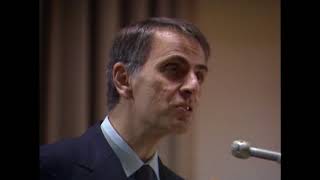
Carl Sagan on Politics & Government
Carl Sagan saw politics and government as matters of survival: democratic power must be guided by scientific literacy, skepticism, and planetary cooperation.
- Democracy fails when citizens and leaders are powerful but scientifically illiterate.
- Government should use skepticism and evidence, not faith, wishful thinking, or authority.
- National security is not just weapons; it includes education, well-being, and avoiding self-destructive arms races.
- The biggest political problems are planetary, so they require international cooperation.
- On nuclear war, Sagan thought existing strategy was irrational because it risked civilization itself.
Politics begins with an informed public
Sagan’s political starting point is democratic competence. He thought modern societies had built immense systems of science and technology while leaving most citizens unable to understand them, which creates a dangerous mismatch between public power and public knowledge. In his view, that is not a side issue for government; it is a central civic problem because major decisions in Washington turn on science and technology.1234
That is why he treated science not mainly as a set of facts but as a civic habit of mind. Citizens in a democracy need to know how to question claims, weigh uncertainty, and recognize human fallibility, because otherwise they cannot effectively oversee the institutions acting in their name.54
Sagan also thought this weakness spread beyond government offices into schools and media. When a society neglects scientific ways of thinking, it loses a crucial defense against bad judgment in political and social life.67
Good government follows evidence, not comforting belief
Sagan’s view of public reasoning was sharply anti-dogmatic. He argued that belief without evidence is a mistake, and that the right intellectual posture is to hold back assent until the case is strong enough. For politics, that means governments should not be driven by ideology, magical thinking, or emotional convenience when the stakes are scientific and global.8910
At the same time, he did not defend a closed-minded technocracy. He praised the balance between openness and skepticism: being willing to consider possibilities while still demanding disciplined scrutiny. That combination, for him, is what serious public judgment looks like.1112
This is also why uncertainty was not, in his hands, an excuse for paralysis. He repeatedly emphasized the need to question intelligently rather than either dismiss warnings or accept them blindly.1314
National security must protect society, not hollow it out
Sagan rejected narrow definitions of security. He argued that a country is not made safe simply by increasing military power, especially when military spending or strategy damages the society it claims to defend. His standard for security included the well-being of citizens, economic life, education, and a credible future.15163
That led him to a broader political point: more weapons can make a nation less safe. In the nuclear age, traditional intuitions about strength and defense can become self-defeating, because the buildup itself may deepen insecurity and consume the social resources a functioning democracy needs.1617
So for Sagan, politics and government should redefine defense in human terms. A state that neglects education, especially in science and technology, is undermining its own capacity to make rational decisions about survival.31
Nuclear policy is a test of whether government can think clearly
No issue better reveals Sagan’s politics than nuclear weapons. He argued that nuclear winter turns nuclear war from a matter of battlefield strategy into a global threat to agriculture, climate, and civilization. In that framework, even a limited exchange becomes politically and morally unacceptable because its effects would spread far beyond the combatants.181917
He was especially critical of official thinking that ignored these implications. He faulted defense analysis for being too narrow and insisted that policymakers confront biological, social, doctrinal, and verification problems rather than treating them as secondary details.202122
This was not abstract theorizing for him. He urged Congress to demand fuller disclosure and reconsider strategic assumptions, because a policy that gambles with civilization is not serious statecraft.2324
Planetary problems require planetary politics
Sagan thought the largest public problems had outgrown national boundaries. Climate change, ozone depletion, pollution, and nuclear war do not stop at borders, so a politics built only around separate national compartments is inadequate to reality.252627
His alternative was not vague idealism but practical interdependence. If causes and consequences are global, then the response must be cooperative as well. That is why he stressed that humanity is in a common situation and must act together.2829
Behind this was a moral view: life is rare, precious, and difficult to preserve. Government therefore has a responsibility to think at planetary scale, because the most important political duty is no longer just managing one nation’s short-term interests but protecting the conditions for civilization and life itself.3031
Sagan on politics & government, in his own words
“The problem in defense spending is to figure how far you should go without destroying from within what you are trying to defend from without.”
Where to watch
 Carl Sagan on Climate Change and Nuclear Arms: A Planetary Future1990 · 44 min · full transcriptBest single overview of how Sagan connects climate, nuclear danger, and the need for global political cooperation.
 Carl Sagan on Science and Pseudoscience: The Demon-Haunted World1995 · 20 min · full transcriptShows why he thought democracy needs skeptical, scientifically literate citizens rather than passive belief.
 Carl Sagan on Nuclear Winter: Congress Must Reconsider Strategy1985 · 42 min · full transcriptHis clearest direct engagement with government, policy failure, and what Congress should do about nuclear risk.
 Carl Sagan on Scientific Illiteracy: A Baloney Detection Kit1989 · 57 min · full transcriptExplains his broader idea of national security, defense spending, and the political cost of scientific illiteracy.
 Carl Sagan on Global Warming: The Planet Is a Unity1990 · 59 min · full transcriptBest for understanding how he approached climate policy under uncertainty and why he saw the planet as one political unit.
Questions people ask
- What did Carl Sagan say about balancing openness and skepticism?
- What did Carl Sagan say about faith and evidence?
- What did Carl Sagan say about how humanity got into environmental crisis?
- What did Carl Sagan say about nuclear weapons and national security?
- What did Carl Sagan say about science reporters and science teaching?
- What did Carl Sagan say about scientific illiteracy in America?
Sources
Every quote above, word for word from the transcripts. Numbers match the text.
“The clearest prescription for disaster is for the public not to know about science and technology.”
“The scientific illiteracy of Americans in general is scandalous.”
“Any definition of national security, it seems to me, has to involve the well-being of the citizens, economic well-being, a positive sense of the future based not on path but on real expectations, education, especially in science and technology. The scientific illiteracy of Americans in general is scandalous. Every day there are significant decisions made in Washington involving science and technology which…”
“There's two kinds of dangers. One is what I just talked about, that we've arranged a society based on science and technology in which nobody understands anything about science and technology. And this combustible mixture of ignorance and power, sooner or later, is gonna blow up in our faces. I mean, who is running the science and technology in a democracy if the people don't know anything about it? And the second reason that I'm worried about this is that science is more than a body of knowledge. It's a way of thinking, a way of skeptically interrogating the universe with a fine understanding of human fallibility. If if we are not able to ask skeptical questions to interrogate those who tell us that something is true, to be skeptical of those in authority, then we're up for grabs for the next charlatan political or religious who comes ambling along.”
“…science is more than a body of knowledge. It's a way of thinking…”
“Another is you look at people who are called science reporters for the networks, and you find that, they don't report science. It's not scientific ideas, theories, discoveries. It's almost entirely, medicine and technology. There ought to be a medical reporter. There ought to be a technology reporter, but there ought to be a science reporter. I think the general level of teaching science in the in the public schools is woefully low. I think scientific attitudes of thought, including skepticism of received wisdom, is desperately needed in various social, economical, political, and even religious aspects of our society and isn't there.”
“I think we are a scientific species.”
“What is faith? It is belief in the absence of evidence.”
“Let's let's let's let's look a little more deeply into that. What is faith? It is belief in the absence of evidence. Now I don't propose to tell anybody what to believe, but for me, believing when there's no compelling evidence is a mistake. The idea is to withhold belief until there is compelling evidence. And if the universe does not comply with our predispositions, okay, then we have the wrenching obligation to accommodate to the way the universe is.”
“I I I don't... We've... This is part of being human. Humans have had this way of magical thinking through all of our history. The problem is that today, the technology has reached formidable, maybe even awesome proportions. And so the dangers of thinking this way are larger. Not that this is a new kind of thing.”
“It is exactly the tension between this openness and the skepticism, which I think is is one of Phil's great virtues, one well worth emulating if we can.”
“I don't want you to think that, this openness to to speculative ideas is untempered in Phil Morrison's personality. There is also a very appropriate dose of scientific skepticism, which you can see in many different areas, his famous remark, I will believe a black hole when I see one, is an example. And it is exactly the tension between this openness and the skepticism, which I think is is one of Phil's great virtues, one well worth emulating if we can.”
“We don't know if it's there. We don't know if it's not there.”
“These very serious global environmental issues may have a deep silver lining…”
“The problem in defense spending is to figure how far you should go without destroying from within what you are trying to defend from without.”
“More nuclear weapons you have, the less safe you are. As I was trying to argue before, there’s a kind of counterintuitive aspect of modern technology in the military and in the civilian spheres. And there is a necessity after 1945 of what Einstein called a new way of thinking, which is very slowly permeating into the minds of leaders on the question of the definition of national defense. I’d like to read to you a one-sentence quote from Dwight Eisenhower: "The problem in defense spending is to figure how far you should go without destroying from within what you are trying to defend from without.”
“…the United States and the Soviet Union have together contrived a Doomsday Machine…”
“Nuclear winter, if it were brought about, would be a disaster unparalleled in the history of the human species.”
“Nuclear winter globalizes the environmental impact of nuclear war.”
“I do not see this report as coming, within light years of that requirement.”
“It seems to me that even from the narrowest of perspectives of the Department of Defense, this report is inadequate.”
“Nuclear winter is not a problem amenable to experimental verification. At least not more than once, and few of us wish to perform the experiment. It is therefore restricted necessarily to the best theoretical physics, the best computing programs, and the best small simulations that can be managed. Every one of those, of course, should be vigorously pursued and I'm concerned that the level of funding that the administration under restricted budgetary circumstances to be sure has proposed is inadequate. But at the same time... And and by the way, other witnesses will will provide their opinion on the degrees of uncertainty. Doctor Carrier, for example, who chaired the National Academy study.”
“First short term question I would raise is, please provide immediately the report by CADRE on the policy and doctrinal implications of nuclear winter. I think that would not involve going back and doing any more work. It's just the Department of Defense left home part of the assignment. Then beyond that, I would... I mean, my understanding is that that report exists. It's locked up somewhere. And so there isn't any rewriting necessary. It just someone has to reach into the drawer and hand it to, the Congress. That ought to be, done, it seems to me, if Congress requested, in twenty four hours after the request. That should surely be a significant first step.”
“You have to be really loony tunes to bet the human race on this one.”
“…those molecules don't have passports…”
“The national boundaries have no bearing on these global environmental issues.”
“No one nation can solve this problem by itself.”
“We're all in this together, and we have to work together.”
“We have to solve our own problems.”
“Life isn't all that easy to come by…”
“Life is something rare and precious.”
How this guide was made: drafted with AI from the full transcripts of the recordings cited, then checked: every quotation must match a transcript word for word and be the speaker's own words, and an independent review gates accuracy. Methodology and corrections.