Carl Sagan on Learning & Education
Carl Sagan saw education as the protection and expansion of human curiosity through scientific thinking, cultural memory, and public understanding.
- Children begin with deep curiosity, and education should protect it rather than suppress it.
- Learning is not just collecting facts; it is learning how to think skeptically and follow evidence.
- Human beings learn across generations by storing knowledge outside the body in books, computers, and media.
- Science education matters for everyone because modern democracies make high-stakes decisions shaped by science and technology.
- The best education combines openness to new ideas with disciplined skepticism.

“…science is more than a body of knowledge. It's a way of thinking…”Charlie Rose interview, 1995 · 3:24
Education should protect the curiosity children already have
Sagan treats curiosity as natural, especially in children. His view is not that education must create wonder from nothing, but that it must stop crushing the wonder that is already there and give it room to grow into serious inquiry.12
That is why he links learning to big questions about origins, the universe, and our place in reality. For him, people become fully educated not by avoiding such questions as childish, but by pursuing them with courage and depth.32
This also gives education a moral direction: encourage question-asking, encourage more scientists, and make intellectual ambition feel healthy rather than odd.1
Learning means learning how to think, not just what to know
Sagan's most important educational idea is that science is a habit of mind. Facts matter, but the deeper goal is to learn how to examine claims, test them, and resist the comfort of belief without support.45
He repeatedly returns to intellectual humility. A good learner can say something may be true, may be false, or may remain undecided until stronger evidence appears. That refusal to pretend certainty is part of mature thinking.7
He also connects intelligence to synthesis rather than memorization. To be intelligent is to put many facts together into a truer picture of the world, which makes education an active process of understanding reality rather than passively storing information.8
Human education is possible because culture stores knowledge outside the body
Sagan sees a distinctive human power in our ability to place memory outside ourselves. Books, computers, and other media let each generation inherit far more than instinct or private experience could ever provide.910
That means education is not only classroom instruction. It is the whole civilizational process by which accumulated discoveries, histories, and ideas are preserved and handed on. In his view, this external storehouse of knowledge greatly expands human understanding and possibility.910
This is one reason he connects learning with long human and cosmic history. When we study origins and scientific discovery, we are entering a conversation much larger than one lifetime and joining a species-wide effort to understand reality.1112
Science education is a civic necessity, not a luxury
For Sagan, public ignorance about science is dangerous because modern societies are built on science and technology whether citizens understand them or not. If people lack scientific literacy, they still live with the consequences of decisions about energy, weapons, health, and the environment, but without the tools to judge those decisions.131415
That is why he does not frame science education as training only for specialists. Democracies need broad public competence, because power without understanding creates a volatile mix. His warning is that a society organized by science and technology cannot safely remain scientifically uneducated.1415
He also thinks ordinary institutions often fail here. Public school science teaching can be too weak, and public communication can confuse science with only medicine or gadgets, instead of conveying the ideas and habits of thought that people need in social and political life.1617
The best education joins openness with skepticism
Sagan admires a mind that is open to new possibilities without surrendering standards of proof. He presents this balance as a model for learners: be imaginative enough to consider surprising ideas, but skeptical enough not to be fooled by them.1819
This matters because human beings are vulnerable to magical thinking, especially when a claim is emotionally attractive. Education, then, should not merely fill minds with approved conclusions; it should train people to interrogate their own wishes and ask whether the evidence is really there.15
Seen this way, learning is a form of self-discipline and freedom at once. It frees us from myth, flattery, and easy reassurance by teaching us how to accommodate ourselves to the way the universe actually is.
Sagan on learning & education, in his own words
“…science is more than a body of knowledge. It's a way of thinking…”
“We make our world significant by the courage of our questions and by the depth of our answers.”
Where to watch
 Carl Sagan on Science and Pseudoscience: The Demon-Haunted World1995 · 20 min · full transcriptBest single short introduction to Sagan's idea that education should teach skeptical scientific thinking, not just information.
 Carl Sagan on Scientific Illiteracy: A Baloney Detection Kit1989 · 57 min · full transcriptShows why Sagan thought scientific literacy is essential for citizenship in a technological democracy.
 Carl Sagan on Human Intelligence: How We Evolved to Think1977 · 14 min · full transcriptExplains his view of intelligence, children's curiosity, and humanity's unique ability to store knowledge outside the body.
 Carl Sagan on Origins of Science: from wonder to knowledge1980 · 58 min · full transcriptConnects wonder, the birth of science, and the movement from myth to knowledge.
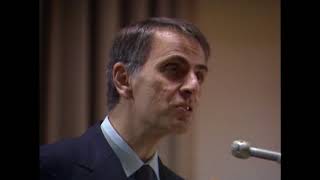 Carl Sagan on the Copernican Perspective: Joining the Universe1985 · 60 min · full transcriptBest for his educational ideal of combining openness to possibilities with rigorous skepticism.
Questions people ask
- What did Carl Sagan say about faith and evidence?
- What did Carl Sagan say about science reporters and science teaching?
- What did Carl Sagan say about scientific illiteracy in America?
- What did Carl Sagan say science is, and why is skepticism important?
- What did Carl Sagan say about Phil Morrison's skepticism?
- What did Carl Sagan say about storing information outside the human brain?
Sources
Every quote above, word for word from the transcripts. Numbers match the text.
“It would be very healthy for the human species if, uh, there were less discouragement and more scientists.”
“We make our world significant by the courage of our questions and by the depth of our answers.”
“The great thing that is happening in our time is that we are able, through a method which can actually make some progress towards the real universe out there, to find out something about origins.”
“…science is more than a body of knowledge. It's a way of thinking…”
“What is faith? It is belief in the absence of evidence.”
“We don't know if it's there. We don't know if it's not there.”
“…it's our ability to put a great many facts together…”
“…we have information stored outside of our bodies…”
“History of life on this planet, the organisms had almost all the information they had to deal with in their genes, hereditary information, instinct. Then about maybe 100 million years ago, a little longer ago than that, there came to be a reptile that for the first time in the history of life had more information in its brains than in its genes, and that was a major step, symbolically, in the evolution of life on this planet. Well, now we have an organism — us — which can store more information outside the body altogether than inside the body, and that's in books and computers and television, video cassettes, and that extraordinarily expands our ability to understand what's happening and to manipulate or control our...”
“We are the product of a grand evolutionary sequence—Cosmic Evolution—about which we are only occasionally aware.”
“This is the place where science was born.”
“The scientific illiteracy of Americans in general is scandalous.”
“The clearest prescription for disaster is for the public not to know about science and technology.”
“There's two kinds of dangers. One is what I just talked about, that we've arranged a society based on science and technology in which nobody understands anything about science and technology. And this combustible mixture of ignorance and power, sooner or later, is gonna blow up in our faces. I mean, who is running the science and technology in a democracy if the people don't know anything about it? And the second reason that I'm worried about this is that science is more than a body of knowledge. It's a way of thinking, a way of skeptically interrogating the universe with a fine understanding of human fallibility. If if we are not able to ask skeptical questions to interrogate those who tell us that something is true, to be skeptical of those in authority, then we're up for grabs for the next charlatan political or religious who comes ambling along.”
“Another is you look at people who are called science reporters for the networks, and you find that, they don't report science. It's not scientific ideas, theories, discoveries. It's almost entirely, medicine and technology. There ought to be a medical reporter. There ought to be a technology reporter, but there ought to be a science reporter. I think the general level of teaching science in the in the public schools is woefully low. I think scientific attitudes of thought, including skepticism of received wisdom, is desperately needed in various social, economical, political, and even religious aspects of our society and isn't there.”
“Any definition of national security, it seems to me, has to involve the well-being of the citizens, economic well-being, a positive sense of the future based not on path but on real expectations, education, especially in science and technology. The scientific illiteracy of Americans in general is scandalous. Every day there are significant decisions made in Washington involving science and technology which…”
“It is exactly the tension between this openness and the skepticism, which I think is is one of Phil's great virtues, one well worth emulating if we can.”
“I don't want you to think that, this openness to to speculative ideas is untempered in Phil Morrison's personality. There is also a very appropriate dose of scientific skepticism, which you can see in many different areas, his famous remark, I will believe a black hole when I see one, is an example. And it is exactly the tension between this openness and the skepticism, which I think is is one of Phil's great virtues, one well worth emulating if we can.”
How this guide was made: drafted with AI from the full transcripts of the recordings cited, then checked: every quotation must match a transcript word for word and be the speaker's own words, and an independent review gates accuracy. Methodology and corrections.
