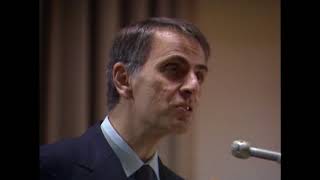
Carl Sagan on Science
For Carl Sagan, science is a humble, skeptical way of finding out what is real, even when reality overturns our deepest wishes and conceits.
- Science is not just facts; it is a way of thinking grounded in skepticism and evidence.
- Its moral discipline is to prefer hard truth over comforting illusion.
- Science repeatedly corrects human self-importance by showing we are not the center.
- It begins in wonder, but advances through questions, observation, and natural law.
- A society shaped by science and technology becomes dangerous if the public is scientifically illiterate.

“…science is more than a body of knowledge. It's a way of thinking…”Charlie Rose interview, 1995 · 3:24
Science is a way of thinking, not just a pile of facts
Sagan’s most important point is that science is not mainly a storehouse of results. It is a disciplined habit of mind: asking skeptical questions, testing claims, and trying to correct for human error. That matters because people live inside systems powered by science and technology whether they understand them or not.123
He treats this as both an intellectual and civic necessity. In a democracy, decisions about weapons, health, climate, and technology cannot safely be left to a small priesthood of experts while the public remains uninformed. A society with great technical power and weak scientific understanding puts itself in danger.452
“…science is more than a body of knowledge. It's a way of thinking…”Charlie Rose interview, 1995 · full transcript →
The core ethic of science is humility before evidence
Sagan returns again and again to the same intellectual virtue: do not believe something just because it is comforting, traditional, or emotionally satisfying. Belief should be proportioned to evidence, and when evidence is weak or absent, the right move is restraint rather than certainty.6
This is why he contrasts science with faith understood as belief without evidence, and with pseudoscience understood as claims protected from serious testing. For him, the deepest scientific character is the willingness to let reality overrule desire, even when that is painful.691011
He does not present this as coldness. He explicitly recognizes how strongly people can want certain things to be true. But wanting is not knowing, and science begins when that distinction is respected.1110

“He preferred the hard truth to his dearest illusions. That is the heart of science.”Cosmos bonus episode, 1980 · full transcript →
Science corrects human conceit by showing our true place
One of Sagan’s largest themes is that science repeatedly removes humans from the imagined center of things. Cultures naturally put themselves at the middle of the universe, but astronomy, biology, and physics keep showing otherwise. Earth is not the cosmic center, and humanity is not set apart from nature in the way many traditions assumed.12131415
He thinks these demotions are not insults but liberations. They free us from fantasy and place us inside a larger, more truthful story: a small planet, in a vast galaxy, in a universe under lawful processes. The result is humility, but also wonder.161718
This perspective changes how science itself works. If our intuitions are parochial and self-flattering, then careful observation and testing become essential, because common sense alone is not enough for the real universe.192014
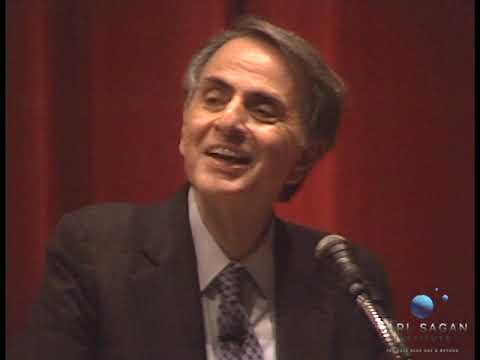
“It's a pale blue dot.”Cornell University symposium lecture, 1994 · full transcript →
Science grows from wonder into explanation through natural law
Sagan sees wonder as the emotional starting point of science. Children ask large questions naturally, and a healthy culture would encourage rather than suppress that impulse. The task of science is to turn awe into understanding.2122
He explains the historical breakthrough as the discovery that the world can be understood without mythic personalities directing every event. Science was born when people began to look for regularities, causes, and laws in nature itself.2324
Science is possible because the universe is ordered enough to be intelligible, but not so static that nothing ever happens, and not so chaotic that nothing can be learned. That middle condition makes observation, experiment, and theory worthwhile.2526
This is why he praises moments like Galileo’s observations and Kepler’s commitment to reality over elegance. Progress comes when predictions meet the world and the world gets the final vote.272810

“This is the place where science was born.”Cosmos, 1980 · full transcript →
Science stays open to new ideas, but only with disciplined skepticism
Sagan does not equate science with narrow-mindedness. He values openness to speculative possibilities, including large questions about origins and life elsewhere. But openness without skepticism collapses into credulity, while skepticism without openness can become dogma.1929
His model is a productive tension between imagination and criticism. That is why he rejects astrology and other unfalsifiable systems: they offer personalized meaning without the hard work of real testing. Scientific claims must risk being wrong.91025
He applies the same standard broadly, even to questions that attract deep feeling or cultural prestige. The right stance is neither automatic belief nor automatic dismissal, but patient judgment guided by evidence.

“It is exactly the tension between this openness and the skepticism, which I think is is one of Phil's great virtues, one well worth emulating if we can.”The Worlds of Philip Morrison symposium, University of Glasgow lecture, 1985 · full transcript →
Scientific literacy is necessary for survival and shared responsibility
For Sagan, science is not a luxury for laboratories. It is necessary for making sane choices in a civilization whose tools can alter climate, threaten the biosphere, and destroy cities. Without scientific habits of thought, societies make decisions they do not understand and then suffer the consequences.4325
He thinks this is especially urgent because scientific thinking cuts against ordinary human weakness. People are vulnerable to magical thinking, short time horizons, and cultural conformity, and scientists are not exempt from those pressures. The discipline of science is one way to resist them.342
Seen from this angle, science is also a unifying perspective. From space, borders fade, and the planet appears as one world facing common problems. Scientific understanding can widen loyalty from tribe and nation toward planetary responsibility.3516

“The scientific illiteracy of Americans in general is scandalous.”MIT Sloan School Symposium, 1989 · full transcript →
Sagan on science, in his own words
“…science is more than a body of knowledge. It's a way of thinking…”
“He preferred the hard truth to his dearest illusions. That is the heart of science.”
“We make our world significant by the courage of our questions and by the depth of our answers.”
“The clearest prescription for disaster is for the public not to know about science and technology.”
“The universe has no obligation to conform to our conceit.”
“The great thing that is happening in our time is that we are able, through a method which can actually make some progress towards the real universe out there, to find out something about origins.”
Where to watch
 Carl Sagan on Science and Pseudoscience: The Demon-Haunted World1995 · 20 min · full transcriptBest single statement of Sagan’s view that science is a skeptical way of thinking needed to resist pseudoscience and govern a technological society.
 Carl Sagan on Scientific Illiteracy: A Baloney Detection Kit1989 · 57 min · full transcriptShows why scientific literacy is a public necessity, not just a private interest, in a world shaped by high-stakes technology.
 Carl Sagan on Origins of Science: from wonder to knowledge1980 · 58 min · full transcriptExplains how science began as a break from myth and became a search for natural law rooted in wonder and questioning.
 Carl Sagan on The Harmony of the Worlds: astrology, science, and Kepler1980 · 59 min · full transcriptClarifies why science prefers testable truths to flattering illusions, using astrology and Kepler as contrasts.
 Carl Sagan on the Great Demotions: Earth Is Not the Center1994 · 96 min · full transcriptShows how science repeatedly humbles human self-importance and why Sagan sees that as intellectually freeing.
 Carl Sagan on Cosmology and God: The Mind of the Universe1988 · 52 min · full transcriptApplies Sagan’s scientific outlook to the biggest questions about origins, cosmology, and the limits of human intuition.
Questions people ask
- How does Carl Sagan explain why science is possible?
- What did Carl Sagan say Galileo discovered about Venus?
- What did Carl Sagan say about faith and evidence?
- What did Carl Sagan say about scientific illiteracy in America?
- What did Carl Sagan say about Phil Morrison's skepticism?
- What did Carl Sagan say science is, and why is skepticism important?
Sources
Every quote above, word for word from the transcripts. Numbers match the text.
“…science is more than a body of knowledge. It's a way of thinking…”
“There's two kinds of dangers. One is what I just talked about, that we've arranged a society based on science and technology in which nobody understands anything about science and technology. And this combustible mixture of ignorance and power, sooner or later, is gonna blow up in our faces. I mean, who is running the science and technology in a democracy if the people don't know anything about it? And the second reason that I'm worried about this is that science is more than a body of knowledge. It's a way of thinking, a way of skeptically interrogating the universe with a fine understanding of human fallibility. If if we are not able to ask skeptical questions to interrogate those who tell us that something is true, to be skeptical of those in authority, then we're up for grabs for the next charlatan political or religious who comes ambling along.”
“The clearest prescription for disaster is for the public not to know about science and technology.”
“The scientific illiteracy of Americans in general is scandalous.”
“Any definition of national security, it seems to me, has to involve the well-being of the citizens, economic well-being, a positive sense of the future based not on path but on real expectations, education, especially in science and technology. The scientific illiteracy of Americans in general is scandalous. Every day there are significant decisions made in Washington involving science and technology which…”
“What is faith? It is belief in the absence of evidence.”
“They're consciously designed to be so vague that it could apply to anybody.”
“He preferred the hard truth to his dearest illusions. That is the heart of science.”
“What I wanted to say is going back to the question of adequate evidence on something that's emotionally really pulling you. I lost both my parents about twelve or fifteen years ago, and I had a great relationship with them. I really miss them. I would love to believe that their spirits were around somewhere, and I'd give almost anything to spend five minutes a year with them.”
“…every human culture has considered itself at the center of the universe.”
“…what we have found is just the opposite that we are a very humdrum and ordinary locale in the universe.”
“The universe has no obligation to conform to our conceit.”
“And you know the list. No one else has altruism, compassion. No other animal loves their young. Nobody else can foresee the future consequences of present actions. Nobody else has art or music. Nobody else can use tools. Nobody else can make tools. And this list, it goes on and on, is essentially agreed to by Plato, Aristotle, Saint Augustine, Saint Thomas Aquinas, Hobbes, Locke, all the great figures in philosophy with the single exception of David Hume, hats off to him, bought into by all scientists, including highly skeptical ones up until the year 1859, bought into, of course, by all the religious leaders of at least the Western religions, especially the Judeo Christian Islamic religion.”
“It's a pale blue dot.”
“We live in a galaxy vast and awesome beyond ordinary imagining.”
“We are the product of a grand evolutionary sequence—Cosmic Evolution—about which we are only occasionally aware.”
“The great thing that is happening in our time is that we are able, through a method which can actually make some progress towards the real universe out there, to find out something about origins.”
“We are on the debris, the little tiny chunks of incidental matter in the inside of the solar system.”
“It would be very healthy for the human species if, uh, there were less discouragement and more scientists.”
“We make our world significant by the courage of our questions and by the depth of our answers.”
“This is the place where science was born.”
“And so it was here that the great idea arose, the realization that there might be a way to know the world without the god hypothesis—that there might be principles, forces, laws of nature through which the world might be understood without attributing the fall of every sparrow to the direct intervention of Zeus. This is the place where science was born. That's why we're here. This great revolution happened between 600 and 400 BC.”
“And those countless suns all obey natural laws, some of which are already known to us. How did we discover that there are such laws? If we lived on a planet where nothing ever changed, there wouldn't be much to do. There'd be nothing to figure out, there'd be no impetus for science. And if we lived in an unpredictable world where things changed in random or very complex ways, we wouldn't be able to figure things out, and again there'd be no such thing as science. But we live in an in-between universe.”
“There are two ways to view the stars: as they really are and as we might wish them to be.”
“Now, that kind of motion is exactly what Galileo found Venus to do when he looked at it with the first telescope several hundred years ago. And Galileo found that the waxing and waning, the changing from crescent to full, back to crescent of Venus did exactly what the sun centered hypothesis predicted and not at all what the earth centered hypothesis predicted.”
“He speculated on the mountains, valleys, craters, climate, and possible inhabitants of the Moon. Before Kepler, astronomy had little connection with physical reality. With Kepler came the idea that a physical force moves the planets in their orbits.”
“It is exactly the tension between this openness and the skepticism, which I think is is one of Phil's great virtues, one well worth emulating if we can.”
“More nuclear weapons you have, the less safe you are. As I was trying to argue before, there’s a kind of counterintuitive aspect of modern technology in the military and in the civilian spheres. And there is a necessity after 1945 of what Einstein called a new way of thinking, which is very slowly permeating into the minds of leaders on the question of the definition of national defense. I’d like to read to you a one-sentence quote from Dwight Eisenhower: "The problem in defense spending is to figure how far you should go without destroying from within what you are trying to defend from without.”
“I I I don't... We've... This is part of being human. Humans have had this way of magical thinking through all of our history. The problem is that today, the technology has reached formidable, maybe even awesome proportions. And so the dangers of thinking this way are larger. Not that this is a new kind of thing.”
“The planet is one, and the national boundaries don't count at all.”
How this guide was made: drafted with AI from the full transcripts of the recordings cited, then checked: every quotation must match a transcript word for word and be the speaker's own words, and an independent review gates accuracy. Methodology and corrections.