Carl Sagan on Science Literacy
For Carl Sagan, science literacy is essential because modern citizens live inside systems shaped by science and technology, and only a skeptical, evidence-based public can govern them wisely.
- Science literacy is not just facts; it is a habit of skeptical, evidence-based thinking.
- A democracy becomes dangerous when citizens rely on science and technology they do not understand.
- Science literacy protects people from pseudoscience, magical thinking, and belief without evidence.
- Curiosity should be cultivated from childhood, not discouraged.
- Global problems require scientifically informed citizens who can think beyond borders and short-term habits.

“It would be very healthy for the human species if, uh, there were less discouragement and more scientists.”Cornell University Olin Lecture discussion, 1988 · 4:47
Science literacy means learning how to think, not just what to know
Sagan treats science literacy as more than memorizing results. He says science is a way of thinking: a disciplined practice of asking questions, testing claims, and recognizing human fallibility. That makes science literacy a civic and intellectual skill, not a specialist hobby.12
He ties intelligence itself to the ability to connect many facts and understand reality as it is. In that sense, being scientifically literate means building habits that help people make sense of the world instead of merely collecting information.3
This way of thinking also requires humility. Sagan stresses that we often do not know, and that the right response is not certainty for comfort's sake but careful judgment about what the evidence does and does not support.45
Why it matters: democracy is at risk when power outruns understanding
Sagan's warning is political as well as educational. He argues that society is organized around science and technology, yet ordinary people often do not understand the forces shaping their lives. In a democracy, that creates a dangerous gap between public power and public understanding.267
He is especially worried because major decisions in national life involve scientific and technical questions. If citizens cannot judge claims, weigh risks, or challenge leaders and experts, democratic self-government weakens.72
His point is not that everyone must become a professional scientist. It is that a free society needs many people capable of skeptical inquiry, especially when decisions affect defense, health, energy, and the environment.128
Science literacy is a defense against pseudoscience and wishful thinking
Sagan sees pseudoscience and superstition as enduring human temptations. They are not new, but they become more dangerous in a technologically powerful society because bad reasoning can now scale into large consequences.91
His standard is simple and demanding: belief should follow compelling evidence, not emotional need or tradition alone. He is explicit that faith understood as belief without evidence is a mistake, and that people should withhold belief when the case has not been made.1011
This does not mean being closed-minded. Sagan praises the balance of openness and skepticism: being willing to consider possibilities while still requiring serious proof. That balance is at the heart of science literacy as he understands it.1314
He also recognizes how hard this is emotionally. People can deeply want something to be true, yet still have an obligation to ask whether the evidence supports it. For Sagan, science literacy helps people manage that tension honestly.1511
Curiosity begins early and should be protected
Sagan repeatedly returns to the natural curiosity of children. He thinks big questions come easily to them, and that adults too often train that impulse out of them rather than helping it grow. A more scientifically literate culture would do the opposite.1617
He connects science to wonder rather than to dryness. The search to understand origins, stars, life, and reality begins in amazement, but it matures by moving from myth to inquiry and from intuition to evidence.181920
He also sees human beings as unusually able to accumulate knowledge beyond one lifetime because we store information outside our bodies in books, computers, and media. Science literacy therefore depends on passing on both knowledge and habits of thought from one generation to the next.2122
“It would be very healthy for the human species if, uh, there were less discouragement and more scientists.”Cornell University Olin Lecture discussion, 1988 · full transcript →
Scientific literacy is necessary for solving planetary problems
Sagan argues that modern risks are global and often counterintuitive. Climate change, ozone depletion, pollution, and nuclear danger are consequences of human power growing faster than human wisdom. Science literacy is necessary because these problems cannot even be understood, much less solved, without scientific reasoning.232425
He emphasizes that nature does not respect political boundaries. When causes and effects cross borders, citizens need a planetary perspective and an ability to follow evidence beyond tribal or national reflexes.242526
He extends the same logic to military policy. In a technological age, common sense can fail, and more weapons can mean less safety. A scientifically literate public is better equipped to think through unintended consequences and resist policies that sound strong but are self-destructive.278
Underneath this is a broader belief that human institutions are made by people and can be changed by people. Science literacy gives the public tools to recognize problems clearly and act before ignorance becomes catastrophe.282

“We're all in this together, and we have to work together.”Dialogue with Ted Turner, NC State University Emerging Issues Forum, 1990 · full transcript →
Sagan on science literacy, in his own words
“It would be very healthy for the human species if, uh, there were less discouragement and more scientists.”
Where to watch
 Carl Sagan on Science and Pseudoscience: The Demon-Haunted World1995 · 20 min · full transcriptBest short statement of why science literacy matters in a democracy and why science is a way of thinking.
 Carl Sagan on Scientific Illiteracy: A Baloney Detection Kit1989 · 57 min · full transcriptShows how scientific illiteracy affects real public decisions about defense, environment, and collective survival.
 Carl Sagan on Climate Change and Nuclear Arms: A Planetary Future1990 · 44 min · full transcriptApplies scientific thinking to global problems like climate change and nuclear risk.
 Carl Sagan on Origins of Science: from wonder to knowledge1980 · 58 min · full transcriptExplains how humanity moved from myth to evidence and why questioning is central to science.
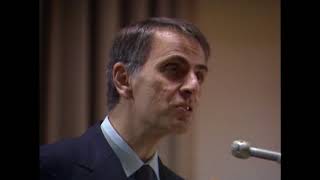 Carl Sagan on the Copernican Perspective: Joining the Universe1985 · 60 min · full transcriptHighlights the balance of openness and skepticism and why public ignorance about science invites disaster.
 Carl Sagan on Human Intelligence: How We Evolved to Think1977 · 14 min · full transcriptConnects intelligence, learning, and the human capacity to store and transmit knowledge.
Questions people ask
- What did Carl Sagan say about balancing openness and skepticism?
- What did Carl Sagan say about faith and evidence?
- What did Carl Sagan say about how humanity got into environmental crisis?
- What did Carl Sagan say about science reporters and science teaching?
- What did Carl Sagan say about scientific illiteracy in America?
- What did Carl Sagan say about wanting to believe in an afterlife after losing his parents?
Sources
Every quote above, word for word from the transcripts. Numbers match the text.
“…science is more than a body of knowledge. It's a way of thinking…”
“There's two kinds of dangers. One is what I just talked about, that we've arranged a society based on science and technology in which nobody understands anything about science and technology. And this combustible mixture of ignorance and power, sooner or later, is gonna blow up in our faces. I mean, who is running the science and technology in a democracy if the people don't know anything about it? And the second reason that I'm worried about this is that science is more than a body of knowledge. It's a way of thinking, a way of skeptically interrogating the universe with a fine understanding of human fallibility. If if we are not able to ask skeptical questions to interrogate those who tell us that something is true, to be skeptical of those in authority, then we're up for grabs for the next charlatan political or religious who comes ambling along.”
“…it's our ability to put a great many facts together…”
“We don't know if it's there. We don't know if it's not there.”
“Well, you know, ultimate ultimate is a big word. I would say one thing that I've learned is how little we know, Is how the the frontiers of... You can think of of us as standing on a little island of knowledge surrounded by an enormous ocean of ignorance. And every year, we sort of eke out just a little more land and prevent the ocean of ignorance from swamping us. And, that's all that stands between us and and drowning. And I I think it's fair for a technical civilization, agricultural economy, where not just entertainment but the difference between life and death, look at medicine for example, is knowledge. We have to be much more serious about knowledge.”
“The clearest prescription for disaster is for the public not to know about science and technology.”
“Any definition of national security, it seems to me, has to involve the well-being of the citizens, economic well-being, a positive sense of the future based not on path but on real expectations, education, especially in science and technology. The scientific illiteracy of Americans in general is scandalous. Every day there are significant decisions made in Washington involving science and technology which…”
“The problem in defense spending is to figure how far you should go without destroying from within what you are trying to defend from without.”
“I I I don't... We've... This is part of being human. Humans have had this way of magical thinking through all of our history. The problem is that today, the technology has reached formidable, maybe even awesome proportions. And so the dangers of thinking this way are larger. Not that this is a new kind of thing.”
“What is faith? It is belief in the absence of evidence.”
“Let's let's let's let's look a little more deeply into that. What is faith? It is belief in the absence of evidence. Now I don't propose to tell anybody what to believe, but for me, believing when there's no compelling evidence is a mistake. The idea is to withhold belief until there is compelling evidence. And if the universe does not comply with our predispositions, okay, then we have the wrenching obligation to accommodate to the way the universe is.”
“If that were ever to happen, there is no question that we would all owe the greatest debt of gratitude to Phil Morrison. I don't want you to think that, this openness to to speculative ideas is untempered in Phil Morrison's personality. There is also a very appropriate dose of scientific skepticism, which you can see in many different areas, his famous remark, I will believe a black hole when I see one, is an example. And it is exactly the tension between this openness and the skepticism, which I think is is one of Phil's great virtues, one well worth emulating if we can.”
“I don't want you to think that, this openness to to speculative ideas is untempered in Phil Morrison's personality. There is also a very appropriate dose of scientific skepticism, which you can see in many different areas, his famous remark, I will believe a black hole when I see one, is an example. And it is exactly the tension between this openness and the skepticism, which I think is is one of Phil's great virtues, one well worth emulating if we can.”
“What I wanted to say is going back to the question of adequate evidence on something that's emotionally really pulling you. I lost both my parents about twelve or fifteen years ago, and I had a great relationship with them. I really miss them. I would love to believe that their spirits were around somewhere, and I'd give almost anything to spend five minutes a year with them.”
“It would be very healthy for the human species if, uh, there were less discouragement and more scientists.”
“We make our world significant by the courage of our questions and by the depth of our answers.”
“The great thing that is happening in our time is that we are able, through a method which can actually make some progress towards the real universe out there, to find out something about origins.”
“And so it was here that the great idea arose, the realization that there might be a way to know the world without the god hypothesis—that there might be principles, forces, laws of nature through which the world might be understood without attributing the fall of every sparrow to the direct intervention of Zeus. This is the place where science was born. That's why we're here. This great revolution happened between 600 and 400 BC.”
“This is the place where science was born.”
“…we have information stored outside of our bodies…”
“History of life on this planet, the organisms had almost all the information they had to deal with in their genes, hereditary information, instinct. Then about maybe 100 million years ago, a little longer ago than that, there came to be a reptile that for the first time in the history of life had more information in its brains than in its genes, and that was a major step, symbolically, in the evolution of life on this planet. Well, now we have an organism — us — which can store more information outside the body altogether than inside the body, and that's in books and computers and television, video cassettes, and that extraordinarily expands our ability to understand what's happening and to manipulate or control our...”
“That's a good question. Well, we got into it by not paying attention and by business as usual. Humans have been on this planet for something like a million years, and for the vast bulk of that time things changed extremely slowly. The population increased very slowly, our technology increased, improved but by very slow steps, and just recently, you know this what's called an exponential. It's flat for a long time and then boom! You suddenly get a huge increase: increase in population, increase in technology, increase in pollution, increase in our powers to disturb the environment, to change the planetary environment. But we're the same old human beings as we were a thousand years ago and 100 thousand years ago.”
“…those molecules don't have passports…”
“We're all in this together, and we have to work together.”
“We have to solve our own problems.”
“More nuclear weapons you have, the less safe you are. As I was trying to argue before, there’s a kind of counterintuitive aspect of modern technology in the military and in the civilian spheres. And there is a necessity after 1945 of what Einstein called a new way of thinking, which is very slowly permeating into the minds of leaders on the question of the definition of national defense. I’d like to read to you a one-sentence quote from Dwight Eisenhower: "The problem in defense spending is to figure how far you should go without destroying from within what you are trying to defend from without.”
“There is nothing about them that cannot be unmade by people.”
How this guide was made: drafted with AI from the full transcripts of the recordings cited, then checked: every quotation must match a transcript word for word and be the speaker's own words, and an independent review gates accuracy. Methodology and corrections.


