Carl Sagan on Skepticism
Sagan treats skepticism as disciplined openness: stay curious, but withhold belief until claims meet the standard of evidence.
- Skepticism is not cynicism; it is a way of thinking that tests claims carefully.
- He urges people to withhold belief when evidence is weak, even when a claim is emotionally appealing.
- Good skepticism keeps openness and doubt in tension, especially with extraordinary or speculative ideas.
- Sagan uses skepticism to challenge comforting illusions, from astrology to human self-importance.
- He thinks a free society needs skeptical, scientifically literate citizens because power without understanding is dangerous.

“Let's let's let's let's look a little more deeply into that. What is faith? It is belief in the absence of evidence. Now I don't propose to tell anybody what to believe, but for me, believing when there's no compelling evidence is a mistake. The idea is to withhold belief until there is compelling evidence. And if the universe does not comply with our predispositions, okay, then we have the wrenching obligation to accommodate to the way the universe is.”Charlie Rose interview, 1995 · 7:16
Skepticism is a habit of mind, not just a set of opinions
For Sagan, skepticism is built into what science is. Science is not only a collection of facts; it is a method for questioning, testing, and correcting what we think we know12.
That method begins with humility about human fallibility. We are prone to error, wishful thinking, and cultural blind spots, so claims should be interrogated rather than accepted because they are familiar, comforting, or widely repeated23.
This is why skepticism matters far beyond laboratories. Sagan thinks skeptical habits are needed in public life, where citizens must judge claims about technology, risk, and policy instead of surrendering judgment to authority or fashion5.
Withhold belief until the evidence is strong
Sagan draws a sharp line between possibility and belief. A thing might be true, but that alone is not enough to justify believing it; belief should wait for compelling evidence678.
He is especially clear that personal desire is not evidence. Even when a claim answers a deep emotional need, he argues that wanting it to be true does not make it so, and intellectual honesty requires restraint7.
This position is why his skepticism can sound severe, but the aim is not harshness. It is fidelity to reality: if the universe does not fit our preferences, then our job is to adjust ourselves to the universe rather than the other way around710.
“Let's let's let's let's look a little more deeply into that. What is faith? It is belief in the absence of evidence. Now I don't propose to tell anybody what to believe, but for me, believing when there's no compelling evidence is a mistake. The idea is to withhold belief until there is compelling evidence. And if the universe does not comply with our predispositions, okay, then we have the wrenching obligation to accommodate to the way the universe is.”Charlie Rose interview, 1995 · full transcript →
The best skepticism stays open without becoming gullible
Sagan does not praise closed-minded debunking. He admires a balance in which one remains genuinely open to new possibilities while still demanding evidence before assent1112.
That balance matters most in frontier questions, such as extraterrestrial life. His view is neither automatic belief nor automatic disbelief, but a refusal to pretend we know what we do not know68.
So skepticism, in his sense, is not the rejection of wonder. It is the discipline that protects wonder from self-deception by making sure curiosity is tethered to proof111.
Skepticism cuts through comforting illusions like astrology
Sagan often applies skepticism to claims that feel meaningful because they flatter human hopes. Astrology is a central example: it offers personal guidance, but it survives by being vague enough to fit almost anyone13.
He contrasts two approaches to the stars: seeing them as they are or seeing them as we wish them to be. Skepticism chooses the first path, even when the second is more emotionally satisfying1410.
This same lesson extends beyond astrology. Sagan thinks people are repeatedly tempted by magical thinking, and in a technological civilization that temptation becomes more dangerous because false beliefs can have larger consequences151.

“There are two ways to view the stars: as they really are and as we might wish them to be.”Cosmos bonus episode, 1980 · full transcript →
Skepticism also means doubting human self-importance
Sagan links skepticism to the Copernican lesson that human beings are often wrong when we place ourselves at the center. Cultures naturally imagine themselves central and special, but science repeatedly corrects that instinct1617.
This is why skepticism for him is also moral and philosophical. It teaches us to suspect grand claims about our uniqueness, our cosmic status, and our favored place in nature1618.
Far from being bleak, he sees this as liberating. By giving up flattering illusions, we gain a truer picture of the universe and of ourselves within it1710.
A skeptical public is necessary for a healthy democracy
Sagan thinks skepticism is not optional in a society shaped by science and technology. When citizens lack scientific understanding, power accumulates without public judgment, and that creates serious danger192.
He warns that ignorance combined with technological power is unstable. People need the ability to ask skeptical questions of leaders, experts, and institutions, especially when decisions affect security, health, and the future220.
So for Sagan, skepticism is a civic virtue. It helps a democracy resist manipulation, magical thinking, and destructive short-term choices by grounding public judgment in evidence and intellectual honesty5.
“There's two kinds of dangers. One is what I just talked about, that we've arranged a society based on science and technology in which nobody understands anything about science and technology. And this combustible mixture of ignorance and power, sooner or later, is gonna blow up in our faces. I mean, who is running the science and technology in a democracy if the people don't know anything about it? And the second reason that I'm worried about this is that science is more than a body of knowledge. It's a way of thinking, a way of skeptically interrogating the universe with a fine understanding of human fallibility. If if we are not able to ask skeptical questions to interrogate those who tell us that something is true, to be skeptical of those in authority, then we're up for grabs for the next charlatan political or religious who comes ambling along.”Charlie Rose interview, 1995 · full transcript →
Sagan on skepticism, in his own words
“What is faith? It is belief in the absence of evidence.”
“There's two kinds of dangers. One is what I just talked about, that we've arranged a society based on science and technology in which nobody understands anything about science and technology. And this combustible mixture of ignorance and power, sooner or later, is gonna blow up in our faces. I mean, who is running the science and technology in a democracy if the people don't know anything about it? And the second reason that I'm worried about this is that science is more than a body of knowledge. It's a way of thinking, a way of skeptically interrogating the universe with a fine understanding of human fallibility. If if we are not able to ask skeptical questions to interrogate those who tell us that something is true, to be skeptical of those in authority, then we're up for grabs for the next charlatan political or religious who comes ambling along.”
Where to watch
 Carl Sagan on Science and Pseudoscience: The Demon-Haunted World1995 · 20 min · full transcriptBest single overview of skepticism as science’s method and as a defense against pseudoscience and magical thinking.
 Carl Sagan on Scientific Illiteracy: A Baloney Detection Kit1989 · 57 min · full transcriptShows why skeptical thinking matters politically in a technological democracy, not just in science.
 Carl Sagan on The Harmony of the Worlds: astrology, science, and Kepler1980 · 59 min · full transcriptApplies skepticism concretely to astrology and contrasts comforting stories with the hard truth.
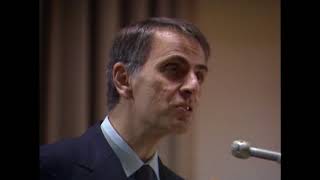 Carl Sagan on the Copernican Perspective: Joining the Universe1985 · 60 min · full transcriptCaptures Sagan’s ideal balance of openness and skepticism in evaluating speculative claims.
 Carl Sagan on Extraterrestrial Life: Science, Skepticism, and Humility1996 · 14 min · full transcriptA concise example of how he handles uncertain claims without collapsing into belief or denial.
Questions people ask
- What did Carl Sagan say about balancing openness and skepticism?
- What did Carl Sagan say about faith and evidence?
- What did Carl Sagan say about science reporters and science teaching?
- What did Carl Sagan say about scientific illiteracy in America?
- What did Carl Sagan say about wanting to believe in an afterlife after losing his parents?
- What did Carl Sagan say about Phil Morrison's skepticism?
Sources
Every quote above, word for word from the transcripts. Numbers match the text.
“…science is more than a body of knowledge. It's a way of thinking…”
“There's two kinds of dangers. One is what I just talked about, that we've arranged a society based on science and technology in which nobody understands anything about science and technology. And this combustible mixture of ignorance and power, sooner or later, is gonna blow up in our faces. I mean, who is running the science and technology in a democracy if the people don't know anything about it? And the second reason that I'm worried about this is that science is more than a body of knowledge. It's a way of thinking, a way of skeptically interrogating the universe with a fine understanding of human fallibility. If if we are not able to ask skeptical questions to interrogate those who tell us that something is true, to be skeptical of those in authority, then we're up for grabs for the next charlatan political or religious who comes ambling along.”
“We have a weakness and scientists are creatures of the culture in which they swim…”
“The clearest prescription for disaster is for the public not to know about science and technology.”
“We don't know if it's there. We don't know if it's not there.”
“Let's let's let's let's look a little more deeply into that. What is faith? It is belief in the absence of evidence. Now I don't propose to tell anybody what to believe, but for me, believing when there's no compelling evidence is a mistake. The idea is to withhold belief until there is compelling evidence. And if the universe does not comply with our predispositions, okay, then we have the wrenching obligation to accommodate to the way the universe is.”
“Belief in the absence of evidence maybe exists in religion, but it shouldn’t exist in science.”
“He preferred the hard truth to his dearest illusions. That is the heart of science.”
“It is exactly the tension between this openness and the skepticism, which I think is is one of Phil's great virtues, one well worth emulating if we can.”
“I don't want you to think that, this openness to to speculative ideas is untempered in Phil Morrison's personality. There is also a very appropriate dose of scientific skepticism, which you can see in many different areas, his famous remark, I will believe a black hole when I see one, is an example. And it is exactly the tension between this openness and the skepticism, which I think is is one of Phil's great virtues, one well worth emulating if we can.”
“They're consciously designed to be so vague that it could apply to anybody.”
“There are two ways to view the stars: as they really are and as we might wish them to be.”
“I I I don't... We've... This is part of being human. Humans have had this way of magical thinking through all of our history. The problem is that today, the technology has reached formidable, maybe even awesome proportions. And so the dangers of thinking this way are larger. Not that this is a new kind of thing.”
“…every human culture has considered itself at the center of the universe.”
“It's a pale blue dot.”
“Many of these stars are more or less like the sun. As I was saying before, it now looks as if planets are a frequent, if not invariable accompaniment of star formation. And again, I ask you to consider the contention that the only life and intelligence in the universe is, let's say, that dot. No. Not that one. That one right there. See? That's it. Nowhere else. Maybe hard to extrapolate from one example, and one example is all we have, but this is so resonant with the other human conceits I tried to outline in the great demotions that I am suspicious of it for that reason alone.”
“The scientific illiteracy of Americans in general is scandalous.”
“Any definition of national security, it seems to me, has to involve the well-being of the citizens, economic well-being, a positive sense of the future based not on path but on real expectations, education, especially in science and technology. The scientific illiteracy of Americans in general is scandalous. Every day there are significant decisions made in Washington involving science and technology which…”
How this guide was made: drafted with AI from the full transcripts of the recordings cited, then checked: every quotation must match a transcript word for word and be the speaker's own words, and an independent review gates accuracy. Methodology and corrections.
