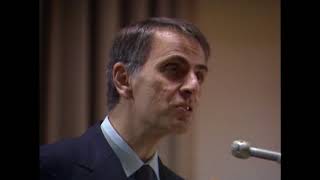
Carl Sagan on Long-Term Thinking
Sagan treats long-term thinking as a scientific and moral discipline: see Earth in planetary time, anticipate global risks early, and act together before short-term habits become irreversible disasters.
- Think on planetary and cosmic timescales, not just electoral or national ones.
- Modern power outruns old habits, so short-term thinking now creates global danger.
- Climate change, nuclear war, and environmental damage ignore borders and demand cooperation.
- Long-term thinking requires science literacy, skepticism, and better public judgment.
- Humanity should protect Earth first while also reducing existential risk through exploration and diversification.

“The thing is, Milton, that, we have not yet inventoried the near earth world.”Interview with Milton Rosenberg on WGN Chicago, 1994 · 16:09
Long-term thinking begins with a larger sense of time
Sagan wants people to stretch their imagination beyond everyday human scales. He presents human life as taking place inside immense spans of space and time, where looking outward also means looking backward into history. That perspective makes short-term urgency look less like wisdom and more like myopia.123
This cosmic framing is not meant to belittle humanity. It is meant to remind us that a species capable of understanding time so deeply also has to take responsibility for what it does next. His view of human destiny assumes that knowledge creates obligation.45
The real danger is power without foresight
Sagan’s central warning is that human capabilities have grown much faster than human judgment. Population, technology, pollution, and the power to alter the planet have surged, while our instincts remain shaped by a much older world. Long-term thinking matters because old habits become catastrophic when amplified by modern tools.67
He applies this especially to public life. A society dependent on science and technology cannot afford ignorance about either, because decisions with long-lasting consequences are constantly being made by citizens and leaders. For Sagan, scientific illiteracy is not just an educational problem; it is a civilizational risk.8910
Planetary problems require planetary thinking
Sagan argues that the biggest long-term threats are global by nature. Greenhouse warming, ozone depletion, pollution, and nuclear war do not stop at national borders, so they cannot be solved by national thinking alone. If causes and consequences are planetary, then responsibility must be planetary too.111213
He also emphasizes that life is rare and fragile, which raises the stakes. Long-term thinking therefore means treating the biosphere as precious, not assuming resilience without limit. His environmental argument is not only practical but reverential: civilization depends on protecting something uncommon in the known universe.1415
This is why he treats cooperation not as idealism but as realism. When everyone shares the same atmosphere and the same risks, working together becomes the only serious strategy.1617
Nuclear war is the clearest case against short-term thinking
For Sagan, nuclear strategy shows how badly institutions can fail at long-term reasoning. Weapons built in the name of security can make everyone less safe, while defense spending can hollow out the society it claims to protect. He repeatedly presses the idea that means and ends have become dangerously confused.1819
Nuclear winter makes that failure concrete. A nuclear exchange would not stay limited to battlefields or immediate blast zones; it could trigger worldwide climatic collapse, agricultural failure, and mass suffering. Long-term thinking here means recognizing delayed, indirect, and planetary consequences before action makes them unavoidable.2021
His point is not only that catastrophe is possible, but that it is human-made. Because these systems were built by people, they can be dismantled by people.22
Good long-term thinking combines openness, skepticism, and exploration
Sagan does not equate long-term thinking with fantasy. He praises a balance between openness to big possibilities and skepticism toward weak claims, because planning for the future requires both imagination and discipline. That balance helps prevent two opposite failures: complacency and self-deception.2324
This is also how he thinks about Mars and space. Mars matters because it teaches lessons about planetary environments, atmospheric vulnerability, and climate, not because we should project myths onto it. He prefers the real complexity of other worlds to comforting stories about them.25262728
Space exploration also has a prudential role in his long-term view. Earth must not be treated as disposable, but it is still wise to reduce existential risk by learning about nearby hazards and eventually building self-sustaining human settlements elsewhere. In that sense, exploration is both curiosity and insurance.2930
“The thing is, Milton, that, we have not yet inventoried the near earth world.”Interview with Milton Rosenberg on WGN Chicago, 1994 · full transcript →
Sagan on long-term thinking, in his own words
“This mixture of ignorance and power is gonna blow up in our face sooner or later.”
“We're all in this together, and we have to work together.”
Where to watch
 Carl Sagan on Climate Change and Nuclear Arms: A Planetary Future1990 · 44 min · full transcriptBest single overview of why long-term risks are planetary and why cooperation is the necessary response.
 Carl Sagan on Scientific Illiteracy: A Baloney Detection Kit1989 · 57 min · full transcriptShows how short-term institutions and scientific illiteracy create long-run danger in climate, war, and public policy.
 Carl Sagan on Global Warming: The Planet Is a Unity1990 · 59 min · full transcriptBest on acting under uncertainty: take climate risk seriously before certainty arrives too late.
 Carl Sagan on Nuclear Winter: Why Arms Control Matters1983 · 52 min · full transcriptThe sharpest example of Sagan’s warning that delayed global consequences can dwarf immediate intentions.
 Carl Sagan on Human Future in Space: Pale Blue Dot and our cosmic place1994 · 90 min · full transcriptConnects the pale blue dot perspective to prudence, asteroid awareness, and long-term survival beyond Earth.
 Carl Sagan on Time, Space, and Relativity: Travels in Time and Space1980 · 62 min · full transcriptExpands the time horizon itself by showing how cosmic perspective changes human judgment.
Questions people ask
- What did Carl Sagan say Mars teaches us about Earth’s environment?
- What did Carl Sagan say about how humanity got into environmental crisis?
- What did Carl Sagan say about nuclear weapons and national security?
- What did Carl Sagan say about scientific illiteracy in America?
- What did Carl Sagan say about why humans should build colonies elsewhere in space?
- What did Carl Sagan say about Phil Morrison's skepticism?
Sources
Every quote above, word for word from the transcripts. Numbers match the text.
“We are drifting in a great ocean of space and time.”
“We see that space and time are intertwined.”
“When the light we see from the star set out on its long interstellar voyage, the young Albert Einstein, working as a Swiss patent clerk, had just published his epical special theory of relativity here on Earth. We see that space and time are intertwined. We cannot look out into space without looking back into time. The speed of…”
“We are a star which has taken its destiny into its own hands.”
“Well, you know, ultimate ultimate is a big word. I would say one thing that I've learned is how little we know, Is how the the frontiers of... You can think of of us as standing on a little island of knowledge surrounded by an enormous ocean of ignorance. And every year, we sort of eke out just a little more land and prevent the ocean of ignorance from swamping us. And, that's all that stands between us and and drowning. And I I think it's fair for a technical civilization, agricultural economy, where not just entertainment but the difference between life and death, look at medicine for example, is knowledge. We have to be much more serious about knowledge.”
“That's a good question. Well, we got into it by not paying attention and by business as usual. Humans have been on this planet for something like a million years, and for the vast bulk of that time things changed extremely slowly. The population increased very slowly, our technology increased, improved but by very slow steps, and just recently, you know this what's called an exponential. It's flat for a long time and then boom! You suddenly get a huge increase: increase in population, increase in technology, increase in pollution, increase in our powers to disturb the environment, to change the planetary environment. But we're the same old human beings as we were a thousand years ago and 100 thousand years ago.”
“This mixture of ignorance and power is gonna blow up in our face sooner or later.”
“The scientific illiteracy of Americans in general is scandalous.”
“Any definition of national security, it seems to me, has to involve the well-being of the citizens, economic well-being, a positive sense of the future based not on path but on real expectations, education, especially in science and technology. The scientific illiteracy of Americans in general is scandalous. Every day there are significant decisions made in Washington involving science and technology which…”
“The clearest prescription for disaster is for the public not to know about science and technology.”
“…those molecules don't have passports…”
“The national boundaries have no bearing on these global environmental issues.”
“No one nation can solve this problem by itself.”
“Life isn't all that easy to come by…”
“Life is something rare and precious.”
“We're all in this together, and we have to work together.”
“We have to solve our own problems.”
“The problem in defense spending is to figure how far you should go without destroying from within what you are trying to defend from without.”
“More nuclear weapons you have, the less safe you are. As I was trying to argue before, there’s a kind of counterintuitive aspect of modern technology in the military and in the civilian spheres. And there is a necessity after 1945 of what Einstein called a new way of thinking, which is very slowly permeating into the minds of leaders on the question of the definition of national defense. I’d like to read to you a one-sentence quote from Dwight Eisenhower: "The problem in defense spending is to figure how far you should go without destroying from within what you are trying to defend from without.”
“…the United States and the Soviet Union have together contrived a Doomsday Machine…”
“Nuclear winter is not a problem amenable to experimental verification. At least not more than once, and few of us wish to perform the experiment. It is therefore restricted necessarily to the best theoretical physics, the best computing programs, and the best small simulations that can be managed. Every one of those, of course, should be vigorously pursued and I'm concerned that the level of funding that the administration under restricted budgetary circumstances to be sure has proposed is inadequate. But at the same time... And and by the way, other witnesses will will provide their opinion on the degrees of uncertainty. Doctor Carrier, for example, who chaired the National Academy study.”
“There is nothing about them that cannot be unmade by people.”
“It is exactly the tension between this openness and the skepticism, which I think is is one of Phil's great virtues, one well worth emulating if we can.”
“I don't want you to think that, this openness to to speculative ideas is untempered in Phil Morrison's personality. There is also a very appropriate dose of scientific skepticism, which you can see in many different areas, his famous remark, I will believe a black hole when I see one, is an example. And it is exactly the tension between this openness and the skepticism, which I think is is one of Phil's great virtues, one well worth emulating if we can.”
“Mars has become a kind of mythic arena onto which we've projected our earthly hopes and fears.”
“The real Mars is a world of wonders.”
“The only question was which side of the telescope the intelligence was on.”
“Mars today is strictly relevant to the global environment of the Earth. Its antiseptic surface is a cautionary tale of what happens if you don't have an ozone layer. Its great dust storms and the resulting cooling of its surface played a role in the discovery of nuclear winter, the catastrophic climate change on Earth predicted to follow nuclear war.”
“The thing is, Milton, that, we have not yet inventoried the near earth world.”
“There is a possibility. I don't suggest that, the Earth is a disposable planet. In any case, we could not possibly launch any significant fraction of the human species into space. There are 250,000 more of us born than die every day. But it seems to me that it's good to take out an insurance policy, diversify our portfolio. That means planting human colonies elsewhere. Don't put all our eggs in one basket almost literally. Yes. So self sustaining human colonies elsewhere would be an insurance policy for the long term survival.”
How this guide was made: drafted with AI from the full transcripts of the recordings cited, then checked: every quotation must match a transcript word for word and be the speaker's own words, and an independent review gates accuracy. Methodology and corrections.