Carl Sagan on Thinking & Rationality
Carl Sagan treats rationality as a disciplined mix of curiosity, skepticism, humility, and evidence-based thinking that helps us see reality as it is rather than as we wish it to be.
- Science is not just facts but a way of thinking built on skeptical questioning and evidence.
- Good reasoning requires humility: withhold belief when evidence is weak and accept uncertainty when we do not know.
- Humans are vulnerable to comforting illusions, vague claims, and magical thinking, so rationality means preferring hard truth to wishful belief.
- Curiosity should be protected, especially in children, because deep questions are the starting point of real understanding.
- Clear thinking matters for public life because a technological society becomes dangerous when citizens cannot judge scientific claims.
Rationality begins with curiosity, not cynicism
Sagan sees clear thinking as beginning in wonder. The impulse to ask large, uncomfortable questions is not a distraction from rationality but its starting point. He treats human significance as something earned through questioning and understanding, not handed to us by custom or authority.12
This is why he repeatedly defends curiosity in children and criticizes the habits that suppress it. For him, discouraging inquiry weakens the species, while encouraging more questioning strengthens our ability to understand reality.34
He also links intelligence to connecting many facts into a coherent picture of the world. Rationality is not memorizing isolated information; it is learning how to fit observations together so they describe how the world really works.45
Science is a method for thinking, not just a pile of results
Sagan’s central claim is that science is a style of thought. Its value lies not only in discoveries but in the habits it teaches: asking skeptical questions, checking claims, and remembering that human beings are fallible.67
He presents the rise of science as a turning point in human history because it introduced the idea that the world could be understood through laws of nature rather than by repeating myths. That shift matters for rationality because it replaces authority and story with observation and explanation.89
For Sagan, this method works because the universe has patterns that can be discovered. If the world were totally fixed or completely chaotic, there would be nothing to learn; science is possible because reality is ordered enough to investigate.102
The core discipline is to prefer evidence over comfort
Sagan returns again and again to one practical rule: do not believe something just because it is comforting, familiar, or emotionally attractive. He is especially blunt that belief without evidence is a mistake, and that in science one should withhold belief until the case is strong.111213
That does not mean pretending certainty where none exists. A rational mind can say that the evidence is insufficient and stop there. Sagan models this by insisting that when the facts are unclear, neither belief nor disbelief should race ahead of what is known.14
This combination of skepticism and restraint is part of his deeper humility. He thinks some questions are extremely difficult, and that honesty about the limits of knowledge is wiser than confident declarations unsupported by facts.15

“Belief in the absence of evidence maybe exists in religion, but it shouldn’t exist in science.”The Dennis Prager Show interview, 1996 · full transcript →
Rationality protects us from vague claims and magical thinking
Sagan uses astrology as a clear example of how people get fooled. Claims can feel personal and persuasive while remaining so vague that they could fit almost anyone. A rational thinker asks whether a claim is specific, testable, and exposed to possible failure.1617
He thinks the danger here is not only that false ideas are wrong, but that they train the mind to accept wishful thinking. His contrast is sharp: we can look at the stars as they really are or as we want them to be. Rationality means choosing reality even when illusion is more flattering or comforting.1718
He broadens this point beyond astrology to a long human history of magical thinking. Such habits are ancient, but in a technologically powerful civilization their consequences grow much larger, which makes disciplined thinking a social necessity, not a private luxury.196
Good judgment requires openness and skepticism together
Sagan does not equate rationality with closed-mindedness. He praises the ability to stay open to speculative possibilities while also demanding an appropriate level of skepticism. For him, the healthiest intellect balances imagination with disciplined doubt.2021
That balance matters in questions where people are tempted to leap ahead of the evidence, such as extraterrestrial life, God, or other emotionally charged topics. Sagan’s habit is to keep the question open, resist premature belief, and let evidence decide as far as it can.1412
This makes rationality a moral as well as an intellectual discipline. It asks us to accommodate ourselves to the universe instead of demanding that the universe accommodate our preferences.1318
Why rationality matters in everyday public life
For Sagan, clear thinking is not just for laboratories. A modern democracy runs on science and technology, so citizens need enough rational discipline to judge claims that affect war, health, environment, and the future. When public understanding is weak, ignorance gains power.22237
He worries that scientific illiteracy leaves societies vulnerable to manipulation and bad decisions. If people cannot ask skeptical questions of leaders, experts, and media, they surrender control over forces that shape their lives.24257
His practical advice is therefore civic as much as personal: learn enough to interrogate claims, respect knowledge, think past short-term comfort, and remember that human institutions can be remade by human choices.262715
Sagan on thinking & rationality, in his own words
“Belief in the absence of evidence maybe exists in religion, but it shouldn’t exist in science.”
Where to watch
 Carl Sagan on Science and Pseudoscience: The Demon-Haunted World1995 · 20 min · full transcriptBest single overview of Sagan’s view that science is a way of thinking, and why skepticism matters in a world full of pseudoscience.
 Carl Sagan on Scientific Illiteracy: A Baloney Detection Kit1989 · 57 min · full transcriptShows why rational thinking is a public necessity in a technological society, not just a personal virtue.
 Carl Sagan on The Harmony of the Worlds: astrology, science, and Kepler1980 · 59 min · full transcriptGives a concrete lesson in how to spot vague, unfalsifiable claims and why truth matters more than comforting illusion.
 Carl Sagan on Origins of Science: from wonder to knowledge1980 · 58 min · full transcriptExplains how wonder grew into science and why courageous questioning is central to human understanding.
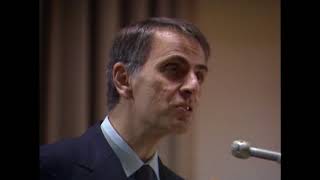 Carl Sagan on the Copernican Perspective: Joining the Universe1985 · 60 min · full transcriptExcellent on the balance between openness and skepticism, especially when evaluating extraordinary claims.
Questions people ask
- How does Carl Sagan explain why science is possible?
- What did Carl Sagan say about balancing openness and skepticism?
- What did Carl Sagan say about faith and evidence?
- What did Carl Sagan say about science reporters and science teaching?
- What did Carl Sagan say science is, and why is skepticism important?
- What did Carl Sagan say we know about knowledge and ignorance?
Sources
Every quote above, word for word from the transcripts. Numbers match the text.
“We make our world significant by the courage of our questions and by the depth of our answers.”
“The great thing that is happening in our time is that we are able, through a method which can actually make some progress towards the real universe out there, to find out something about origins.”
“It would be very healthy for the human species if, uh, there were less discouragement and more scientists.”
“…it's our ability to put a great many facts together…”
“…we have information stored outside of our bodies…”
“…science is more than a body of knowledge. It's a way of thinking…”
“There's two kinds of dangers. One is what I just talked about, that we've arranged a society based on science and technology in which nobody understands anything about science and technology. And this combustible mixture of ignorance and power, sooner or later, is gonna blow up in our faces. I mean, who is running the science and technology in a democracy if the people don't know anything about it? And the second reason that I'm worried about this is that science is more than a body of knowledge. It's a way of thinking, a way of skeptically interrogating the universe with a fine understanding of human fallibility. If if we are not able to ask skeptical questions to interrogate those who tell us that something is true, to be skeptical of those in authority, then we're up for grabs for the next charlatan political or religious who comes ambling along.”
“This is the place where science was born.”
“And so it was here that the great idea arose, the realization that there might be a way to know the world without the god hypothesis—that there might be principles, forces, laws of nature through which the world might be understood without attributing the fall of every sparrow to the direct intervention of Zeus. This is the place where science was born. That's why we're here. This great revolution happened between 600 and 400 BC.”
“And those countless suns all obey natural laws, some of which are already known to us. How did we discover that there are such laws? If we lived on a planet where nothing ever changed, there wouldn't be much to do. There'd be nothing to figure out, there'd be no impetus for science. And if we lived in an unpredictable world where things changed in random or very complex ways, we wouldn't be able to figure things out, and again there'd be no such thing as science. But we live in an in-between universe.”
“What is faith? It is belief in the absence of evidence.”
“Belief in the absence of evidence maybe exists in religion, but it shouldn’t exist in science.”
“Let's let's let's let's look a little more deeply into that. What is faith? It is belief in the absence of evidence. Now I don't propose to tell anybody what to believe, but for me, believing when there's no compelling evidence is a mistake. The idea is to withhold belief until there is compelling evidence. And if the universe does not comply with our predispositions, okay, then we have the wrenching obligation to accommodate to the way the universe is.”
“We don't know if it's there. We don't know if it's not there.”
“Well, you know, ultimate ultimate is a big word. I would say one thing that I've learned is how little we know, Is how the the frontiers of... You can think of of us as standing on a little island of knowledge surrounded by an enormous ocean of ignorance. And every year, we sort of eke out just a little more land and prevent the ocean of ignorance from swamping us. And, that's all that stands between us and and drowning. And I I think it's fair for a technical civilization, agricultural economy, where not just entertainment but the difference between life and death, look at medicine for example, is knowledge. We have to be much more serious about knowledge.”
“They're consciously designed to be so vague that it could apply to anybody.”
“There are two ways to view the stars: as they really are and as we might wish them to be.”
“He preferred the hard truth to his dearest illusions. That is the heart of science.”
“I I I don't... We've... This is part of being human. Humans have had this way of magical thinking through all of our history. The problem is that today, the technology has reached formidable, maybe even awesome proportions. And so the dangers of thinking this way are larger. Not that this is a new kind of thing.”
“It is exactly the tension between this openness and the skepticism, which I think is is one of Phil's great virtues, one well worth emulating if we can.”
“I don't want you to think that, this openness to to speculative ideas is untempered in Phil Morrison's personality. There is also a very appropriate dose of scientific skepticism, which you can see in many different areas, his famous remark, I will believe a black hole when I see one, is an example. And it is exactly the tension between this openness and the skepticism, which I think is is one of Phil's great virtues, one well worth emulating if we can.”
“The scientific illiteracy of Americans in general is scandalous.”
“The clearest prescription for disaster is for the public not to know about science and technology.”
“Another is you look at people who are called science reporters for the networks, and you find that, they don't report science. It's not scientific ideas, theories, discoveries. It's almost entirely, medicine and technology. There ought to be a medical reporter. There ought to be a technology reporter, but there ought to be a science reporter. I think the general level of teaching science in the in the public schools is woefully low. I think scientific attitudes of thought, including skepticism of received wisdom, is desperately needed in various social, economical, political, and even religious aspects of our society and isn't there.”
“Any definition of national security, it seems to me, has to involve the well-being of the citizens, economic well-being, a positive sense of the future based not on path but on real expectations, education, especially in science and technology. The scientific illiteracy of Americans in general is scandalous. Every day there are significant decisions made in Washington involving science and technology which…”
“There is nothing about them that cannot be unmade by people.”
“The problem in defense spending is to figure how far you should go without destroying from within what you are trying to defend from without.”
How this guide was made: drafted with AI from the full transcripts of the recordings cited, then checked: every quotation must match a transcript word for word and be the speaker's own words, and an independent review gates accuracy. Methodology and corrections.


