Carl Sagan: The Age of Exploration
On the Great Demotions: Earth Is Not the Center

What Sagan talks about
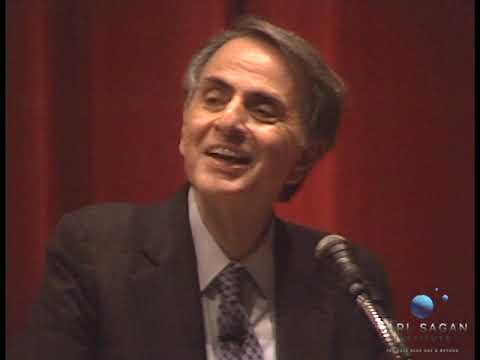
Carl Sagan gave this lecture at a Cornell University symposium honoring his 60th birthday in November 1994, tracing how science repeatedly overturns human claims to centrality in the universe, life, and meaning.
Also known as: Carl Sagan's 1994 "Lost" Lecture: The Age of Exploration; "The Age of Exploration" – Carl Sagan; lost lecture.
In this Cornell lecture, Sagan traces a long history of human chauvinism: the belief that we are at the center of the universe, the center of life, and the center of meaning. He argues that science repeatedly overturns these assumptions, and that each “demotion” is both humbling and liberating.
He moves from hunter-gatherer science and the night sky to Copernicus, Galileo, Darwin, relativity, planetary science, and the search for extraterrestrial life. Along the way, he shows how careful observation replaces comforting myths with a larger, less self-flattering view of reality.
Sagan closes by turning demotion into a challenge: if humans want self-respect, they should do something worthy of it—feed the hungry, expand equality, use science for everyone’s benefit, and explore other worlds.
Dale Corson introduces Sagan; the rest is Sagan with audience Q&A at the end.
In his words
“Every human culture has considered itself at the center of the universe.”
“It's a pale blue dot.”
“We have a weakness and scientists are creatures of the culture in which they swim”
“My mind is open. You come up with evidence we're the center of the universe, I will gladly confess defeat.”
Key points
- Human beings have been technological and scientific from the beginning, not just in modern times.
- The geocentric view felt natural because the sky appears to turn around us, but it is still a mistaken perspective.
- Copernicus, Galileo, and later astronomers showed that Earth is not the center of the cosmos.
- Darwin’s work further demoted human exceptionalism by showing our kinship with other animals, especially chimpanzees.
- The search for extraterrestrial life and planets suggests Earth may not be unique in life-bearing potential.
- Special creation and anthropic arguments can reflect a deep human desire to remain central.
- Sagan says real human worth should come from what we accomplish, not from accident of birth.
Full transcript: Carl Sagan, The Age of Exploration (1994)
IntroducerGood evening, ladies and gentlemen. It is my privilege to introduce to you Emeritus Professor of Physics, Emeritus dean of engineering, Emeritus provost of Cornell University, and Emeritus president of Cornell University, Dale Corson, who will introduce Carl.
Dale CorsonProfessor Terzian, ladies and gentlemen, it's my pleasure to introduce Carl Sagan for his lecture, The Age of Exploration. Doctor Sagan first crossed my consciousness one day in 1967 when professor Thomas Gold, chairman of our astronomy department at the time, came to my office. I was university provost at the time to tell me about Carl Sagan, promising young astronomer at Harvard, whom Tom said he thought we could get. He told me that Sagan was a brilliant planetary scientist, and furthermore, he had a great ability to tell the lay public in understandable terms what astronomy and science are all about. This latter particularly caught my attention.
It represented a unique ability, and we needed more of it in the university. I responded that this seemed like a good opportunity, and why didn't he make an offer? Professor Gould said he had no money and that I would have to provide the funds. Now this is a game that every entrepreneurial department chairman tries to play, But I didn't dismiss gold as quickly as I might have some people. I'd known Tom for a long time. I'd been chairman of the search committee that brought him to Cornell, also from Harvard. Harvard's good recruiting ground. Tom's always been an exciting person to have around with more ideas per second than anyone else, and I've always enjoyed talking with him.
He has ideas about everything, the expanding universe, how to ride a unicycle, pulsars, Carl Sagan. But there's a problem. Sometimes his ideas are wrong. On the theory of riding the unicycle, for example, I think he never learned. But usually, he's right. He was right about pulsars from the first moment. He told me that if I put up the money to hire Carl Sagan, I would never regret it. I did put up the money, the offer was made, and Carl came to Cornell, and I have never regretted it. Tom was right. You already know all the great things Carl has done the past quarter century.
Although you may not appreciate all the solid science he has done. You can take my word for that. I've always been grateful to Carl for his willingness to talk to alumni groups and to other lay groups. When I was president, I asked him to do this billions of times when I could find him, and he always said yes. He did hesitate once when it was a black tie affair in Chicago, but when I explained the importance of the occasion, he accepted. I think he rather liked the black tie part of it, and I'm not sure he ever returned the rented tuxedo. Maybe that's why he's never been able to go back to Chicago.
Carl has received more honors and awards than I could possibly relate. Let me limit this reference to reading the citation for one of his recent honors, the public welfare medal of the National Academy of Sciences, the academy's most prestigious award. For his ability to communicate the wonder and importance of science, to capture the imagination of so many, and to explain difficult concepts of science in understandable terms, that says it all. Carl Sagan on the age of exploration.
Carl SaganThank you, Dale. I never knew that Tommy hit you up for my salary. Grateful to you both. It's true that Tommy Gold recruited me for Cornell. I remember the inducement, a very small and exceptionally good astronomy department, superb ancillary departments in physics, chemistry, and biology, a beautiful campus, laboratory facilities, which were by some standards very generous. But still I hesitated.
And I remember Tommy made the final inducement. I think knowing full well what he was doing. He took me on a little trip to Upper Infield. And I thought, my goodness, here is a national park as exquisite, well, it's not really a national park, here is something as exquisite as any national park I've ever been in, and it would be right on my doorstep and that is the missing ingredient. Tommy was extremely persuasive on every level of inducement and I thank him very much for the invitation. I've lived now in Ithaca longer than I have lived in any other place in my life.
And I'm extremely grateful to Cornell and the town of Ithaca. I consider this my my true roots. I didn't know what it was I was going to talk to you about tonight, and so I tried to to pick a topic which was sufficiently broad and ambiguous that whatever I thought I would talk about would fit. However, what I've decided to talk about doesn't fit. Well, maybe it does. We humans have had civilization only for about ten thousand years. Our species is a few 100,000 years old.
Our genus, the genus Homo, is a few million years old. And therefore, for the vast bulk of our tenure on earth, we were something other than sedentary. And the word has such an aura of self congratulation, civilized. What were we? We were hunters and foragers. We wandered in small itinerant extended families, and our knowledge of the hunter gatherer lifestyle is due to a few courageous and far seeing anthropologists who went and lived with the few remaining hunter gatherer groups before they were finally and utterly destroyed by civilization.
The anthropologist from whom I learned the most about hunter gatherers is actually here with us, Richard Lee of the University of Toronto. He studied a people, the Kung son of the Kalahari Desert in The Republic Of Botswana. And I want to just give a little flavor about my understanding of our ancestors from Richard Lee's study of the Kung Sun. I want you to know I practiced before the mirror for about half an hour. The first thing that I think is very important is that they are highly technological.
The technology is wood and stone and domestication of fire technology, but it's absolutely technology and there are experts and other people who are not quite as good at the technology. But not only are they technological for fun, they are technological because their lives depend upon it. Chipping and flaking stone tools back before they had a little trickle of metal into their economy. It's very difficult to do. Of course, they did it superbly well. And the archaeological and anthropological record is clear that we were technologists all the way back to the beginning. So the idea that science and technology is something new, something unusual, something...
We can even find books that say, not really very human is completely backwards. Technology is, if anything, the most characteristically human activity. Although, as I'll mention later, it is not exclusively a human activity. Now, one very interesting insight I thought is hunt together tracking techniques. A small group with their bows and poison arrows and digging tools and a few other lightweight technological contrivances is following the game. They come near a stand of trees.
They take one close look at the ground. Immediately, they know how many animals went by, what their ages and sexes were, how long ago they passed. This one is lame in the back left foot. At the pace they're going, we should be able to overtake them in another two hours if we hurry. Now how do they know all? In fact, what do they notice in order to follow the game on which their lives pretty well depend? One thing is a hoofprint. Different animals have different characteristic shapes of their hooves. Different sized animals leave different sized hoofprints. But the decay of the hoof crater, the falling of pebbles in, the collapse of the raised rims, debris blown into it tells you age.
And in fact, it reminds me of nothing so much as determining ages of planetary surfaces by looking at how fresh the impact craters are. I think the reason that studying cratering physics seems so natural to us is because we've been doing it for a million years. They also know that herd animals in the hot sun like to avoid the sun. If there is a shadow on the ground, they will deviate from their path to just run through the shadow a little bit. Well, where the shadow is depends on where the sun is. And therefore, when you see the deviation, you know that there had to be a shadow at that spot when they passed. Well, where in the sky did the sun have to be in order to cast that shadow?
Oh, it was 11:00 this morning. Now, I don't claim that every contemporary... Well, there are none, but back ten, twenty years ago, every contemporary Tung San made a scientific calculation, did the trigonometry of the the angle of the sun. That's not what it's about. This was tradition. They... Each generation taught the next, but someone had to have figured it out. And that someone had to be a scientist. And this is another reminder that we've been scientists and technologists from the beginning. Now having said that, I want to turn to the important and rueful fact that every human culture has considered itself at the center of the universe.
What's this about? Well, I think it's very straightforward. Back then in Hunter and Forager times, many modes of modern nocturnal entertainment were unavailable. Some were available, but many were not. Television was not available. So over the dying embers of the campfire, people watched the stars. And they did it, I imagine, for many reasons. One, it is just dazzling and we today living in polluted, under polluted skies and in cities with light pollution have mainly forgotten how gorgeous the night sky can be. It is not only an aesthetic experience, but it elicits unbidden feelings of reverence and awe.
Secondly, people made up stories about the stars. They invented Rorschach tests up there, follow the dots constellations, look like a bear to you, Ogg. Yes. I guess it does. And and then forced their children to memorize these absolutely arbitrary patterns. I don't see the bear's tail, dad. Shut up. And then myths were invented either before or after. So these were visual reminders of stories. The bear ate your grandpa, something like that was put up in heaven as an example. Or there was the story first and then people put the bears up there. But beyond that, there was something enormously practical.
That is the stars and their rising and setting are a great clock and calendar in the sky. And in the absence of artificial timepieces, that's extremely important because there are certain seasons of the year when the herds are running. There are certain seasons of the year when the trees are ripe with nuts or fruit. And if you know what those seasons are and you know what the moment is, you can prepare and you can also eat. Now the most superficial examination of the sky shows the stars are rising in the east. Some of them pass directly overhead and some of them pass on small circles close to the horizon, but they all rise in the east.
They all set in the west. And then in the daytime, they do something else. They somehow go around the bottom of the earth that none of us has ever seen. It's flat as a board, of course. And then the next morning, they come up again in the east. Now there's there's absolutely no doubt from this fact that the stars, the planets, the sun, and the moon all go around us and we're obviously not moving, that we are at the center of the universe. It's an observed fact. Anybody who denies that is... There's something wrong with them. This is the geocentric conceit. Now not only did every culture draw this conclusion, but I think it's clear that our ancestors took enormous personal satisfaction in it.
Because think about it, we are at the center of the universe. The center of the universe is surely an important place. Not only that, what other animals, what plants make use of the apparent motion of the stars? Only us. Therefore, the stars have been put there for our benefit. And the sun and the moon are practical objects. Maybe there was some confusion. Maybe you know the the old story about the Persian wise man and philosopher who was asked which is more useful, the sun or the moon, and replied, of course, the moon because the sun shines in the daytime when it's light out anyway. Whereas the moon only shines at night when we need a little light.
But even when people got things, you know, a little wrong, the centrality of our position was stunning. And I I imagine an extraterrestrial visitation of the sort that there is absolutely no evidence for coming upon the earth, of course, running around the sun once every year and then listening in on on what people all over the planet are saying. And they're saying, we're at the center. We're important. We're special. Everything goes around us. And then I imagine the extraterrestrials thinking of us as, I don't know, the the planet of the idiots. But that's too harsh because there's a resonance here between the most obvious interpretation of absolutely straightforward observational facts that every person can verify for him or herself, a resonance between that and our emotional hopes and needs.
The idea that the universe is made for us, not because of any particular merit of ours, but just because we're here or just because we're human. To me, this seems to resonate with the same psychic wellsprings responsible for the view that our nation is special and the center of the universe, which by the way is the literal meaning of the Middle Kingdom for centuries applied by the Chinese to China. And even those who haven't made it that explicit, nationalists of all stripes. You can see it by the way in the maps, how often each nation has itself at the center of the map. And other nations look at it as extremely peculiar to to see Peru at the center of the map.
What's it doing there? It's weird. And the same psychic wellsprings that say that our gender or our ethnic group or our particular melanin content in the skin or a particular language or headdress or clothing styles or convention of pulling out the handkerchief when we sneeze or anything is important and central and all those alternative ways of being human are somehow less central, less important, less worthy than we are. We have a weakness and scientists are creatures of the culture in which they swim, in which they have grown up.
And so we also are vulnerable to this siren song, which we can call chauvinism or geocentrism or anthropocentrism. So you know the story about what happened next except for a little blip associated with the name of Aristarchus of Samos. We went on every human culture, every great philosopher, every scientist, every religious leader, thinking we were at the center of the universe. We put it in various guises in our scriptures, declared the scriptures to be infallible, thereby making it not just a secular, but a religious crime to even think about the issue until in the late fifteenth century, a astronomer, cleric from Poland named Nicholas Copernicus thought he had an alternative idea, namely that the sun was at the center and the earth like the other planets went around it.
He knew that this was dangerous stuff. And so he withheld the publication of his book until he was on his deathbed. And even then, the way it worked out, when the book was published, it had a preface by a well meaning friend of his, Alexander Ossiander, which essentially said, dear reader, when you look at this book, it may appear that the author is saying that the earth is not at the center of the universe. He doesn't really believe that. You see, this book is for mathematicians. If you're not a mathematician, close the book. I'm paraphrasing slightly. Mathematicians find that if you wish to know where Jupiter will be two years from next Wednesday, you can get a good answer by assuming that the sun is at the center.
This is a mere mathematical fiction and it does not challenge our holy faith. And please have no emotional angst in reading this book. And this peculiar split brain compromise actually lasted for almost two centuries in which people actually said, well, it's alright. It's only for mathematicians. The Bible says the earth is at the center. We all believe that. And then, as you know, Galileo made a forthright and brilliant defense of Copernicus based in part on a set of observations from the newly invented astronomical telescope.
And the church got increasingly annoyed. Galileo remained obdurate. I once had the pleasure at the behest of Franco Pacini, director of the Archeri Observatory, who is also with us here today to actually trod in Galileo's footsteps and hold a close replica of his telescope. In any case, when Galileo became too insistent, the princes of the church showed him the instruments of torture in the dungeons.
They weren't making any particular point, just thought he'd like to see them. And shortly thereafter, Galileo made his confession in which he abjured the abominable doctrine that the sun and not the earth was at the center. But the stage had been set. The debate went on. And when in the eighteenth century, Bradley discovered the aberration of light and then in the nineteenth century, the long sought annual parallax was found, the the opposition collapsed. And now everybody has thought that the earth is not at the center of the universe.
Except, I think there's a lot of evidence that we are all geocentrists with a heliocentric veneer that's been painted on us. Think for example about about our language, sunrise. I was up before sunrise. Sunset. It was a gorgeous sunset. But the sun isn't rising or setting. The earth is turning. Think of how difficult it is for us to simply parse a simple word or phrase, which conforms to the Copernican perspective. Billy, be sure to be home before the rotation of the earth makes the local horizon occult the sun.
Billy's gone before you're halfway through. Why isn't there any snappy phrase like sunrise or sunset in the Copernican context? Recent opinion polls show that 25% of adult Americans do not know that the earth goes around the sun and takes a year to do it. In China, the figure is 70%. If you bear in mind that the Copernican perspective gets a lot of press in The United States, I mean, there is NASA. There are television programs other than in search of or obscure and erroneous mysteries or whatever it's called.
We do hear that the sun is at the center and still a quarter of us have missed it. And in China, you can see where there isn't a NASA and where the television programs are much less sophisticated. A much larger percentage of people have missed it. If anything like China is typical, it may be that today, five centuries after Copernicus, most people on this planet still think in their heart of hearts that the earth is at the center. So I think congratulations on our insights in deducing or important. There's something fantastic and great about human beings.
There is then actual observation of the circumstances nobody ever thought to look before. And then the result is the daunting and disquieting discovery. No, we're not at the center. No, we're not important. And to my mind, many of the key findings of science, much of the modern scientific perspective, evolves from debates with that character. So let me just try to outline a few a few examples. Shortly after Copernicus, there were people who said, okay. Okay. Maybe we're not at the center of the universe. Maybe the sun is. But we're close to the sun. Look, we're almost at the sun.
So we're almost at the center of the universe. It's almost as good. Where was the sun at the center of the universe, which we can loosely translate as at the center of the Milky Way galaxy? Well, the answer is no. We are not at the center where it looks important or at least well lit. Instead, we are in or at least near an obscure spiral arm 30,000 light years from the center of the Milky Way galaxy in the galactic boondocks. If you were an intergalactic traveler coming into the Milky Way, would...
What would you think if someone had said, excuse me, captain, that's the center of the Milky Way, it's true, but count out spiral arms with me. See, there's one, there's another one really big and beautiful, there's another one, Then over there, you see that somewhat obscure spiral arm. Well, don't look exactly in it, but just a little out of it. See over there? I know it's hard to see. Take a closer look right right there. No, no, not that one. That one, see? Yeah. Yeah. The guys who live on that one say they're at the center of the universe and the entire universe is made for their benefit. What would you think of those guys? And then suppose you had the information, there's not one soul on that planet who thinks otherwise.
Every one of them thinks they're at the center of the universe. Then there was a moment when it was thought, well, at least the Milky Way's... We're in the only galaxy. But no, that's not the case. Not only are there other galaxies, there may be as many as a 100,000,000,000 of them. Then there was a moment when the Hubble flow was discovered when it was found that the galaxies are all running away from us, the more distant galaxies running away, the faster as if we had committed some dreadful cosmic social blunder. When there were people who breathe the sigh of relief, this was was in the twenties of this century.
Look, we're at the center. Our galaxy, at least we're not at the center of our galaxy, okay, but our galaxy is at the center of the entire universe. And this is based upon a serious misapprehension. There is no center to the universe at least in ordinary three-dimensional space. And astronomers in any one of these galaxy would see all galaxies, would see all the others running away from them in the same way that we do. Then there was for a long time, all through my growing up in undergraduate and graduate school career, the statement there are no other planets. There was always... That is in no other solar system. There there was always a nearby star that was suspected to have planets and it never did.
Barnard's star was for a long time a leading hope. And if there are no other planets, if life has to arise on planets, then there's no other life and there's no other intelligence. And so in that sense, we're at the center of the universe. Well, one of the one of the things about the age we live in, last fifteen years, is that this chauvinism is in the process of teetering and collapsing. Because we find that more than half of the nearby young sun like stars have circum stellar disks of gas and dust extremely like what has been deduced for the birthing ground of the planets in our solar system.
The key datum being that the orbital planes of the planets are very largely coplanar. And this was by the way, something that Isaac Newton no less thought he could deduce the hand of God from. That is God took each planet and threw it in the initial condition all in the same plane. But can't and Laplace independently knew better and they use nothing more than Newtonian physics. Newton had just missed it. That the conservation of angular momentum meant that an irregular spinning contracting cloud would collapse into a disk and the planetary formation would occur in the disk and therefore you had to have collisions aside, coplanarity of the orbits of the planets.
Not only are there amazingly numerous such circumstantial disks that we now have the first Bona Fide extrasolar planetary system going around a star that must be at the bottom of the list of potential candidates that anyone would have imagined, a pulsar named B1257 plus 12. This particular pulsar is something like the size of the Cornell campus. It's something like an atomic nucleus, the size of the Cornell campus spinning at 10,000 RPM, 10,000 revolutions per minute.
It's a supernova remnant. There was a colossal catastrophe that blew off most of the mass of that star. And going around it are at least three planets, two roughly earth like mass, one roughly lunar mass, a little in closer than than Mercury, Venus, and the Earth. And whether these planets survived the supernova explosion or formed recently out of the supernova debris, whichever it is, the processes which lead to planets look to be very, a very broad and general application. And the technology is now improving so that in the next ten, twenty, thirty years, in other words, in the lifetime of most of the students in this audience, we ought to have completed comprehensive surveys of the nearest few 100 stars, maybe much more than that, to see what planetary systems they have.
So this chauvinism, I think we can also chalk off. Now there's been the view that if we're not... There's nothing special about us in space, maybe there's something special about us in time. We've been put here by the creator to take care of things. Stewardship is the very engaging word that is often used. Who knows what would happen to the environment without us? So we we have an obligation to make sure everything goes as God would have wished it. The only trouble with this idea, well, there are several, but to me, the principal trouble with this idea is that 99.998% of the lifetime of the universe from its beginning to now was over before any human appeared on the scene.
So if we are the caretakers, where have we been for most of the time we're supposed to be doing our job? We have been terribly lax. I could see that the chief gardener might be very annoyed with us, which in turn might explain a great deal. We could not have been put here as caretakers because we have not been taking care, a, because we weren't here, and b, because when we have been here, we haven't been doing very well either. Then there was the view that if there is nothing special about our position in space or a position in time, there's something special about our motion. We have a privileged frame of reference.
This was the classical, absolute motion physics that every great physicist bought into until nineteen o five. Albert Einstein, a keen critic of privilege in the social sphere immediately mistrusted the contention that the planet we happen to live on was affixed to an imaginary frame of reference which had special merit with regard to the laws of nature and instead asked what kind of physics would it be if you deduce the same laws of physics no matter what planet you lived on, what star you lived on. And that is one approach to special relativity, which is repeatedly confirmed and is the way the universe is put together.
Another chauvinism biting the dust. Now this is a set of what Annie Drean has called the great demotions. And there are people who find it very upsetting, who still long to be at the center. And one area where you can see the emotions not hidden but written out in clear is in special creation. The notion that we are the particular objects of the devotion of the creator of the universe, that we're different from the other animals, never mind plants, not just in degree, but in kind.
And you know the list. No one else has altruism, compassion. No other animal loves their young. Nobody else can foresee the future consequences of present actions. Nobody else has art or music. Nobody else can use tools. Nobody else can make tools. And this list, it goes on and on, is essentially agreed to by Plato, Aristotle, Saint Augustine, Saint Thomas Aquinas, Hobbes, Locke, all the great figures in philosophy with the single exception of David Hume, hats off to him, bought into by all scientists, including highly skeptical ones up until the year 1859, bought into, of course, by all the religious leaders of at least the Western religions, especially the Judeo Christian Islamic religion.
And in 1859, Charles Darwin made the first and heroic effort at pricking this balloon, showing that one species could in fact evolve by absolutely natural processes without any thing for ordained from another species. And then when he got up the courage, it took a great deal of it. More than a decade later, he published his second book on the subject suggesting not only does it apply to lots of species, but us too. We and the chimps have a common ancestor. They're our cousins. This contention really makes a lot of people upset. Have you been to a zoo lately?
Have you looked at what a chimpanzee does? Maybe you're related to chimps, buddy, but I'm not. Well, we can learn about chimp behavior in zoos about as well as we can learn about human behavior in jails And for exactly the same reasons, they don't bring out the best in us. But when people like Jane Goodall devote themselves to observing chimpanzees in their natural habitats. The chimps get used to them. The chimps have no trouble recognizing after a while that the humans are somewhat inept chimps. Then we find very different behavior.
And I can't resist telling the story of Geza Taleki, a anthropologist and animal behaviorist who wished to learn chimpanzee technology, particularly the termite fishing industry in which they are adept. And so he apprenticed himself for nine months to a chimp named Leakey, who was expert. Now the chimpanzee termite fishing industry goes as follows. You find a reed, not any kind of reed, the right kind of reed.
You strip it of supernumerary branches, feel that it's right, and then go to the enormous termite mound. Now each night, the termites cover over the entrances to their nests. The chimp takes one look, scratches away two, three places where the entryways have been walled up, takes the reed or grass stem in one depth motion, puts it down into the termite mound, gives a few twists, carefully pulls it out. The thing is covered with termites. The temp goes, and here is a good source of protein. Now if a human were dropped down in the same place and had a need of protein, this source is unavailable to humans.
Toleki spending full time on this problem for months could a, not break off the right kind of reed. In fact, had to use the leftovers that chimps had picked out. Could not after nine months find the openings to the apertures that that the chimp takes one look at and opens up. Could not put it down definitely, would do that and the thing would come out accordion. Could not wiggle it enticingly to get the termites on and could not withdraw it without scraping off almost all the termites. At the end of nine months, he'd come up with one termite per... Chimps know how to do stuff.
And how do young chimps know to do what Geza Taleki does... Did not learn how to do? They were apprenticed for years. By the way, in Talecki's wonderful paper in the acknowledgments, he thanks his patient tutor and apologizes for his failures because they are not the fault of the being he was apprenticed to. It's just humans aren't very good at this stuff. There is in fact a bonobo, a kind of chimp who lives in Atlanta, who not only knows how to use stone tools, but knows how to make stone tools. This source of human pride is again misplaced.
Now of course, there are differences between chimps and us and we have, you know, electric light bulbs, police cars, CD players, nuclear weapons, all sorts of things that chimps don't have. But we can't say that they don't have any technology. And when it became possible in the late nineteenth century to do DNA based sequencing, you could get a quantitative measure of the relationship between humans and chimps. And it turns out that the two species share 99.6% of their active genes. So one way to look at that is 0.4% is a much larger number than we had guessed.
And another way to look at that is you want to know about us, take a look at chimps. There's a lot there to learn. In any case, the idea of special creation is really an idea for another time. If nothing else but the molecular biological evidence were available, it would be very clear that there is nothing in us that is qualitatively different from our nearest chimpanzee relatives. That then takes us to the present stands where where these great chauvinism battles are taking place.
One is the search for extraterrestrial intelligence. We have not found life, much less intelligence, anywhere else yet. We send spacecraft to other planets to look for life. We construct large radio telescopes and listen if anyone is sending us a message lately. Both of these activities have led to occasional tantalizing data, but none of it of a sufficient quality to say that we've detected life or intelligence elsewhere. In our ignorance, the geocentrists find hope. They confuse absence of evidence with evidence of absence. You haven't found life elsewhere?
There isn't any. We're the only living creatures on the planet... On... In the universe, on this planet. You haven't found intelligence elsewhere? There isn't any elsewhere. It's only here. We are at the center of the intellectual cosmos. And while I could give you what I consider to be a strong plausibility argument why this conceit is also erroneous, It's only fair to say that nobody knows the answer to this issue. We have not found life or intelligence elsewhere. We are in the course of looking. Maybe we will find it tomorrow. Maybe it will take centuries. Maybe we will never find it. And all we have to do is keep an open mind. There's no other approach. You don't have to make up your mind in the absence of evidence.
And then finally, there is a new and, to my mind, bizarre field for this debate, something called the anthropic principle, which would be much better called the anthropocentric principle, which comes in strong, weak, and various shades of middling flavors. The weak anthropic principle says, if the laws of nature and the fundamental constants of nature were significantly different, then the paths which led to us would have been different and we wouldn't be here. That is unexceptionable, certainly true. No problem. But then there is a strong anthropic principle which to my mind is dangerously close to the following argument.
We would not be here if the laws of nature and the values of the physical constants were other than they are. Therefore, the laws of nature and the physical constants are as they are in order for the universe to produce us. God had us in mind at the time the universe was made, and here we are back at the center of the universe again. There are many things which can be said about this, including the point that Philip Morrison among others has made that who has traced through what other laws of nature and physical constants will lead to the functional equivalence of life and intelligence, it's impossible to do. You can also argue against it that it is not very vulnerable to experimental investigation.
But I would just like to point out that there's something telling about calling it the anthropic principle because the same laws of nature and the same physical constants are required to make a rock as to make a person. Why is it not called the lithic principle? So there's a strong and weak lithic principle. And in the strong lithic principle, the laws of nature and the physical constants are as they are so rocks could come into being. Not nearly as satisfying. Right? But if rocks could philosophize, I bet you we would hear nothing of the anthropic principle and at the cutting edge of rock philosophy would be the lithic principle. I have only two slides.
If I can show the first one, please. This is a absolutely typical astronomical photograph of what's called a star field. Now focus is important, Oh, one right through it. That's pretty good. Oh, back a little. Yep. Good. Now take a look up here. What you are looking at is some, I'm not sure, 10,000 stars, something like that. One in front of another so that they seem so closely packed that from a greater distance or with a smaller aperture telescope, you could not even tell they are individual stars. This is what the Milky Way is.
Its stars in line of sight so closely packed that it looks like a continuum of light. Many of these stars are more or less like the sun. As I was saying before, it now looks as if planets are a frequent, if not invariable accompaniment of star formation. And again, I ask you to consider the contention that the only life and intelligence in the universe is, let's say, that dot. No. Not that one. That one right there. See? That's it. Nowhere else. Maybe hard to extrapolate from one example, and one example is all we have, but this is so resonant with the other human conceits I tried to outline in the great demotions that I am suspicious of it for that reason alone.
Lights, please. I want to conclude with one of the many psychic rewards that, planetary exploration has brought has brought to me. As Ed Stone outlined in his talk this morning, there was a moment when the two Voyager spacecraft had completed their close-up reconnaissance of the Jupiter, Saturn, Uranus, and Neptune systems. No other planets that we were going to rendezvous with further out in the solar system. It was now possible to turn the cameras close to the sun and if the worst happened and we burnt out the optics, so what?
There was nothing else we were gonna photograph. Because I had wanted from the time of the Saturn encounter to take a picture of the earth from that remote vantage point. And at the same time, I want us to get to Uranus and Neptune and see see what was there and the spacecraft phenomenally outperformed its design specifications and our... The bulk of our knowledge of the outer solar system has come because JPL did such a brilliant job with these extraordinary spacecraft coming in on time, under cost, and vastly exceeding the fondest hopes of their designers.
Anyway, as Ed well knows, it was by no means easy even though the downside was almost nil to turn the cameras back and it required an actual intervention by the NASA administrator to get it done, but it was done. Now it was clear that because the picture, Voyager one picture was taken from beyond the orbit of Neptune, that the earth would appear only as a single picture element, a single pixel. You would not even see continents. You could not tell any detail. I still thought it would be useful to do in the same sense that the great frame filling Apollo 17 picture of the whole earth has become a kind of icon of our age because it said something very powerful to us, including the fact that from that perspective, national boundaries were not in evidence.
Well, these pictures were taken in part due to the excellent estimates of exposure times by Carolyn Porco. And, I'd like to show you in the last slide due to motion. The earth momentarily, no chauvinistic implications. This is just foreground optics. The earth in a sunbeam. Wait a little bit that it's not in the sunbeam. So there it is. I mean, take a look. It's a pale blue dot.
That's us. That's home. That's where we are. On it, everybody you love, everybody you know, everybody you've ever heard of lived out their days there. The aggregate of all our joy and suffering, thousands of confident ideologies, religions, economic doctrines, every hunter and forager, every hero and coward, every creator and destroyer of civilizations, every king and peasant, every young couple in love, every hopeful child, every mother and father, every inventor and explorer, every revered teacher of morals, every corrupt politician, every uncorrupt politician too, every superstar, every supreme leader, every saint and sinner in the history of our species lived there.
The earth is a very small stage in a great cosmic arena. Think of the rivers of blood spilled by all those generals and emperors, presidents and prime ministers, party leaders, so that in glory and triumph, they could become the momentary masters of the corner of a dot. Think of the endless cruelties visited by the inhabitants of one part of the dot on the scarcely distinguishable inhabitants of another part of the dot. How frequent their misunderstandings, how eager they are to kill one another, how fervent their hatreds.
Our posturings, our imagined self importance, the delusion that we have some privileged position in the universe seemed to me challenged by this point of pale light. Our planet is a lonely speck in the great enveloping cosmic dark, in our obscurity, in all this vastness, there is no hint that there's anyone who will come and save us from ourselves. That will happen only if we do it. It's been said that astronomy is a humbling experience and I would add character building.
To me, this is one of many demonstrations through astronomy of the folly of human conceits. To me, this picture underscores our responsibility to deal more kindly with one another and to preserve and cherish the pale blue dot, the only home we've ever known. Thank you.
Dale CorsonThank you, Carl, for a great speech. I'm already looking forward to your seventieth birthday. Professor Sagan will answer questions for a while. If there are microphones in the aisles, if you could come to the microphone, it will make it much easier. He'll feel the questions himself.
Carl SaganThank you, Dale. I'd be glad to answer questions on anything we've been we, anything I've been talking about or anything else that's on your mind. I don't promise to be able to answer anything everything, but I'd be glad to give it a shot. Professor James Henderson is not asking a question, but merely taking a picture. Yes, please.
Speaker 4Yes, please. We would like to know two things. First one is who said billions and billions?
Carl SaganThat I can answer very quickly. It's someone named Johnny Carson. I never said it. I never ever said it.
Speaker 4He's off the hook everybody.
Carl SaganI mean it's sort of like Humphrey Bogart never said play it again, Sam. Nobody believes it.
Speaker 4It's elementary, my dear Watson. Say again? It's elementary.
Carl SaganIt's elementary, my dear Watson. In the movies, he says it. Basil Rathbone says it. But in the Arthur Conan's Oil books, he never says it. Yes. And your second.
Speaker 4Okay. So we also want to know what, if any one thing in particular, would you have yourself be remembered by?
Carl SaganYou know, I hate the one only kind of question, you know. What's your favorite scientist or what's the greatest discovery in the history of the world? I don't know. I I have to leave the decision about how I'm gonna be remembered, which I hope will not have to be faced for some time to to others. But thanks very much for the for the question. Yes.
Speaker 5I was interested in your great demotions and I certainly
Carl SaganSpeak more into them.
Speaker 5I certainly, let's say, agree in certain... In some... Most ways with what you say. Where among the great demotions would you fit in or would you fit in at all the appearance of consciousness among humans?
Carl SaganYes. That's an important question. I'll repeat it because her voice, while lovely, is very soft. The question is, what about the evolution of consciousness? Isn't this another of the conceits that only humans are conscious? I'm paraphrasing. But would I include that in the emotions? Annie Drean and I wrote wrote a book called Shadows of Forgotten Ancestors in which we tried systematically to look at each of these, what I've called conceits. And I think the most startling thing we've learned or I'll speak for myself that I learned in the course of doing that book was how we kept getting it wrong on these issues.
Now consciousness has various meanings. If it means an awareness of the external world and modifying your behavior to take account of the external world, then I think microbes are conscious. If you mean deep thoughts like Bishop Barclays contention that nothing exists except what's in his mind, I'm with the microbes myself. You see, how do you know that I think any thoughts? Only because I happen to be communicating to you.
You can't easily tell that I have philosophical thoughts by looking at me drinking this cup of water. Right? So imagine that I was mute, that I could not communicate by speech or writing or anything else. Then how would you know if I had such thoughts? The evidence for not just the so called higher apes, but running through the apes and the monkeys, to me, is very persuasive that they have thoughts. Not only deep philosophical thoughts, but useful practical thoughts like lying, like deceit, like planning to fool others, thinking about it far in advance.
But let me just give one one little image which I like because it covers many different grounds. These are the results of work at the Arnhem Colony in The Netherlands where there is a large free roaming community of chimps. Males are testosterone riven and subject to raging hormonal imbalances. They get angry at each other and pick up rocks. They go quite a distance to get the rocks in order to confront the guy who they don't like and throw stones. The very act of going over there out of sight of the enemy to pick up the stones and then bring them back to throw the stones shows thinking ahead, understanding a goal and aware of yourself and the opposition.
But most interesting thing is it is common for female chimps, seeing the males burdened with their stones, to walk up to them and disarm them. Pluck the stones out of their arms, open up their fingers, and throw the stones away. And when the males in a huff gather them up, the females disarm them again. So not only do the males know what they have in mind, the females know what they have in mind. And that to me, not only is consciousness, but a social arrangement I'd like to see more of in humans.
Speaker 6My question is, given all these demotions, what is your personal religion? Or do you... Is there any type of god to you? Like, is there a purpose given that we're just sitting on this speck in the middle of this sea of stars.
Carl SaganNow I don't want to duck any questions. And I'm not going to duck this one. Even though I have high religious percentages who are close friends of mine in this room. But let me ask you, what do you mean when you use the word God?
Speaker 6Well, I guess what my question, it's like is there a purpose for, I mean, given all these demotions, why don't we just blow ourselves up?
Carl SaganWhy don't we?
Speaker 6Yeah. What what is what is our purpose? I mean I
Carl Saganmean, turn the question around. If we do blow ourselves up, does that disprove the existence of god?
Speaker 6No. I guess not.
Carl SaganI mean, it will be a little late to make the discovery, but still.
Speaker 6Yeah. I guess what I'm asking is since as we as we kind of make god almost go away in this... As as he... Through these demotions, and I I I don't mean he because who knows what god is. But But
Carl Saganstill saying it makes it sort of icky, doesn't it?
Speaker 6Yeah. Yeah. It's it's it's tough.
Carl SaganWe like it to be a he, don't we?
Speaker 6Yeah. We've been trained to think of it as a he. It seems that through the ages, we have, humans have created a mythological framework that has always involved some kind of, often involves some kind of higher spiritual powers. And as... Every human culture has done that. As that goes away, as we know more and more that... And it seems harder and harder to prove that anything might exist like that, where does that leave us? On our own.
Carl SaganWhich to my mind is much more responsible than hoping that someone will save us from ourselves so we don't have to make our best efforts to do it ourselves. And if we're wrong there is someone who steps in and saves us, okay, that's alright. I'm for that, but we, you know, hedged our bets. It's Pascal's bargain run backwards. I'll say another word. The word god covers an enormous range of different ideas, and you recognize that in the way you phrased the question. Running from an outsized light skinned male with a long white beard sitting in a throne in the sky and tallying the fall of every sparrow Mhmm.
For which there is no evidence. To my mind, if anybody has some, I sure would like to see it. To the kind of God that Einstein or Spinoza talked about, which is very close to the sum total of the laws of the universe. Now it would be crazy to deny that there are laws in the universe. If that's what you want to call God, then of course God exists. And there are also some other nuances. There is, for example, the deist God that many of the founding fathers of this country believed in, although it is a secret whose name may not be spoken in some circles, a do nothing king. The god who creates the universe and then retires. And to whom praying to is sort of pointless.
He's not here. He went somewhere else. He had other things to do. Now that's also a god. So when you say, do you believe in god? If I say yes or if I say no, you have learned absolutely nothing.
Speaker 6I guess I'm asking you to define yours if you have one.
Carl SaganBut why would we use a word so ambiguous that means so many different things?
Speaker 6Gives you freedom to
Carl Sagandefine it as you choose. You freedom to seem to agree with someone else with whom you do not agree. It covers over differences. It makes for social lubrication, but it is not an aid to truth in my view. And therefore, I think we need much sharper language when we ask these questions. Sorry to take so long in answering this, but this is an important issue.
Audience memberHi. Hi. Me and some of the other students here at Cornell were wondering about your house. Was it some kind of power plant or what was it before it was your house?
Carl SaganRight, right, right. Good. I guess what I said, try to answer questions even that aren't related to what I talked about. I really really let myself in for it. Okay. That is a study that Annie and I work in and we're we love. It was a long time ago, the headquarters of the Cornell Sphinx head society in which God knows what abominable rights were performed. But I can assure you these days, it is extremely placid. Eddie And says she's not so sure. Anyway, it's it's very benign whatever its early history which goes back to I think 1892 may have been.
It also was once a sculpture studio of a remarkable Cornell professor, designer of nuclear accelerators and sculptor par excellence named Bob Wilson. Yes.
Speaker 8Yeah. I want to know what your views were on astrology. I know it's a related science to astronomy. On what? On astrology, exersensitivity.
Carl SaganExcuse me? It's a hoax. Hoax. H o a x. So
Speaker 8what about... Okay. What about the documented proof of...
Carl SaganSay again?
Speaker 8What about documented proof of studies where you must be clairvoyant, so you totally...
Carl SaganThat's different. That's different. Right?
Audience memberWell, that's
Carl SaganAstrology is different from ESB clairvoyance.
Speaker 8Sorry to confuse the two. About No. I'm happy to answer it.
Audience memberJust just
Carl Saganwanna be be clear.
Speaker 8Extrasensory perception telekinesis, do they exist and does everybody... Do certain individuals have it? How did it arrive them? If To society.
Carl SaganExists, it would have arrived by evolution by natural selection the same way as everything else. But what do we mean by extrasensory perception? There is a African freshwater fish that establishes static electric fields and then detects its prey by perturbations in the electric field. We can't do that at all. It doesn't correspond to any of our senses. Does this fish have ESP?
Speaker 8In a sense, yes. But... Okay.
Carl SaganIf it does have ESP, is this mysterious? Is it a challenge to science? Or is it just another way of perceiving the world?
Speaker 8It's a different way of perceiving the world.
Carl SaganYeah. So therefore, if there is ESP, I think the chances are excellent that it can be well understood by science, but to the best of my knowledge, there isn't any ESP. Yes.
Audience memberHi. I'd like, first of all to say that it must be a true privilege to be able to develop a career in something as stimulating intellectually and spiritually as astronomy. Now my question to you is what's your opinion on the use of animals in biomedical research?
Carl SaganOn on what?
Audience memberUse of animals. In
Carl Sagananimals and biomedical
Audience memberresearch. Right.
Carl SaganI have struggled greatly with this issue. In part because I have a graduate student, Peter Wilson, who holds my feet to the fire on this issue. For example, I have a twenty year old leather jacket that I used to wear to Cornell that I don't wear anymore. I do wear it around the house if truth be told. I am very conflicted on this issue. That gratuitous pain should not be inflicted on other animals or for that matter plants, I think is clear. And that animals should not be made to suffer for fairly trivial goals.
The making of lipstick, for example, I think is clear. To argue though that animals should not be used in the pursuit of medicines and medical procedures that might save the lives of humans is not so clear to me. And Charles Darwin had just the same distinction. He was way ahead of his time in opposing gratuitous pain, but would also not argue that no animal experiments should be done. And I think if I had to if I had to explain, somehow it was my job to do so, to some people whose child was dying because a medical procedure was unavailable which might very well have been available if animal experimentation had been performed.
I don't know how I would do that justification. Now you might say to me that I'm putting humans higher than other animals. And where do I come off doing that especially at the end of an evening where I've been decrying chauvinisms? This to me is like the argument that is sometimes... Dave Morrison mentioned it in his talk today. Why should we take any steps to save ourselves if an asteroid is gonna hit the earth since asteroids have hit the earth in the past? And you know, others have gone, so we might be here, so we'll go, so know, whatever it is, the raccoons will have their chance or the ants or the sulfur oxidation state altering submarine worms will inherit the earth. At this point, I have no difficulty in... Since I happen to be, it's an accident of birth, a human being, to justify human beings trying to survive under sometimes trying circumstances.
That's my judgment. I'm sure if, you know, I were a lizard up here, I would be talking about, yes, let's sacrifice the humans so we can get better medicine for the lizards. After all, I'm a lizard. I'm sorry. I can't help it. I'm a human. I'm not saying this as if I know what your point of view is, but I'm just trying to clarify how I think about it. You.
Audience memberI'd first like to say happy birthday, Professor Sagan. I'm sorry I didn't get you a present. Now there are various structures in the Andes and also formations and crops in Northern England which people say are results of extraterrestrial interference or appearances.
Carl SaganThe plains the Plains Of Nazca. Yes. N A Z C A.
Audience memberI was just wondering about your views of this, whether or not we actually have been landed upon and...
Carl SaganYeah. Well, one way to look at this is, first of what is on... Where did all this stuff about the planes of Nazca being somehow mysterious and extraterrestrial come from? It came from a guy named Eric Van Donaken, a Swiss hotelier who wrote a book called Chariots of the Gods which became a worldwide bestseller in which he argued as follows. On the plains of Nazca in Peru, there are large drawings. Some of them look like spiders, some look like turkeys, some are straight lines. Von Daniken concluded that the straight lines were airfields, and the other stuff was messages that doltish humans were instructed in carving in the desert of Peru by extraterrestrial overseers.
Why? What's this about? We don't know how to draw big pictures without extraterrestrials telling us what to do. Some of those straight lines are six inches across. How big are the airplanes that land on those airfields? What are we to imagine? An interstellar spacecraft effortlessly crosses hundreds, thousands of light years. The cargo doors open and outcome little propeller driven airplanes about that size like like like my 3.5 year old son plays with. And they land in Peru and tell people, we got toy airplanes, please make airports for us. And by the way, make a big turkey. This is silly. The the common feature in all of Van Donaken's fantasizing is that he sells our ancestors short.
He goes to Egypt. He sees pyramids. Boy, those are big. How big are the constituent blocks? 100 tons. 100 tons, says Von Daniken. I couldn't lift a block that weighed half that. Therefore, human beings are unable to lift blocks of that mass. Therefore, extraterrestrials did it QED. But if he had read Herodotus, never mind archaeology, this Herodotus is written. You know, it's in English translation. It's in German translation. We have an idea about quarries and logs as rollers and rafts up the Nile and how humans could do it. We're perfectly capable of building things big. Even those of us who lived a long time ago, even those of us with dark skin, people know how to build big. And the the the idea of extraterrestrial visitation is required every time a naive observer can't figure out how something could be done is silly.
The one possible positive aspect of Von Daniken is that it might, in frustration, drive an occasional reader into archaeology.
Audience memberThank you.
Happy birthday. I'll be honest with you. A friend of mine, well, now an acquaintance of mine, sold me the idea that Steven Spielberg was going be here. So that's why I came. But look.
I'm really happy. Wait. Wait. I'm not done. I'm not done. I'm not done.
Carl SaganThe first I heard of it, I... I'm awfully sorry that you just
Audience memberI know. But I'm glad I came because when you were doing all that thing about pointing out where Earth is and how, you know, little we are compared to the universe, wouldn't it be easier for man... For man... For men, women, the music, and genetics?
Carl SaganHumans. Humans. I'm
Audience membersorry. Okay. For humans to think that we're not the center of the universe if we have all this now data, it would be... I mean, it's it's easier. Now what what... Why can't we believe... Like, hard... The challenge now is to think that we are at some way and some... And somehow the center of the universe in some kind of way, not not physically, not intellectually, but somehow the... I I don't wanna make it, like, of a purpose. But some Yes.
Dale CorsonYou do. Okay.
Audience memberIt's a purpose. But... No. But you know what? It... It's now easier for us to believe. Okay. It's easier. We can put our mind at rest. But somehow, aren't we aren't we closing our mind?
Carl SaganAren't we closing our mind?
Audience memberBy not saying that we're not in some way the center of the universe.
Carl SaganBut imagine that you're an octopus.
Audience memberOkay. The the... Okay. Wait. Wait. Wait. I got it.
I got it. Wait.
What about organisms are not at the center of the universe? Okay. I'll change it. Not... I mean, humans... Because we can communicate and understand each other. I'm just saying it because, you know, me... Man, you know, we're we're... But what I'm saying, but you... Organisms
Carl SaganMy mind is open. You come up with evidence we're the center of the universe, I will gladly confess defeat.
Audience memberNot now. But
Hello. First of all, I'd like to say I'm glad I didn't get to ask my first question about God, and I left it to him.
But my second question, which might be oversimplified, is if every matter has an antimatter and the Big Bang theory created the universe, which
is supposedly the matter, where is the antimatter in the Big Bang theory?
Carl SaganThere is quite sophisticated cosmological speculation and theory on this. Clearly, there's an an excess of one over the other and the universe is well mixed, then since matter and anti matter annihilate each other, whichever had a...
Dale CorsonWould you stay and talk to people after we discuss the audience?
Carl SaganMy good friend, the Emeritus everything.
Dale CorsonThe dismisser
Carl Sagansuggests that it's time to come to an end. Let me take Dale, if I may, one or two more questions and then I will stop.
Audience memberDo you think that we are now as demoted as we can get? Or do you think that can you see what further humiliations can see for us in the near future?
Carl SaganDoctor. Wing asked what further demotions, humiliations do I foresee for us? You see, the idea that our sense of self worth comes not from anything that we've done, not from anything worthy, but by an accident of birth is where the crux of the humiliation is in my opinion. I would say those of us worried about being demoted, those of us who wish for us to be important should do something important.
We should make a... An easily understandable, achievable, and inspiring goal for the human species and then set out and do it. That would give us the confidence that we sorely lack by being dependent on our self esteem being based on nothing we do. We want to have self esteem. Let's make a planet in which nobody is starving. Let's make a planet in which men and women have equal access to power. Let us make a planet in which no ethnic group has it over another ethnic group. Let's have a planet in which science and engineering is used for the benefit of everybody on the planet. And my personal idiosyncrasy, let's have a world in which we go to other worlds.
I think I'll stop there. Thank you.
Transcribed from the audio by speech recognition (Deepgram); speaker labels are automatic. Timestamps link to the video above. Errors are possible.
Cite this recording
Carl Sagan, “The Age of Exploration (1994)”, Cornell University symposium honoring Sagan's 60th birthday, November 1994. Transcript and video: Thinkers Archive, https://thinkersarchive.com/carl-sagan/great-demotions-cornell-lecture-1994/
Quoting a passage? Link to its exact moment: every timestamp above has its own anchor (for example https://thinkersarchive.com/carl-sagan/great-demotions-cornell-lecture-1994/#t-153).