Cosmic Demotions
The universe becomes larger as human arrogance becomes smaller.
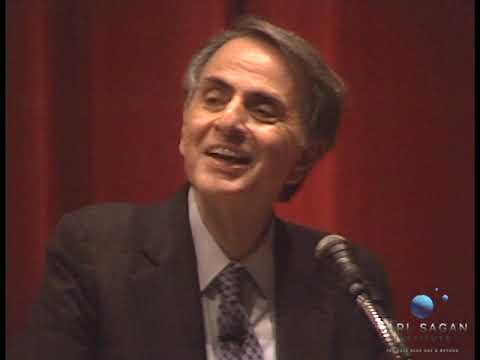
“…every human culture has considered itself at the center of the universe.”Cornell University symposium lecture, 1994 · 14:01
The lesson
A recurring human habit, Sagan argues, is to imagine ourselves at the center: of the universe, of life, and of meaning. He says this is not peculiar to one society but a broad cultural pattern, and that science keeps testing it against reality rather than comfort12. The chapter’s demotions matter because they are not insults; they are corrections that replace flattering appearances with better-supported explanations.
The first great demotion is astronomical. The sky makes it seem as if everything circles us, so geocentrism felt natural, but observation overturned it. Sagan points to Galileo’s observations of Venus as a decisive case: its changing phases fit a sun-centered system and contradict an earth-centered one3. From there the lesson widens: Earth is not a cosmic throne but one ordinary world in a vast setting, a small planet seen from afar as only a tiny point45.
Modern astronomy extends that demotion beyond the solar system. Earth is one planet among many, and even from space much of what we care about most is not obvious at a glance6. Sagan stresses both our smallness and our inclusion in a much larger story: we live in a galaxy beyond ordinary intuition, and scientific inquiry lets us learn about origins in that immense setting rather than rely on myth or assumption78.
A second major demotion comes from biology. In Sagan’s account, people long compiled lists of human traits supposed to set us absolutely apart from other animals, but Darwin undermined that confidence by placing us within nature rather than outside it9. The point is not that humans are meaningless; it is that human exceptional claims should be examined the same way geocentric claims were examined: by evidence, not by tradition or vanity.
Sagan treats these demotions as a discipline of thought. Since intuition and culture easily pull us back toward self-importance, we need a style of inquiry that combines openness with skepticism and is willing to change its mind when the evidence changes1011. On this view, the Copernican perspective is not just a fact about astronomy; it is a method for thinking clearly about our place in the universe and about any claim that flatters us too much.
5 principles from Carl Sagan
Test flattering ideas against evidence
Ideas that place humans at the center often feel natural, but feeling natural is not the same as being true. When a claim supports our importance, examine it especially carefully and ask what observations could prove it wrong.
“…every human culture has considered itself at the center of the universe.”
Let observation outrank appearance
The heavens appear to move around Earth, yet careful observation showed otherwise. In your own reasoning, prefer models that explain the evidence, even when they conflict with everyday intuition.
“Now, that kind of motion is exactly what Galileo found Venus to do when he looked at it with the first telescope several hundred years ago. And Galileo found that the waxing and waning, the changing from crescent to full, back to crescent of Venus did exactly what the sun centered hypothesis predicted and not at all what the earth centered hypothesis predicted.”
See Earth as one world among many
A planetary perspective shrinks arrogance and sharpens judgment. Thinking of Earth as a small world in a vast cosmos can change what questions you ask and what counts as significant evidence.
“It's a pale blue dot.”
Treat human exceptionalism as a hypothesis, not a starting point
Claims that humans stand wholly apart from the rest of life have a long history, but they should not be assumed. Apply the same critical standards to claims about human uniqueness that you would apply to any scientific claim.
“And you know the list. No one else has altruism, compassion. No other animal loves their young. Nobody else can foresee the future consequences of present actions. Nobody else has art or music. Nobody else can use tools. Nobody else can make tools. And this list, it goes on and on, is essentially agreed to by Plato, Aristotle, Saint Augustine, Saint Thomas Aquinas, Hobbes, Locke, all the great figures in philosophy with the single exception of David Hume, hats off to him, bought into by all scientists, including highly skeptical ones up until the year 1859, bought into, of course, by all the religious leaders of at least the Western religions, especially the Judeo Christian Islamic religion.”
Balance openness with skepticism
You should be willing to consider large possibilities, but not surrender standards of evidence. This balance helps prevent both gullibility and dogmatism.
“I don't want you to think that, this openness to to speculative ideas is untempered in Phil Morrison's personality. There is also a very appropriate dose of scientific skepticism, which you can see in many different areas, his famous remark, I will believe a black hole when I see one, is an example. And it is exactly the tension between this openness and the skepticism, which I think is is one of Phil's great virtues, one well worth emulating if we can.”
In his own words
The quotes behind the lesson, word for word from the transcripts. Numbers match the lesson above.
“…every human culture has considered itself at the center of the universe.”
“The universe has no obligation to conform to our conceit.”
“Now, that kind of motion is exactly what Galileo found Venus to do when he looked at it with the first telescope several hundred years ago. And Galileo found that the waxing and waning, the changing from crescent to full, back to crescent of Venus did exactly what the sun centered hypothesis predicted and not at all what the earth centered hypothesis predicted.”
“It's a pale blue dot.”
“And that not only all the planets went around the earth once every day. The earth was not imagined to rotate. But also the sun went around the earth. And that was a kind of astronomical egotism in which we thought we were splendid and all the other objects in the universe somehow secondary to the earth and its inhabitants. Well, what we have found is just the opposite that we are a very humdrum and ordinary locale in the universe.”
“It’s a blue and white planet, and beyond that hard to tell what’s happening, at least just from looking.”
“We live in a galaxy vast and awesome beyond ordinary imagining.”
“The great thing that is happening in our time is that we are able, through a method which can actually make some progress towards the real universe out there, to find out something about origins.”
“And you know the list. No one else has altruism, compassion. No other animal loves their young. Nobody else can foresee the future consequences of present actions. Nobody else has art or music. Nobody else can use tools. Nobody else can make tools. And this list, it goes on and on, is essentially agreed to by Plato, Aristotle, Saint Augustine, Saint Thomas Aquinas, Hobbes, Locke, all the great figures in philosophy with the single exception of David Hume, hats off to him, bought into by all scientists, including highly skeptical ones up until the year 1859, bought into, of course, by all the religious leaders of at least the Western religions, especially the Judeo Christian Islamic religion.”
“We have a weakness and scientists are creatures of the culture in which they swim…”
“I don't want you to think that, this openness to to speculative ideas is untempered in Phil Morrison's personality. There is also a very appropriate dose of scientific skepticism, which you can see in many different areas, his famous remark, I will believe a black hole when I see one, is an example. And it is exactly the tension between this openness and the skepticism, which I think is is one of Phil's great virtues, one well worth emulating if we can.”
Reflect
- What belief do you hold partly because it places you, your group, or your field in a privileged position? What evidence would genuinely count against it?
- Think of a time when appearances were persuasive but misleading. What helped you move from intuition to better evidence?
- How would your priorities change if you more consistently viewed Earth as one small world rather than the stage on which everything important happens?
Check your understanding
Go deeper
 Carl Sagan on the Great Demotions: Earth Is Not the Center1994 · 96 min · full transcript
 Carl Sagan on the Copernican Perspective: Joining the Universe1985 · 60 min · full transcript
 Carl Sagan on Earth as a Planet: A View from Space1977 · 60 min · full transcript
 Carl Sagan on Earth from Space: Signs of Life and Intelligence1993 · 127 min · full transcript
 Carl Sagan on Cosmology and God: The Mind of the Universe1988 · 52 min · full transcript