Baloney Detection
Democracy needs citizens who can tell knowledge from illusion.

“There's two kinds of dangers. One is what I just talked about, that we've arranged a society based on science and technology in which nobody understands anything about science and technology. And this combustible mixture of ignorance and power, sooner or later, is gonna blow up in our faces. I mean, who is running the science and technology in a democracy if the people don't know anything about it? And the second reason that I'm worried about this is that science is more than a body of knowledge. It's a way of thinking, a way of skeptically interrogating the universe with a fine understanding of human fallibility. If if we are not able to ask skeptical questions to interrogate those who tell us that something is true, to be skeptical of those in authority, then we're up for grabs for the next charlatan political or religious who comes ambling along.”Charlie Rose interview, 1995 · 3:24
The lesson
Sagan’s basic warning is political, not just intellectual: in a society shaped by science and technology, citizens cannot afford to be passive about evidence. He argues that ignorance becomes dangerous when public decisions involve tools and systems most people do not understand, because power without understanding invites disaster123. That is why baloney detection matters in a democracy: it is part of self-government, not a hobby for specialists.
For Sagan, science is not mainly a pile of facts but a disciplined habit of mind. He defines it as skeptical inquiry, a way to question claims while remembering how easily human beings fool themselves41. This also means resisting belief just because an idea is comforting, emotionally attractive, or culturally familiar; he treats belief without adequate evidence as a mistake and asks us to withhold assent until the case is strong57.
Astrology is one of his clearest examples of how weak ideas survive. It offers human-centered meaning, but it does so through claims so broad and flexible that almost anyone can see themselves in them, which makes the system hard to test and easy to accept8. Against this, Sagan contrasts a universe understood on its own terms rather than as we wish it to be, and he points to scientific progress as requiring precise measurement and the courage to accept unwelcome facts910.
That contrast works only because the world is intelligible. Sagan says science is possible because reality is neither frozen nor chaotic: enough changes happen to raise questions, but enough regularity exists for answers to be found11. Astronomy, at its best, moved from symbolic stories to physical reality, from projected meanings to lawful processes, and that shift is his model for leaving magical thinking behind12.
Still, baloney detection is not closed-mindedness. Sagan recommends a balance: be open to possibilities, including uncertain ones, while refusing to pretend certainty where evidence is missing1415. That combination of openness and skepticism is what he thinks public life needs, because many of our institutions and beliefs are human-made and therefore can be remade if citizens learn to think more clearly about reality1617.
5 principles from Carl Sagan
Treat skepticism as a civic duty
When science and technology shape public choices, citizens need more than trust in experts; they need enough understanding to evaluate claims and consequences. Apply this by asking what evidence supports a policy, what risks are being ignored, and who benefits if the public stays confused.
“There's two kinds of dangers. One is what I just talked about, that we've arranged a society based on science and technology in which nobody understands anything about science and technology. And this combustible mixture of ignorance and power, sooner or later, is gonna blow up in our faces. I mean, who is running the science and technology in a democracy if the people don't know anything about it? And the second reason that I'm worried about this is that science is more than a body of knowledge. It's a way of thinking, a way of skeptically interrogating the universe with a fine understanding of human fallibility. If if we are not able to ask skeptical questions to interrogate those who tell us that something is true, to be skeptical of those in authority, then we're up for grabs for the next charlatan political or religious who comes ambling along.”
Withhold belief until evidence is strong
A claim can feel meaningful, hopeful, or frightening without being well supported. In practice, notice when emotion is pulling you toward a conclusion, then pause and ask what would count as compelling evidence either way.
“What is faith? It is belief in the absence of evidence.”
Distrust vague claims that fit everyone
One sign of baloney is a statement so loose and personalized that almost anyone can recognize themselves in it. Test claims by asking whether they could be wrong in a clear way or whether they are built to survive every outcome.
“There are two ways to view the stars: as they really are and as we might wish them to be.”
Prefer hard truth to comforting illusion
Science advances when measurement and reality outrank loyalty to elegant stories or familiar beliefs. Use this by looking for precise checks on your assumptions and by being willing to revise a view that the facts do not support.
“He preferred the hard truth to his dearest illusions. That is the heart of science.”
Be open, but do not pretend certainty
Good judgment keeps two attitudes together: curiosity about what might be true and discipline about what has actually been shown. You can explore unusual ideas without affirming them before the evidence arrives.
In his own words
The quotes behind the lesson, word for word from the transcripts. Numbers match the lesson above.
“There's two kinds of dangers. One is what I just talked about, that we've arranged a society based on science and technology in which nobody understands anything about science and technology. And this combustible mixture of ignorance and power, sooner or later, is gonna blow up in our faces. I mean, who is running the science and technology in a democracy if the people don't know anything about it? And the second reason that I'm worried about this is that science is more than a body of knowledge. It's a way of thinking, a way of skeptically interrogating the universe with a fine understanding of human fallibility. If if we are not able to ask skeptical questions to interrogate those who tell us that something is true, to be skeptical of those in authority, then we're up for grabs for the next charlatan political or religious who comes ambling along.”
“The clearest prescription for disaster is for the public not to know about science and technology.”
“Any definition of national security, it seems to me, has to involve the well-being of the citizens, economic well-being, a positive sense of the future based not on path but on real expectations, education, especially in science and technology. The scientific illiteracy of Americans in general is scandalous. Every day there are significant decisions made in Washington involving science and technology which…”
“…science is more than a body of knowledge. It's a way of thinking…”
“What is faith? It is belief in the absence of evidence.”
“What I wanted to say is going back to the question of adequate evidence on something that's emotionally really pulling you. I lost both my parents about twelve or fifteen years ago, and I had a great relationship with them. I really miss them. I would love to believe that their spirits were around somewhere, and I'd give almost anything to spend five minutes a year with them.”
“They're consciously designed to be so vague that it could apply to anybody.”
“There are two ways to view the stars: as they really are and as we might wish them to be.”
“He preferred the hard truth to his dearest illusions. That is the heart of science.”
“And those countless suns all obey natural laws, some of which are already known to us. How did we discover that there are such laws? If we lived on a planet where nothing ever changed, there wouldn't be much to do. There'd be nothing to figure out, there'd be no impetus for science. And if we lived in an unpredictable world where things changed in random or very complex ways, we wouldn't be able to figure things out, and again there'd be no such thing as science. But we live in an in-between universe.”
“He speculated on the mountains, valleys, craters, climate, and possible inhabitants of the Moon. Before Kepler, astronomy had little connection with physical reality. With Kepler came the idea that a physical force moves the planets in their orbits.”
“It is exactly the tension between this openness and the skepticism, which I think is is one of Phil's great virtues, one well worth emulating if we can.”
“I don't want you to think that, this openness to to speculative ideas is untempered in Phil Morrison's personality. There is also a very appropriate dose of scientific skepticism, which you can see in many different areas, his famous remark, I will believe a black hole when I see one, is an example. And it is exactly the tension between this openness and the skepticism, which I think is is one of Phil's great virtues, one well worth emulating if we can.”
“There is nothing about them that cannot be unmade by people.”
“Another is you look at people who are called science reporters for the networks, and you find that, they don't report science. It's not scientific ideas, theories, discoveries. It's almost entirely, medicine and technology. There ought to be a medical reporter. There ought to be a technology reporter, but there ought to be a science reporter. I think the general level of teaching science in the in the public schools is woefully low. I think scientific attitudes of thought, including skepticism of received wisdom, is desperately needed in various social, economical, political, and even religious aspects of our society and isn't there.”
Reflect
- Where in your work or media diet do you encounter claims that are persuasive mainly because they are vague, flattering, or hard to disprove?
- Think of a belief you want to be true. What evidence would justify holding it, and what evidence would make you scale back your confidence?
- What public issue you care about most depends on scientific or technical understanding, and how could you become a less passive citizen on that issue?
Check your understanding
Go deeper
 Carl Sagan on Science and Pseudoscience: The Demon-Haunted World1995 · 20 min · full transcript
 Carl Sagan on The Harmony of the Worlds: astrology, science, and Kepler1980 · 59 min · full transcript
 Carl Sagan on Scientific Illiteracy: A Baloney Detection Kit1989 · 57 min · full transcript
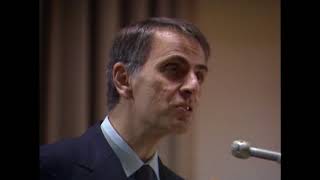 Carl Sagan on the Copernican Perspective: Joining the Universe1985 · 60 min · full transcript
- What did Carl Sagan say science is, and why is skepticism important?
- What did Carl Sagan say about magical thinking and why it is dangerous?
- What did Carl Sagan say about scientific illiteracy in America?
- What did Carl Sagan say about balancing openness and skepticism?
- What did Carl Sagan say about Kepler and the physical reality of astronomy?
- What did Carl Sagan say about Phil Morrison's skepticism?