Carl Sagan on Pale Blue Dot
Sagan treats the Pale Blue Dot as a scientific and moral perspective shift: Earth is small and ordinary in the cosmos, yet uniquely precious to us and therefore a reason for humility, unity, and long-term responsibility.
- The Pale Blue Dot shows Earth as tiny, ordinary, and not the center of anything.
- For Sagan, that smallness is not depressing; it corrects human conceit and widens our perspective.
- From far away, Earth’s divisions fade and the planet appears as one shared home.
- That perspective implies responsibility: learn more, reduce ignorance, and protect our fragile world against dangers we can understand and address.
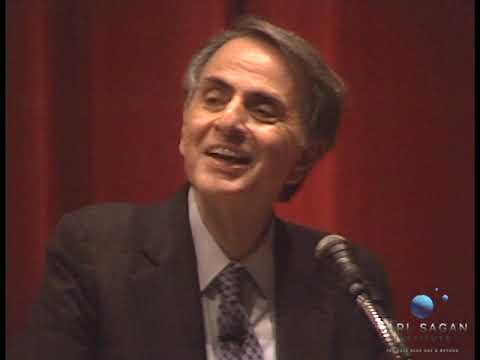
“Well, these pictures were taken in part due to the excellent estimates of exposure times by Carolyn Porco. And, I'd like to show you in the last slide due to motion. The earth momentarily, no chauvinistic implications. This is just foreground optics. The earth in a sunbeam. Wait a little bit that it's not in the sunbeam. So there it is. I mean, take a look. It's a pale blue dot.”Cornell University symposium lecture, 1994 · 1:01:32
Pale Blue Dot means Earth is tiny, not central
Sagan’s basic point is straightforward: the image matters because it reveals our actual scale. Earth is a tiny world in a vast setting, not the fixed center around which everything else is arranged123.
He connects that image to a larger scientific lesson. Again and again, inquiry has shown that human beings are not cosmically privileged, and that what feels natural from our local viewpoint can still be false45.
That is why the dot is so powerful for him. It condenses the Copernican perspective into a single sight: our world is real and important to us, but ordinary in the larger universe56.
“Well, these pictures were taken in part due to the excellent estimates of exposure times by Carolyn Porco. And, I'd like to show you in the last slide due to motion. The earth momentarily, no chauvinistic implications. This is just foreground optics. The earth in a sunbeam. Wait a little bit that it's not in the sunbeam. So there it is. I mean, take a look. It's a pale blue dot.”Cornell University symposium lecture, 1994 · full transcript →
Its main moral lesson is humility
Sagan uses the Pale Blue Dot to push back against human conceit. He thinks people repeatedly assume that the universe should validate our importance, but nature does not bend to that expectation74.
Humility, for him, is not self-hatred or passivity. It is the discipline of seeing things as they are, even when that strips away flattering illusions about our special status57.
This is also why he treats science as liberating. If we let evidence rather than vanity guide us, we gain a truer sense of our place and a better basis for judgment8.
From a distance, Earth becomes one world
The Pale Blue Dot does not erase human life; it reframes it. Seen from far away, Earth is a blue-and-white planet, and many of the distinctions that dominate politics and identity become visually irrelevant1011.
This is one reason Sagan thinks the image has unusual ethical force. It makes clear that borders are not features of the planet itself and that the whole Earth is the shared stage of human life1112.
At the same time, the distant view reminds us how little can be inferred from appearance alone. Earth can look simple from afar even while holding oceans, life, intelligence, and civilization, which makes the planet both modest in scale and extraordinary in significance to us1014.

“The planet is one, and the national boundaries don't count at all.”Bunyan Lecture at Wheaton College, 1993 · full transcript →
The image points to fragility and practical responsibility
For Sagan, the Pale Blue Dot is not just poetic. It is a practical warning that a small world inhabited by a powerful technological species can be endangered by its own ignorance1516.
That is why he ties cosmic perspective to scientific seriousness. We have not fully mapped nearby dangers, and failing to understand the environment around Earth is, in his view, reckless1715.
He also insists that many threats are not fate. Human arrangements can be changed by human action, and public understanding of science is essential if a technological civilization is going to survive its own power1819.
Pale Blue Dot also supports exploration beyond Earth
Sagan does not take Earth’s smallness as a reason to stay home forever. He sees exploration as a natural expression of a scientific species trying to understand its surroundings and extend its future820.
In that spirit, the Pale Blue Dot argument includes prudence as well as wonder. Since Earth is vulnerable, he thinks it is wise over the long term not to keep all of humanity’s prospects confined to a single world.
Still, his case is not escapist. The point is not that Earth is disposable, but that loving this small world should make us both better stewards of it and more thoughtful about preparing for the longer future17.
Sagan on pale blue dot, in his own words
“…what we have found is just the opposite that we are a very humdrum and ordinary locale in the universe.”
“The planet is one, and the national boundaries don't count at all.”
“We live in a galaxy vast and awesome beyond ordinary imagining.”
Where to watch
 Carl Sagan on Human Future in Space: Pale Blue Dot and our cosmic place1994 · 90 min · full transcriptBest direct discussion of the Pale Blue Dot as a perspective on fragility, risk, exploration, and human survival.
 Carl Sagan on the Great Demotions: Earth Is Not the Center1994 · 96 min · full transcriptShows how Pale Blue Dot fits Sagan’s larger theme of the great demotions of human self-importance.
 Carl Sagan on Earth from Space: Signs of Life and Intelligence1993 · 127 min · full transcriptExplains what Earth looks like from space and why the planetary view weakens borders while sharpening awareness of life.
 Carl Sagan on Earth as a Planet: A View from Space1977 · 60 min · full transcriptBuilds the scientific perspective behind the image by treating Earth as one ordinary planet among many.
 Carl Sagan on the Copernican Perspective: Joining the Universe1985 · 60 min · full transcriptDeepens the Copernican side of the argument: humility, skepticism, and our place in a non-human-centered universe.
Questions people ask
- What did Carl Sagan say Galileo discovered about Venus?
- What did Carl Sagan say about balancing openness and skepticism?
- What did Carl Sagan say about human arrogance and our place in the universe?
- What did Carl Sagan say about why humans should build colonies elsewhere in space?
- What did Carl Sagan say we know about knowledge and ignorance?
- Why does Carl Sagan say he is suspicious that only one place has life?
Sources
Every quote above, word for word from the transcripts. Numbers match the text.
“It's a pale blue dot.”
“We are on the debris, the little tiny chunks of incidental matter in the inside of the solar system.”
“We live in a galaxy vast and awesome beyond ordinary imagining.”
“…every human culture has considered itself at the center of the universe.”
“…what we have found is just the opposite that we are a very humdrum and ordinary locale in the universe.”
“And that not only all the planets went around the earth once every day. The earth was not imagined to rotate. But also the sun went around the earth. And that was a kind of astronomical egotism in which we thought we were splendid and all the other objects in the universe somehow secondary to the earth and its inhabitants. Well, what we have found is just the opposite that we are a very humdrum and ordinary locale in the universe.”
“The universe has no obligation to conform to our conceit.”
“I think we are a scientific species.”
“It’s a blue and white planet, and beyond that hard to tell what’s happening, at least just from looking.”
“The planet is one, and the national boundaries don't count at all.”
“…the perspective of seeing the earth as a dot…”
“You cannot tell just by looking at the stars which have planets, which planets are inhabited, or anything of that sort.”
“This mixture of ignorance and power is gonna blow up in our face sooner or later.”
“Well, you know, ultimate ultimate is a big word. I would say one thing that I've learned is how little we know, Is how the the frontiers of... You can think of of us as standing on a little island of knowledge surrounded by an enormous ocean of ignorance. And every year, we sort of eke out just a little more land and prevent the ocean of ignorance from swamping us. And, that's all that stands between us and and drowning. And I I think it's fair for a technical civilization, agricultural economy, where not just entertainment but the difference between life and death, look at medicine for example, is knowledge. We have to be much more serious about knowledge.”
“The thing is, Milton, that, we have not yet inventoried the near earth world.”
“There is nothing about them that cannot be unmade by people.”
“The clearest prescription for disaster is for the public not to know about science and technology.”
“So we are in a very preliminary way trying to say hello to the cosmos.”
How this guide was made: drafted with AI from the full transcripts of the recordings cited, then checked: every quotation must match a transcript word for word and be the speaker's own words, and an independent review gates accuracy. Methodology and corrections.