Carl Sagan on Copernican Perspective
For Sagan, the Copernican Perspective is the habit of accepting that humans are not the cosmic center and finding in that fact a deeper humility, freedom, and seriousness about evidence.
- The Copernican Perspective says Earth and humanity are not the center of the universe.
- Science advances by testing appearances and conceit against evidence, as with Galileo’s observations of Venus.
- Sagan thinks our apparent smallness is not depressing but freeing: it joins us to a vast universe.
- This perspective also demands skepticism, especially toward claims that flatter human importance without evidence.
- Seen from space, Earth’s divisions shrink, and human responsibility to one planet becomes harder to ignore.

“Now, that kind of motion is exactly what Galileo found Venus to do when he looked at it with the first telescope several hundred years ago. And Galileo found that the waxing and waning, the changing from crescent to full, back to crescent of Venus did exactly what the sun centered hypothesis predicted and not at all what the earth centered hypothesis predicted.”Royal Institution Christmas Lectures, 1977 · 15:44
The core idea: we are not the center
Sagan treats the Copernican Perspective as a direct challenge to the ancient human habit of putting ourselves in the middle of everything. He says cultures naturally imagined themselves at the center, but astronomy gradually showed that this was a mistake12.
The point is larger than the orbit of Earth around the Sun. Sagan sees heliocentrism as one of several great demotions in which science discovers that what feels central from our local point of view is often only local point of view23.
That is why he describes Earth not as a privileged cosmic throne but as a tiny world in an immense setting, a small planet in a galaxy far beyond ordinary intuition45.
Why Copernicus mattered: evidence over appearances
For Sagan, geocentrism seemed plausible because the sky appears to move around us. The achievement of Copernicus and Galileo was not just proposing a new arrangement of planets, but showing that appearances can mislead and that nature must be checked against observation62.
He highlights Galileo’s observation of the phases of Venus because it gave a clean test between two pictures of the world. Venus behaved the way the sun-centered model predicted and not the way the earth-centered model predicted, making the Copernican view a triumph of evidence over intuition6.
This becomes a model for scientific thinking in general: do not ask what flatters us or feels obvious; ask what the world is actually like37.
“Now, that kind of motion is exactly what Galileo found Venus to do when he looked at it with the first telescope several hundred years ago. And Galileo found that the waxing and waning, the changing from crescent to full, back to crescent of Venus did exactly what the sun centered hypothesis predicted and not at all what the earth centered hypothesis predicted.”Royal Institution Christmas Lectures, 1977 · full transcript →
Humbling does not mean meaningless
Sagan does not treat the loss of cosmic centrality as a tragedy. He thinks the discovery that we are ordinary in location can be liberating, because it replaces comforting illusion with a more mature sense of belonging to the universe25.
He pairs smallness with possibility. Human significance does not come from occupying the middle of creation, but from asking brave questions and pursuing honest answers about the larger reality we inhabit8.
That is why he can move from Earth’s tiny scale to a tone of wonder rather than despair. We are beginning to speak outward, to study other worlds, and to place ourselves within a much broader cosmic story910.
The Copernican Perspective expands beyond astronomy
Sagan treats heliocentrism as the start of a wider pattern. Once science removed Earth from the center of the cosmos, other sciences kept narrowing human claims to uniqueness, including the recognition of our kinship with other animals and the possibility that life may not be confined to one world.
He is especially suspicious of claims that the only life and intelligence in the universe must be here, because that conclusion resembles older forms of human conceit. The Copernican habit is to distrust arguments that make us uniquely important for no evidential reason3.
At the same time, he insists that openness must be disciplined by proof. Possibilities about extraterrestrial life are worth exploring, but belief should not outrun evidence7.
What this perspective asks of us now
Seen from space, Earth looks unified and fragile. Sagan stresses that many of the boundaries humans care about disappear at planetary scale, while the planet itself stands out as one connected world144.
That shift in viewpoint has moral and civic force for him. A public that does not understand science is easier to mislead, less able to judge claims, and more likely to cling to comforting errors about nature and ourselves15.
So the Copernican Perspective is not only a fact about planetary motion. It is a discipline of humility, skepticism, and shared planetary identity: accept that the universe does not revolve around us, then act responsibly on the knowledge that this small world is our common home314.
Sagan on copernican perspective, in his own words
“…what we have found is just the opposite that we are a very humdrum and ordinary locale in the universe.”
“The universe has no obligation to conform to our conceit.”
Where to watch
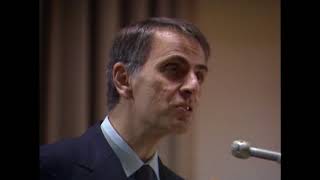 Carl Sagan on the Copernican Perspective: Joining the Universe1985 · 60 min · full transcriptHis most direct statement of the Copernican Perspective as a broader habit of humility, openness, and skepticism.
 Carl Sagan on the Great Demotions: Earth Is Not the Center1994 · 96 min · full transcriptBest single lecture on the great demotions, showing how heliocentrism fits into a longer story of human decentering.
 Carl Sagan on Earth as a Planet: A View from Space1977 · 60 min · full transcriptShows how planetary science and observations like Venus’s phases make the Copernican view concrete.
 Carl Sagan on Earth from Space: Signs of Life and Intelligence1993 · 127 min · full transcriptApplies the same perspective from space, showing Earth as one planet and challenging human conceit.
 Carl Sagan on Origins of Science: from wonder to knowledge1980 · 58 min · full transcriptPlaces the Copernican shift in the deeper history of science, wonder, and natural explanation.
Questions people ask
- What did Carl Sagan say Galileo discovered about Venus?
- What did Carl Sagan say about balancing openness and skepticism?
- What did Carl Sagan say about claims that only humans have special traits?
- What did Carl Sagan say about science reporters and science teaching?
- Why does Carl Sagan say he is suspicious that only one place has life?
- What did Carl Sagan say about Phil Morrison's skepticism?
Sources
Every quote above, word for word from the transcripts. Numbers match the text.
“…every human culture has considered itself at the center of the universe.”
“…what we have found is just the opposite that we are a very humdrum and ordinary locale in the universe.”
“The universe has no obligation to conform to our conceit.”
“It's a pale blue dot.”
“We live in a galaxy vast and awesome beyond ordinary imagining.”
“Now, that kind of motion is exactly what Galileo found Venus to do when he looked at it with the first telescope several hundred years ago. And Galileo found that the waxing and waning, the changing from crescent to full, back to crescent of Venus did exactly what the sun centered hypothesis predicted and not at all what the earth centered hypothesis predicted.”
“Belief in the absence of evidence maybe exists in religion, but it shouldn’t exist in science.”
“We make our world significant by the courage of our questions and by the depth of our answers.”
“So we are in a very preliminary way trying to say hello to the cosmos.”
“We are ready at last to set sail for the stars.”
“The planet is one, and the national boundaries don't count at all.”
“The clearest prescription for disaster is for the public not to know about science and technology.”
How this guide was made: drafted with AI from the full transcripts of the recordings cited, then checked: every quotation must match a transcript word for word and be the speaker's own words, and an independent review gates accuracy. Methodology and corrections.
