Carl Sagan on Evolution
Sagan sees evolution as a central scientific demotion of human vanity: it explains life’s complexity through natural processes and places us firmly within, not above, the rest of nature.
- Evolution is one of the great blows to human self-importance.
- Human beings are continuous with other animals, not a separate creation.
- Complexity in life does not require a designer; science should follow evidence.
- Human intelligence is an evolved capacity, extended by culture and stored knowledge.
- The right attitude is openness joined to skepticism, not belief without evidence.
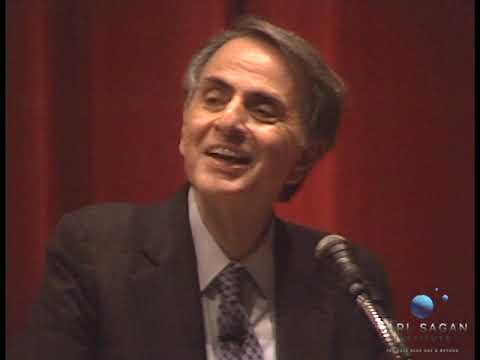
“…every human culture has considered itself at the center of the universe.”Cornell University symposium lecture, 1994 · 14:01
Evolution is part of Sagan’s attack on human exceptionalism
Sagan treats evolution as one of the major revolutions that knocked humans out of the privileged center we long assigned ourselves. He says cultures repeatedly imagined themselves at the center, and he places Darwin in the same broad pattern as Copernicus: science corrects flattering illusions about our special status.12
For him, this matters because older views drew a sharp line between humans and the rest of life. He points to the long tradition of claiming that no other animals share our supposedly unique capacities, and presents Darwin’s break with that tradition as a profound reordering of how we see ourselves.
“…every human culture has considered itself at the center of the universe.”Cornell University symposium lecture, 1994 · full transcript →
Natural selection explains complexity without invoking design
Sagan rejects the idea that biological complexity automatically implies a designer. His basic rule is that science should not permit belief where evidence is absent, and that applies to claims about life’s origins and structure as much as to anything else.4
That does not mean closing off inquiry. It means explaining living complexity through testable natural processes rather than treating design as the default answer. This is part of his larger scientific style: be open to possibilities, but discipline that openness with skepticism.
Human intelligence is an evolved achievement, not an escape from evolution
Sagan describes intelligence in practical evolutionary terms: the ability to connect many facts and understand reality well enough to act effectively in the world. On this view, the human mind is not a supernatural exception but a natural development with distinctive strengths.7
What makes humans unusual, for Sagan, is not that we stand outside evolution, but that evolution produced a creature able to store information beyond the body. Genes were once the main storehouse of adaptive information; later brains took on more of that role; with humans, books, computers, and other media extend memory and learning even further.89
This lets Sagan explain both continuity and difference at once. We are animals with an evolutionary history, yet culture dramatically amplifies what evolution made possible.89

“History of life on this planet, the organisms had almost all the information they had to deal with in their genes, hereditary information, instinct. Then about maybe 100 million years ago, a little longer ago than that, there came to be a reptile that for the first time in the history of life had more information in its brains than in its genes, and that was a major step, symbolically, in the evolution of life on this planet. Well, now we have an organism — us — which can store more information outside the body altogether than inside the body, and that's in books and computers and television, video cassettes, and that extraordinarily expands our ability to understand what's happening and to manipulate or control our...”The Tonight Show Starring Johnny Carson, 1977 · full transcript →
Evolution supports the Copernican view that we are ordinary, not central
Sagan’s larger worldview is that science repeatedly reveals us to be less central than we imagined. Evolution fits this pattern by showing that human beings arose within the same natural history as other organisms, not as the preordained goal of the universe.110
He applies the same caution to life and intelligence elsewhere. Once you recognize how often human conceit has misled us, it becomes harder to assume that life, mind, or significance are confined to one tiny world. That suspicion of human centrality is one reason evolution matters so much in his thought.112
“Many of these stars are more or less like the sun. As I was saying before, it now looks as if planets are a frequent, if not invariable accompaniment of star formation. And again, I ask you to consider the contention that the only life and intelligence in the universe is, let's say, that dot. No. Not that one. That one right there. See? That's it. Nowhere else. Maybe hard to extrapolate from one example, and one example is all we have, but this is so resonant with the other human conceits I tried to outline in the great demotions that I am suspicious of it for that reason alone.”Cornell University symposium lecture, 1994 · full transcript →
The practical lesson is intellectual humility and better judgment
For Sagan, evolution is not just a biological theory; it trains a habit of mind. It teaches that our intuitions about our own importance are unreliable, and that understanding reality requires scientific thinking rather than comforting stories.213
That is why he connects science literacy with civic survival. A society that does not understand science is vulnerable to confusion, vanity, and bad decisions, while a more scientific public is better equipped to face the consequences of the powers evolution and culture have given us.1415
His ideal stance is neither cynicism nor credulity. It is a combination of curiosity, openness, and disciplined skepticism, the same posture he recommends across questions about life, intelligence, and our place in the cosmos.4
Sagan on evolution, in his own words
“…every human culture has considered itself at the center of the universe.”
“…it's our ability to put a great many facts together…”
“…we have information stored outside of our bodies…”
Where to watch
 Carl Sagan on Extraterrestrial Life: Science, Skepticism, and Humility1996 · 14 min · full transcriptBest for Sagan’s direct case that science should explain life without belief unsupported by evidence.
 Carl Sagan on the Great Demotions: Earth Is Not the Center1994 · 96 min · full transcriptShows how Sagan places Darwin and evolution among the great scientific demotions of human vanity.
 Carl Sagan on Human Intelligence: How We Evolved to Think1977 · 14 min · full transcriptExplains how Sagan thinks human intelligence itself emerged through evolution and cultural extension.
 Carl Sagan on the Copernican Perspective: Joining the Universe1985 · 60 min · full transcriptConnects evolution to the broader Copernican perspective of humility, openness, and skepticism.
 Carl Sagan on Earth from Space: Signs of Life and Intelligence1993 · 127 min · full transcriptBroadens evolution into Sagan’s larger argument that the universe does not conform to human conceit.
Questions people ask
- What did Carl Sagan say about balancing openness and skepticism?
- What did Carl Sagan say about claims that only humans have special traits?
- What did Carl Sagan say about science reporters and science teaching?
- Why did Carl Sagan think finding extraterrestrial life would be important for humanity?
- Why does Carl Sagan say he is suspicious that only one place has life?
- What did Carl Sagan say about Phil Morrison's skepticism?
Sources
Every quote above, word for word from the transcripts. Numbers match the text.
“…every human culture has considered itself at the center of the universe.”
“The universe has no obligation to conform to our conceit.”
“Belief in the absence of evidence maybe exists in religion, but it shouldn’t exist in science.”
“…it's our ability to put a great many facts together…”
“…we have information stored outside of our bodies…”
“History of life on this planet, the organisms had almost all the information they had to deal with in their genes, hereditary information, instinct. Then about maybe 100 million years ago, a little longer ago than that, there came to be a reptile that for the first time in the history of life had more information in its brains than in its genes, and that was a major step, symbolically, in the evolution of life on this planet. Well, now we have an organism — us — which can store more information outside the body altogether than inside the body, and that's in books and computers and television, video cassettes, and that extraordinarily expands our ability to understand what's happening and to manipulate or control our...”
“And that not only all the planets went around the earth once every day. The earth was not imagined to rotate. But also the sun went around the earth. And that was a kind of astronomical egotism in which we thought we were splendid and all the other objects in the universe somehow secondary to the earth and its inhabitants. Well, what we have found is just the opposite that we are a very humdrum and ordinary locale in the universe.”
“Many of these stars are more or less like the sun. As I was saying before, it now looks as if planets are a frequent, if not invariable accompaniment of star formation. And again, I ask you to consider the contention that the only life and intelligence in the universe is, let's say, that dot. No. Not that one. That one right there. See? That's it. Nowhere else. Maybe hard to extrapolate from one example, and one example is all we have, but this is so resonant with the other human conceits I tried to outline in the great demotions that I am suspicious of it for that reason alone.”
“I think we are a scientific species.”
“The clearest prescription for disaster is for the public not to know about science and technology.”
“There is nothing about them that cannot be unmade by people.”
How this guide was made: drafted with AI from the full transcripts of the recordings cited, then checked: every quotation must match a transcript word for word and be the speaker's own words, and an independent review gates accuracy. Methodology and corrections.