Yuval Noah Harari on Sapiens
Harari sees Sapiens as the story of how humans came to dominate the planet by building large-scale cooperation through shared fictions rather than through individual strength alone.
- Humans rule the world because they cooperate flexibly in huge numbers, not because each person is strongest or smartest.
- That cooperation depends on imagination: shared stories about money, nations, laws, gods, and rights.
- For Harari, the Cognitive Revolution is the turning point that made this possible.
- These stories are powerful and useful, but they are also fragile and can mislead us.
- The same Sapiens logic matters now because new technologies like AI may create and manipulate stories at unprecedented scale.
Sapiens begins with a claim about collective power
Harari’s central claim is that the human advantage is not mainly about individual intelligence, strength, or virtue. It is about what humans can do together. He argues that the decisive difference between us and other animals appears at the collective level, where humans can organize in ways no other species can match.12
This is why Sapiens, in his view, is not simply a book about human nature in the abstract. It is an explanation of human dominance. Humans became the ruling species because they can cooperate both flexibly and at very large scale, combining two capacities that other animals do not combine in the same way.23
The Cognitive Revolution made large human societies possible
Harari frames early human history around the Cognitive Revolution. He marks it as the beginning of history in the strong sense, because this is when Homo sapiens developed the capacity to create and spread the kinds of ideas that let strangers coordinate their behavior.4
The key ability is imagination. Humans can invent and believe fictional stories, and these stories create common rules, norms, and values across large populations. That is the mechanism behind tribes becoming kingdoms, markets, religions, and states.567
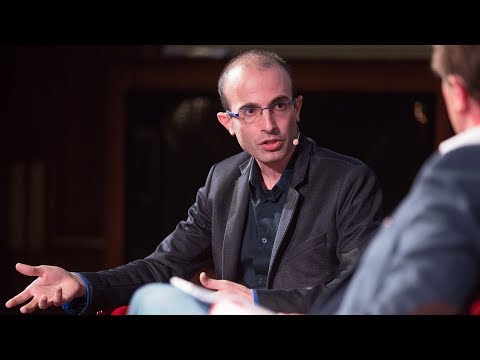
“…history begins about 70,000 years ago with the Cognitive Revolution…”Intelligence Squared talk, 2014 · full transcript →
Sapiens is not just a triumph story
Harari does not present human success as simple progress. The very stories that make civilization possible can also generate conflict, delusion, and rigidity. Many of the forces that organize society are powerful precisely because people treat them as natural or eternal when they are historically created.1516
That makes civilization both powerful and brittle. Harari stresses that human systems can achieve extraordinary scale, yet they remain vulnerable because they depend on fragile networks of trust and belief. Our species is therefore strong and unstable at the same time.17
He also suggests that science gives humans immense power, but not a built-in answer about what goals that power should serve. Meaning, values, and justification come from another domain, which is why the stories societies tell still matter so much.18
Why Sapiens still matters in the age of AI
Harari applies the same framework to the present. If human history has been shaped by stories that coordinate mass cooperation, then any technology that can generate, spread, or optimize stories changes the terms of civilization. This is why he sees AI as a historic rupture rather than just another tool.192021
His worry is not only automation. It is that humans may lose control over systems of information, decision-making, and persuasion that become too complex to understand. In that sense, the old Sapiens question remains the key one: what kinds of stories will organize human life, and who or what will be producing them.2219
For an individual reader, the practical lesson is to become better at distinguishing reality from the stories layered on top of it, and to create space for reflection instead of being swept along by information flows. Harari explicitly urges less passive consumption and more reflection.
Harari on sapiens, in his own words
“…history begins about 70,000 years ago with the Cognitive Revolution…”
Where to watch
 Yuval Noah Harari on Human Cooperation: Why We Run the World2015 · 17 min · full transcriptBest short introduction to Harari’s core Sapiens thesis: human dominance comes from flexible mass cooperation built on shared fictions.
 Yuval Noah Harari on Human Stories and Cooperation: Sapiens Talk2015 · 79 min · full transcriptA fuller Sapiens lecture that expands the dual-reality idea and applies it to religion, rights, nations, and conflict.
 Yuval Noah Harari on Myths and Civilization: Why Stories Hold Societies Together2014 · 87 min · full transcriptUseful for seeing how Harari places Sapiens inside his larger story of the Cognitive, Agricultural, and Scientific Revolutions.
 Yuval Noah Harari on Fictional Stories: Civilization Is Fragile2023 · 42 min · full transcriptShows how the classic Sapiens argument leads to Harari’s later view that civilization is powerful but fragile.
 Yuval Noah Harari on AI and Human Futures: Urgent Warnings2024 · 106 min · full transcriptConnects the Sapiens framework on stories and cooperation to Harari’s warning that AI can produce and manipulate narratives itself.
Questions people ask
- What did Yuval Noah Harari say about human rights?
- What did Yuval Noah Harari say about imagination and human cooperation?
- What did Yuval Noah Harari say about stories and the meaning of life?
- What did Yuval Noah Harari say about why AI is different from previous technologies?
- Why did Yuval Noah Harari say humans live in a dual reality?
- How can society inoculate itself against toxic myths, according to Yuval Noah Harari?
Sources
Every quote above, word for word from the transcripts. Numbers match the text.
“The real difference between humans and all other animals is not on the individual level; it's on the collective level.”
“Humans control the planet because they are the only animals that can cooperate both flexibly and in very large numbers.”
“Humans are the only animals that can combine the two abilities.”
“…history begins about 70,000 years ago with the Cognitive Revolution…”
“We can cooperate flexibly with countless numbers of strangers, because we alone, of all the animals on the planet, can create and believe fictions, fictional stories.”
“What enables us alone, of all the animals, to cooperate in such a way? The answer is our imagination. We can cooperate flexibly with countless numbers of strangers, because we alone, of all the animals on the planet, can create and believe fictions, fictional stories. And as long as everybody believes in the same fiction, everybody obeys and follows the same rules, the same norms, the same values.”
“…the ability to invent and believe fictional stories…”
“We humans control the world because we live in a dual reality.”
“…we live in a dual reality.”
“We humans, we also live in an objective reality. In our world, too, there are rivers and trees and lions and elephants. But over the centuries, we have constructed on top of this objective reality a second layer of fictional reality, a reality made of fictional entities, like nations, like gods, like money, like corporations. And what is amazing is that as history unfolded, this fictional reality became more and more powerful so that today, the most powerful forces in the world are these fictional entities.”
“Money, in fact, is the most successful story ever invented and told by humans, because it is the only story everybody believes.”
“…money is probably the most successful story ever told…”
“…human rights are a fiction, just like God and heaven.”
“Most legal systems today in the world are based on a belief in human rights. But what are human rights? Human rights, just like God and heaven, are just a story that we've invented. They are not an objective reality; they are not some biological effect about homo sapiens. Take a human being, cut him open, look inside, you will find the heart, the kidneys, neurons, hormones, DNA, but you won't find any rights.”
“…the laws governing our society, they are not eternal…”
“Much of what we take to be real is fictions.”
“…we are extremely powerful, and we are extremely fragile at one and the same time…”
“Science provides the power; religion tells us what to do with it…”
“It's the first technology in history that can make decisions by itself…”
“AI is different from any previous invention in history…”
“They underestimate the magnitude of the AI revolution. AI is nothing like print. It's nothing like the industrial revolution of the 19th century. It's far, far bigger. There is a fundamental difference between AI and the printing press or the steam engine or the radio or any previous technology we invented. The difference is it's the first technology in history that can make decisions by itself and that can create new ideas by itself. A printing press or a radio set could not write new music or new speeches and could not decide what to print and what to broadcast.”
“…the really big and interesting question is whether we'll be able to produce good stories to match this wonderful technology.”
How this guide was made: drafted with AI from the full transcripts of the recordings cited, then checked: every quotation must match a transcript word for word and be the speaker's own words, and an independent review gates accuracy. Methodology and corrections.