Yuval Noah Harari on Fascism & Totalitarianism
Harari sees fascism and totalitarianism less as relics of the 20th century than as recurring temptations that new data and AI systems could make far more powerful.
- Harari distinguishes fascism from ordinary nationalism: fascism demands exclusive loyalty to the nation.
- He thinks fascism is tempting because it makes people feel beautiful, important, and united.
- His modern warning is that AI, biotech, and data systems could give centralized power unprecedented ability to monitor and manipulate people.
- He argues democracy is most vulnerable when algorithms exploit fear, hate, vanity, and social division.
- For Harari, the danger is not only evil leaders but confused societies that hand authority to systems they no longer understand.

“…if somebody puts a mirror in front of your eyes that hides all your ugly bits and makes you see yourself as far more beautiful and far more important than you really are, just break that mirror.”TED talk, 2018 · 13:41
Fascism, for Harari, is nationalism made absolute
Harari’s basic distinction is that fascism is not just pride in a country or attachment to a shared culture. It is a politics that turns the nation into the highest value and pushes aside all other loyalties and identities. That is why he treats it as more dangerous than ordinary nationalism.1
He stresses that fascism works partly because it is emotionally rewarding. It offers people a flattering self-image by letting them feel fused with something grand, pure, and supremely important. In that sense, it is not attractive only to brutes; it can appeal to ordinary people who want dignity, certainty, and belonging.13
Its power comes from emotional seduction, not just force
Harari’s warning is that anti-democratic politics does not win only through open violence. It also wins by flattering the ego and channeling fear, hate, and vanity into a simple political identity. That is why he says the danger begins inside people’s emotions before it becomes institutional power.43
This helps explain why he often focuses on delusion and self-deception. He argues that societies are endangered when people prefer stories that make them feel strong or innocent over realities that are painful and complicated. In his view, destructive politics often begins with the refusal to face reality as it is.5
“…if somebody puts a mirror in front of your eyes that hides all your ugly bits and makes you see yourself as far more beautiful and far more important than you really are, just break that mirror.”TED talk, 2018 · full transcript →
Data and AI could make future dictatorship far more effective
Harari’s distinctive contribution is to connect old authoritarian temptations to new technology. He argues that the next struggle is not only over land, factories, or armies, but over data and the systems that interpret it. As authority shifts from human judgment to algorithms, centralized power could gain tools that earlier dictators never possessed.78
He is especially concerned about systems that know people intimately through bodies, behavior, and preferences. Once institutions can read and predict individuals at that level, they can guide choices in ways that feel helpful while steadily reducing autonomy. What looks like protection or convenience can become dependence and control.911
His starkest warning is that totalitarianism may no longer require constant visible repression. If power can operate from inside habits, desires, and decision-making, it can become more efficient and less noticeable than the police states of the past. That would make domination not only stronger but more seductive.1213
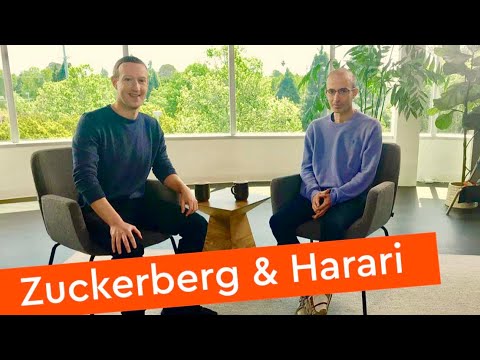
“And this is like the full fledged totalitarian dystopia, which could be so effective that people would not even resent it because they would be completely aligned with the values or the ideals of the... It's not 1984 where you need to torture people all the time. No. If you have agents inside their brain, you don't need the external secret police. So that's one danger. It's like the full-fledged totalitarianism. Then in places like the US, the more immediate danger or problem to think about is what is increasingly people refer to as surveillance capitalism. That you have this system that constantly interact with you and come to know you and it's all supposedly in your best interests.”Conversation with Mark Zuckerberg, 2017 · full transcript →
Democracy breaks down when information is poisoned
Harari argues that the central political battlefield is information. Democracies rely on some shared account of reality and institutions capable of checking what is true. When that information environment is flooded with manipulation, trust decays and citizens become easier to divide.1415
This is where AI sharply raises the stakes for him. Because AI can make decisions and generate content on its own, it can scale persuasion, deception, and emotional targeting beyond anything older media systems could do. The result is not just more propaganda, but a more adaptive and personalized form of it.816
That is why Harari often says the immediate danger is not machines acting alone, but humans turned against one another through algorithmic amplification. A fractured public is easier to control than a united one, and that makes democratic fragility a direct opening for authoritarian politics.154
His practical lesson is to resist both blind faith and flattering myths
Harari’s response is not to reject technology outright. He says tools can serve humane ends, but only if people remember that institutions and systems are supposed to serve human beings rather than reverse that relationship. The political question is who controls these systems, what values guide them, and whether citizens still retain meaningful agency.13
At the personal level, he puts weight on reflection, self-knowledge, and the ability to avoid being constantly manipulated. He warns that consuming endless information without reflection makes people easier to steer, while clearer awareness helps them resist emotional hacking. That inward discipline matters politically because propaganda first captures attention and feeling.181920
He also thinks modern life will demand adaptability. Societies facing rapid technological change need citizens able to rethink assumptions instead of clinging to rigid identities or nostalgic myths. That flexibility is one defense against movements that promise certainty by narrowing reality to a single collective story.2122
Harari on fascism & totalitarianism, in his own words
“…if somebody puts a mirror in front of your eyes that hides all your ugly bits and makes you see yourself as far more beautiful and far more important than you really are, just break that mirror.”
“And this is like the full fledged totalitarian dystopia, which could be so effective that people would not even resent it because they would be completely aligned with the values or the ideals of the... It's not 1984 where you need to torture people all the time. No. If you have agents inside their brain, you don't need the external secret police. So that's one danger. It's like the full-fledged totalitarianism. Then in places like the US, the more immediate danger or problem to think about is what is increasingly people refer to as surveillance capitalism. That you have this system that constantly interact with you and come to know you and it's all supposedly in your best interests.”
Where to watch
 Yuval Noah Harari on Fascism and Data: Why It’s So Tempting2018 · 18 min · full transcriptBest single overview of how Harari defines fascism and why modern data systems could make it newly dangerous.
 Yuval Noah Harari on AI and Democracy: Algorithms, Trust, Fragility2024 · 114 min · full transcriptShows how poisoned information, mistrust, and algorithmic division can hollow out democracy from within.
 Yuval Noah Harari on Dataism and Algorithms: Who Will Rule Next2017 · 58 min · full transcriptExplains why Harari thinks authority may shift from human judgment to algorithms.
 Yuval Noah Harari on AI, Biotech, and Meaning: Google Talk2018 · 59 min · full transcriptConnects AI and biotech to surveillance, manipulation, and the erosion of autonomy.
 Yuval Noah Harari on AI and Human Futures: Urgent Warnings2024 · 106 min · full transcriptClarifies why Harari sees AI as historically different from earlier technologies and politically destabilizing.
 Yuval Noah Harari on Pandemic, Politics & Society: Making Sense of Crisis2020 · 71 min · full transcriptApplies his concerns about authoritarian drift and trust to a real crisis context.
Questions people ask
- What did Yuval Noah Harari say about asking Google or Amazon what to do with your life?
- What did Yuval Noah Harari say about how people will come to trust algorithms with major life decisions?
- What did Yuval Noah Harari say about strong leaders and war?
- What did Yuval Noah Harari say about technology and compassion?
- What did Yuval Noah Harari say about why AI is different from previous technologies?
- What did Yuval Noah Harari warn about surveillance capitalism and totalitarianism?
Sources
Every quote above, word for word from the transcripts. Numbers match the text.
“Fascism makes people see themselves as belonging to the most beautiful and most important thing in the world -- the nation.”
“…if somebody puts a mirror in front of your eyes that hides all your ugly bits and makes you see yourself as far more beautiful and far more important than you really are, just break that mirror.”
“They hack our feelings of fear and hate and vanity, and then use these feelings to polarize and destroy democracy from within.”
“If something ultimately destroys us, it will be our own delusions, not the AIs.”
“…authority is beginning to slip away, to shift from us to other entities, and in particular, to shift from us to algorithms.”
“It's the first technology in history that can make decisions by itself…”
“An AI system that gets to know me in order to protect me…”
“And it won't happen overnight, like in some immediate revolution, it's a process. We'll ask Google or Amazon or Facebook or whatever, for their advice on more and more decisions, and if we see that indeed we get good recommendations better than the decisions we ourselves usually take, then we trust them more and more, trust them more with our data, and also trust them more with authority to make decisions for us.”
“And this is like the full fledged totalitarian dystopia, which could be so effective that people would not even resent it because they would be completely aligned with the values or the ideals of the... It's not 1984 where you need to torture people all the time. No. If you have agents inside their brain, you don't need the external secret police. So that's one danger. It's like the full-fledged totalitarianism. Then in places like the US, the more immediate danger or problem to think about is what is increasingly people refer to as surveillance capitalism. That you have this system that constantly interact with you and come to know you and it's all supposedly in your best interests.”
“The key is to remember that we created them to serve us, and not that we are here in order to serve them.”
“The problem is not with the humans; it's with the information.”
“The problem is that we are divided against each other, and the algorithms are using our weaknesses against us.”
“They underestimate the magnitude of the AI revolution. AI is nothing like print. It's nothing like the industrial revolution of the 19th century. It's far, far bigger. There is a fundamental difference between AI and the printing press or the steam engine or the radio or any previous technology we invented. The difference is it's the first technology in history that can make decisions by itself and that can create new ideas by itself. A printing press or a radio set could not write new music or new speeches and could not decide what to print and what to broadcast.”
“I would say that people should consume less information and spend more time reflecting…”
“No, I don't think that knowing yourself is necessarily all about intelligence. Certainly not in the narrow sense of intelligence. If you include emotional intelligence and so forth, then yes. But in the more narrow sense of IQ, I think this is not-- there are many very intelligent people in the world who don't know themselves at all, which is an extremely dangerous combination. Now some people explore themselves through therapy. Some use meditation. Some use art. Some use poems.”
“And maybe the two most important influences is that first it enabled me to have more clarity and more focus. And certainly when you write about such big subjects like trying to summarize the whole of history in 400 pages. So having a very, very focused mind is very important, because the great difficulty is that everything kind of distracts you. You start writing about the Roman Empire and you say, well, I have to explain this and this and this and this, and you end up with 4,000 pages. So we have to be very-- what is really important, and what can be left outside? And the other thing is that at least the meditation that I practice, which is with passive meditation, it's all about really knowing the difference between the fictions and stories generated by our mind and the reality.”
“…the ability to reinvent themselves repeatedly throughout their lives…”
“Much of what we take to be real is fictions.”
How this guide was made: drafted with AI from the full transcripts of the recordings cited, then checked: every quotation must match a transcript word for word and be the speaker's own words, and an independent review gates accuracy. Methodology and corrections.