Yuval Noah Harari on Stories & Myths
Harari argues that humans dominate not through individual strength but through shared stories that let huge numbers of strangers trust, coordinate, and build societies together.
- Human power comes from flexible cooperation among strangers, not individual superiority.
- That cooperation depends on shared fictions such as money, nations, religions, laws, corporations, and human rights.
- These stories are not trivial lies; they are the social layer that organizes civilization.
- But stories can also mislead, manipulate, and fuel conflict if they lose contact with reality.
- In the age of AI, creating and preserving good stories becomes even more urgent because machines can now generate and spread them at scale.
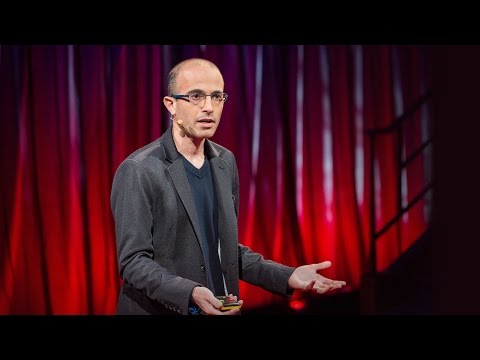
“We can cooperate flexibly with countless numbers of strangers, because we alone, of all the animals on the planet, can create and believe fictions, fictional stories.”TED talk, 2015 · 6:54
Stories are the foundation of large-scale human cooperation
Harari’s central claim is that the decisive advantage of Homo sapiens is collective, not individual. Humans rule because they can cooperate both flexibly and at very large scale, something other animals cannot match.123
What makes this possible is imagination. People who do not know one another personally can still act together if they believe the same story and accept the same rules, norms, and values.45
This is why myths and stories are not a side topic in Harari’s view of history. They are the operating system of civilization.67
“We can cooperate flexibly with countless numbers of strangers, because we alone, of all the animals on the planet, can create and believe fictions, fictional stories.”TED talk, 2015 · full transcript →
Humans live in two realities at once
Harari says human life unfolds in both an objective reality and a fictional one. There are physical things like trees, rivers, and bodies, but layered on top are invented entities such as nations, gods, money, and corporations.8910
These fictional entities are powerful because they are shared. A corporation or a nation is not something you can find in nature the way you find a mountain, yet people organize jobs, wars, taxes, laws, and identities around them.1011
In Harari’s account, history increasingly turns on this second layer. Many of the strongest forces in human life are not biological facts but intersubjective agreements maintained by collective belief.106
“We humans, we also live in an objective reality. In our world, too, there are rivers and trees and lions and elephants. But over the centuries, we have constructed on top of this objective reality a second layer of fictional reality, a reality made of fictional entities, like nations, like gods, like money, like corporations. And what is amazing is that as history unfolded, this fictional reality became more and more powerful so that today, the most powerful forces in the world are these fictional entities.”TED talk, 2015 · full transcript →
Money, law, and human rights work because people believe together
Harari often uses money as the clearest example of a successful shared story. Money works not because paper or digits have inherent value, but because people trust the system and expect others to trust it too.1213
He extends the same logic to legal and moral orders. Human rights, like gods and heaven in his formulation, are not objective features you can discover inside the body; they are stories people created and then built institutions around.1415
This does not mean these ideas are useless or meaningless. It means their power comes from collective belief and coordinated behavior rather than from physical existence in nature.157
“Money, in fact, is the most successful story ever invented and told by humans, because it is the only story everybody believes.”TED talk, 2015 · full transcript →
Stories can unify civilization, but they can also distort reality
Harari does not treat myths as simply bad or simply good. Shared fictions make civilization possible, but they can also mislead people, justify conflict, and pull attention away from reality.166
That is why he pushes back against pure cynicism on one side and naïve faith on the other. History is shaped by fiction, but truth still matters because reality is one, and without contact with it people cannot understand suffering or solve real problems.171819
His warning is especially sharp when stories become totalizing. If everything is reduced to power, trust collapses; but if invented stories are mistaken for objective reality, people can become trapped inside delusion.71819

“Don't believe people who tell you that all reality is just power…”People by WTF conversation, 2025 · full transcript →
AI raises the stakes by becoming a storyteller and decision-maker
Harari sees AI as a new kind of threat because it is not just another tool for spreading human stories. He argues that it is the first technology that can make decisions by itself and create new ideas by itself.2021
That matters because human society already runs on stories. If a nonhuman intelligence can generate persuasive narratives, simulate intimacy, and shape trust at scale, it can intervene directly in the mechanisms that hold civilization together.20222324
So the question is not whether humans can live without myths. Harari’s question is whether we can create better stories, keep them connected to reality, and resist manipulation as technological power grows.2526

“They underestimate the magnitude of the AI revolution. AI is nothing like print. It's nothing like the industrial revolution of the 19th century. It's far, far bigger. There is a fundamental difference between AI and the printing press or the steam engine or the radio or any previous technology we invented. The difference is it's the first technology in history that can make decisions by itself and that can create new ideas by itself. A printing press or a radio set could not write new music or new speeches and could not decide what to print and what to broadcast.”Diary of a CEO interview, 2024 · full transcript →
Harari on stories & myths, in his own words
“We can cooperate flexibly with countless numbers of strangers, because we alone, of all the animals on the planet, can create and believe fictions, fictional stories.”
“Money, in fact, is the most successful story ever invented and told by humans, because it is the only story everybody believes.”
“We humans control the world because we live in a dual reality.”
“…history is shaped by the human imagination, by fiction and not just by truth.”
“…ultimately human power is based on cooperation, not on force.”
“…the really big and interesting question is whether we'll be able to produce good stories to match this wonderful technology.”
Where to watch
 Yuval Noah Harari on Human Cooperation: Why We Run the World2015 · 17 min · full transcriptBest short introduction to Harari’s core claim that shared fictions let strangers cooperate at massive scale.
 Yuval Noah Harari on Human Stories and Cooperation: Sapiens Talk2015 · 79 min · full transcriptExpands the cooperation argument with examples like human rights, religion, and the need for better stories.
 Yuval Noah Harari on Myths and Civilization: Why Stories Hold Societies Together2014 · 87 min · full transcriptShows how myths fit into Harari’s broad view of history, from the Cognitive Revolution to modern civilization.
 Yuval Noah Harari on Truth, Power & AI2025 · 84 min · full transcriptBest for the tension between fiction and truth: stories shape history, but reality still matters.
 Yuval Noah Harari on Fictional Stories: Civilization Is Fragile2023 · 42 min · full transcriptUseful for understanding why story-based civilization is both powerful and fragile.
 Yuval Noah Harari on AI and Human Futures: Urgent Warnings2024 · 106 min · full transcriptBest for how AI could generate, manipulate, and weaponize stories in the future.
Questions people ask
- What did Yuval Noah Harari say about human rights?
- What did Yuval Noah Harari say about imagination and human cooperation?
- What did Yuval Noah Harari say about stories and the meaning of life?
- What did Yuval Noah Harari say about why AI is different from previous technologies?
- Why did Yuval Noah Harari say humans live in a dual reality?
- How can society inoculate itself against toxic myths, according to Yuval Noah Harari?
Sources
Every quote above, word for word from the transcripts. Numbers match the text.
“The real difference between humans and all other animals is not on the individual level; it's on the collective level.”
“Humans control the planet because they are the only animals that can cooperate both flexibly and in very large numbers.”
“Humans are the only animals that can combine the two abilities.”
“We can cooperate flexibly with countless numbers of strangers, because we alone, of all the animals on the planet, can create and believe fictions, fictional stories.”
“What enables us alone, of all the animals, to cooperate in such a way? The answer is our imagination. We can cooperate flexibly with countless numbers of strangers, because we alone, of all the animals on the planet, can create and believe fictions, fictional stories. And as long as everybody believes in the same fiction, everybody obeys and follows the same rules, the same norms, the same values.”
“…history is shaped by the human imagination, by fiction and not just by truth.”
“…ultimately human power is based on cooperation, not on force.”
“We humans control the world because we live in a dual reality.”
“…we live in a dual reality.”
“We humans, we also live in an objective reality. In our world, too, there are rivers and trees and lions and elephants. But over the centuries, we have constructed on top of this objective reality a second layer of fictional reality, a reality made of fictional entities, like nations, like gods, like money, like corporations. And what is amazing is that as history unfolded, this fictional reality became more and more powerful so that today, the most powerful forces in the world are these fictional entities.”
“…the laws governing our society, they are not eternal…”
“Money, in fact, is the most successful story ever invented and told by humans, because it is the only story everybody believes.”
“…money is probably the most successful story ever told…”
“…human rights are a fiction, just like God and heaven.”
“Most legal systems today in the world are based on a belief in human rights. But what are human rights? Human rights, just like God and heaven, are just a story that we've invented. They are not an objective reality; they are not some biological effect about homo sapiens. Take a human being, cut him open, look inside, you will find the heart, the kidneys, neurons, hormones, DNA, but you won't find any rights.”
“Much of what we take to be real is fictions.”
“The truth ultimately is one because reality is one.”
“Don't believe people who tell you that all reality is just power…”
“To really understand life, life is not a story. The universe does not function like a story. So I think to really understand life, you need to observe it directly in a nonverbal way. Don't turn it into a story. And the question to start with is what is suffering? What is causing suffering? You know, the question, what is the meaning of life? It'll take you to fantasies and delusions. We want to stay with the reality of life. And the most important question about the reality of life is what is suffering and where is it coming from?”
“It's the first technology in history that can make decisions by itself…”
“They underestimate the magnitude of the AI revolution. AI is nothing like print. It's nothing like the industrial revolution of the 19th century. It's far, far bigger. There is a fundamental difference between AI and the printing press or the steam engine or the radio or any previous technology we invented. The difference is it's the first technology in history that can make decisions by itself and that can create new ideas by itself. A printing press or a radio set could not write new music or new speeches and could not decide what to print and what to broadcast.”
“AI is different from any previous invention in history…”
“The aliens are here. They're just not from outer space.”
“I think it stands for alien intelligence because AI is an alien type of intelligence.”
“…the really big and interesting question is whether we'll be able to produce good stories to match this wonderful technology.”
“I would say that people should consume less information and spend more time reflecting…”
How this guide was made: drafted with AI from the full transcripts of the recordings cited, then checked: every quotation must match a transcript word for word and be the speaker's own words, and an independent review gates accuracy. Methodology and corrections.